This Take 5 report is for chief AI officers, CIOs, CDIOs, and enterprise data leaders diagnosing why AI portfolios stall at task level and what it takes to close the gap to workflow and systemic AI.
Executive summary
Enterprise AI is trapped. Fifty-nine percent of Fortune 1000 AI portfolios sit at task or use-case level, yet 63% of leadership want to reach workflow or systemic levels within 24 months. The gap between where enterprises are and where they want to be is the context deficit. Two-thirds of enterprises admit that their critical business logic, tribal knowledge, and decision rules are fragmented or undocumented. Only 26% treat context as owned IP, and only 38% have a funded initiative to fix it. Meanwhile, the partner ecosystem is failing on key aspects, with 63% saying their partners cannot codify tribal knowledge and 56% struggling to move AI from pilot to systemic production. HFS Research, in partnership with MathCo, surveyed more than 100 senior AI and data leaders across CPG, pharma, retail, manufacturing, and high-tech in the US to map the enterprise context gap and its consequences.
The survey uncovered five key takeaways:
-
-
Fifty-nine percent of AI portfolios are stuck at the task or use-case level. The ambition-reality gap is a 2.5x leap that current approaches cannot bridge.
-
Data foundation and talent top the constraint list at 44% and 38%, respectively, but context-specific barriers reveal the deeper challenge.
-
Sixty-seven percent say context is fragmented, but only 26% treat it as owned IP. The context gap is real and remains unaddressed.
-
There’s a process-people paradox, where returns and investment favor process, but trust lives with people.
-
Sixty-three percent say partners cannot codify tribal knowledge, a defining partner gap for the context era.
The Bottom Line: Your AI portfolio is stuck at task level because your enterprise context is undocumented, fragmented, and unowned. Treat context consolidation as a funded, owned program.
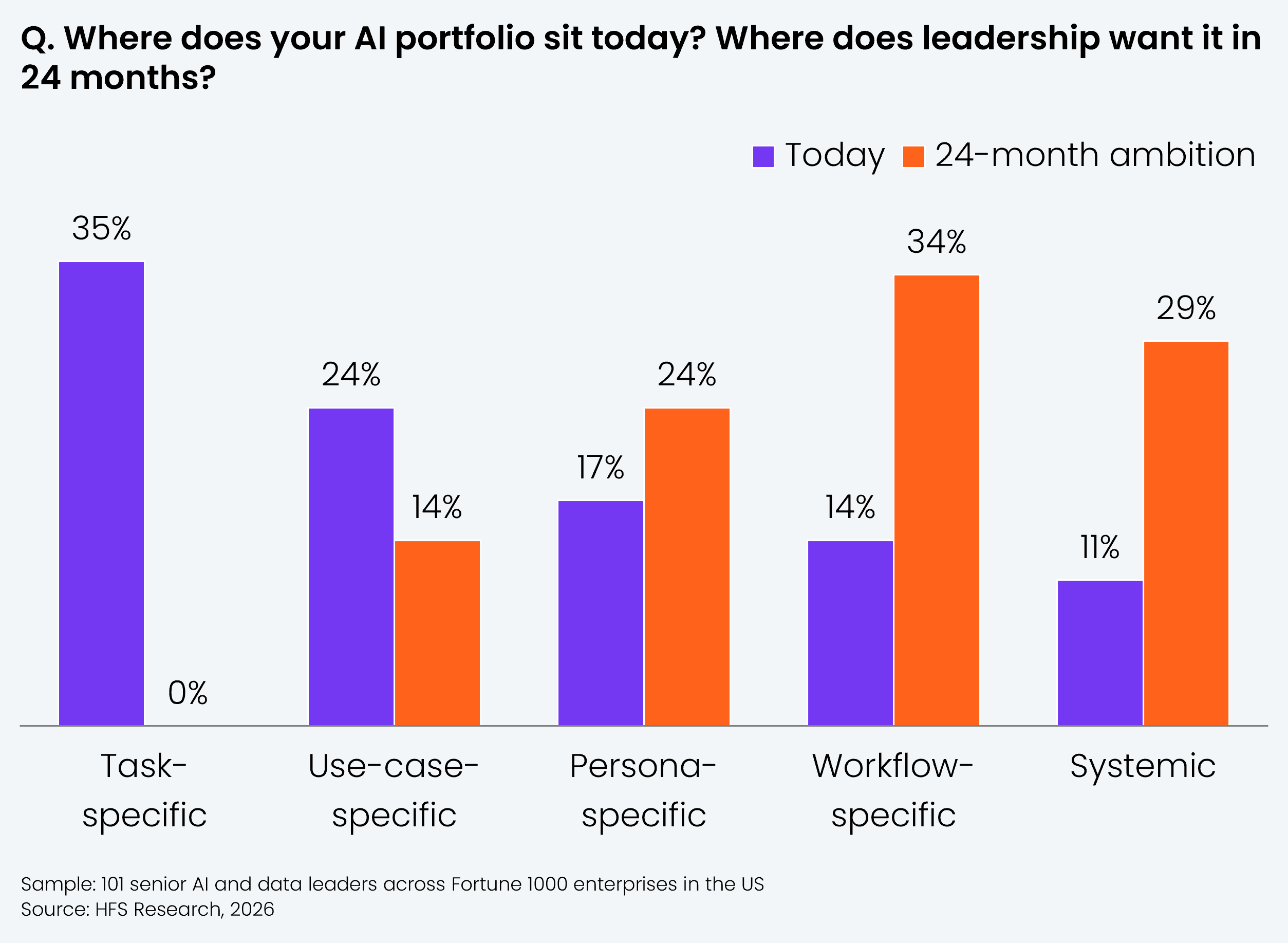
- Fifty-nine percent of enterprise AI portfolios sit at task or use-case level today. Only 11% have reached systemic, i.e., AI operating across workflows and functions as an orchestrated decision system.
- But ambition tells a different story. Sixty-three percent of leadership want to be at workflow or systemic within 24 months. The ambition-reality gap is stark: 25% are at workflow or systemic today, versus 63% who want to be there. That is a 2.5x leap.
- Nobody targeting task-specific in 24 months is telling. It means nobody wants to stay where most portfolios currently sit. The entire industry is trying to climb the same curve simultaneously.
Half of it goes into cleaning up the data estate before anyone touches another model. We’ve got six different systems none of which talk to each other.
— CIO of a mid-size retailer
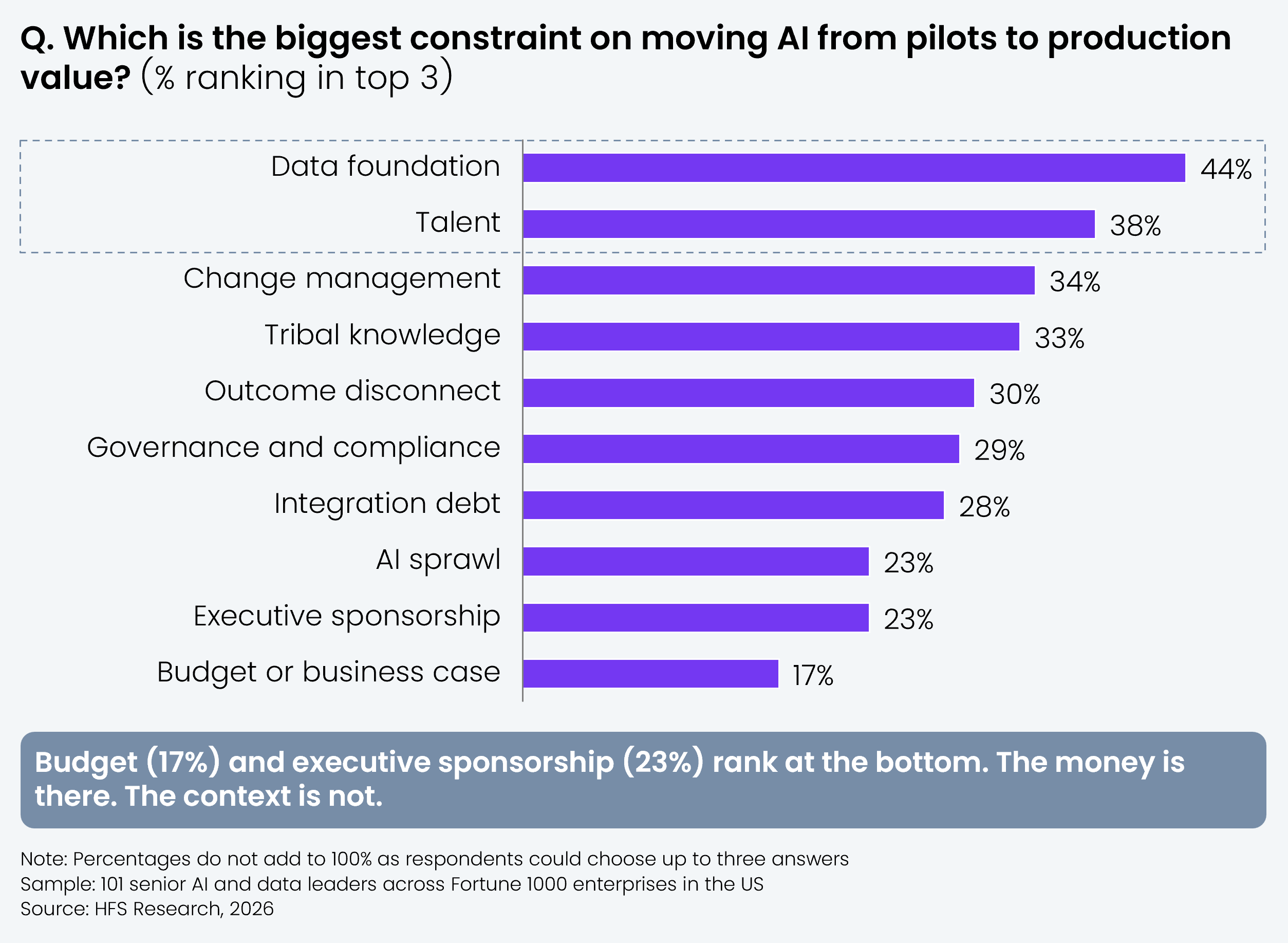
- Data foundation (44%) and talent (38%) lead the conventional constraint list. But look at what follows: change management (34%), tribal knowledge (33%), and outcome disconnect (30%) cluster tightly behind them.
- These are not technology problems. They are context problems, i.e., the inability to capture, codify, and operationalize the business logic and workflow knowledge that make AI useful in production rather than just in demos.
- Budget (17%) and executive sponsorship (23%) are at the bottom. The money and the mandate are there. What is missing is the connective tissue between data, people, and processes that turns AI from a pilot into a production system.
We’ve spent more on consulting fees than on people who can actually sustain the systems once they’re live.
— SVP, Enterprise Architecture, at a consumer brand
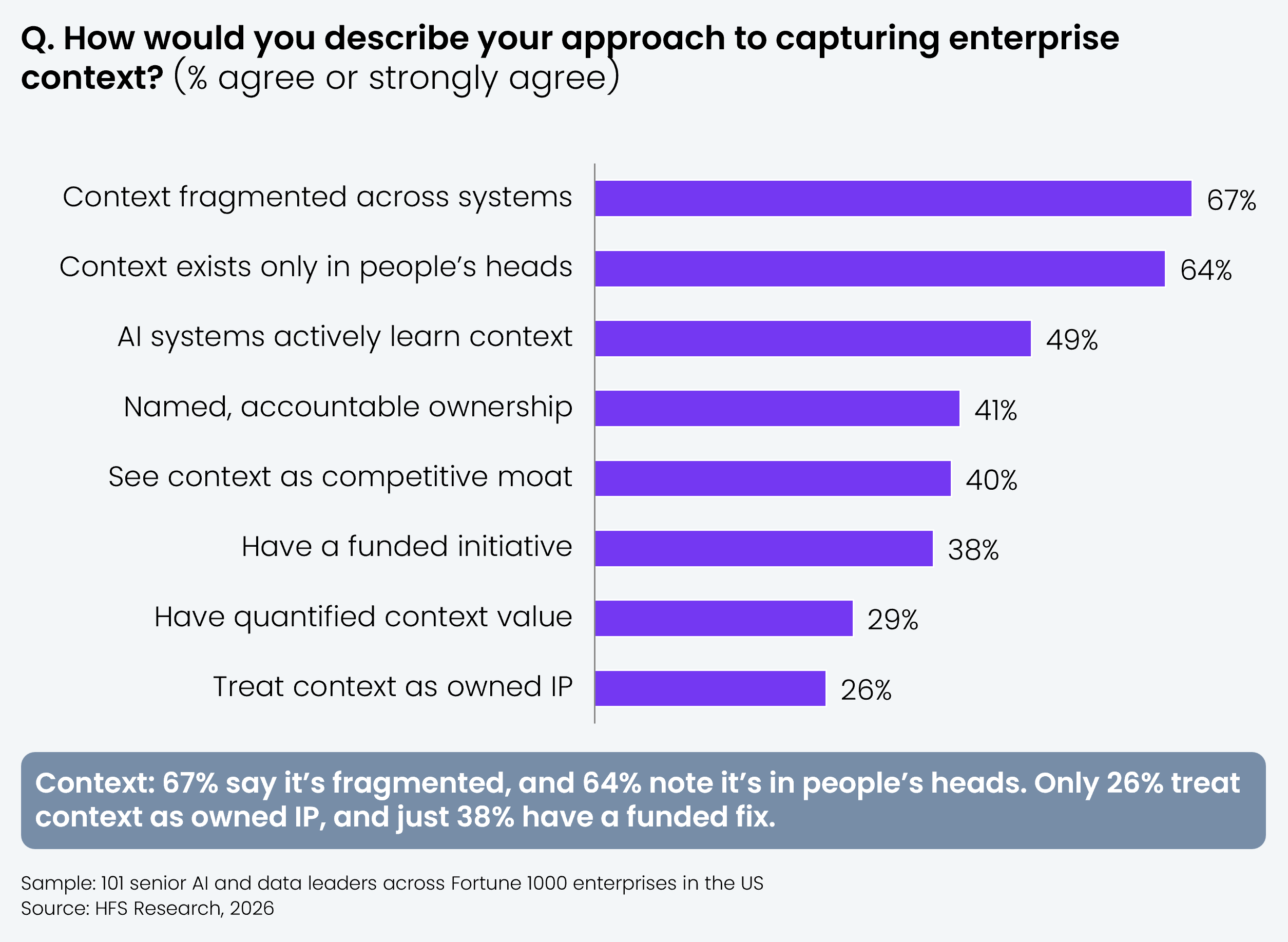
- The data reveals that the context gap is real, large, and unaddressed. Sixty-seven percent agree that their enterprise context is fragmented across dozens of systems, documents, and spreadsheets. Sixty-four percent say that critical context exists only in people’s heads.
- The response is that only 38% have a funded initiative to consolidate it. Only 26% treat context as owned IP, which compounds over time. Only 29% have quantified the business value of their context assets.
- The industry knows the problem. It has not started solving it. For example, a leader mentioned that they waste so much working capital on bad forecasts that even a 5% accuracy lift pays for itself.
For forecasting and demand planning, we waste so much working capital on bad forecasts that even a 5% accuracy lift pays for itself.
— CTO at a leading CPG
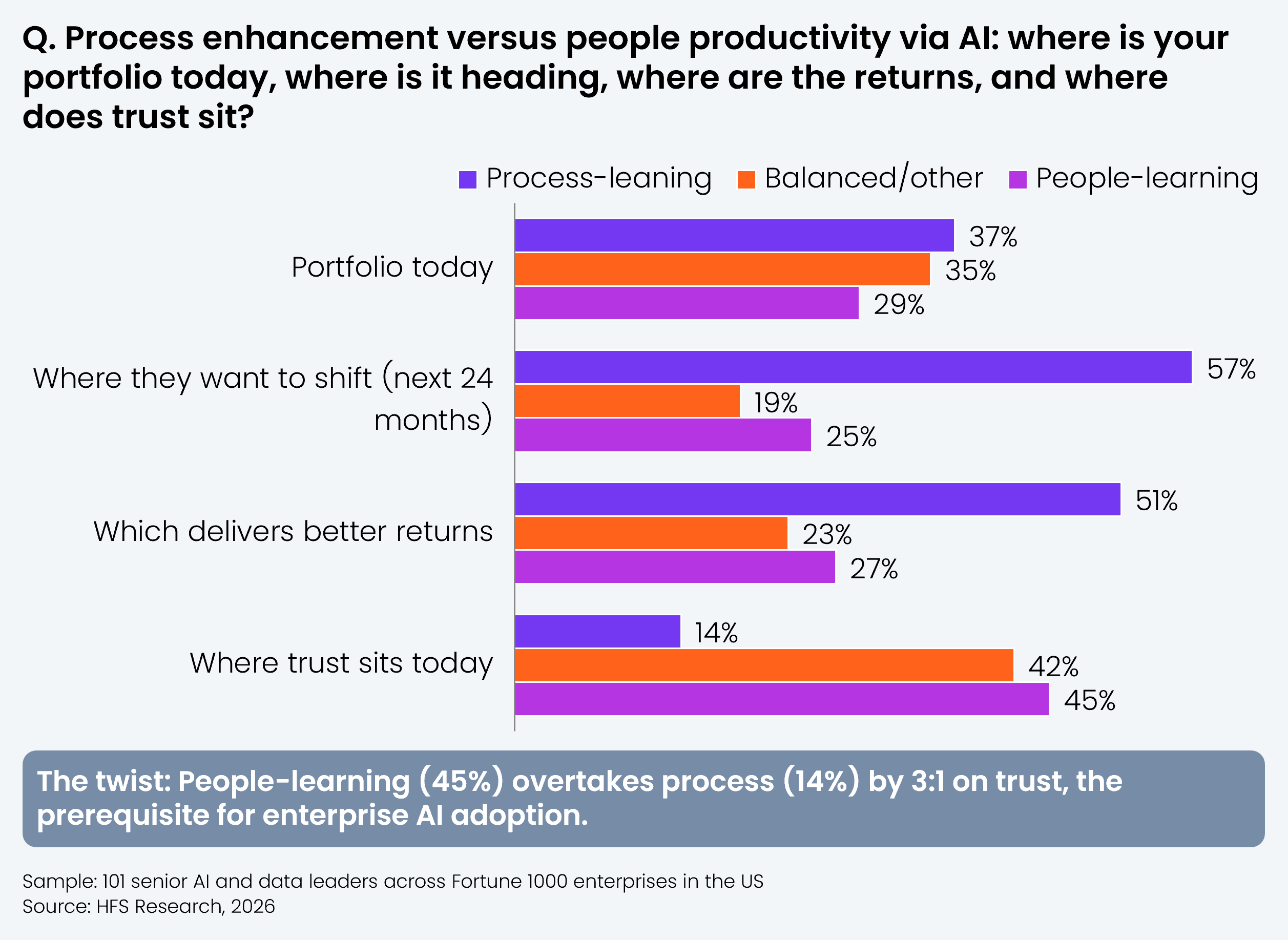
- Today’s state: A mild 37%–29% tilt toward enterprise AI initiatives prioritizing process improvement. This means enterprises are currently following a balanced AI investment approach between process improvement and workforce augmentation.
- Future direction (24 months): The tilt sharpens, i.e., 57% want to shift toward improving processes versus only 25% toward empowering people.
- Higher returns is the reason: 51% say returns on AI-augmented processes outperform people empowered via AI tools. Therefore, returns are backing the investment thesis.
- Trust is the twist in the tale: 45% say trust is higher when AI supports a person versus only 14% for process.
- The paradox: Returns and investment favor AI investments in improving processes. However, organizational trust, the prerequisite for adoption at scale, lives with people productivity. Enterprises that skip the trust-building step will build AI that might work technically but fail organizationally.
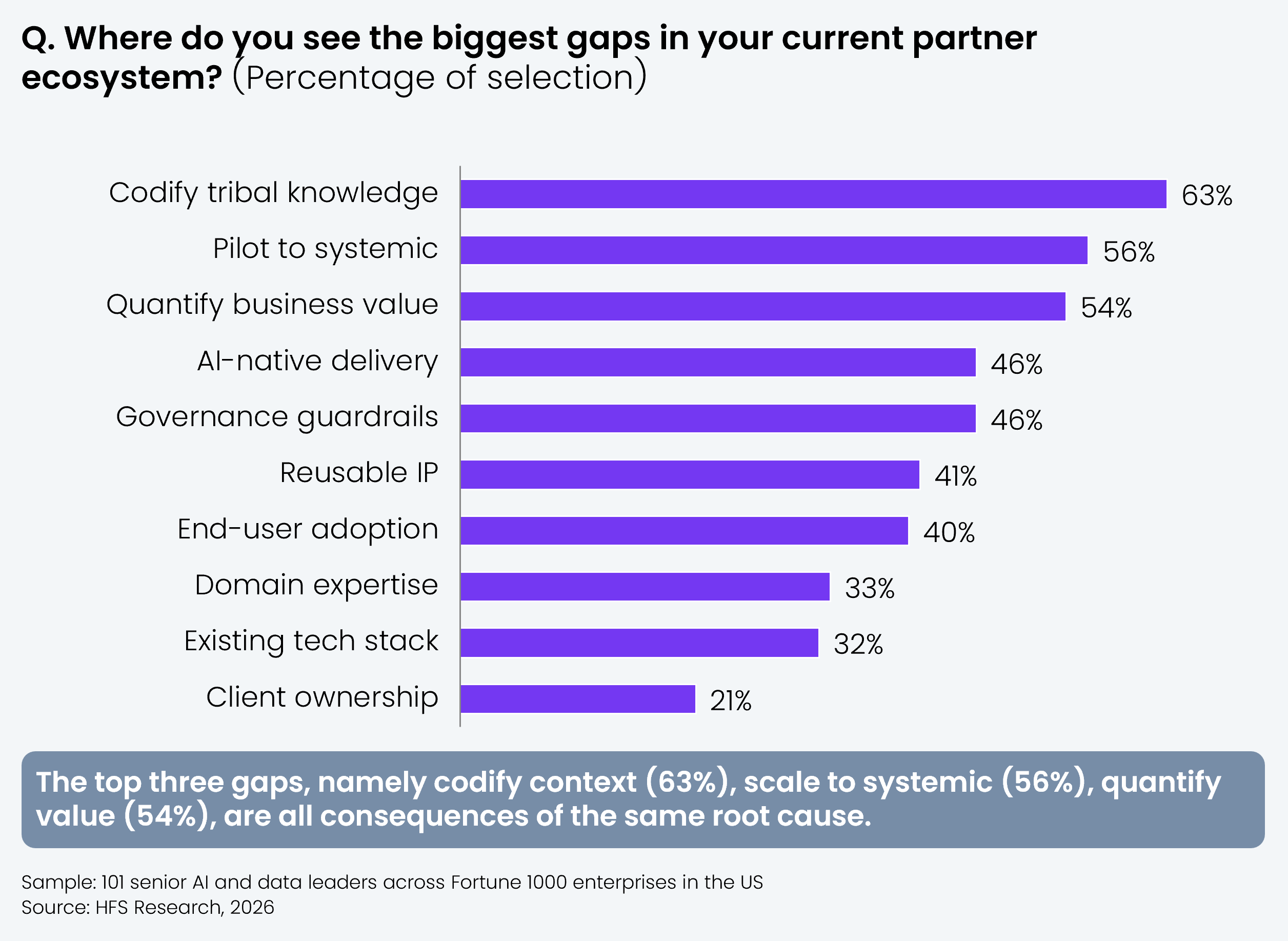
- Sixty-three percent of enterprises say their partners cannot extract and codify tribal knowledge and workflow context. This is the single largest partner gap in the study.
- The second and third gaps, i.e., moving AI from pilot to systemic production (56%) and quantifying business value (54%), are consequences of the same root cause. Without codified context, you cannot scale beyond pilots. Without scale, you cannot demonstrate value.
- AI-native delivery (46%) and governance (46%) round out the top five. The pattern is clear: the partner ecosystem is built for building models, not for building the contextual intelligence layer that makes models useful in production.
Probably half (budget) goes to data foundation. The rest is split between two or three big bets. I’d avoid the temptation to fund ten POCs.
— CDIO at a large retailer
The Bottom Line: Your AI portfolio is stuck at task level because your enterprise context is undocumented, fragmented, and unowned. Treat context consolidation as a funded, owned program.
-
-
Fund and own the context layer
Fifty-nine percent of AI portfolios sit at task or use-case level. Sixty-seven percent say context is fragmented. Only 38% have a funded initiative to fix it. Enterprise leaders should treat context consolidation as a funded, owned program rather than a side project appended to a data platform migration.
-
Stop measuring models; start measuring decisions
Fifty-one percent say process-enhancement AI outperforms, but 45% trust AI more when it supports people. Enterprises should measure AI by whether it changes decisions and behaviors, not by model accuracy or automation rates.
-
Demand partners who codify context, not just build models
Sixty-three percent say their partners cannot codify tribal knowledge. Fifty-six percent say they cannot move AI from pilot to systemic. When evaluating partners, the test is whether they can extract, structure, and operationalize your enterprise context instead of whether they can build another model.