This HFS Research MVP is for engineering, IT, and operations leaders integrating engineering, AI, and operations under one lifecycle accountability model to drive superior outcomes.
How Akkodis is helping enterprises integrate engineering, AI, and operations to drive superior outcomes
Industrial enterprises are entering a new phase of transformation. Products that were once primarily mechanical are becoming software-defined, interconnected, and increasingly autonomous. Yet most organizations continue to manage their internal functions to make these products separately, creating fragmented accountability, slower innovation cycles, and growing operational complexity.
A recent HFS Research survey of more than 200 engineering, IT, and operations leaders across asset-intensive industries reveals a clear shift underway. Enterprises are integrating engineering, software, data, and operations under a unified delivery model, consolidating provider ecosystems, demanding greater accountability across the product lifecycle, and seeking partners that can support these changes. The direction of travel is clear and accelerating (see Exhibit 1).
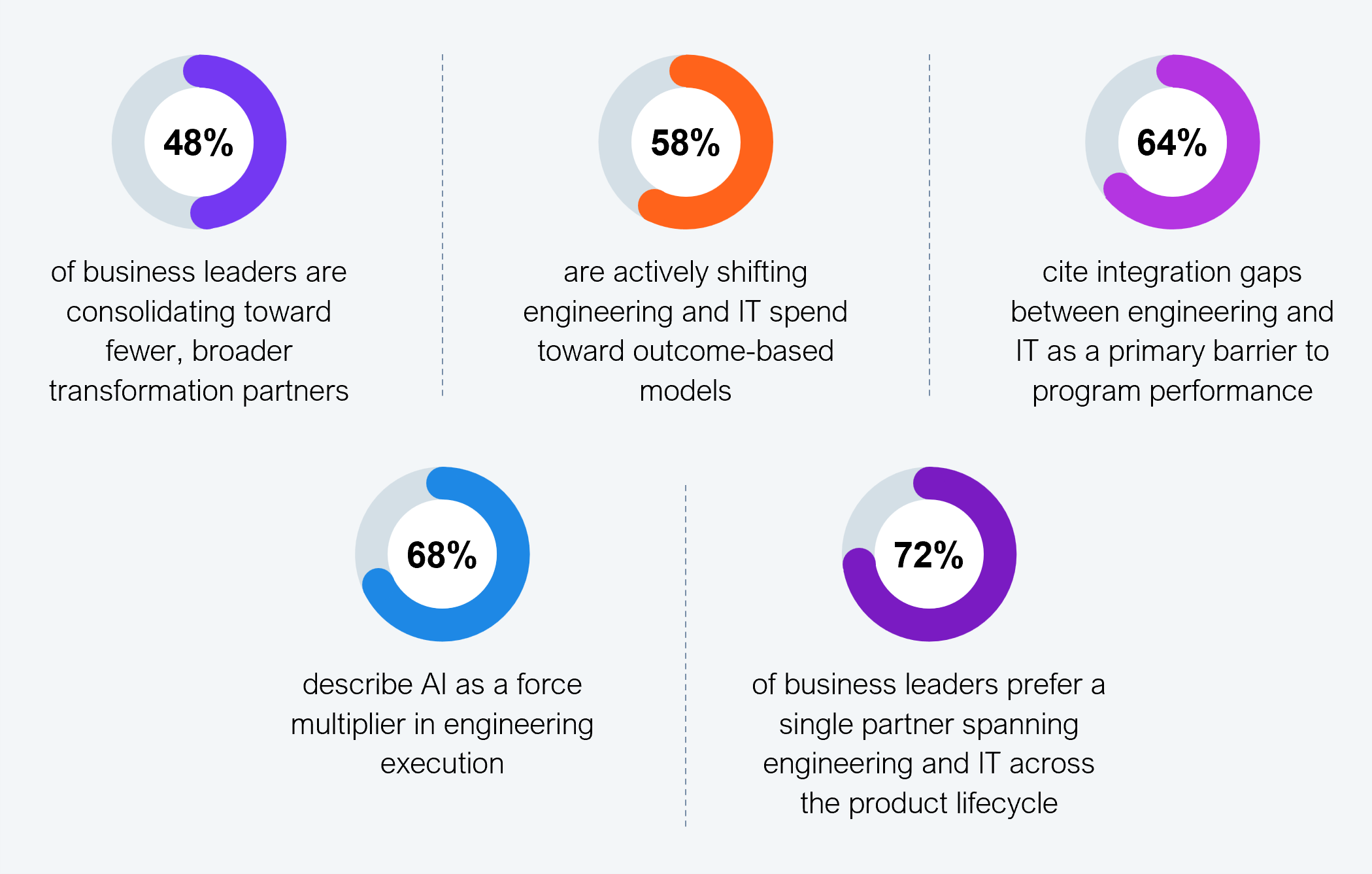
Sample size: 2026 HFS Research survey with 200+ engineering, IT, and operations leaders across asset-intensive enterprises
Source: HFS Research, 2026
Through our discussions with Akkodis and its clients, we found that the organizations making the most progress are moving beyond effort- and project-based delivery toward lifecycle accountability. Rather than optimizing individual functions, they are connecting engineering, digital, and operational teams around shared outcomes across the entire lifecycle of a product.
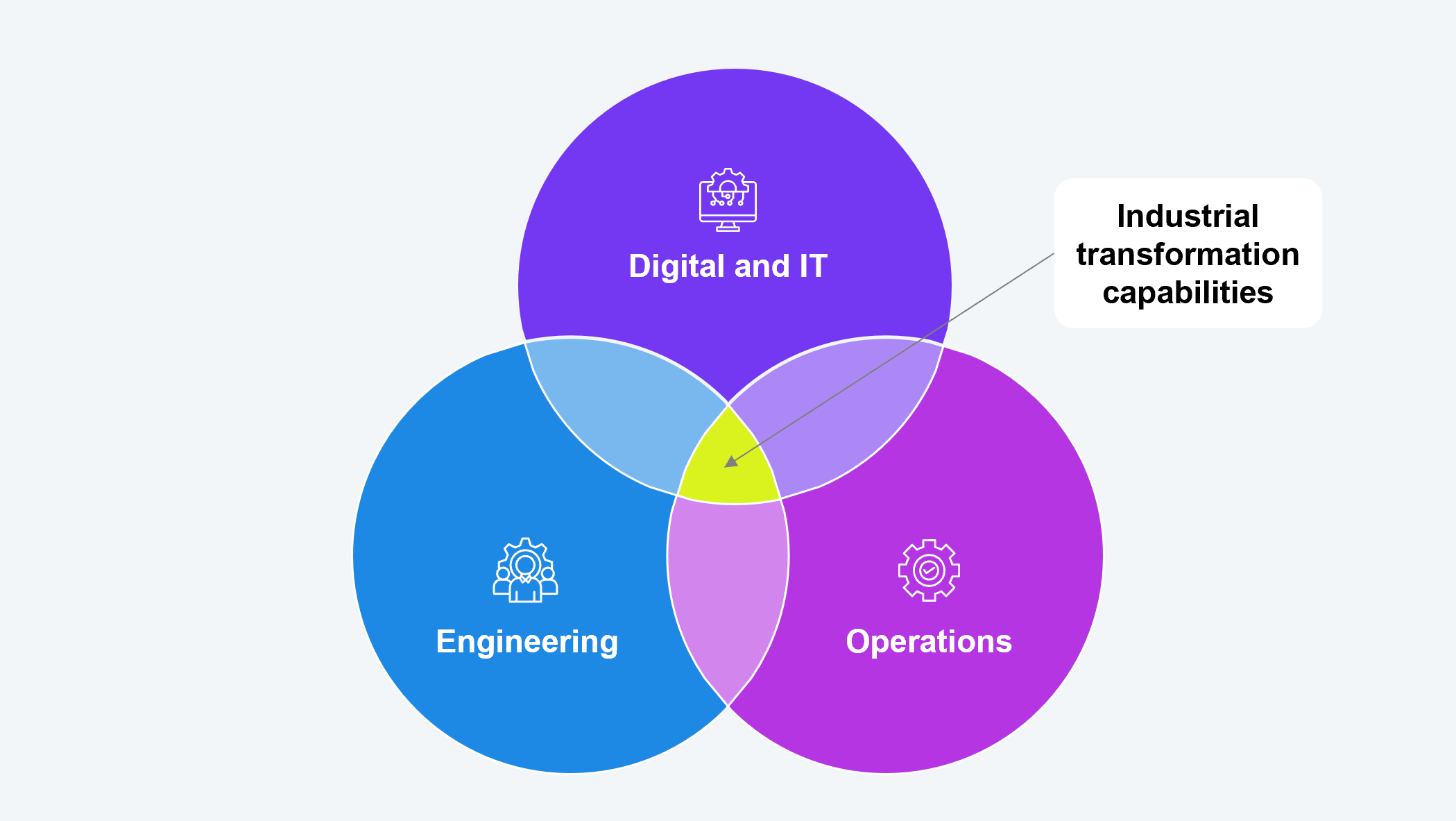
At HFS Research, we describe this shift as industrial transformation: bringing engineering, digital, operations, and AI together to create a more connected and accountable operating model. The client examples in this paper demonstrate how this approach is helping organizations accelerate innovation, improve product quality, and manage growing complexity.
Three lessons emerged for enterprise executives:


The enterprises that successfully connect these capabilities will be best positioned to compete in an increasingly software-defined world (see Exhibit 2).
Source: HFS Research, 2026
Software-defined systems integrate hardware and software continuously, in parallel, not at the end of development. That makes intermediate milestones the wrong unit of accountability; a vendor can hit every milestone while the product still fails to come together on time because no one is accountable for the lifecycle end to end.
The pattern repeats across industries. A connected vehicle is a continuously updated software platform demanding embedded AI, cybersecurity, and regulatory compliance. A commercial aircraft needs software certification, predictive maintenance, and supply chain coordination across decades of service. Industrial equipment depends on connected sensors, edge AI, and telemetry to function as designed. Yet most enterprises still split this work across separate engineering, IT, and operations providers, with separate governance structures and no unified accountability for the product lifecycle.
The intersection between traditional digital and IT and engineering is getting more and more blurred.
— Jo Debecker, President and CEO, Akkodis
The operations dimension is consistently underweighted in transformation conversations. In asset-intensive industries, a significant share of enterprise investment flows not into engineering or digital initiatives but into supply chain management, manufacturing execution, and aftermarket services. These workstreams are directly dependent on engineering decisions and digital data flows yet sit outside most outsourcing accountability models. So, the highest-spend workstreams in the enterprise are accountable to no one for how engineering and digital decisions land in production, with gaps between the functions. This results in cost overshoots due to rework, delay, and missed targets across the lifecycle.
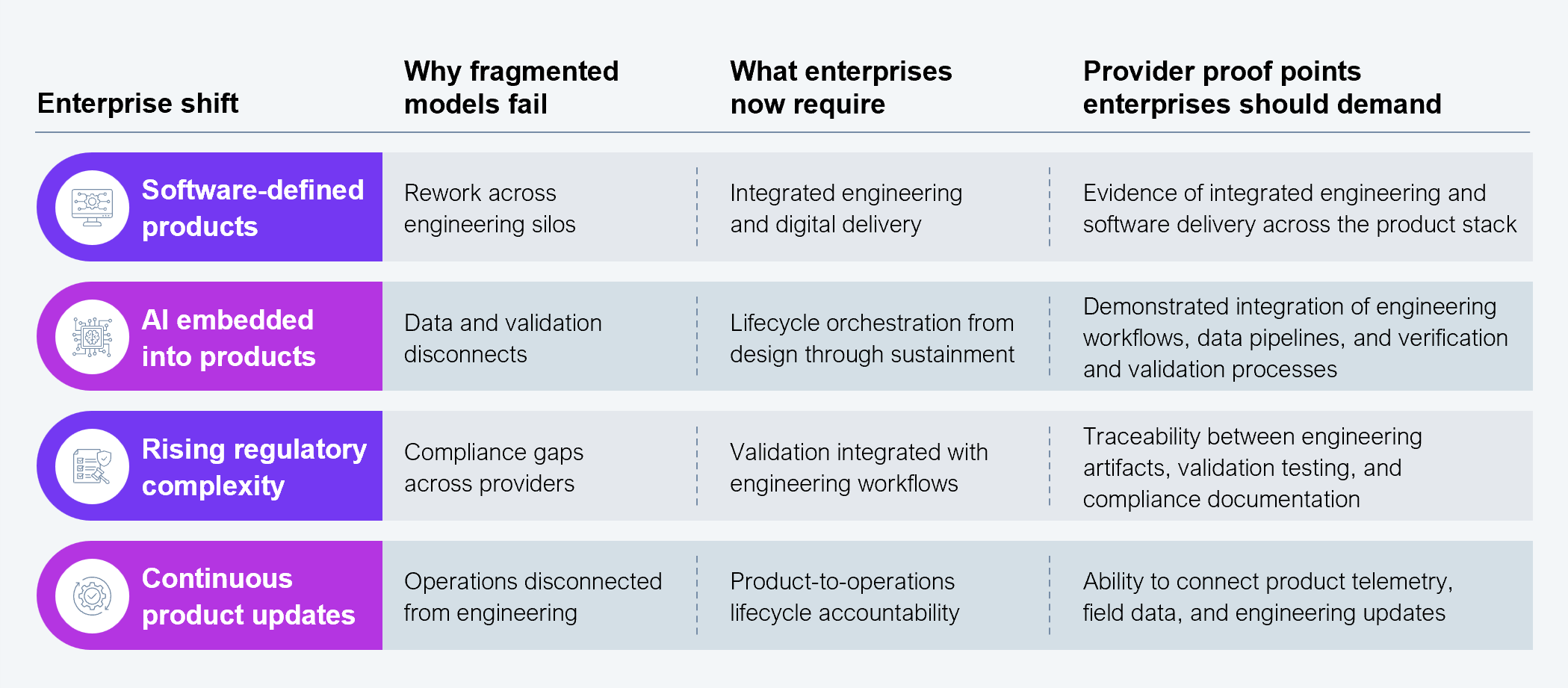
If a trusted vendor cannot close the gaps between engineering, digital, and operations, the answer is a different operating model, not a better outsourcing arrangement. HFS calls it industrial transformation: engineering, digital, and operations under one lifecycle accountability model, with AI as the connective layer. The unit of value becomes the product lifecycle, not the project (see Exhibit 3).
Source: HFS Research, 2026
Three structural changes define this shift:
Akkodis illustrates this in regulated environments. For a major European aerospace organization, it holds a Design Organization Approval (DOA) from the European Union Aviation Safety Agency. This approval lets its engineers certify aircraft modifications under their own authority and accountability rather than routing each change through the manufacturer. In automotive, it coordinates embedded engineering, testing, and validation across a German manufacturer’s connected vehicle platforms, measured on release velocity and regulatory compliance throughout the software lifecycle, lifecycle outcomes, not milestones.
We are not just building the software or supporting it. We are ‘in the process, we are in the business.’
— Jo Debecker, President and CEO, Akkodis
AI here is not a task automation layer. It is the connective intelligence behind continuous validation, accelerated certification, predictive maintenance, and feedback loops that link operational performance back into engineering decisions.
Leaders already see it this way: 68% describe AI as a force multiplier in engineering execution, not a productivity tool; 60% are investing in digital continuity and lifecycle integration as the platform for AI-enabled delivery; and 54% expect AI-driven reuse and modular architectures to compress engineering cycles within two years (see Exhibit 4).
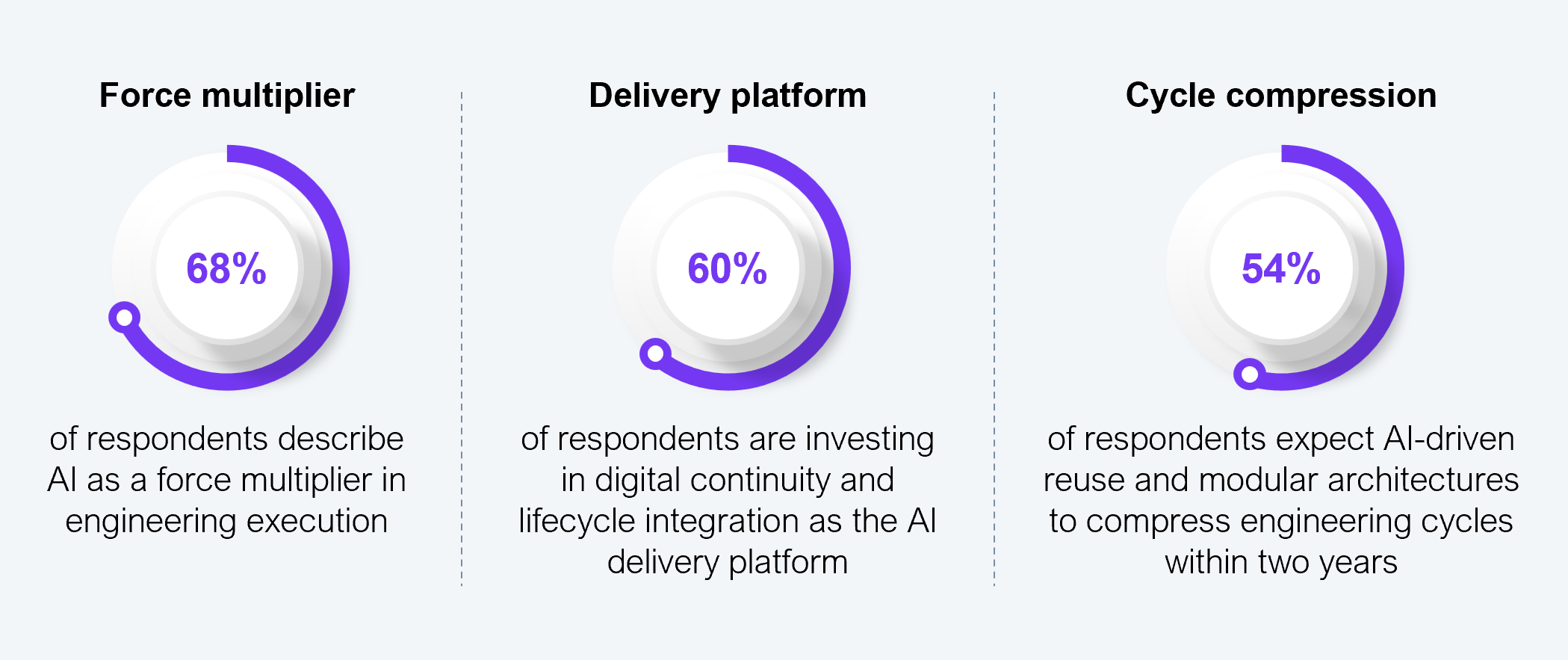
Sample size: 2026 HFS Research survey with 200+ engineering, IT, and operations leaders across asset-intensive enterprises
Source: HFS Research, 2026
One of Akkodis’ automotive clients faced challenges in manual validation of engineering documents, needing an automated approach. Akkodis implemented an AI agent capable of extracting measurements from a large dataset of technical drawings using prompts to identify and flag inconsistencies.
We’ve embraced AI first in everything that we do: in operations, in our solutions, and in how we bring that capability to market.
— Vinod Kumar, President and CEO, North America, Akkodis
But the foundation usually isn’t ready. The barrier is almost never ambition: 52% of enterprises lack a unified source of truth across engineering systems, and data integration gaps are among the most cited obstacles to scaling AI. Deploy AI without an integrated data and digital thread architecture and you get isolated productivity gains, not lifecycle-wide value.
The sequence matters. The foundation comes first, a unified data and digital thread across engineering, operations, and lifecycle systems, without which AI stays siloed. With that in place, validation, certification, and engineering change management offer the clearest near-term return in regulated industries through shorter approval cycles, less rework, and lower compliance exposure. The payoff compounds once operational telemetry and maintenance data feed back into engineering decisions, the mechanism that makes the lifecycle adaptive rather than reactive.
Few enterprises will build this data foundation and lifecycle model alone, which is why the partner decision now carries the weight it does. As engineering complexity grows, 62% of leaders plan to rely more on external providers while consolidating toward fewer of them. The market is moving toward greater dependence on fewer partners, chosen for lifecycle accountability rather than narrow capability depth.
We truly want to be the integrator of both: traditional engineering and digital-first, software-embedded capabilities.
— Vinod Kumar, President and CEO, North America, Akkodis
Enterprises should evaluate potential partners against five criteria:
Akkodis meets these across automotive, aerospace, and defense: EASA DOA certification, AI-enabled engineering and validation workflows, embedded program accountability, and a commercial model increasingly tied to lifecycle outcomes. Its work with Thales tests the first criterion: on a new generation of software-defined satellites, Akkodis designs and simulates the orbit control systems and, through its Space Software Service Center, owns software across mission control, navigation, imaging, and the verification and validation of ground segments, one provider spanning the engineering-to-operations thread, not separately managed businesses stitched together.
The product lifecycle is the product. Managing it through fragmented accountability is not a transitional risk. It is a structural cost that is already accruing.
Engineering leaders who put one partner on the hook for the whole lifecycle, on the data foundation, and on outcome-linked terms, in the next 12 to 18 months will not be reacting to this shift. They will be defining it.
Register now for immediate access of HFS' research, data and forward looking trends.
Get StartedIf you don't have an account, Register here |
With the exception of our Horizons reports, most of our research is available for free on our website. Sign up for a free account and start realizing the power of insights now.
Our premium subscription gives enterprise clients access to our complete library of proprietary research, direct access to our industry analysts, and other benefits.
Contact us at [email protected] for more information on premium access.