
Nvidia’s reported multi-billion-dollar pursuit of Hugging Face draws attention to a great rebundling of the AI stack every c-suite leader must consider. Multi-vendor stack assembly, the default enterprise AI architecture since 2023, was a bet that the layers stay separable. Our market structure tracker (below) reflects how that assumption no longer holds. Procurement, exit costs and concentration risk must all be reconsidered.
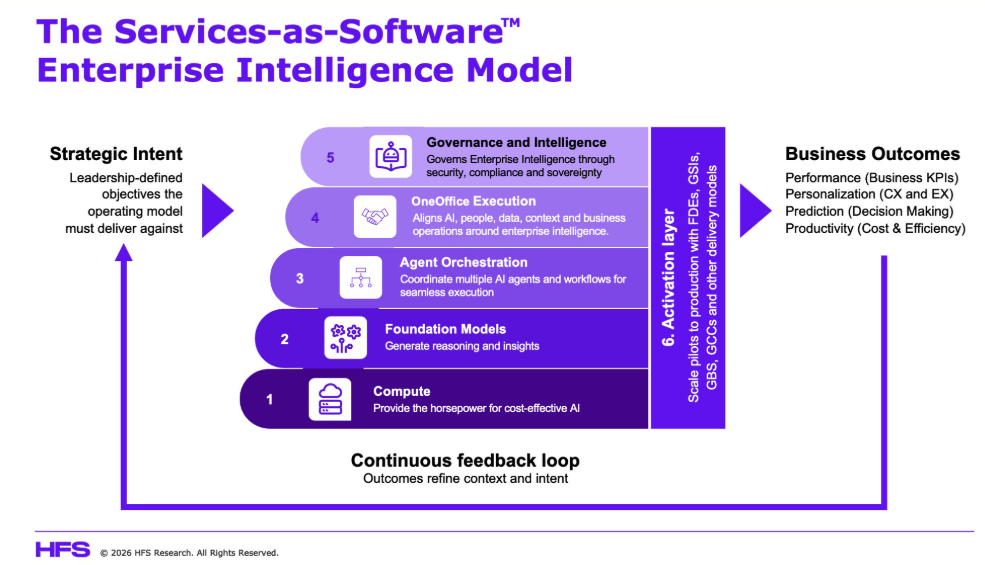
The frontier is creeping upwards and the tracker (see exhibit 2) reveals to what extent – organised in alignment with the six bands of the Services-as-Software Enterprise Intelligence Model (see exhibit 1). HFS leaders Phil Fersht and Saurabh Gupta argue that if every enterprise rents increasingly powerful intelligence from the same handful of providers, enterprise leaders must establish where lasting competitive advantage will be derived. The real challenge – detailed in the Horses For Sources post The Services-as-Software™ Framework: Building Sovereign Intelligence in the Age of Rented AI. is maintaining ownership of what makes you unique.
Exhibit 1: More than a stack, the SaS Enterprise Intelligence Model represents an operating system designed to connect leadership intent with business execution.
The stack to deliver the Enterprise Intelligence Model is being closed from opposite ends. No parties are buying scale in their ‘own’ layer; they are buying adjacency to make their own positions more defensible. Mapped to the HFS Enterprise Intelligence Model, we see consolidation in rented intelligence, but no parties yet reaching the activation, and governance & intelligence layers that enterprise leaders must retain ownership of.
Exhibit 2: Adjacent acquisitions are dominating – resulting in near complete stacks from Google and OpenAI.
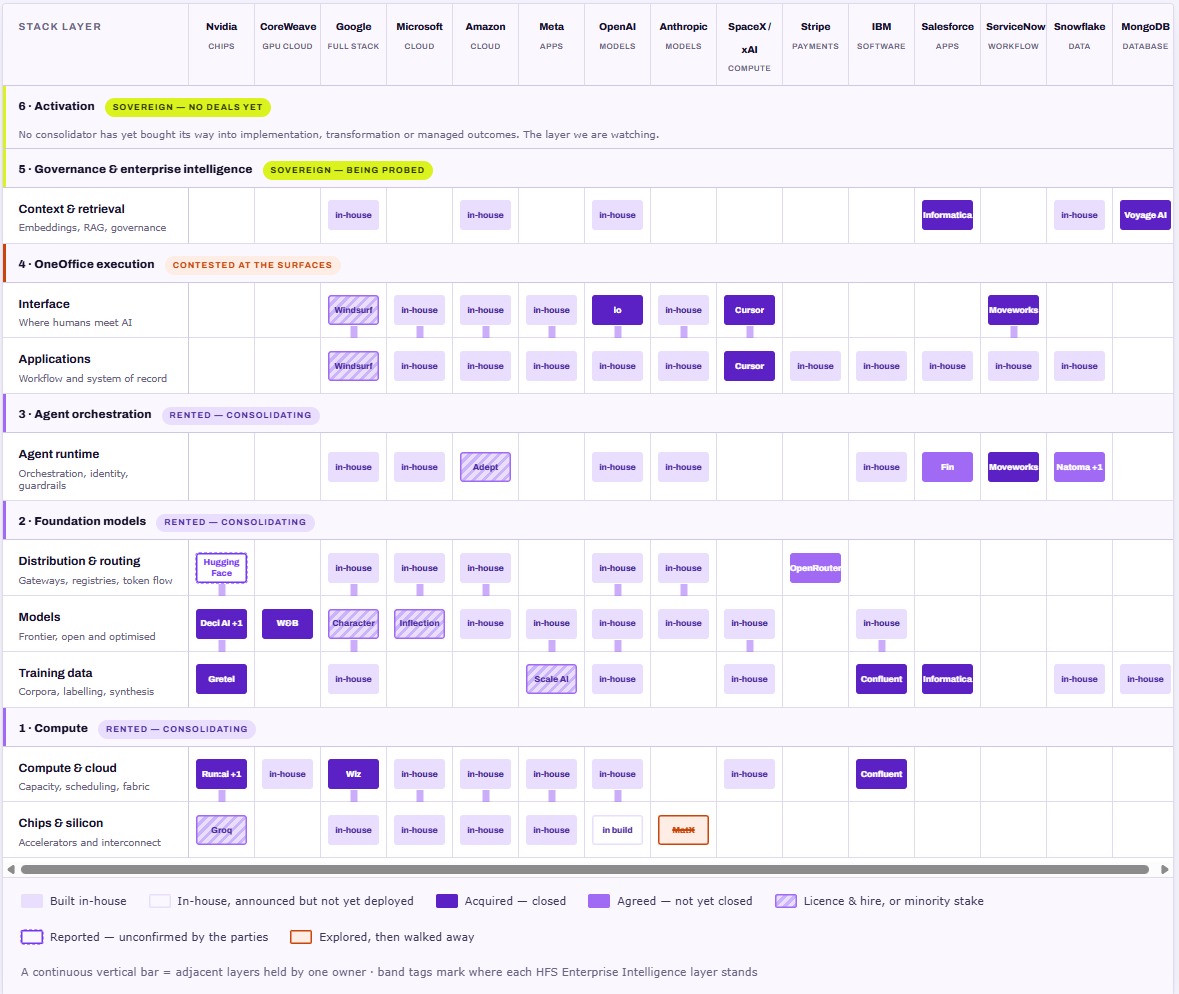
Deals reveal the desire to control adjacent layers – capturing ‘rented intelligence’
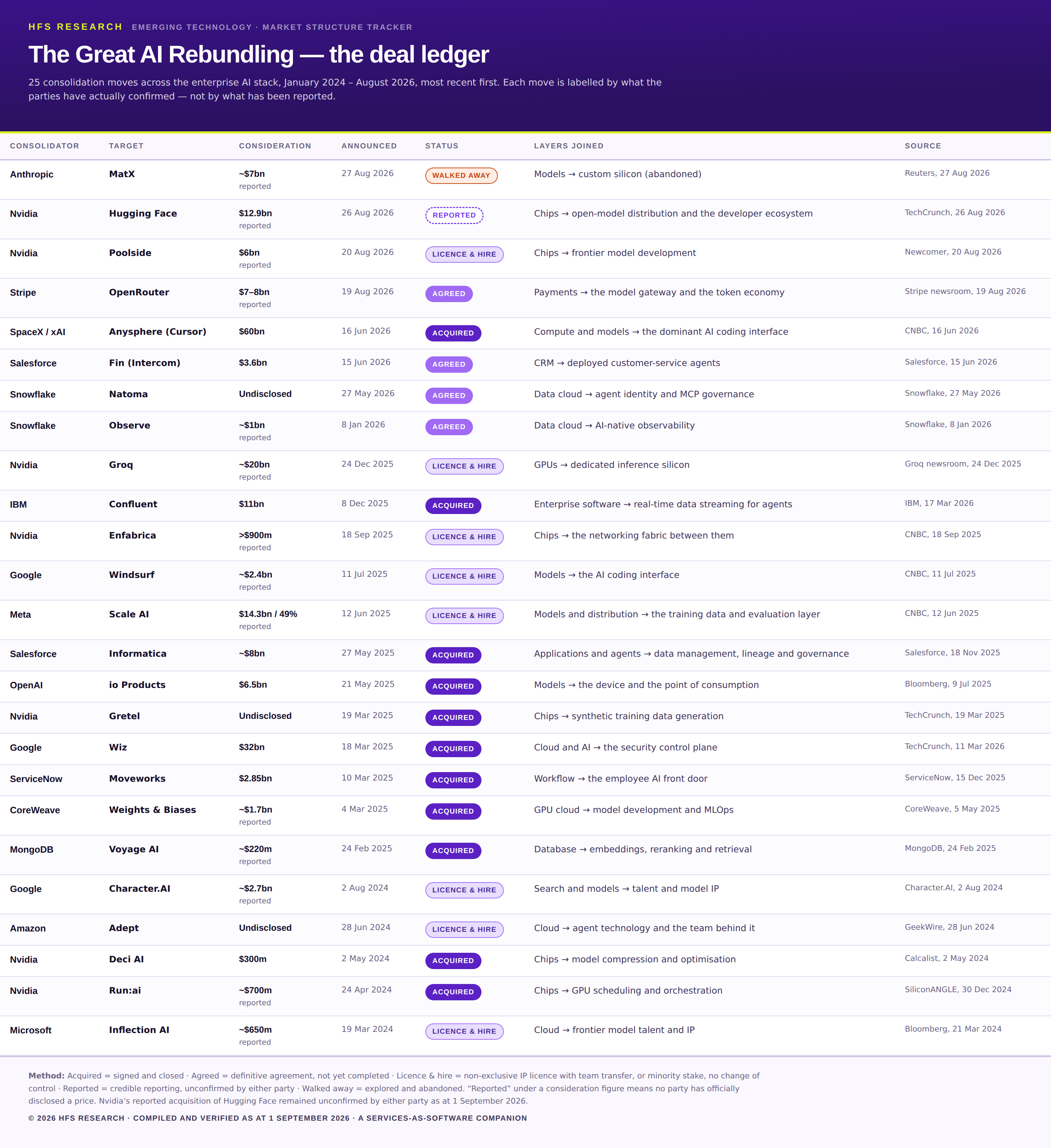
Exhibit three shows the deals, the sources for the mapping of consolidation shown in exhibit 2.
Every deal is indicating that control of one layer is no longer enough. Models without distribution is cost without profit, agents without proprietary data? A wrapper. If you have the cash, the logical step is to acquire the rung next to yours. We can expect this to settle into five to eight stacks each attempting to control a combination of compute, model, context, agent runtime, distribution, and applications. Enterprise leaders should keep this front of mind in all current deal making.
And as the stacks consolidate rented intelligence (agent orchestration, foundation models, and compute), owned intelligence is what remains left to fight for. Be on guard to ensure Activation, and Governance & Enterprise Intelligence remain sovereign to your enterprise. That leaves OneOffice execution as the contested space – exposing services to the great rebundling.
Once a stack owner controls compute, models, orchestration, and context, the remaining gap between its platform and business outcome is implementation, transformation, and managed service. Services-as-Software is the race to close that gap first and fastest. Those presenting the best economics are likely to win.
Exhibit 3: The deals that reveal the great AI rebundling – capturing ‘rented’ intelligence in agent orchestration, foundation models, and compute (open image in a new tab for clearest view)
What history warns about vertical integration
We’ve ridden this rodeo before. Vertical integration has repeatedly lost to modular ecosystems in computing history. The canonical example is the PC in the 1980s/90s. The minicomputer giants (DEC, Wang, Data General, and IBM’s own mainframe business) were vertically integrated: they designed the processors, built the hardware, wrote the operating system and applications, and sold through their own salesforce. Then IBM (ironically?), launched the 1981 PC with an open, modular architecture, Intel’s chip, Microsoft’s OS, third-party everything else – because it was in a hurry. The modular ecosystem it accidentally created (Compaq and the clone makers, plus the Intel/Microsoft duopoly) commoditised the hardware layer, drained profit pool from the two component specialists, and destroyed the integrated players. DEC, worth more than almost any tech company in the late 80s, was sold to a PC clone maker (Compaq) in 1998, and IBM itself nearly collapsed in 1993 before pivoting to services.
Integration tends to win while the technology is still not good enough, modularity once it is. Which side of “good enough” enterprise AI sits on right now is the call facing us all.
The Bottom Line
The consolidation of control confronting enterprises is clear in the deals shown above. However the pieces are still in play. Vertical integration has repeatedly lost to modular ecosystems in computing history, regulators are circling, and you as the buyers and consumers of this technology, you have enough experience of single-vendor lock-in to be keen to keep your options open. Where you place your bet will come down to how ‘good’ you understand enterprise AI to be right now.

