
In the HFS Industry 4.0 value chain, we identified 3D printing as a core technology component for Industry 4.0. Often called “additive manufacturing,” 3D printing has typically been used for rapid prototyping, product innovation, and other similar purposes.
As the design principles, materials, and other components of this technology have matured, 3D printing applications have gained traction in critical applications across the automotive, aerospace, industrial manufacturing, and medical devices industries. For example, recently, researchers 3D printed collagen-based anatomical structures such as a heart and parts of a heart. Some manufacturers, like Volkswagen, have begun experimenting with 3D printing technology. In this PoV, we discuss how 3D printing is influencing the manufacturing industry and how the manufacturers can accelerate their 3D printing journey.
3D printing is influencing the entire Industry 4.0 value chain
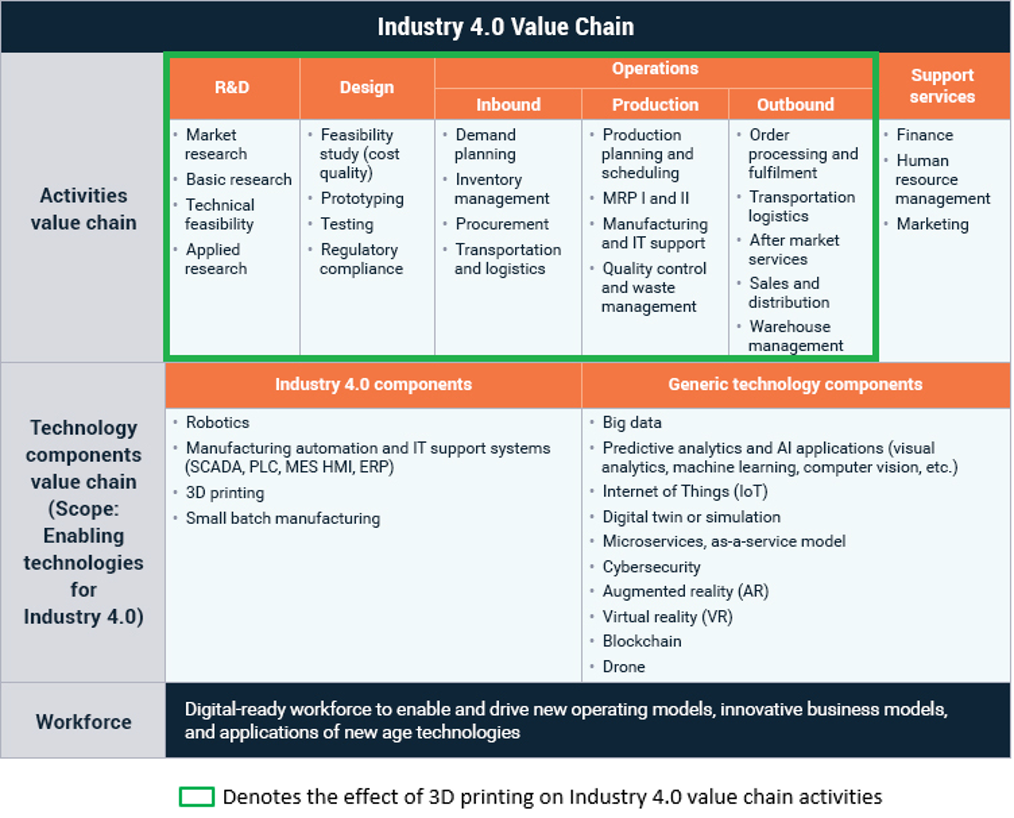
The applications of 3D printing are spread across the Industry 4.0 value chain in Exhibit 1.
Exhibit 1: HFS Industry 4.0 value chain
Source: HFS Research, 2019
Several manufacturers have 3D printing initiatives, as Exhibit 2 describes.
Exhibit 2: 3D printing initiatives across the Industry 4.0 value chain
|
Value chain
|
Typical activities
|
Initiatives
|
|
R&D |
New composites, product innovation |
BMW leveraged 3D printing to make lightweight construction for its new i8 Roadster model
|
|
Design |
Customized and differentiated design for customer experience, cost engineering and efficiency improvement, rapid prototyping and testing |
Adidas partnered with Carbon to develop Futurecraft 4D shoes using 3D printing
Audi reduced its product development cycle significantly using 3D printing |
|
Operations |
Inventory on demand, spare part production for aftermarket services, limited quantity production |
Mercedes-Benz produced its first metal 3D printed spare parts for its Unimog models
Volvo leveraged 3D printing to create spare parts for customers |
Source: HFS Research, 2019
3D printing is best suited for low-volume manufacturing
Traditional mass manufacturing techniques still have a cost advantage over 3D printing, and 3D printing benefits ore from the economy of scope than from economy of scale. Thus, at present, 3D printing is restricted to low-volume manufacturing. For example, the technology is ideal for limited edition car development (Local Motors, for example), medical device manufacturing (components based on individual measurement), spare parts development (for models that are no longer manufactured), and high-value density goods (such as jewelry). This type of manufacturing is a shift from mass manufacturing to micro-manufacturing, which has limited quantity production with a short lead time.
3D printing will change the manufacturing operating model
3D printing is fundamentally shifting manufacturers’ operating models. We’ve identified a few of the latest trends:
Four steps to accelerate 3D printing journey for manufacturers
The opportunities for 3D printing looks promising, but manufacturers need to accomplish a lot of background work to pave the way for 3D printing applications. 3D printing application is an unfamiliar territory for the manufacturers as it involves several software applications. We have outlined the steps that can facilitate the implementation process.
The Bottom Line: 3D printing is an essential lever for smart manufacturing. Include the tenets of 3D printing across manufacturing activities.
3D printing can accelerate the new product development, testing, and validation journey for manufacturers, and it can provide better aftermarket services to customers. Manufacturers must focus on their internal landscape to pave the way for 3D printing implementations and leverage 3D printing for both execution (cost efficiency, time-to-market) and innovation (new design, lightweight structure). Manufacturers have begun to embrace Industry 4.0, and 3D printing remains a critical puzzle in the adoption of smart manufacturing.
Register now for immediate access of HFS' research, data and forward looking trends.
Get StartedIf you don't have an account, Register here |
With the exception of our Horizons reports, most of our research is available for free on our website. Sign up for a free account and start realizing the power of insights now.
Our premium subscription gives enterprise clients access to our complete library of proprietary research, direct access to our industry analysts, and other benefits.
Contact us at [email protected] for more information on premium access.

