
Alibaba Cloud is rapidly emerging as a leading hyperscale cloud provider in the Asia-Pacific (APAC) market, putting AWS and Microsoft under increasing pressure. At a global level, the firm’s revenue pushes it ahead of Google’s revenues in Platform-as-a-Service (PaaS) and Infrastructure-as-a Service (IaaS) from 2018 (see Exhibit 1). APAC will be a major battleground, particularly as China is the second-largest cloud market after the US and a $100 billion market opportunity for Alibaba. But the real challenge Alibaba faces is expansion beyond APAC. Currently, Alibaba cloud operates nine data centers outside the APAC region, with an estimated global market share of just 5% by June 2019. In APAC, it has more than 20% market share, and its data centers operate in 50 zones. On its home turf in China, Alibaba Cloud holds over 40% of the market. Alibaba is a major player in the APAC cloud market, and enterprise leaders would be foolish to ignore the firm’s cloud capabilities by not partnering with it.
Exhibit 1: Alibaba is the newest—but not the smallest—hyperscale cloud provider
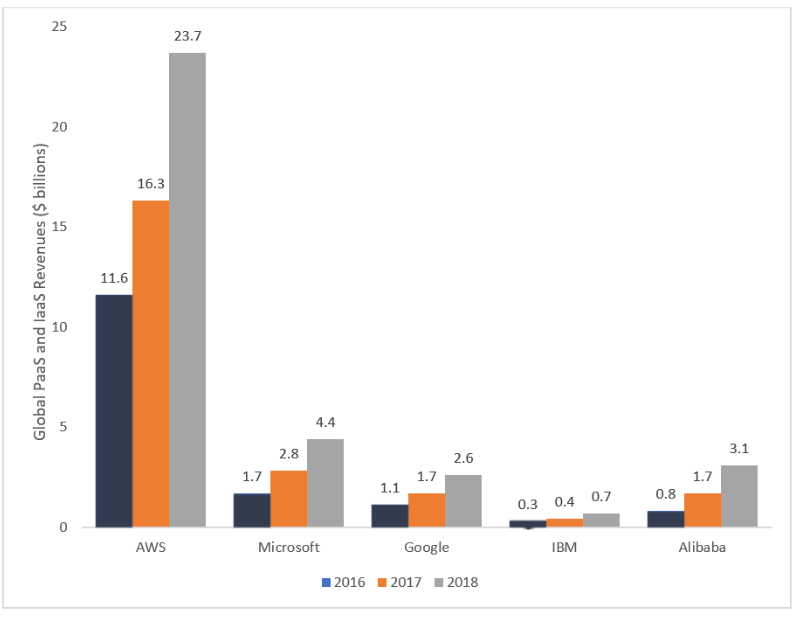
Source: HFS Research based on company financials and estimates where public data does not exist
Expanding into US and European markets won’t be easy for Alibaba cloud. While enterprises should pay attention to the firm’s aggressive growth strategy, right now, its role is as a regional player. Expansion is possible, but there are two major challenges Alibaba needs to overcome in US and European markets—government regulations and client trust—the inverse of the challenges US firms experience moving into China. For example, to enter China, AWS had to partner with local players because of strict regulations and data security compliance policies. Alibaba will face similar challenges in the US and areas of Europe as wary government bodies try to dig through the complications of data moving into the datacenters of a Chinese–owned company. This challenge is more acute for the firm given current geopolitical sentiment—take Huawei’s ban in the US and continuous rising of trade tension between the US and China as prime examples.
Alibaba cloud’s global expansion strategy could move your firm up the list of hyperscale partners
Alibaba’s global strategy is an open secret. Its core focus is on Chinese companies that are expanding globally and international companies looking for cloud services in the Chinese market. Alibaba Cloud partners with these companies and uses them to broaden its footprint globally. Ultimately, the strategy is proving effective. June 2019 quarterly results reported revenues of $ 1.13 billion revenue and year-over-year (YoY) growth of 66%.
To international companies looking for infrastructure in China, Alibaba is a tempting partner, particularly given the firm’s accumulated knowledge in the Chinese market over the past decade. The firm has also developed clear capabilities in the market, which will help the firm take the fight on Google, AWS, and Microsoft, who have been investing heavily in their solutions. For example, Alibaba’s ET brain (an intelligent AI platform) offers vertical-specific AI applications that include solutions for industrial IoT—a valuable capability given China’s manufacturing dominance and the allure of the sector to international businesses and foreign investors.
The firm also leverages its China Gateway, which helps international companies launch and grow businesses in China and the APAC market with the support of Alibaba’s suite of tools and solutions. Alibaba has also shown it’s willing to open the war chest to access growing markets; for example, through the recent acquisition of UOL Diveo to build a footprint in Brazil and from there expand across South America. The reality is, as this growth strategy plays out, enterprise leaders will need to factor the firm in if they’re to execute their best-in-breed technology strategies.
The Bottom Line: Alibaba has a clear growth strategy with a strong footprint in China, enticing international companies looking for a regional cloud partner, but the firm’s global expansion plans could see Alibaba feature more prominently on IT leaders’ radar.
The heritage of Alibaba Cloud is very similar to AWS. Both firms stem from e-commerce companies, which means Alibaba could encounter the same challenges as AWS, particularly around competition with clients in retail and other verticals. But, its e-commerce heritage also furnishes Alibaba with a compelling story for its ability to bring scale and vertical knowledge to the market.
Currently, Alibaba cloud has plenty of market space in China, and we can expect the leadership team’s focus to remain on China and the rest of APAC. Expansion into the US and Europe will be a lower priority, at least for the next five years, particularly as the current US-China trade war shows no signs of calming.
Nevertheless, Alibaba Cloud is aggressively launching new products after testing them in their own Alibaba group environment. In the last six months, Alibaba Cloud launched 597 new products and services in its cloud portfolio, including changes and updates for cloud offerings, security, data intelligence, artificial intelligence applications, and AI interference chips (Hanguang 800), helping to provide the firm’s commitment to innovation and capacity to add value to the growing appetite for enterprise AI. Alibaba Cloud also hasn’t shied away from multi-cloud and hybrid delivery models, showing it is open to working with other cloud providers. Crucially, it is aggressively competitive on pricing, an important factor for enterprises that view cloud as a utility rather than a differentiator. In addition, the firm continues to build a strong partner ecosystem with leading tech vendors such as SAP, VMware, Siemens, Bosch, Salesforce, Intel, and RedHat, and it has developed strong credentials for delivering cloud solutions to major clients, such as the Olympics.
The reality is that while many enterprise leaders are unsure of Alibaba, particularly in the US and Europe, Alibaba continues to innovate and expand, pushing the firm into direct competition with the other cloud players in terms of use cases and corporate mindshare. It’s time to pay attention to Alibaba Cloud.
Register now for immediate access of HFS' research, data and forward looking trends.
Get StartedIf you don't have an account, Register here |
With the exception of our Horizons reports, most of our research is available for free on our website. Sign up for a free account and start realizing the power of insights now.
Our premium subscription gives enterprise clients access to our complete library of proprietary research, direct access to our industry analysts, and other benefits.
Contact us at [email protected] for more information on premium access.

