
Globalization has allowed countries to specialize in producing the goods or services that offer them the lowest opportunity cost, meaning international trade is crucial for economic growth. Currently, Maersk reports that over $4 trillion of goods are shipped each year globally. Countless shipments are processed at customs, forming a cornerstone of international relationships, but they are lengthy and expensive processes that ultimately burden governments, enterprises, and consumers with the costs. Discussing the constantly controversial and changing Irish border situation surrounding Brexit at a Conservative Party conference, Philip Hammond, the UK’s Chancellor of the Exchequer said:
“There is technology becoming available.”
“I don’t claim to be an expert on it, but the most obvious technology is blockchain.”
Initially, the audience met his comment with skepticism—probably due to his self-confessed knowledge gap—but the concept may not be as ludicrous as many initially believed. Exhibit 1 is from the HFS Blockchain Case Study Treasury, and it shows that trade is one of the most prominent use-cases for the technology. Ultimately, stakeholders must put their differences aside and come together if they hope to solve cross-border trade issues, creating new streamlined processes and maximizing efficiency for every party.
Exhibit 1: Trade is one of the most prominent use cases for Blockchain
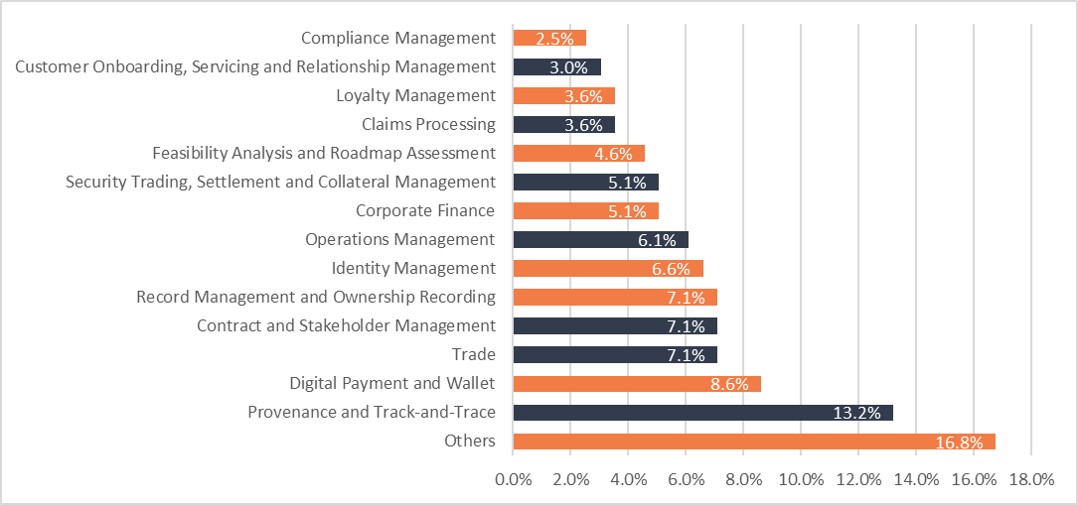
Source: HFS Research, 2019 n= 197
Controlling borders is big business—more than $4 trillion in goods are shipped and passed through customs each year
Moving goods across borders is expensive for enterprises. As Brexit looms, a lack of preparation could see enterprises struggle to cope with new and largely higher tariffs, drastically affecting their ability to trade on the global market and ultimately affecting their profit margins. Jon Thompson, Chief Executive and Permanent Secretary of HM Revenue & Customs (HMRC), predicts that enterprises could face as much as £20 billion per year in added costs, depending on the type of deal reached.
Decentralization has the potential to create hyperconnected countries and ease global trade
The problem plaguing international trade is the excess time and cost requirement associated with manually completing and sharing paperwork with enterprises and customs authorities. Pioneering service providers that can facilitate blockchain-based ecosystems, driving down time and costs, will benefit from an early adopter advantage in the market, making them a more attractive partner for governments and enterprises.
Blockchain is the key to frictionless international trade due to its decentralized nature. It would enable the necessary documentation and certification to be uploaded onto a single decentralized database, allowing all authorized parties instant access. Another benefit is its immutability; customs officers, enterprises, and consumers can be safe in the knowledge that nobody has tampered with the information. Exhibit 1 depicts how tracking and traceability are very much achievable in the near-term.
Exhibit 2: Blockchain’s tracking and traceability is in the near term for businesses
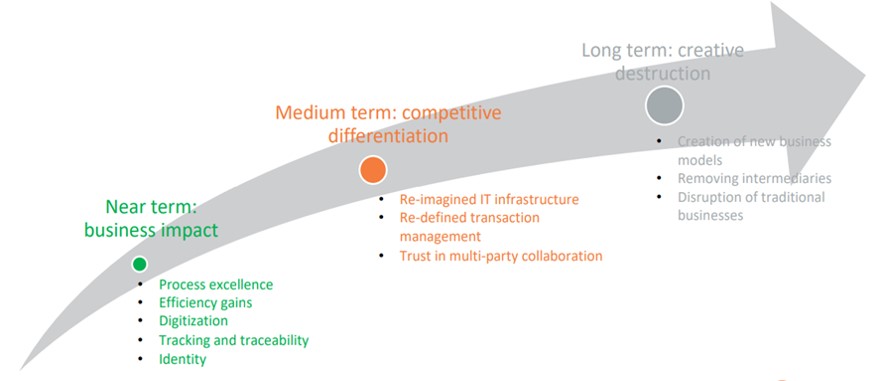
Source: HFS Research Top 10 Enterprise Blockchain Services, 2018
Service providers are exploring blockchain to simplify global trading—the window to define the space is closing
One service provider already navigating the space is NTT Data, which is working with Japan’s New Energy and Industrial Technology Development Organization (NEDO). NEDO explains that existing paper and PDF files take a significant amount of time to manually re-enter into the system, check, and correct for incorrect input. It has developed a blockchain trade collaboration platform that allows all involved parties to exchange the necessary information using a blockchain-powered API. Furthermore, the US Customs and Border Protection (CBP) has completed tests for a blockchain shipment tracking system, hoping to record transactions in a transparent and verifiable manner. Following this, it announced further testing, suggesting the initial test was successful.
IBM has also been making headway in this area, pioneering two of the most popular trade consortiums; TradeLens and we.trade. IBM developed TradeLens with Maersk, and it aims to replace manual and paper-based systems, allowing its members to digitally share information across the shipping supply chain ecosystem. Differently, we.trade developed a financial trading platform leveraging smart contracts; it allows companies to efficiently trade with complete trust. The consortium boasts names like Deutsche Bank, HSBC, and CaixaBank.
Brexit has created a debate around the Irish border—for service providers, this represents the perfect opportunity to partner
Brexit has caused great debate surrounding the border between Ireland and Northern Ireland. Currently, because both are part of the EU single market and customs union, goods can move between the countries with no inspections. However, as Brexit may see Northern Ireland leave the single market, goods will have to be checked before moving between countries, creating a physical border—something many UK politicians are keen to avoid on account of the Good Friday Agreement, ensuring peace on the border.
The Bottom Line: The uncertainly of the modern global economy means it’s time for stakeholders to put their differences aside and come together to augment cross-border trade, but blockchain may not be the perfect solution.
While blockchain certainly has the potential to simplify cross-border trade, it is far from the perfect solution. HFS’ Blockchain Bullshit Buster contains key questions that must business leaders must answer before they can deploy it in an area as sensitive as international trade. Examples include the privacy of blockchains and the regulatory requirements of such an initiative. Furthermore, challenges with data entry would likely arise—and all of this is alongside the significant investment needed to create the infrastructure.
Ultimately, stakeholders need to come together to streamline cross-border trade processes, and blockchain could be a genuine solution, but they must remain realistic in their goals and acknowledge the technology’s flaws.
Register now for immediate access of HFS' research, data and forward looking trends.
Get StartedIf you don't have an account, Register here |
With the exception of our Horizons reports, most of our research is available for free on our website. Sign up for a free account and start realizing the power of insights now.
Our premium subscription gives enterprise clients access to our complete library of proprietary research, direct access to our industry analysts, and other benefits.
Contact us at [email protected] for more information on premium access.


