
Smart companies are no longer just trying to get faster and cheaper; they are rewiring operations to prepare for a future hyperconnected state. Taking this approach focuses on the human elements of business, but it requires increasingly intelligent technology to support these experiences. Enterprises must look at the way conversational automation can help their organizations achieve the OneOffice.
Conversational services have evolved in the workplace: they are now our ‘digital associates’
We’ve been following the development of cognitive assistants and their role in this shift for several years, but the discussion of tools has recently accelerated and matured. Cognitive assistants are actually “digital associates” that work for and with enterprises to create better experiences across their stakeholder ecosystems. Digital associates can be an integral element in making data flow easily and intelligently and helping everyone in an organization make better decisions—not only in the digital front office but also across all business processes. Businesses use them for both conversational interaction and process execution. The “digital workforce” is a workplace entity involving humans and bots together (see Exhibit 1). Digital associates’ behavior coincides with the abilities of humans more than a rules-based bot does. Digital associates can also be both front-office and back-office bots (not just front-office like traditional digital assistants).
Exhibit 1: Digital associates go beyond conversational services, and enterprises use them for process execution

Source: HFS Research 2020
The HFS OneOffice experience focuses on the experiences of all components of a successful business to create satisfaction across all stakeholders: consumers, partners, and employees. Optimizing digital associates across these areas (and beyond simply front-office use) is one of the differentiators of a digital associate beyond basic chatbots and virtual assistants. Digital associates also go beyond in their combined conversational and learning capabilities. Chatbots and virtual assistants are utilized in widespread consumer and social practices, whereas digital associates have specific business value across the OneOffice value chain. While companies can use digital associates in customer-facing interactions, we also find them to be very valuable behind the scenes to help companies with their internal processes.
Exhibit 2: Digital associates can help create OneOffice experiences for employees
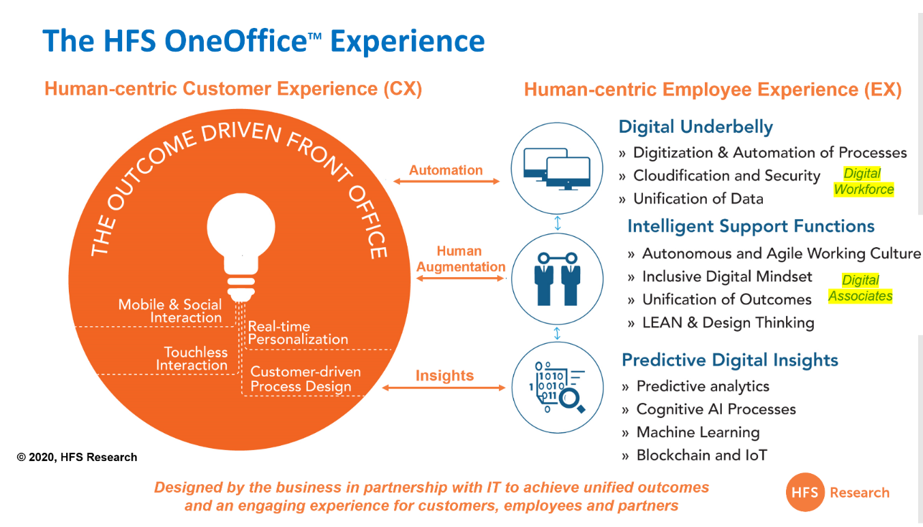
One of the ways digital associates can help with OneOffice experiences is to make employee experiences in the back and middle offices simpler. For example, IPsoft’s 1Desk platform enables self-serve for numerous internal processes such as logging annual leave, providing guest Wi-Fi access, facilitating MDM enrollment requests, or any service catalog request, increasing efficiency and reducing costs. Other companies have utilized this technology to replace the work and validation of several people across procurement and IT that reduces workload and allows people to focus on more complex problems. Using digital associates in these back-office functions can increase efficiencies and cut costs, but it also has the potential to improve the employee experience and increase company security with onboarding processes. Similar to human training, to increase the speed and completion of tasks through automation, companies must place upfront time and energy in the product to train the technology for the task at hand. Time is, therefore, maximized in the long run because digital associates can produce fast and accurate outcomes without the risk of basic human error.
Understanding how and where companies can utilize digital associates to create seamless experiences is necessary to extract value from digital associates
Enterprises’ use cases and approaches have depicted unique digital associate stories, yet the baseline resides in that all enterprises fundamentally use digital associates to augment and align to human-centric processes. Companies looking to utilize digital associates need to consider that this technology should empower and benefit both the employee and the customer. By providing excellent employee experience, customer experience will also benefit.
The Bottom Line: Ditch the chatbots and look to digital associates for more intelligent interaction, but be sure to put human-first design at the heart of your strategy.
It is extremely important to consider the human-first approach when integrating digital associates within enterprises. If you implement them correctly and wit precision and care, digital associates are very successful tools, yet a digital workforce cannot succeed without a firm human base. Design the digital workflow with the impacts on the user in mind. Be ready to adapt the technology to improve user experiences and always take cultural differences into account.
Register now for immediate access of HFS' research, data and forward looking trends.
Get StartedIf you don't have an account, Register here |
With the exception of our Horizons reports, most of our research is available for free on our website. Sign up for a free account and start realizing the power of insights now.
Our premium subscription gives enterprise clients access to our complete library of proprietary research, direct access to our industry analysts, and other benefits.
Contact us at [email protected] for more information on premium access.


