Many of today’s enterprise automation initiatives are delivering lackluster results due to too much focus on tinkering with technology and too little focus on optimizing processes and enabling humans to prioritize high-value work.
This was the overwhelming factor we uncovered at a recent HFS roundtable conversation with two dozen enterprise automation leaders while exploring strategies for creating the digitally augmented workforce. The session was supported by Capgemini. Contrary to popular belief, process automation is not about getting rid of humans; it’s about augmenting them. Intelligent automation technologies such as robotic process automation (RPA) and artificial intelligence (AI) have the ability to change how work is done through process transformation, supported by a hybrid workforce of humans augmented by digital technologies. The roundtable explored strategies for creating an effective augmented workforce at scale with an emphasis on striking a balance between the required components of people, process, and digital technologies. This POV outlines some of our core findings and observations from the day.
Creating the right conditions for augmented workforce success
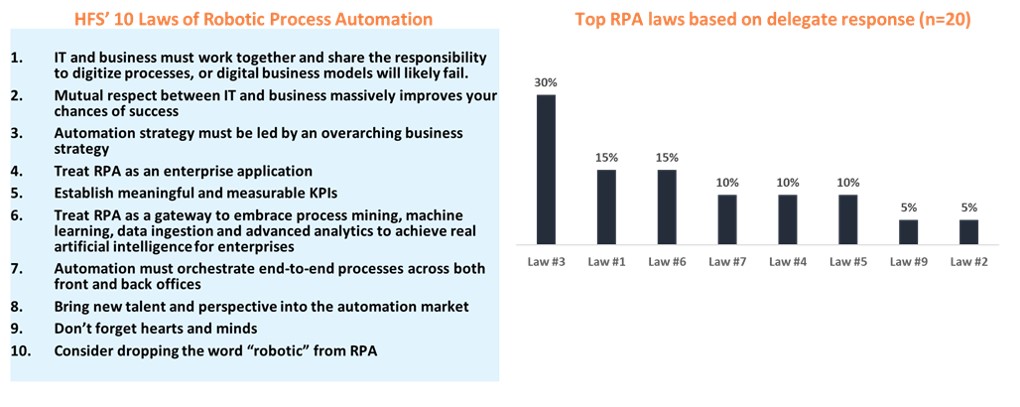
In December 2019, HFS released our “New RPA Manifesto for Success Over the Next Seven Years”. In it, we identified 10 laws intended to help enterprises make better and more effective use of RPA as a gateway toolset to process transformation. At this roundtable, we asked our delegates to identify which law they regarded as most essential to achieving success, as shown in Exhibit 1.
Exhibit 1: Delegate automation priorities favor strategic alignment across the enterprise
Source: HFS Research 2020
The top response was Law #3 – your automation strategy must be tied to an overarching business strategy. This may seem obvious, but the delegates acknowledged that many automation journeys have started with pilots or proof of concepts that were more exploratory than strategic. While due diligence is always critical, when you decide to push forward with an automation program it needs to be based on much more than “we found a good tool”. It needs to align with specific business problems that need solving and strategic business imperatives that are helping drive the overall company strategy. Anything less yields “hammer looking for a nail” syndrome and stalled automation programs.
TIP: Don’t waste time in the proof-of-concept phase. Work with real problems from the outset and progress with multiple small, quick projects.
Source: Drive Business Operations Transformation in Your Organization with RPA by Augmenting Your Workforce – Not Replacing IT, Miriam Deasy, HFS Research, January 20, 2019
Law #1 – necessary alignment between IT and business – tied for second. This prompted some rich discussion around how the age-old corporate holy war lives on. While RPA-led automation initiatives have generally been business-led, it’s a recipe for disaster if IT is not involved. The ideal mix is a program that is business-led for context and purpose and IT-supported for orchestration and governance. Emerging peace agreements between these two factions yield an understanding that IT will sanction the use of RPA and other tools by the business now, with IT’s support and blessing, even for areas where IT has no planned technology intervention in the near term.
The third top rated answer was Law #6 – RPA is a gateway. As a discrete technology, RPA made automation accessible to business leaders and paved the way for other much more complex technologies. And perhaps, due to some of the lackluster success with RPA, it’s helped to clarify the reality that if you don’t take the opportunity to refine, improve or reinvent your processes before adding automation, they will still be the same old poorly constructed processes with RPA mapped on top of them. This led us to a robust discussion about process debt – the creation of awkward and often manual processes that are designed to buttress aging technologies. Process debt must be beaten down for automation to do anything more than deliver minor, incremental success.
Interestingly, the one law not identified as critical was #8 – bring new talent and perspective into the automation market. After reflecting on this, the group agreed that this omission was perhaps short-sighted. If we consider that our downstream success with automation will likely yield a hybrid workforce of humans augmented by digital workers, it is fair to assume that the skills required and the job responsibilities of us humans will also need to change and evolve.
A methodology for achieving the augmented workforce
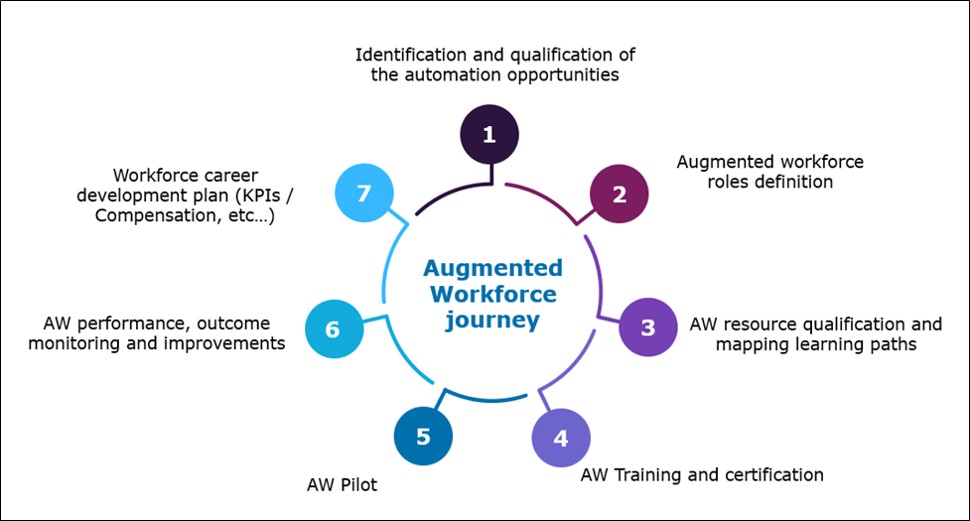
There is a strong linkage between beating down process debt and uplifting your humans! Capgemini provided seven essential organizational steps to the augmented workforce (Exhibit 2), noting foundational must-haves for successful programs, such as a line of sight into business strategy, strong governance, and a centralized CoE in place. From there, process evaluation, identification and qualification (Step 1) begins.
Exhibit 2: Seven essential organizational steps to the augmented workforce
Source: Capgemini 2020
After establishing the right program conditions and focus in step one, there are further steps one can take to cultivate the right people, processes and evolving work roles and responsibilities.
“We can literally change people’s lives more creatively,” notes industry expert Jennifer Valenti, Global Head of AI Advisory – Business Services, Capgemini
There is an existing idea that internal businesspeople make terrible engineers and vice versa, and this is simply not true. Capgemini suggests the need to devise a solid understanding of the KPIs of the automated task/worker; to canvas for good candidates, referred to as “Pacesetters”, by recognizing contextual qualifications; and to train them in both technical and soft skills to succeed, all while offering an interesting career trajectory and the opportunity to reconnect with work in a new way.
In short, determine the correct person for the role, give her the tools to accomplish it, and celebrate wins for a job well-done.
An augmented workforce in action
Guest speaker Brian Klochkoff, Automation Director of the Dentsu Aegis Network, provided an illustrative example of leveraging the technologies you have, or know that exist, to take capabilities straight to the end users with a citizen developer approach.
When the digital workers and the human workers come together, the outcomes can be far greater than the two working in silos, yielding the high-functioning augmented workforce. Klochkoff suggested giving your team the tools to create the automated worker yourself, in-house. Dentsu did this by creating an in-house bot that automated the RFP process. The company was hesitant to implement another piece of software and therefore created one internally, successfully leveraging its automation program to help business functions improve how work was getting done. They didn’t simply hand over a new app but instead educated their team on what resources could be leveraged in an effort to augment their work.
Now in its 3rd iteration in 3 months, this collaboration has resulted in an approximate 70% reduction in overall time spent creating RFPs while allowing the salesperson more time to focus on the higher value activities.
The Bottom Line: Clearing away process debt helps enterprises create optimal roles for humans and digital workers
When you are head to head with competitors, you must have processes on solid ground to accelerate the delivery of value. Breaking and reimagining business processes closes the gulf between strategy and execution – while securing implementation in a new, creative and accelerated way. When it comes to transformation and scaling, striking a balance between the required components of people, process and technology is the new digital golden triangle. You can’t achieve transformation without it.
Register now for immediate access of HFS' research, data and forward looking trends.
Get StartedIf you don't have an account, Register here |
With the exception of our Horizons reports, most of our research is available for free on our website. Sign up for a free account and start realizing the power of insights now.
Our premium subscription gives enterprise clients access to our complete library of proprietary research, direct access to our industry analysts, and other benefits.
Contact us at [email protected] for more information on premium access.