As HFS outlined in our recent POV on advances in AR and VR technologies, these technologies are rapidly shedding their reputations as consumer-focused gimmicks and are making themselves increasingly indispensable to enterprises of a particular profile. Enterprise-grade AR and VR may still be in its early days, but it’s not science fiction—companies are already using these technologies to make a real difference to their business. As AR and VR have the potential to drastically cut operating costs and improve customer experience and loyalty for enterprises, technology decision-makers should be watching this space closely. In particular, they should heed the use cases already in play among their peers.
In our related POV we explore some of the tech firms that are leading the advancement of these technologies. This POV looks at the types of enterprises that stand to benefit most from AR and VR, early-moving organizations harnessing enterprise AR and VR, the benefits they stand to gain, and where these technologies could make a difference next.
Exhibit 1: Enterprises are starting to invest in mixed-reality technologies
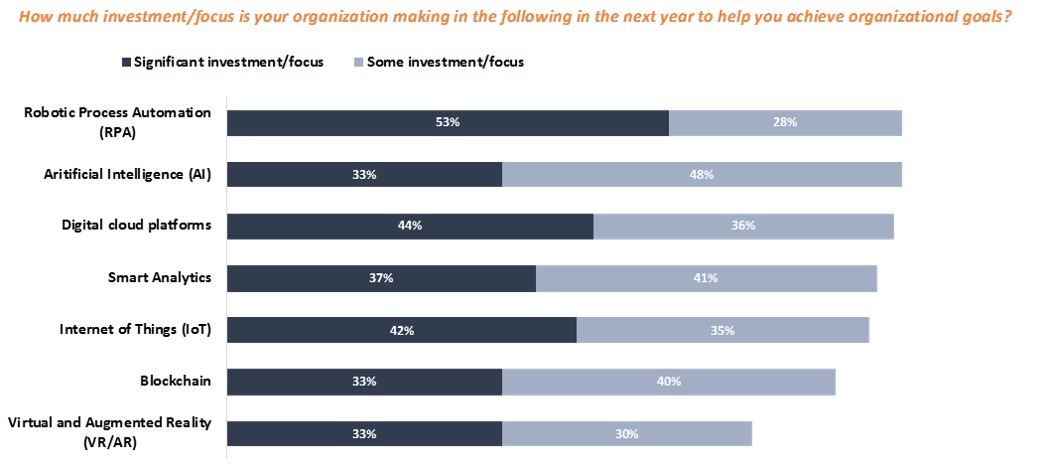
Source: HFS Research with KPMG, n=381 enterprise customers
AR and VR can have a major impact on the way certain enterprises operate
The most obvious clients for AR and VR technologies are enterprises whose business depends on physical environments or objects for earning revenue, whether they are consumer products in need of better display and tactility or expensive machinery that would benefit from being tested in a safe environment before being deployed. This category of physical environments and objects includes organizations that are:
- Operating in high-risk environments. Examples may include armed forces training troops for deployments or relief agencies preparing rescue workers to work in dangerous conditions. Providing hyper-realistic training in simulated versions of high-risk environments like a battlefield or tsunami wreckage can save lives and make operations more cost-efficient.
- Reliant on costly fieldwork. Examples include utility companies with meters in remote locations, oil and gas companies with costly deep-sea rigs to maintain, mining companies monitoring the ongoing stability of their mines, insurance companies conducting field inspections and damage assessments, and telecom and media companies undertaking maintenance. AR and VR can help reduce high maintenance costs by letting engineers explore objects without traveling into the field or access hands-free technical information to improve productivity out in the field.
- Using heavy and expensive machinery or complex logistics. Companies whose livelihood is intimately bound up with very expensive, sensitive, and finicky machinery and vehicles—such as heavy manufacturing companies or space agencies like NASA—can safeguard their staff and costly new equipment (e.g., aircraft) before letting them loose in the real world. Accenture has an example of working with Airbus on smart glasses to improve accuracy and reduce complexity while building aircraft. HFS also sees AR and VR use cases emerging around logistics and warehouse itemization and pick-and-pack lists to improve work quality.
- Looking for ways to better sell physical objects or experiences to customers. E-commerce platforms, travel agencies, and other companies selling objects online may have gained a wider market by being digital, but have also compromised on the ability to display their wares in an appealing, tactile way to potential consumers. AR and VR can help them provide richer customer experience, either through immersive advertising or allowing customers to “get a feel for” something before they buy it, such as a product’s dimensions or textures.
- Looking for highly collaborative environments for employees. In the past year, we have started to see use cases for AR and VR technologies centered around collaboration. A simple example is the use of virtual meeting rooms for globally disbursed teams. More specialized use cases have emerged, such as financial advisors and traders using VR-enabled workbenches to get quick snapshots of market movements and guide clients through insights in a shared collaborative workplace. Mphasis has conducted a proof-of-concept for a solution along these lines called Trader Lens with a financial services client using AR technologies.
Like any emerging technology, AR and VR are still nascent and have risks that must be mitigated to reap results
AR and VR technologies will only be able to make a positive contribution to your business if their attached risks are planned for and mitigated. AR and VR applications come with a wide array of potential difficulties, given the interplay with physical environments, including bulky hardware, a limited or obstructed field of vision, and the varying levels of interaction within environments. Beyond these technical challenges, we outline the three principal concerns attached to AR and VR today:
- Impact on employee and user health and privacy. Commercial AR and VR headsets have been known to cause symptoms, including nausea, anxiety, and eye soreness due to factors like low resolution and poor simulation timing. As the software is refined, these risks will likely be reduced, but if you buy earlier prototypes, be sure to prioritize your employees’ and consumers’ health and safety above all else, and have a discussion with your legal department about to the implications of introducing the technology into the workplace and what precautions you’re legally obligated to take. Privacy issues also emerge for employees required to use AR and VR applications for long time periods.
- Cybersecurity concerns. AR and VR hardware is heavily reliant on sensitive information such as sensor data. If such information were to be stolen, malicious actors could gain access to details on mission-critical locations, landscapes, and equipment, for instance, in military or aerospace contexts. This could become especially serious if the malicious agents learned how to manipulate the hardware’s output, causing users to make serious and potentially life-threatening mistakes while immersed in a simulation. While all enterprises are struggling to maintain their cybersecurity to keep up with evolving threats, enterprises considering deploying AR and VR either internally or to their customers must consider themselves especially responsible for doing all they can to prevent hacking. A practical start might be to limit the number of users who have access to the technology and ensure all employees go through a rigorous cybersecurity primer before using or supporting the technology.
- Infrastructure support. AR and VR applications require significant computational and graphics-intensive processing, especially if visual data needs to be analyzed in real-time. Enterprises looking beyond small pilots and POCs to production deployments of AR and VR technologies will need to invest in foundational data management capabilities to support these new needs.
The Bottom Line: AR and VR benefits aren’t theoretical—early-moving enterprises are already reaping them.
Don’t dismiss AR and VR as a consumer gaming trend or the prerogative of the industrial manufacturing industry. Banking, financial services and insurance firms, retailers, and healthcare providers in our research are starting to test the applicability of AR and VR for industry-specific use cases. As the way forward, HFS expects a multitude of technologies, including AR and VR, to drive the future of work. Test out whether these immersive technologies could have a place with your employees or customers to drive better productivity, performance, and experiences.


