
Evolving scientific evidence of climate change coupled with changing legal interpretations means that a new wave of lawsuits is washing over enterprises—whether they’re the source of environmental damage or just an indirect partner. The historical culture of outsourcing with closed eyes is disappearing as businesses find that their partners’ indiscretions are increasingly coming back to haunt them; manufacturing via modern slavery, for example, or Facebook’s Cambridge Analytica crisis. The cost of first-hand indiscretions is also skyrocketing, as companies are ceremoniously torn apart by the public and media—United Airlines, look away now.
Enterprises must now thoroughly assess and be accountable to their environmental, social, and financial footprints—no matter how far down the line. You can’t outsource responsibility anymore.
Evolving scientific evidence and legal contexts are fueling a new wave of environmental lawsuits
An article published in the Oxford Journal of Legal Studies (OJLS), If at First You Don’t Succeed: Suing Corporations for Climate Change, discusses the new opportunities for legal teams and judges to rethink the interpretation of legal and evidential requirements surrounding climate change, changing the debate and accountability of private corporations’ footprints.
Most of the 828 US cases (stored in the Climate Litigation Database) have occurred since the mid-2000s. The first wave, between 2005 and 2015, were largely unsuccessful due to a failure to properly correlate climate harm and defendants’ actions. But now they’re gaining momentum; innovative legal strategies based on new climate science alongside new contexts for legal interpretation and discussion mean a far higher chance of success.
Even unsuccessful cases can now better demonstrate the legal and financial risks of climate change to enterprises, helping to guide positive responses in the long term.
Enterprises must stay ahead of the game, whether they provide or buy technology and services
Enterprises keep pushing toward emerging technologies. Processes migrating to the cloud, AI, IoT networks, blockchain, and more keep driving technology’s energy appetite upward. Bitcoin has just overtaken Switzerland in energy consumption, according to a new University of Cambridge tool; HFS predicts that cloud spending will soar from $46 billion in 2018 to $88 billion in 2022.
Greenpeace’s 2017 #ClickClean report calls out tech giants on their energy consumption and use of renewables. The report estimates that the IT sector consumes 7% of the world’s electricity, which peer–reviewed research predicts will reach 20% by 2025 and produce 5.5% of global emissions—more than any country bar the US, China, and India.
The looming consequences to enterprises should have executives shivering
Reputational damage, ongoing public scrutiny, pressure to disclose behaviors, and future liabilities all stem from this new wave of legal cases, regardless of the outcome; executives are also finding themselves personally at risk of legal action. Governments are backing up these pressures, and the OJLS study finds it improbable that the law will remain unchanged off the back of these cases.
A group of citizens is suing he US federal government for failing to prevent climate change, which the group’s lawyers and their clients argue breaches citizens’ constitutional rights. There have been calls for the public to “flood the courts” with legal cases against polluters and negligent companies, notably from Jeffrey Sachs, a renowned US economist and UN special adviser. Action is also spreading worldwide and including human rights cases, while southern hemisphere citizens are suing northern majors.
UK firms are also bearing the brunt of environmental litigation: Southern Water was slammed with a record £126 million fine due to wastewater spills and deliberately misrepresenting its performance. The Environment Agency has launched a criminal investigation, and it’s a bleak future for water companies throughout the UK with 11 out of 14 failing the latest reviews in early 2019.
Polluters will soon have nowhere to hide—along with any enterprise that sources power, products, or services from them
On the theme of evolving scientific evidence: Non-profit firm WattTime, backed by a $1.7 million investment from Google’s philanthropic wing Google.org, is developing satellite imagery to track air pollution from every power plant on earth, and it plans to make that data public. Citizens’ access to the data forms a far more terrifying prospect for these companies than any regulator does.
Change agents like blockchain are helping unmask any enterprises pretending to be “green”—check out our separate report on renewable energy certificates.
Poor monitoring of emissions and a lack of agreement on the most comprehensive estimation tool (Life–Cycle Analysis, for example) have, to-date, made assessing corporate impact difficult. As climate science improves and legal contexts shift, all enterprises, no matter how far up or down the supply chain, will soon be fully accountable and open to prosecution.
Technology giants are already committing to 100% renewable energy
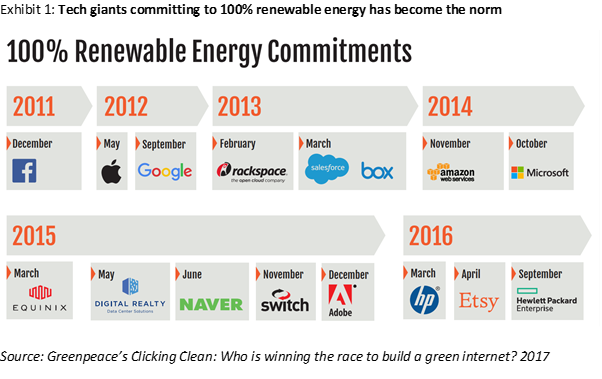
The headlines keep coming—AWS recently announced its investment in three windfarms worldwide as it journeys to 100% renewable energy, in line with its competitors (see Exhibit 1). Its focus on energy is neither purely philanthropic nor a response to public pressure; energy consumption is a critical expense, and providers are naturally looking to maximize the efficiency of their operations.
The Bottom Line: If executives needed an excuse to stop kicking the sustainability can down the road, this is it. Enterprises must thoroughly assess, be accountable for, and clean up their footprints now.
C-suites must recognize that technology’s environmental impact will catch up with their continuing omittance of sustainability in enterprise-level strategy. You can find our more detailed view on the business benefits of sustainability here.
This new wave of lawsuits applies to all—the providers of technology and services, their buyers, and their end-users. It’s not only Greenpeace shouting at you anymore. Evolving scientific evidence and new legal interpretations, combined with the pressure made possible on social media, are holding companies to account.
Your enterprise faces an environmental lawsuit unless it ensures that its every action, purchase, and contract is thoroughly assessed and accountable. It’s a lawsuit you can’t win anymore.
Register now for immediate access of HFS' research, data and forward looking trends.
Get StartedIf you don't have an account, Register here |
With the exception of our Horizons reports, most of our research is available for free on our website. Sign up for a free account and start realizing the power of insights now.
Our premium subscription gives enterprise clients access to our complete library of proprietary research, direct access to our industry analysts, and other benefits.
Contact us at [email protected] for more information on premium access.

