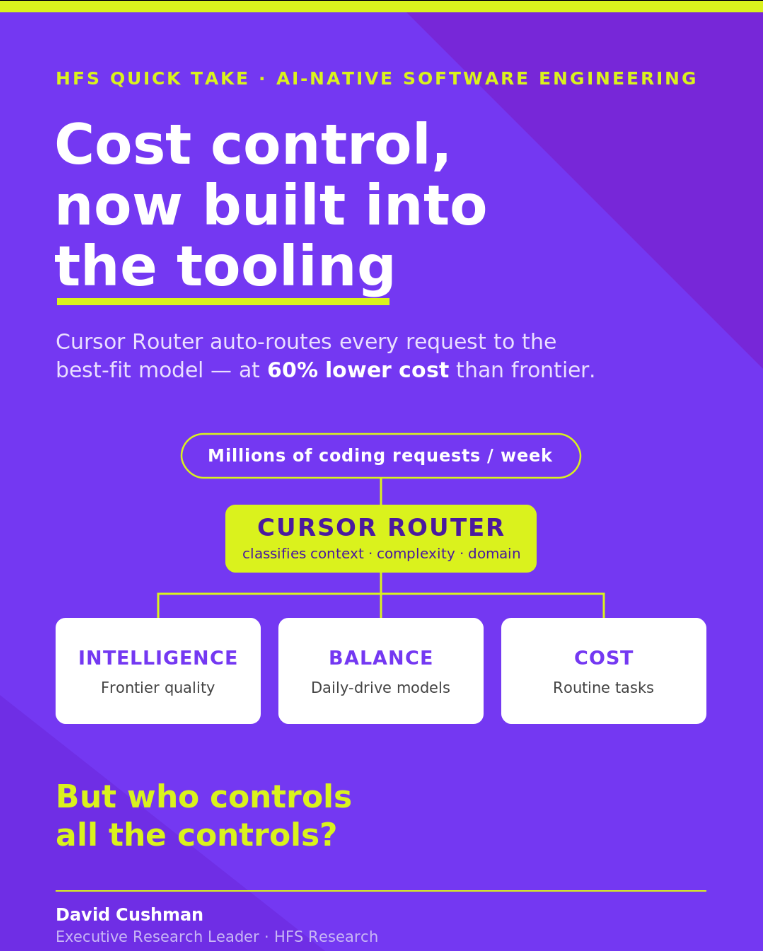
Engineering leaders scaling AI coding are all crashing into the same wall: running frontier models on every request is unaffordable, but forcing cheap models on everyone risks quality and frustrating teams. Token spend climbs unpredictably, and no one can say which task actually needed the expensive model. This is the problem Cursor Router sets out to solve, and it is aimed squarely at the people now feeling it — CIOs, heads of software engineering, and the AI centres of excellence answerable for both developer output and the bill.
Cursor’s answer is automation through ‘The Router’: A classifier that reads each request for context, complexity, and domain and automatically sends it to the best-fit model. The only human choice is a high-level steer: stay on “Auto,” or set one of three optimization modes; Intelligence (frontier quality), Balance (the models people daily-drive), or Cost (good-enough for routine work). Across millions of requests in A/B tests, it matched frontier quality at 60% lower cost than Fable 5 and beat Fable 5, Opus 4.8 Thinking, and GPT-5.6 Sol on cost per commit.
As HFS argued after witnessing the announcement at this year’s Databricks Data + AI Summit, fixing context, cost, and control is what unlocks enterprise AI, and our advice was to make agent cost control mandatory and built in rather than bolted on. Cursor has done exactly that, and it validates the three-tier router (SLM, mid-tier, flagship) we recommended enterprises test in Control the chaos, shipped in this example as a default. More than that, it is control starting to be built into the tooling itself, the shift we read between the lines of the Databricks announcements and expected to spread. Admins decide which teams get the Router, whether use is optional or enforced (soft vs hard), which modes are available, and which models are allowed or blocked.
By default the Router hides which model answered, on the logic that seeing a “cheaper” model biases the user against the output before they read it. The reasoning is sound, but is not a match with the explainability that enterprise buyers demand. Usage analytics show the mix after the fact and admins can switch inline disclosure on. So, at this stage, treat transparency as a deliberate governance decision, not a default to accept unexamined.
Model switching is becoming an inevitable need – and a complexity enterprises could well do without. Someone has to decide which model serves which task, keep those rules current as new models ship, and prove the choices were sound. Much of that burden has been carried by services firms to date, and I suspect it will stay that way because Cursor’s capability is heavily focused on the SDLC. Enterprises need model switching across a far broader set of functions, and no single coding tool spans that estate. Cursor’s advantage is its data. It will be routing hundreds of millions of coding requests a week and that tells it what actually works for its customers, a signal a homegrown orchestrator struggles to match. Even so, it is control in just one domain.
The Bottom Line: Cursor Router is one control for one problem. The real contest is moving up a level. Who controls all the controls across the enterprise, the AI control-plane question HFS has been pressing? Pilot the Router against your own single-model baseline on cost, latency, and acceptance, and set enforcement and allow/block lists deliberately. But don’t mistake a great SDLC router for an enterprise model-switching strategy. Decide who owns routing across all your functions – you, your platform vendors, or your services partners – before a dozen tool-level routers make that decision for you.