
Enterprise leaders must prepare now for the work-transforming, HR-quake of artificial general intelligence (AGI), heralding the imminent arrival of what HFS calls Services-as-Software™ (SaS), in which an entire business unit could ultimately be run by one human at the helm.
Clues suggesting AGI is now within touching distance include the arrival of agentic platforms delivering end-to-end outcomes (such as OpenClaw), Silicon Valley investment in new learning approaches for AI (such as generalized learning from small data sets), new alliances forged between AI-native firms such as OpenAI and Anthropic, and GSIs getting ready for Services-as-Software delivery.
HFS Research defines AGI as able to think, reason, and learn like a human, in any domain (see Exhibit 1, the HFS AI Continuum). Many AI experts now believe that taking the final step to AGI will require a new approach to AI architecture, one in which AI can generalize from small sets of data, more like how humans learn than how LLMs remember.
Lukasz Kaiser, coauthor of the foundational paper Attention Is All You Need and long-serving member of OpenAI’s technical staff, recently connected the dots at NEARCON in San Francisco. He identified a new focus among Silicon Valley labs on generalized learning from small data sets. This, alongside another round of increased investment in frontier LLMs and the recent emergence of “cowork” platforms such as OpenClaw, indicates that AGI is edging closer.
And it appears it is not just OpenAI that is convinced. Companies such as BCG, McKinsey, Accenture, and Capgemini have formed a consortium, the OpenAI Frontier Alliance, to ready themselves and their clients for imminent AGI.
OpenAI Frontier points straight at the future, where AI doesn’t assist work, it runs it.
— Saurabh Gupta, HFS President
The recent deepening of the partnership between Infosys and Anthropic is an additional signal that enterprises should prepare for a giant leap forward. HFS’s perspective, as shared at our summits and in our recent webinar, What Silicon Valley Builds Today, Enterprises Face Tomorrow, is that AGI is the inevitable step following on from the agentic AI world we are already steeped in (see Exhibit 1).
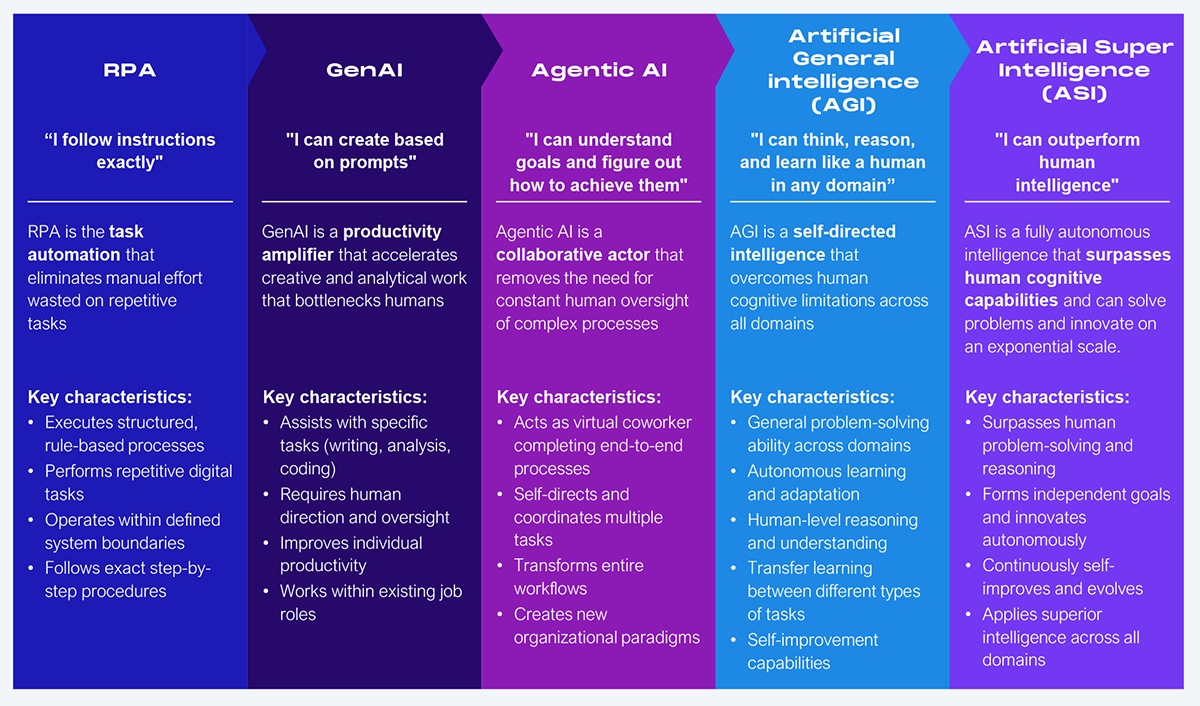
Source: HFS Research, 2026
AGI won’t be easy. At NEARCON, Lukasz called out current AI weaknesses illustrated by examples such as self-driving cars. While LLMs have proven they can out-score humans on benchmarks, we still have Waymos trained on millions of miles of driving that can’t take you across the Bay Bridge to Berkeley if they haven’t been trained on that route. Compare that with a 16-year-old kid trained on 10 hours of lessons who can drive anywhere. Lukasz’s core critique is simply that today’s AI doesn’t generalize from small data.
Generalizing from small data for broader outcomes is important. Today’s models memorize what exists rather than adapt to what’s new. Agents need endless prompts and harnesses to behave. Systems fail when faced with genuinely novel tasks. Lukasz believes that simply scaling layers and tokens will not be enough to scale generalization to the promised land of AGI.
Reasoning models improve things because they shift from “I’ve seen the answer before” to “Here is a strategy to find the answer.” The model searches, retrieves, reads, and extracts, which is much closer to how humans work. But learning from arbitrary data remains unsolved.
What we need, and where much lab work is currently focusing, is parallel reasoning with distributed thought, including learning reasoning from arbitrary data, not just supervised reinforcement tasks; models that generalize from small signals; and models that can operate in domains that don’t exist in their training corpus to date.
When that unlock happens, we will get to AGI, AI that can do real research across domains and where agents can continue to respond and react in genuinely novel environments. Systems won’t need endless guardrails and scripting. Enterprise AI will behave more like a whole bunch of great human employees.
The real shift for enterprises will come when models can generalize across business contexts, adapt to new processes without full retraining, and operate safely in under-specified environments. This ambition is captured in an often-referenced but seldom-published ladder to AGI used as an internal benchmark at OpenAI (see Exhibit 2). Exhibit 2 also shows HFS’s February 2026 estimate on how close we are to AGI level 5. We added the recent arrival of OpenClaw with its end-to-end outcomes, for a hint of the human-helmed agent-delivered workflows now within reach.
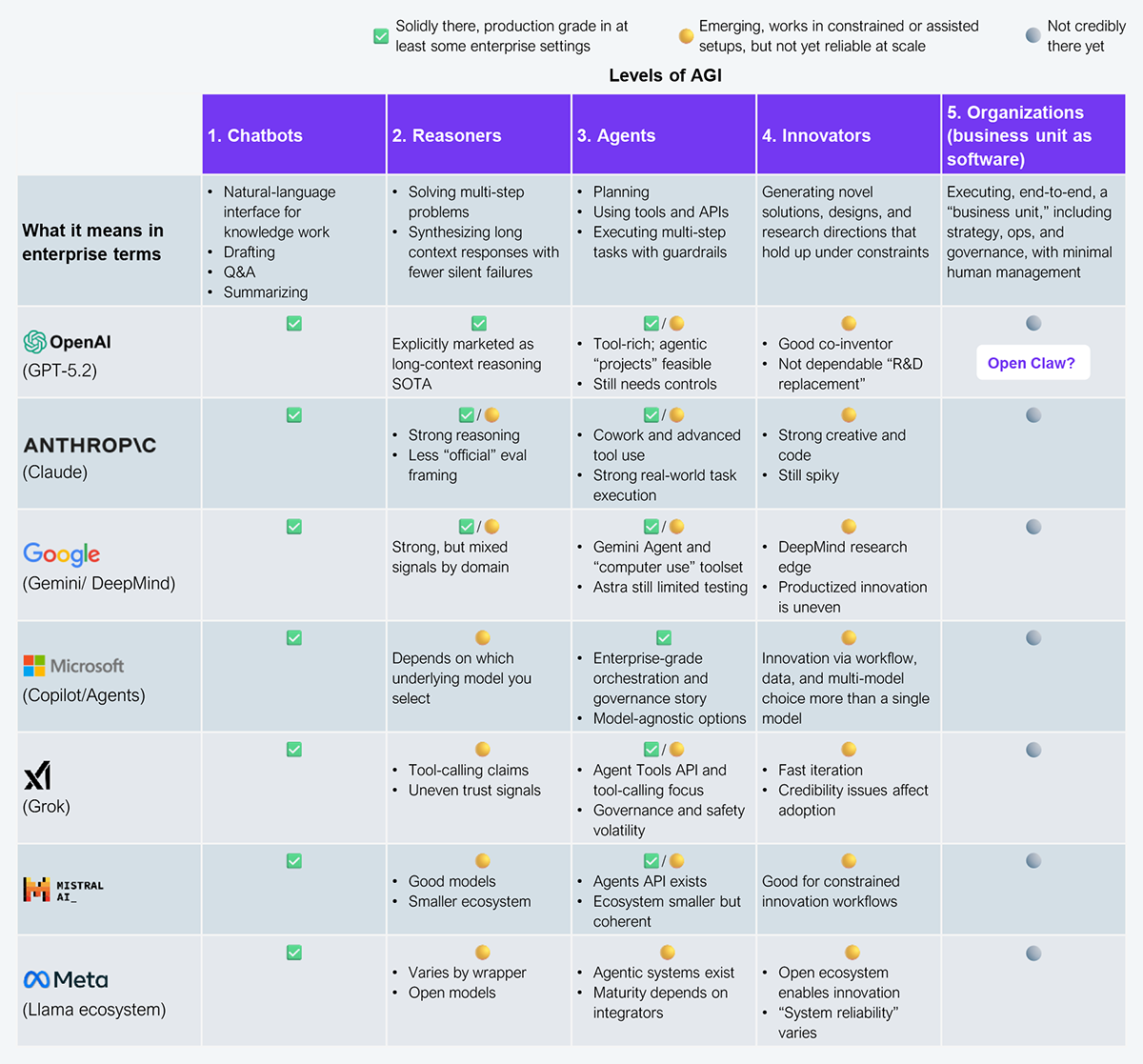
Source: HFS Research, February 2026
Progress matters because “closer to AGI” means
Your eyes need to be wide open at this point in tech and enterprise history. Get a taste of what is quickly heading your way by making one test case business unit legible to machines.
There is a palpable sense today that the AGI paradigm is upon us. It won’t be achieved through incremental scaling and bigger models; it will be via a structural rethink of how AI learns to generalize. It’s happening, and when it lands, we will move from impressive automation to genuinely adaptive intelligence. That will change everything.
Preparing one business unit now will help turn AGI uncertainty into optionality, giving you the control to scale autonomy up and up as AGI emerges. The alternative is to be steamrolled by a pervasive new technology that will be readily available to all your rivals.
HFS Research has already revised down its timeline for the arrival of Services-as-Software, closely aligned with level 5 AGI. We predicted SaS would play out by 2030 two years ago, but last year we updated that to 2028. A year on, and now year-end 2026 is looking realistic.
Register now for immediate access of HFS' research, data and forward looking trends.
Get Started

If you don't have an account, Register here |
Register now for immediate access of HFS' research, data and forward looking trends.
Get Started
