
This HFS Challengers’ Code report is for banking, fintech, and payments technology leaders evaluating whether domain-native engineering partners can deliver faster, more predictable platform modernization than traditional systems integrators.
Banking, fintech, and payments leaders face incredibly complex challenges in transforming and modernizing their platforms to support the hundreds of financial institutions and thousands of customers on them. Regulatory delivery pressure, platform competition, and increasing customer expectations are driving an urgency to modernize, and fast. Systems integrators taking a traditional IT services approach are often unable to bring the speed and resiliency financial firms require for this mission-critical undertaking. Financial services leaders have no choice but to rethink their partnership strategy amid so many competitive pressures. They’re increasingly looking for a domain-native engineering approach to talent, AI-embedded delivery, and outcome-focused programs. Domain-focused providers like Opus Technologies, Inc. (Opus) are emerging to support these needs as alternatives to legacy software development lifecycle (SDLC) services.
HFS sees the industry entering a structural shift from services defined primarily by labor to services enabled by software, engineering assets, and AI-augmented expertise. We call this emerging model Services-as-Software (SAS), where the most effective providers combine deep, domain-native talent with reusable accelerators, automation frameworks, and AI-assisted engineering workflows. Rather than replacing engineers, these capabilities amplify the impact of highly specialized teams that understand the regulatory, operational, and architectural nuances of complex industries like banking and payments. By focusing on domain-led engineering, Opus is using this model to help clients pivot from technical debt to business value.
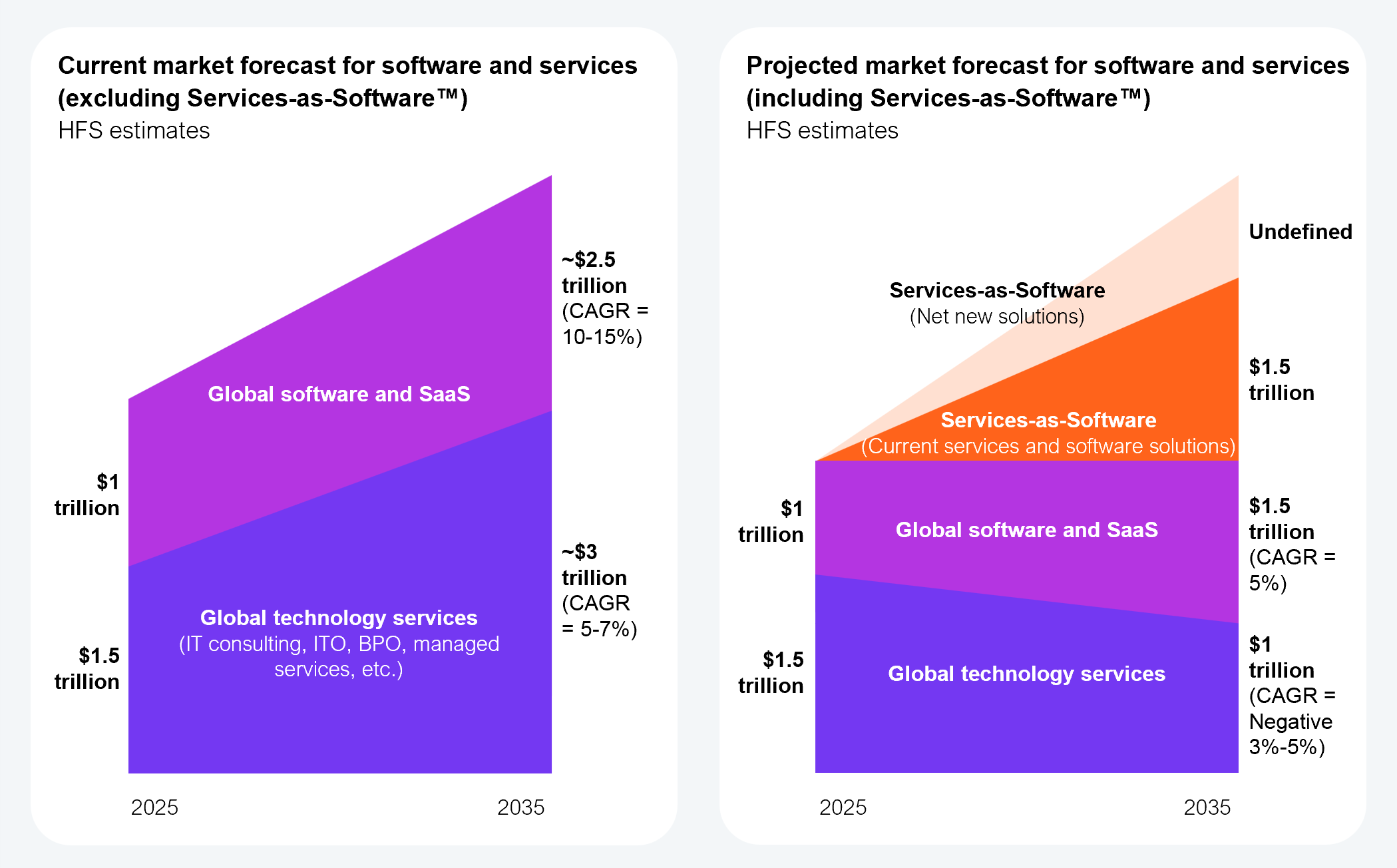
HFS expects the Services-as-Software market to exceed $1.5 trillion by 2035 (see Exhibit 1), as enterprises increasingly favor service providers that embed domain expertise into software assets, automation frameworks, and AI-driven engineering capabilities, rather than relying solely on large pools of developers.
Source: HFS Research, 2026
Regulatory acceleration, platform fragmentation, and AI-driven expectations in banking and payments require delivery models that can operate at the speed of software. Yet many traditional integrators still rely on generalized talent pools and linear program structures originally designed for ERP-era transformations rather than continuously evolving transaction engines.
Client experiences reflect this mismatch. In one engagement highlighted during this research, Opus was selected specifically because larger providers lacked sufficient cloud-native expertise and payments-domain familiarity to modernize a mission-critical payment hub under strict regulatory deadlines. The stakes were significant: missed milestones would have triggered financial penalties and risked eroding customer trust.
Against this backdrop, Opus’ positioning aligns closely with the Services-as-Software paradigm. By focusing exclusively on payments, banking, and fintech, and by investing in domain-native engineering talent, delivery accelerators, and AI-enabled tooling, the firm aims to industrialize parts of the modernization lifecycle that are still largely manual in traditional services models. Rather than scaling programs through larger teams, Opus’ approach centers on domain expertise and reusable engineering assets, enabling faster implementation cycles and more predictable outcomes in one of the most complex segments of financial services technology.
Opus’ leadership frames its ambition around a simple premise: in banking and payments, engineering is no longer a support function. It is the primary lever of business competitiveness. Banks and payment processors have spent years stabilizing aging platforms in “run the business” mode, diverting enormous budgets to maintenance, compliance patches, and operational resilience. The next chapter requires shifting those same platforms into continuous innovation mode without sacrificing regulatory confidence.
Opus’ DNA is deeply rooted in the financial services software products space, where, for its first 15 years of existence, the firm developed card-issuing platforms, payment processing systems, and AML/transaction monitoring platforms. When several of these assets were acquired by large banks in 2018, Opus pivoted its deep expertise to a services model, and now opus.AI is the firm’s framework that brings together tools, methodology, and people to help its clients modernize and expand their platforms.
At its core, Opus is challenging the legacy SDLC market as
Opus’ shift from traditional services delivery to AI-enabled, outcome-driven execution is embodied in opus.AI, which is positioned as a portfolio of context-driven AI solutions to embed intelligence directly into software engineering and business operations. The opus.AI trifecta consists of domain-native engineering talent, a value-creation mindset, and an AI-augmented toolset. Instead of acting as standalone tools, opus.AI focuses on applying AI inside real workflows. This is critical in payments, where enterprises are not lacking access to AI but are struggling with where to start, what to prioritize, and how to scale safely under regulatory pressure.
To address this, opus.AI embeds AI across two core layers: AI-infused SDLC to accelerate engineering productivity and quality, and agentic AI to automate high-volume business processes, such as fraud detection, dispute resolution, and merchant onboarding. The emphasis is on speed to value, with measurable gains in productivity and rapid deployment of agent-enabled processes. The stated business benefits include significant reductions in sprint planning and technical research time, and 30%–40% lower costs.
For Opus, platform modernization is about creating an engineering engine that can absorb constant regulatory change, product experimentation, and ecosystem expansion simultaneously.
The real opportunity in AI for payments lies at the intersection of domain depth and intelligence. With opus.AI, we are addressing this gap, bringing together domain-native engineers and AI capabilities to deliver scalable, high-impact solutions aligned to the needs of modern banking and payments leaders.
— Prakash Devulapalli, Chief Revenue Officer, Opus Technologies
Client experience supports the challenger narrative. A global payments software provider selected Opus over larger incumbents to modernize regulatory delivery, achieving zero critical production incidents while compressing mandate rollouts into two-to-three-week cycles. Elsewhere, Opus has helped payment networks and acquiring platforms migrate most workloads to the cloud, reduce merchant onboarding time by more than half, and expose hundreds of APIs to enable ecosystem expansion.
For enterprise leaders wrestling with transformation under regulatory pressure, the Opus story offers a clear alternative: domain-native engineering teams, AI embedded across the software lifecycle, and fixed-outcome programs designed for environments where failure is not an option.
Opus has unique differentiated tool sets in the modernization space that apply directly to our business.
As a 50-year-old company, we’re battling with the legacy code as well as the need to support the next generation of our modernization journey. This puts pressure on our partners on both ends of the spectrum. We chose Opus as the optimal partner for the modernization of a legacy product.
It’s been a positive fit. What I enjoy most is the flexibility that has allowed us to adapt and refine as we go along. Opus is very flexible in meeting our needs.
— Head of Acquiring/Issuing Development/ Architecture, global payments technology firm
More than half of Opus’ engineers are domain-native, reflecting the company’s deliberate investment in deep domain expertise in payments and banking. New hires undergo domain-first onboarding that includes a structured learning and certification program and extensive training in the payments and banking ecosystem, ensuring engineers understand not only the technology stack but also the regulatory, operational, and network dynamics that shape the industry. Opus combines experienced domain specialists with early-career talent to build a pipeline of engineers capable of supporting complex modernization programs.
Talent development is a core differentiator for the firm. Headcount has doubled over the past two years as demand for specialized domain-native engineering talent grows. Opus has also placed strong emphasis on culture and inclusion, earning accolades such as the “Great Place to Work” certification and ranking among the “Top 100 Workplaces for Women in India.” Through initiatives such as OneOpus, the company promotes diversity across hiring, mentorship, and leadership development, with a particular focus on identifying and advancing women leaders within the organization. Regular hackathons keep employees focused on competitive innovation and further upskilling their expertise.
It is particularly meaningful to see our people recognize this as a place where they can truly thrive.
What stands out are the consistent, everyday experiences they highlight, grounded in trust, mutual respect, and a strong sense of camaraderie. These are not aspirational values but lived realities across the organization.
Being ranked among the top IT organizations in the country is a reflection of this culture in action. It reinforces that our people value not just the environment we’ve built but also the opportunities to learn, grow, and create meaningful impact for our clients.
— Babitha P, Chief People Officer, Opus Technologies
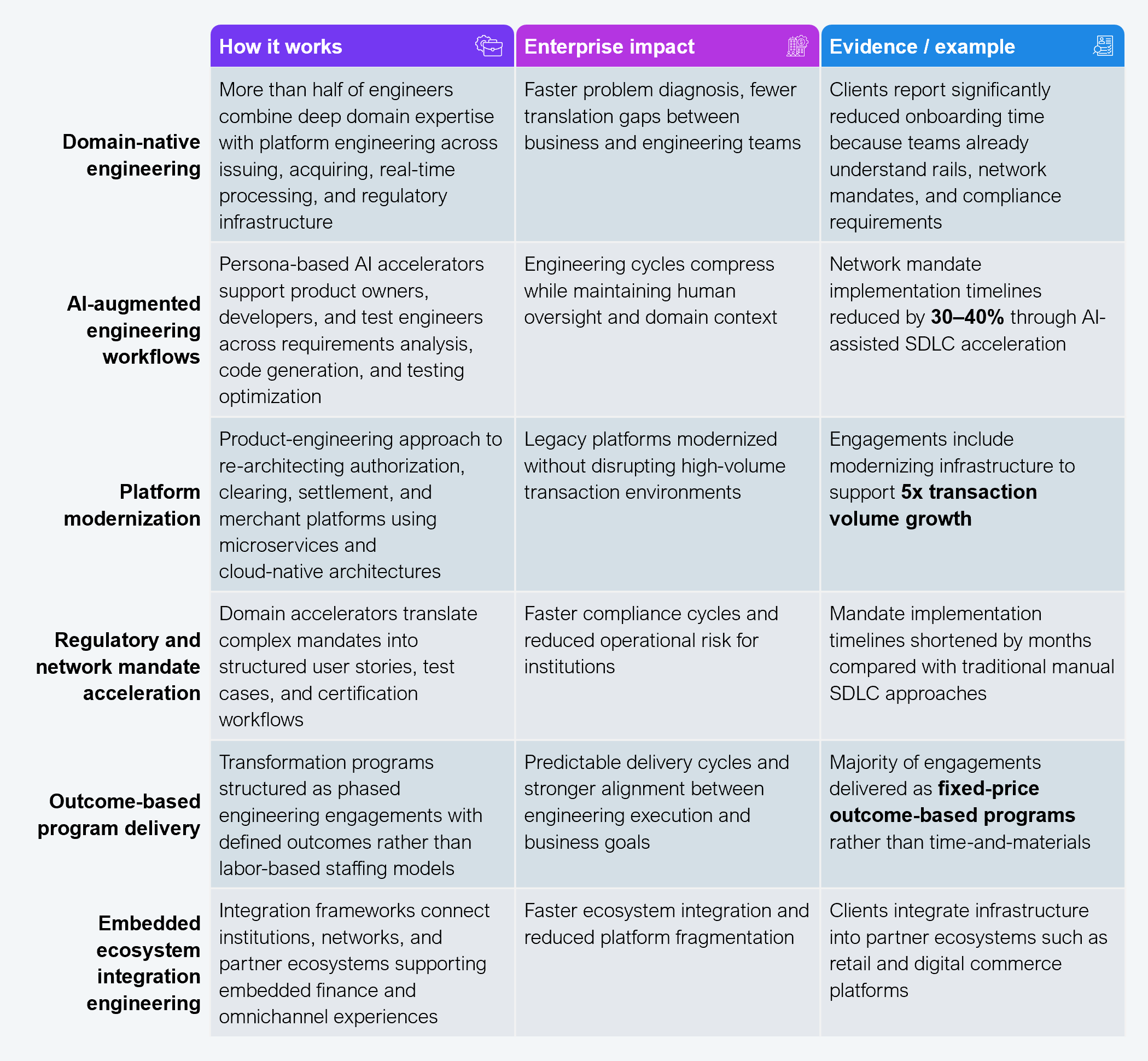
Opus relationships are showing evidence that the engineering playbook is fundamentally changing by combining deep domain expertise and AI-augmented workflows, and modern platform architectures. The impacts on clients include significant time savings and support for tremendous growth (Exhibit 2)
From a GTM perspective, what differentiates Opus is what we call the Opus Trifecta—the intersection of a value creation mindset, domain-native engineering talent, and an AI-augmented toolset.
Our engineers code with context. They bring not only deep technology expertise but also a strong understanding of the domains they serve, from banking to payments, combined with a clear view of the client and industry landscape. This expertise is amplified through our AI-augmented accelerators, powered by opus.AI, enabling teams to deliver outcomes with greater speed, precision, and scale.
The result is a fundamentally unique model where engineering excellence, domain insight, and AI work together to create measurable business impact for our clients.
— Nischala Murthy Kaushik, CMO, Opus Technologies
Source: HFS Research, 2026
Summary
A global payment connectivity platform provider operating across 30+ payment methods faced performance limitations, technical debt, and long release cycles that slowed compliance updates and product innovation. Opus re-architected the platform using APIs and microservices, enabling faster production releases, zero-disruption merchant migration, and scalable infrastructure to support multi-region expansion.
Why this matters
Modern payment connectivity platforms must evolve continuously to support new payment rails, compliance mandates, and merchant integrations. This case highlights how software-driven architectures and automated engineering pipelines allow mission-critical transaction infrastructure to modernize without disrupting production operations.
Summary
A global acquiring provider struggled with fragmented systems inherited through acquisitions, leading to inconsistent merchant experiences, slow onboarding, and limited ability to launch new products. Opus helped design and build a unified omni-commerce acquiring platform with self-service onboarding, developer APIs, and integrated fraud, settlement, and reporting capabilities, reducing merchant onboarding time by 60%.
Why this matters
Acquiring platforms are rapidly becoming ecosystem platforms, requiring faster onboarding, developer-friendly APIs, and seamless partner integration. This case demonstrates how platform engineering and reusable software assets can transform fragmented acquiring infrastructure into scalable digital payment ecosystems.
Summary
A major US payment network was experiencing recurring system outages and operational disruptions caused by its legacy payment switch. Opus took end-to-end ownership of the switch transformation, delivering a cloud-native, microservices-based, API-driven architecture that enabled rapid service deployment while reducing operational costs.
Why this matters
Payment platforms must keep pace with growing transaction volumes and evolving market demands. This case demonstrates how modernizing the payments switch improves scalability, enables real-time processing, and accelerates integration with new payment networks and services—capabilities that legacy switch infrastructures often struggle to support.
Enterprises eager to embrace greater speed, efficiency, and compliance by eschewing legacy labor-heavy models and embracing AI-first, domain-focused services must also pivot to a new way of working. Our advice to banking and payments leaders who are ready to make the shift includes:
Banking and payments leaders can no longer rely on traditional services delivery models to modernize transaction infrastructure. Regulatory mandates, embedded finance ecosystems, and escalating transaction volumes are forcing platforms to evolve continuously. In this environment, scaling transformation programs simply by adding more engineers is no longer sufficient.
Enterprises must instead embrace the emerging Services-as-Software model, where deep domain-native engineering expertise is combined with reusable software assets, accelerators, and AI-assisted engineering workflows as we’ve seen with Opus’ capabilities. This approach enables faster delivery cycles, more predictable outcomes, and the ability to adapt platforms without disrupting live transaction environments. Firms that fail to shift away from traditional labor-based services models risk falling behind as banking and financial services ecosystems grow more complex and time sensitive.
Register now for immediate access of HFS' research, data and forward looking trends.
Get StartedIf you don't have an account, Register here |
With the exception of our Horizons reports, most of our research is available for free on our website. Sign up for a free account and start realizing the power of insights now.
Our premium subscription gives enterprise clients access to our complete library of proprietary research, direct access to our industry analysts, and other benefits.
Contact us at [email protected] for more information on premium access.


