Enterprise banking leaders are under pressure to demonstrate tangible progress in AI, digital operations, and customer experience. Yet transformation economics and operating realities are pushing most institutions toward selective modernization rather than structural reinvention. That creates a complex maze of legacy cores and modern digital layers that increase integration load, even though it delivers real incremental gains.
Banks are investing heavily, but the question is whether they are reducing complexity over time or simply moving it around.
Across major transformation programs across the banking, financial services, and insurance industry (BFSI), the cost structure tells a clear story. Services and integration work consume most of the transformation budgets. In a recent HFS study of 69 BFSI decision makers, 43% reported that more than 70% of project spend goes to services rather than software over a typical three-year transformation cycle. Only 23% reported software-led programs in which licenses accounted for the dominant share. Most organizations indicated that for every dollar invested in software licenses, they spend between three and six dollars on related services such as implementation and integration (see Exhibit 1).
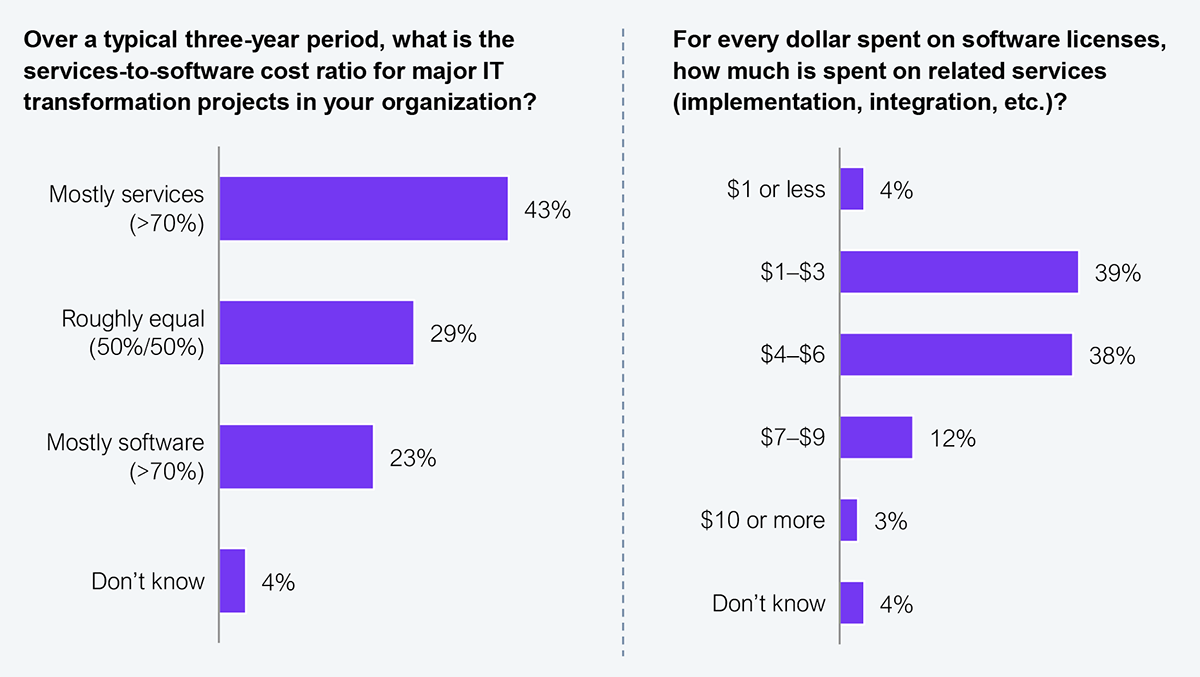
Sample: 69 BFSI decision makers
Source: HFS Research, 2026
Modernization is rarely a clean re-platforming exercise. It is a multi-year integration effort across core banking systems, payment engines, risk platforms, customer relationship management (CRM) environments, and regulatory reporting tools. The heavier the integration burden, the stronger the pull toward incremental modernization. This spending pattern reflects the structural reality of banking IT estates and does not automatically signal inefficiency. In regulated, risk-sensitive environments, integration-heavy transformation is often rational. However, it does shape the trajectory of modernization. When most capital flows into services and integration, the dominant mode of change becomes extension, wrapping, and rationalization, or selective digitization of specific functions. This creates modernization loops that do not meaningfully reduce underlying complexity. Most banks target high-impact domains such as payments, onboarding, and compliance for digital uplift while preserving existing cores that continue to run high-volume transaction processing.
This is not simply conservatism. It reflects accumulated operational complexity and low institutional risk tolerance. Core banking systems underpin liquidity, capital management, and regulatory reporting. Replacing them outright carries material business and regulatory exposure. As a result, banks tend to layer new capabilities on top of stable foundations rather than disrupt the foundation itself.
The current wave of AI investment is not replacing modernization programs. It is amplifying their underlying dependencies. Data quality issues, outdated legacy infrastructure, workforce readiness gaps, and regulatory compliance hurdles are top barriers to core modernization while also complicating AI deployment and automation.
AI initiatives frequently prioritize data modernization, infrastructure upgrades, and process redesign as precursors to model deployment. Strengthening data governance, upgrading platforms, and modernizing infrastructure are prerequisites for scaling AI responsibly in a regulated environment.
This dynamic reinforces the services-heavy cost structure observed in Exhibit 1. AI programs often require deep integration with legacy cores, risk systems, and reporting engines, which increases services spend and further embeds incremental modernization patterns. This creates long-term architectural complexity, especially as core simplification does not keep pace.
BFSI leaders should clearly see this reality. Services-heavy transformation programs need rigorous architecture governance to prevent complexity from compounding. Selective digitization strategies must include explicit plans and funding for core simplification over time. AI initiatives should be sequenced with data and process redesign, with clear accountability for outcomes and dependencies. The strategic risk is that integration-first modernization can deepen legacy dependency when retirement and simplification are not built into the roadmap.
BFSI CIOs should make complexity reduction a first-class transformation outcome. Tie every AI and digital investment to a funded simplification plan for the core and the data estate, with clear retirement decisions, timelines, and owners. Build data architecture coherence into the AI roadmap. Without sustained simplification, integration-heavy change will keep compounding cost and complexity while eroding long-term agility. The next phase of transformation will depend less on headline AI investments and more on disciplined management of the foundations beneath them.
Register now for immediate access of HFS' research, data and forward looking trends.
Get StartedIf you don't have an account, Register here |
Register now for immediate access of HFS' research, data and forward looking trends.
Get Started