
The emergence of renewable energy and a much greater awareness of fossil fuels’ negative environmental effect have combined to give enterprises a strong social impact and competitive advantage to communicate their use of renewable energy sources. However being able to validate true environmental impact has been a major challenge… until now, with advances in the development of blockchain.
In fact, a Nielson survey found that 55% of consumers are willing to pay extra to purchase from enterprise committed to positive social and environmental impacts. Enterprises make green claims by purchasing renewable energy certificates (RECs), which represent 1MWh of energy generated on their behalf. The problem is that each renewable energy source has a different environmental impact, which isn’t considered when valuing RECs. Enterprises can purchase certificates with high negative environmental impacts (hydropower, for example) and still claim to be as green as a competitor that genuinely aids the production of renewable energies by purchasing certificates with a positive environmental impact. When blockchain’s traceability is in the REC market, consumers will be able to trace enterprises’ renewables to their source, and anybody found making false green claims for marketing purposes will be exposed.
If your enterprise wants to advertise itself as truly renewable, act early and start purchasing RECs with positive environmental impacts because the future is blockchain and it’s transparent.
Industries are already experiencing the impact of blockchain’s traceability, and renewable energy certificates are next
Every transaction on blockchain is stored in its own hashed block that contains the hash of the previous block, creating a blockchain. This means if a party edits a block, the hash will be recalculated and the blockchain will break, making it virtually impossible to tamper with the information; thus, we can reliably trace data stored on the blockchain back to its origins.
Exhibit 1: Tracking and traceability are on the near-term horizon for enterprises 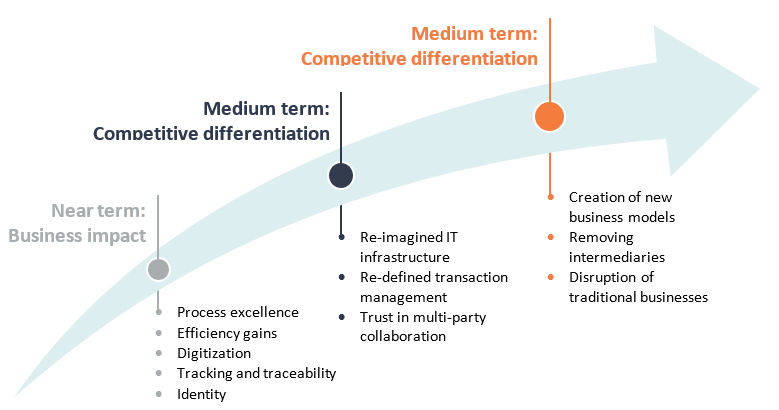
Source: HFS Research Top 10 Enterprise Blockchain Services, 2018
Exhibit 1 shows that traceability is on the near-term horizon for enterprises. In fact, Walmart and IBM have produced a food safety blockchain solution that enabled them to reduce the time required to trace the source of food from 7 days to 2.2 seconds. With the sheer number of enterprises committed to going green, including the likes of Google and Apple, the successful application of renewable energy certification using blockchain could have far-reaching effects for the environment.
The National Renewable Energy Laboratory says RECs can sell for less than $1 each—the low cost means they can have little impact on the environment; blockchain could see their value align with environmental payoffs and false “green” marketeers exposed.
The transparency blockchain offers the opportunity for enterprises to trace RECs through every stage of their production. For example, a provider could consider the complete cost of hydroelectricity, from the wildlife moved to clear space for the dam to the cost of the water, when valuing the certificate. The result would be a more diverse REC marketplace with varying prices, differentiating between enterprises that genuinely want to encourage the production of green energy and those using it as little more than a marketing gimmick. This solution would still struggle to prevent those with deep pockets from using RECs as a marketing tool.
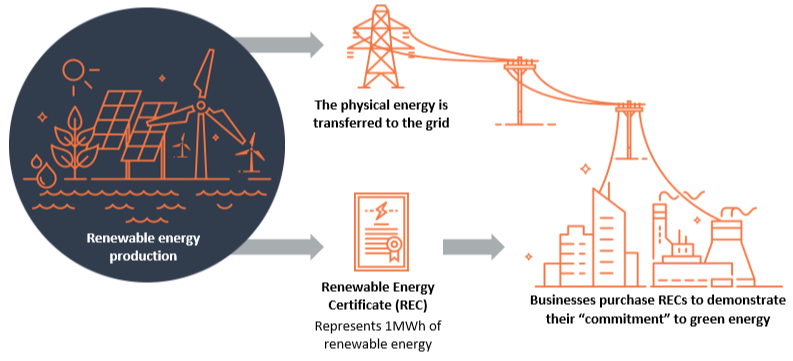
A problem often identified with enterprises claiming to be green is that when purchasing RECs there is no guarantee they helped produce renewable energy in any way. Exhibit 2 demonstrates the lifecycle of the certificates, showing they have no relationship with the associated energy and are sold by producers for nothing more than financial gain.
Exhibit 2: The lifecycle of a renewable energy certificate
Blockchain’s traceability may lead to increasing the popularity of forward RECs, which come from an agreement with a producer to purchase all their certificates over a period. These often hold a higher value because they helped to produce renewable energies, as they allow small producers to invest in infrastructure. As blockchain exposes futile RECs, the demand for forward RECs is likely to increase, meaning the later you are to adapt, the more expensive it will become.
The rising costs associated with transparency in renewable energy certificates means it may be beneficial for your enterprise to begin producing its own energy
Assuming certificates representing better renewable energies increase in price, it may become cost-effective for your enterprise to research alternative methods of acquiring them. Despite the initial cost of infrastructure investment, producing renewable energies in-house may be the best method of obtaining RECs and maintaining your ‘green enterprise’ status. Not only would it eliminate the need to purchase both energy and certificates, but it also presents the opportunity to sell the excess to maximize enterprise revenues. Increasing the amount of renewable energy being produced is likely to have only positive effects on the environment, reducing the world’s dependency on fossil fuels and drastically reducing our carbon footprint—all because of blockchain’s transparency. For your enterprise, producing your own renewable energy can be used to drive your marketing campaign and differentiate you from competitors who are merely purchasing certificates.
The Bottom Line: If you plan to continue marketing yourself as a “green enterprise,” buying any old REC won’t be enough once blockchain has a grip on the market. Get ahead of the game and adopt renewable energies now.
Currently, producers flooding the market with cheap certificates for a one-time financial gain have little to no environmental benefits, and the introduction of blockchain in the marketplace is about to prove it. Your enterprise can continue to use RECs to push its marketing campaign, but it must do so while either investing in renewable energy projects or generating its own renewable energy.
If your enterprise adapts now, it could also benefit from cost savings by being one of the earliest adopters. Basic economics dictates that as demand for high-quality RECs increases, the price will increase, increasing the cost for enterprises. Anybody who signs a long-term renewable energy contract soon can market themselves as a green enterprise at a fraction of the cost to latecomers.
Register now for immediate access of HFS' research, data and forward looking trends.
Get StartedIf you don't have an account, Register here |
With the exception of our Horizons reports, most of our research is available for free on our website. Sign up for a free account and start realizing the power of insights now.
Our premium subscription gives enterprise clients access to our complete library of proprietary research, direct access to our industry analysts, and other benefits.
Contact us at [email protected] for more information on premium access.

