This Market Impact Report is for CIOs, CTOs, and enterprise transformation leaders seeking a practical blueprint to move GenAI initiatives from endless pilots to scaled, measurable business impact.
As a CIO, CTO, or enterprise transformation leader tasked with scaling GenAI across your organization, you’re facing a defining moment. The traditional playbook for technology adoption that served you well in the past—allowing for careful, multiyear deployment cycles—has been fundamentally disrupted. GenAI’s immediate impact on productivity has compressed what was once a years-long transformation journey into a matter of months.
Despite this urgency, many organizations find themselves trapped in what we call “pilot purgatory”—an endless cycle of experiments that never reach enterprise-wide implementation. When these pilots fail to demonstrate clear business value, they become more than just wasted investments. They represent a growing threat to your organization’s competitive position as the gap continues to widen between companies successfully scaling GenAI and those remaining stuck in experimental phases.
To help you navigate this challenge, HFS partnered with Coforge to study seven enterprise leaders who have successfully scaled GenAI across their operations. These leaders, all from organizations with annual revenues exceeding $2 billion across healthcare, financial services, manufacturing, and retail, have each achieved measurable impact by deploying GenAI across multiple business functions.
This report offers a blueprint for moving from pilot purgatory to successful AI leader by focusing on three critical elements:


For organizations ready to move from experimentation to transformation, this blueprint offers practical strategies from those who’ve successfully made the journey. With GenAI capabilities advancing rapidly, the cost of remaining in pilot purgatory grows exponentially each month. Fortunately, addressing these three crucial factors can help your enterprise deploy, manage, and measure the many benefits GenAI can deliver.
As GenAI catapults from experimental curiosity to operational necessity, even the most successful enterprises are grappling with false starts and stalled initiatives.
“We tried, and we tried,” shared one AI executive from a major financial institution, recalling an ambitious attempt to automate model documentation that cost $49,000 in just six weeks before being shuttered. “Sometimes, you have to fail fast and move on.” This sentiment echoes across nearly all our conversations with enterprise leaders who have now successfully scaled GenAI—their victories were often built on the foundation of initial setbacks.
Through these conversations, we developed an understanding of seven innovation killers that kept them—and continue to keep others—trapped in pilot purgatory.
In the race to demonstrate GenAI capabilities, organizations frequently fall into the trap of prioritizing flashy, attention-grabbing proofs of concepts to win executive buy-in, only to realize later that these demos rarely translate into scalable, real-world applications.
A vice president of AI at a major global bank observed: “It’s quite easy to get something appealing going to catch executive attention. But when you get into scaling, you realize many use cases aren’t even represented in your POC.”
Organizations invest heavily in proofs-of-concepts that look impressive in controlled environments but fail to address real-world complexities. The result is a growing portfolio of promising demos that never transition to production, consuming resources while delivering minimal business value.
Organizations consistently underestimate the massive gulf between POC and production infrastructure requirements.
A vice president of AI/ML engineering at a leading healthcare organization shared: “Teams don’t understand the magnitude of scaling costs upfront. When confronted with capacity constraints and latency requirements in production, you suddenly need dedicated infrastructure costing hundreds of thousands of dollars.”
This infrastructure gap manifests in unexpected computational costs, performance bottlenecks, and integration challenges with existing systems. Organizations often discover too late that their current infrastructure cannot support GenAI at scale, leading to significant delays and cost overruns.
Many leaders found themselves ignoring their data readiness.
The head of AI and analytics at a major financial institution explained: “Everyone assumes their data is ready until they actually try to use it. Data is difficult to find, understand, and use. When you have data scattered across mainframes, data marts, lakes, and cloud environments, establishing proper governance becomes a massive challenge.”
This fragmentation creates multiple obstacles: inconsistent data quality, unclear ownership, privacy concerns, and regulatory compliance issues. Organizations cannot progress beyond pilots because they lack the foundational data infrastructure necessary for enterprise-scale AI deployment.
Risk-averse cultures, particularly in regulated industries, stifle innovation by placing excessive hurdles in the path of promising GenAI initiatives.
The head of data analytics and AI at a major airline group noted: “One main aspect of risk aversion has to do with fear—fear of not being perfect, fear of not having a perfect solution, fear of failing. These fears often have less to do with the technological solution and more with how technologies are implemented in an organization, particularly in risk-averse environments.”
This creates a Catch-22 situation where organizations must innovate to remain competitive but face significant regulatory and compliance barriers. The result is a slow, cautious approach that often prevents promising pilots from reaching production scale.
Innovation teams grow disillusioned as slow adoption cycles and bureaucratic hurdles prevent progress, leading top talent to leave for more agile competitors.
The impact extends beyond losing technical skills. It creates a vicious cycle that impedes AI adoption. A VP of AI at a major bank said: “While we debate processes and policies, our competitors are building momentum and attracting top talent. Our best people leave for organizations where they can actually implement their ideas.”
As organizations lose their most innovative talent to more agile competitors, they become even less capable of scaling their AI initiatives effectively.
Companies fail to consider scaling requirements early enough in the process.
The global head of AI at a pharmaceutical company explained: “Organizations get caught up in proving technical feasibility without considering what it takes to scale. They don’t think through data volumes, processing requirements, and integration needs until it’s
too late.”
Far too often, being enamored with the ‘new shiny tech’ leads to one-off gains. This myopic focus on technical proofs-of-concept leads to pilots that work in isolation but fail when attempting to integrate with enterprise systems and processes. Those responsible for their organization’s AI strategy must think through the complexity of their data, information processing requirements, and systems integration needs.
Without clear, business-focused metrics, organizations struggle to justify the ROI of GenAI projects. This leads to excitement without the executive buy-in needed for scaling.
A VP of Digital at a building products company shared: “You need to translate technical metrics into clear business outcomes from day one. Otherwise, you just get excitement without actual buy-in for scaling.”
Without clear alignment to long-term business objectives, early successes can create a false sense of progress, leading to decisions that fail to support sustainable scaling. As the VP highlighted, translating technical wins into measurable business outcomes is essential to securing the executive buy-in needed to move beyond isolated excitement and achieve meaningful impact.
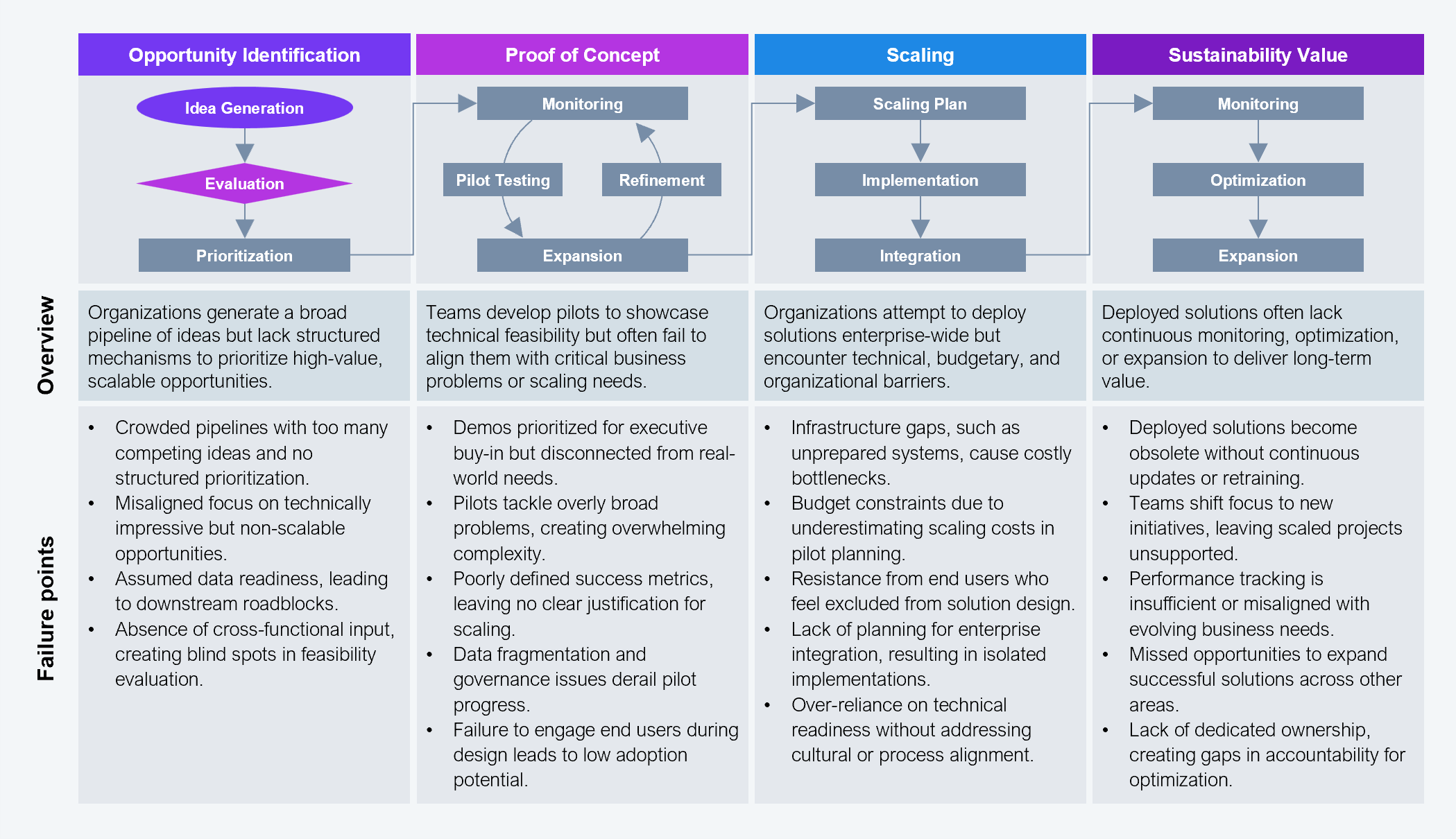
While “pilot purgatory” suggests that challenges stem solely from the pilot stage, the reality is more complex. Pilot purgatory is a systemic problem emerging from missteps and gaps across every stage of the innovation lifecycle, not just during the pilot itself (see Exhibit 1).
Source: HFS Research, 2025
To escape pilot purgatory, organizations must adopt a holistic approach that reimagines how they approach every stage of the lifecycle. This blueprint integrates lessons learned from seven AI innovation killers and proposes how a leader can navigate the four critical stages of AI-enabled innovation.
Innovation pipelines face two critical challenges: generating meaningful opportunities and effectively filtering them. Leaders emphasized that success isn’t about the volume of ideas but the quality of opportunities that align with strategic goals and have the potential to scale. One technology leader observed: “The real challenge isn’t finding use cases—it’s finding the right ones that can scale.”
Generating meaningful opportunities
Organizations must establish structured ideation processes beyond uncoordinated brainstorming to overcome these challenges. Leaders highlighted two proven approaches that help generate impactful, actionable ideas:
From noise to signal through a structured evaluation
Innovation pipelines become cluttered with ideas lacking enterprise-wide potential. But what sets successful organizations apart? They deploy structured frameworks to rigorously assess ideas and ensure alignment with enterprise priorities. For instance, a major financial institution implemented the “4D” framework—evaluating Differentiation, Data Readiness, Deployability, and Dollar Impact—to focus resources on projects with clear, measurable value.
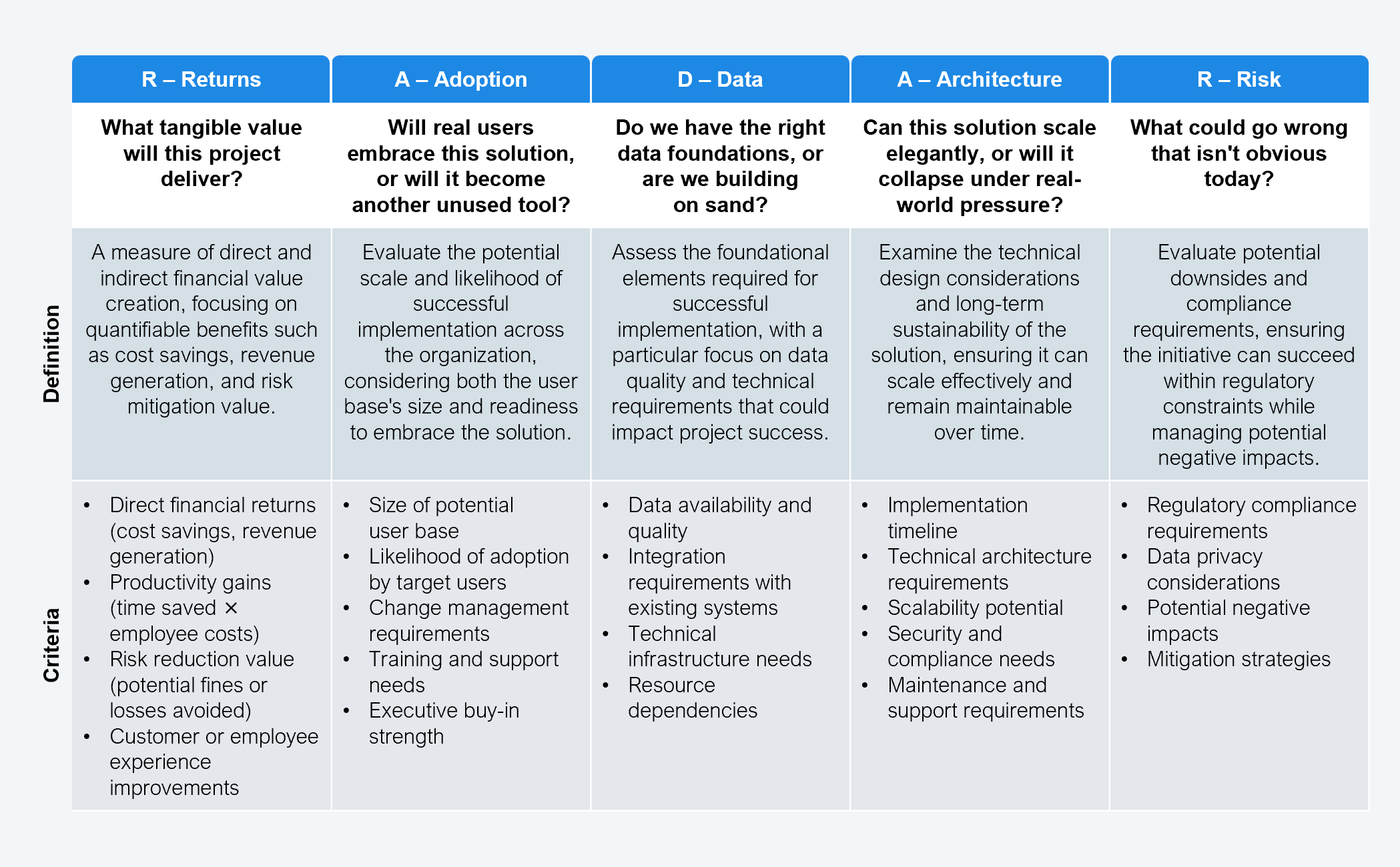
Building on these insights, the RADAR Framework was developed, introducing five critical dimensions for evaluating GenAI initiatives: Returns, Adoption, Data, Architecture, and Risk (see Exhibit 2).
Source: HFS Research, 2025
Key actions to move past this stage:
Key Advice: “A good opportunity isn’t just a great idea—it’s a scalable one.”
Projects stall in the pilot stage—not because organizations pilot too long, but because they fail to align pilots with broader business goals, prepare data adequately, or plan for scaling. Leaders consistently emphasized that successful pilots are not solely about proving technical feasibility but also about demonstrating measurable business value and scalability.
One leader from a global financial institution shared how their technically sound pilots failed to connect with critical business needs, leaving no justification for scaling: “We had results that were technically solid, but they didn’t connect to critical business needs, so they had no justification for scaling.” Another common pitfall is overambitious scoping. A global airline executive reflected: “We tried piloting predictive maintenance across all production lines at once. The complexity was overwhelming. Narrowing it down to one line helped us move forward.”
Key actions to move past this stage:
Key Advice: “A good prototype reveals what doesn’t work as much as what does. That’s where the value lies.”
Scaling GenAI solutions is one of the most challenging phases of the innovation lifecycle, introducing technical and organizational complexities. Leaders consistently emphasize that scaling is not just a technological exercise—it requires aligning people, processes, and infrastructure to ensure seamless deployment and sustained impact.
Infrastructure gaps, cultural resistance, and misaligning goals often derail scaling efforts. A healthcare executive shared their struggle: “Our clinicians saw the GenAI assistant as more of a burden than a benefit. They weren’t convinced it would actually save them time.” Technical readiness is another frequent challenge. A retail leader explained: “We didn’t test how the system would perform at scale. It slowed to a crawl when we rolled it out to multiple regions.”
Key actions to move past this stage:
Key Advice: “Scaling chaos happens when you treat it as a deployment exercise instead of a transformation effort. It’s about more than tech—it’s about alignment.”
Many leaders admit that sustaining value is one of the most challenging parts of the lifecycle. Solutions that work well in the pilot phase often become obsolete without continuous improvement. A financial services executive shared: “Our fraud detection model was great for six months, but as fraud patterns evolved, it couldn’t keep up. We didn’t have a plan for ongoing updates.” Others echoed this sentiment, noting their initial successes often create a false sense of completion, leaving solutions to stagnate.
Another common issue is losing focus after initial success. A manufacturing leader explained: “We proved the ROI early, but the team moved on to other projects. No one was left to optimize or expand the solution.”
Key actions to move past this stage:
Key Advice: “The lifecycle doesn’t end with implementation. It’s a living process that requires constant attention and iteration.”
The AI landscape is evolving rapidly, and organizations stuck in pilot purgatory risk falling permanently behind. While GenAI offers transformative potential, the gap between leaders and laggards grows with each passing quarter. Leaders who’ve successfully scaled their GenAI initiatives are not only delivering measurable results but building the capabilities to thrive in the next wave of AI innovation.
The stakes are high. One banking executive reports $56 million in savings within eight months by scaling GenAI, creating operational efficiencies and future-proofing their business. Conversely, organizations that fail to move beyond pilots are losing more than potential value—they’re eroding competitiveness, momentum, and employee trust. “Every month spent on pilots that go nowhere is a month further behind our competitors,” warned a healthcare executive.
Leaders emphasize that breaking free from pilot purgatory requires decisive action. First, organizations must ruthlessly prioritize scalable opportunities. Frameworks such as RADAR, which evaluate dimensions such as risk and adoption potential, help focus resources on initiatives with enterprise-wide impact. Second, scaling demands investment in robust infrastructure. Those who stress-tested systems during pilots ensured smoother rollouts and avoided costly retrofits. Finally, risk-averse cultures must evolve into engines of managed innovation, where failures are reframed as learning opportunities.
The technology is ready, and the lessons from leaders have charted the path. Now is the time to act. One executive summarized the issue: “The organizations that move decisively today will be the ones defining the future tomorrow.”
Register now for immediate access of HFS' research, data and forward looking trends.
Get StartedIf you don't have an account, Register here |
With the exception of our Horizons reports, most of our research is available for free on our website. Sign up for a free account and start realizing the power of insights now.
Our premium subscription gives enterprise clients access to our complete library of proprietary research, direct access to our industry analysts, and other benefits.
Contact us at [email protected] for more information on premium access.