This Market Impact Report is for non-bank mortgage lenders, IT and operations leaders, and ecosystem partners evaluating how to accelerate growth and transformation through AI, automation, and full-service strategic partnerships.
The mortgage industry’s response to disruption has been predictable—throw people at the problem. During the pandemic-era origination boom, lenders scaled with headcount. When volumes dropped, they cut back. Origination saw some automation gains, but little real transformation. Servicing, meanwhile, remains stuck in a low-margin, manual grind.
Now, as the US mortgage market heads into 2026, a slow but steady recovery is underway—buoyed by easing mortgage rates, marginal affordability gains, and a modest uptick in housing activity. But the affordability crisis is far from solved. Homeownership costs remain well above pre-pandemic levels, locking out large swaths of aspiring buyers. Meanwhile, tariff pressures are also reshaping the landscape, raising construction costs and contributing to volatile interest rates, collateral damage from supply chain reshuffling, making it harder for borrowers to qualify and lenders to close. The market is under pressure, but it’s also recalibrating. M&As continue to redraw the competitive map, as lenders chase scale and operational efficiency. Larger players are absorbing specialized firms to unlock tech synergies and scale. At the same time, agentic AI and advanced automation are no longer fringe; they’re quickly becoming core to how lenders process loans, manage risk, and drive agility. 2025 signals a much-needed reset. The playbook of the past—cutting costs then heads—won’t work anymore. Sustainable growth now demands innovation-led execution.
Against a backdrop of market volatility, affordability pressures, and an industry reset, HFS Research, in partnership with Cognizant, set out to explore how non-bank lenders are evolving in the age of AI, as they carve out a unique and expanding role in the mortgage industry. These lenders are battling to maintain margins, reduce costs, and tap into unconventional funding sources while driving growth, productivity, and differentiation through AI and automation-led innovation.
We surveyed 257 non-bank lenders and ecosystem partners across North America, framing the insights through the lens of Why, What, and How to uncover their evolving strategies and priorities.
The sample intentionally included a mix of IT and business leaders across origination, servicing, and ecosystem partners. To complement the survey, we conducted in-depth interviews with non-bank leaders, road-testing our analysis and augmenting our findings with real-world industry insights.

WHY: Growth is back, but only for those willing to transform

WHAT: AI and automation will lead the charge in technology that is driving the most impact

HOW: Strategic partnerships are critical to scaling transformation
The mortgage industry is weathering a perfect storm of rising rates, market volatility, and mounting regulatory pressure, with non-bank lenders feeling the heat more than most. Mortgage rates are expected to hover around 6%–7% for a standard 30-year fixed loan in 2025, as the Fed holds steady on rate cuts amid persistent inflation concerns. Every move from the Fed will be a market signal, with potential to swing affordability and demand in either direction. Moreover, without the cushion of deposits or access to central bank lifelines, non-bank lenders are leaning on warehouse lines, securitizations, and other volatile funding sources. Liquidity risk is high. Their narrower scope across the banking value chain limits access to rich customer data, and their borrower base skews higher-risk, lower-income, adding another layer of complexity. Yes, they’ve built in some shock absorbers—mortgage-servicing rights offer stable cash flows, and diverse funding levers such as retail notes and lines of credit provide substitutability in financing models. But is that enough to absorb shocks from economic fluctuations and mortgage rate volatility while still enabling growth?
The numbers don’t lie. HFS analyzed the financial performance of the only eight publicly traded US non-bank lenders from FY2020 to FY2024. The data tells a wild story: loan originations shot up 89% in 2020, crashed to -49% in 2022, and clawed back to 43% by 2024. Unpaid principal balances spiked 30% in 2021 and then cooled to single-digit growth in FY2022. Revenues fell off a cliff at -30% in 2022, only to rebound 35% by 2024. Net income experienced dramatic volatility, surging by 61% before plunging to -117% in FY2023, recovering by 32% in FY2024.
These trends underscore the brutal cyclicality of the non-bank lending business. So, the real question is—what will it take to thrive, not just survive? Cost-cutting alone won’t cut it, especially with loan origination costs hitting $11,600 (Fannie Mae, Q3 2023). It’s time to ditch the band-aid and for non-bank lenders to shift gears, moving beyond incremental cost-cutting toward real innovation through automation and AI.
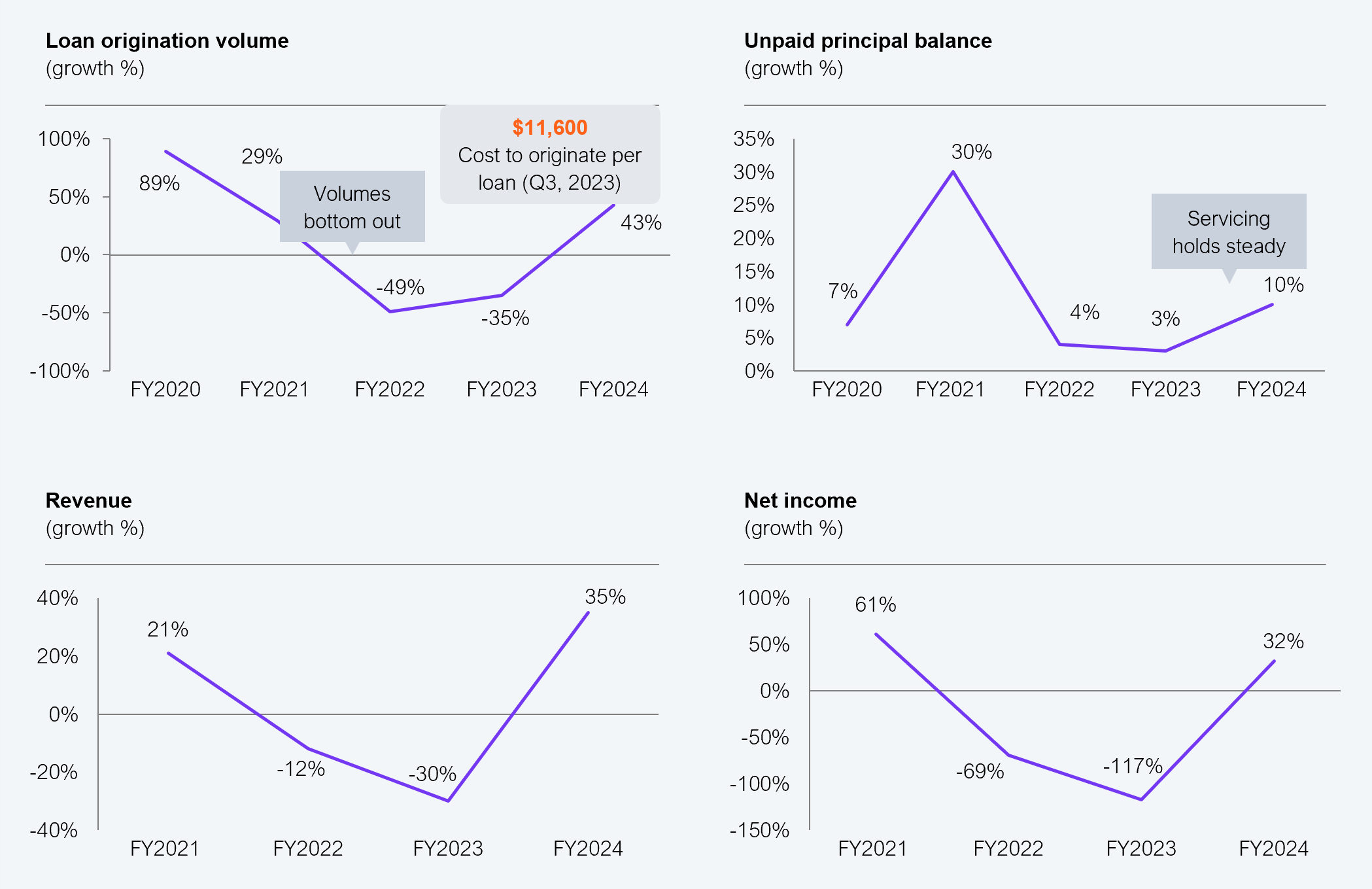
Sample: The eight publicly traded companies: Rocket Mortgage (RKT), UWM Holdings (UWM), loanDepot Inc. (LDI), Mr. Cooper (COOP), Rithm Capital (RITM), PennyMac Financial Services Inc. (PFSI), Walker & Dunlop (WD), Guild Holdings Company (GHLD)
Source: HFS Research in partnership with Cognizant, 2025
Non-bank lenders are riding the vicissitudinous Ferris wheel, constantly pivoting between offense and defense. During the housing market boom, many rode the wave without bracing for the crash. The pandemic-era refinancing surge and record-breaking demand for homeownership masked deep structural vulnerabilities. The post-pandemic shock hit hard—housing affordability plummeted, inflation spiked, and origination volumes cratered. Servicing stayed a low-margin grind, offering little relief.
Lenders are stuck in a high-stakes balancing act. Most default to reactive hiring and firing cycles—not strategy, just survival. What’s needed is a dual transformation across tech and ops. Betting on one without the other is a fast track to failure. The ‘how’ lies in rethinking operating models—leveraging cloud platforms, automation, and AI to drive real agility. Right-shoring isn’t about labor arbitrage or trimming costs. It’s about accessing global talent, accelerating innovation, and building operations fit for the future. This situation is best described by a head of operations at a leading non-QM mortgage lender.
Non-bank lenders are constantly riding the ups and downs of the market. When demand spikes, you scale with people. When it drops, you cut back. But if we’re not investing in innovation during those downturns, we’re just setting ourselves up to fall behind.
— A head of operations at a leading non-QM mortgage lender
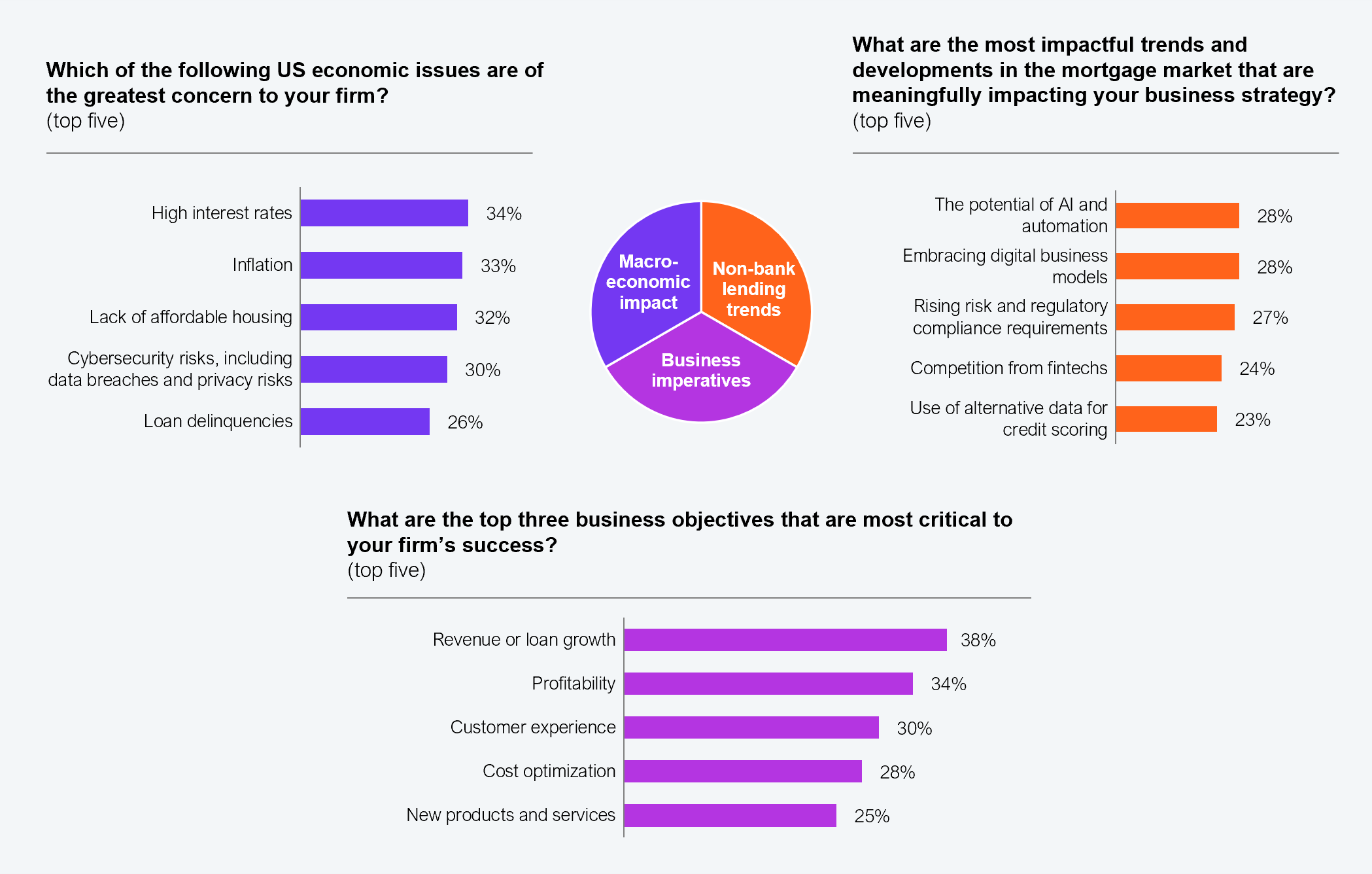
The reality of today’s non-bank lending market is a double blow—housing market volatility meets stubborn inflation. Add to that the latest tariff announcements, and you’ve got a fresh wave of uncertainty fueling recession fears and further shaking an already fragile housing market. But there’s a potential silver lining—a profit-fueled lending revival as rates stabilize, potentially holding in the 4.25%–4.50% range by mid-2025, if the Fed follows through on its signals. Technology and innovation have never been more advanced than today—untethering lending from the unwieldly and outdated processes of the past (endless approvals, mountains of paperwork, and manual underwriting). AI-driven decisions and underwriting, alternative credit data, and automation are rewiring the lending landscape—unlocking speed, efficiency, and scale like never before. Despite the potential, non-bank lenders are stuck in the weeds. Legacy technology, shrinking budgets, and siloed teams are dragging transformation down. Coupled with rising cyber threats and mounting regulatory pressure, the industry is locked in a high-stakes tug-of-war between bold innovation and playing it safe.
Sample: 257 US non-bank lenders and ecosystem partners
Source: HFS Research in partnership with Cognizant, 2025
As Exhibit 2 illustrates, this convergence of circumstances is pushing non-bank lenders to rethink what it takes to succeed. 2025 marks a turning point: growth is back on the table, and innovation is the engine. Revenue and profit, long sidelined by survival mode, are reclaiming their spot as top priorities.
If we take a step back, the dramatic expansion of the industry becomes clear. Before the 2008 crash, banks mastered the art of repackaging risk through asset-backed securities (ABS)—fueling the lending machine until it broke. Dodd–Frank tightened the reins, reined in reckless lending, and stabilized the system. It worked, but it also left a vacuum. Non-bank lenders stepped in fast, filling the credit gap and serving the borrowers banks left behind.
Non-bank lenders’ approach to filling that vacuum keeps evolving, given the relentless pace of innovation. The core nature of non-bank lending hasn’t changed—offer credit at the point of sale. But in today’s iteration, that credit is instantly delivered via smartphones and checkout screens. As lending technology advances, access to mortgage capital becomes faster, smarter, and more modular. It’s no longer about providing access to capital, but about how it’s delivered through innovation.
A data leader from a leading non-bank lending institution candidly remarked that the industry is caught in an unusual contradiction: “What changed in mortgage business processes from the last decade to now? Nothing.” The loan is still a loan. The key difference—it’s not about what gets done, but the efficiency and intelligence applied through data, compute, and automation.
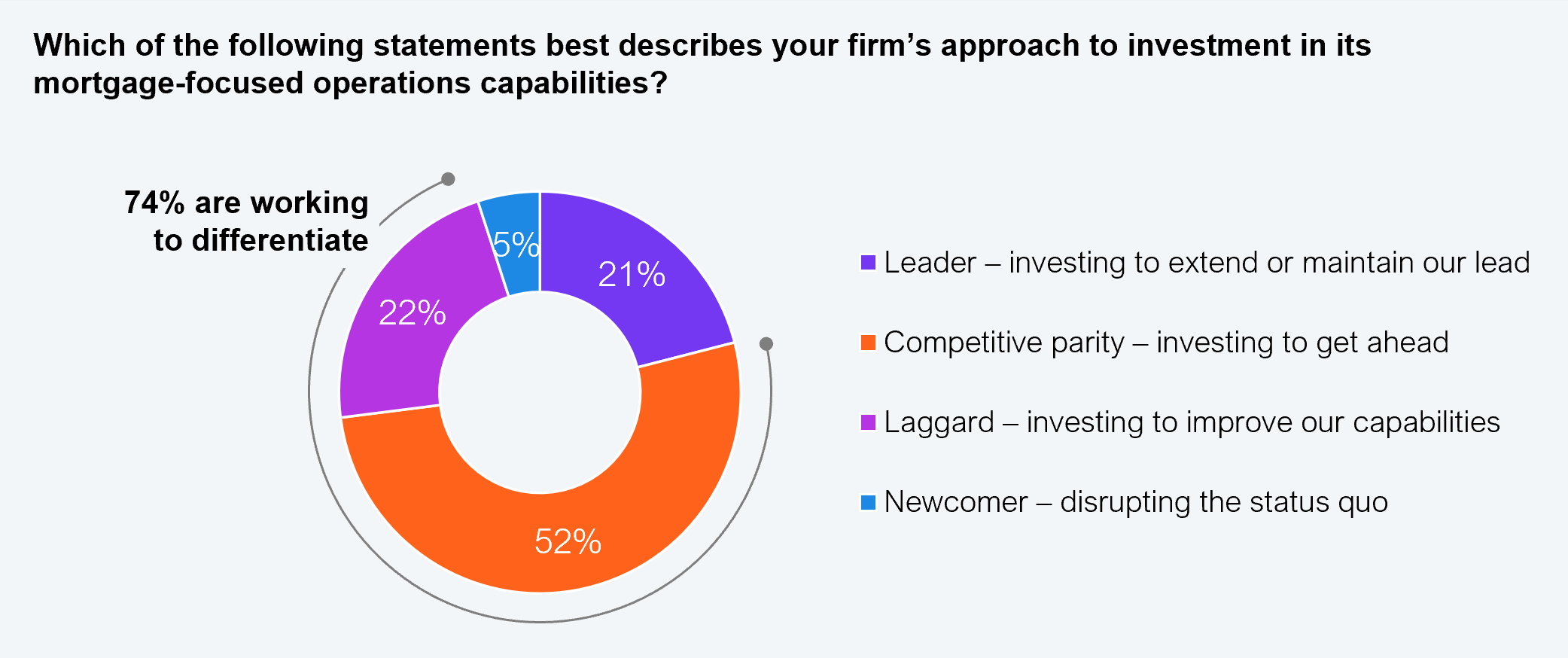
This is probably why most lenders aren’t leading the charge. In our survey of 257 non-bank lenders, only 21% saw themselves as true leaders. The rest are mostly focused on maintaining business continuity (22% laggards) or keeping pace with competitors (52% competitive parity), as shown in Exhibit 3.
A closer look at the data reveals an even starker reality: only 16% of ecosystem teams see themselves as leaders, while 66% operate at parity—creating a crowded middle ground with minimal differentiation. Non-bank lenders, which include purely originators and servicers, show slightly more confidence, with 22% identifying as leaders. Yet nearly half (48%) remain stuck at parity, struggling to stand out in an increasingly competitive landscape.
Sample: 257 US non-bank lenders and ecosystem partners
Source: HFS Research in partnership with Cognizant, 2025
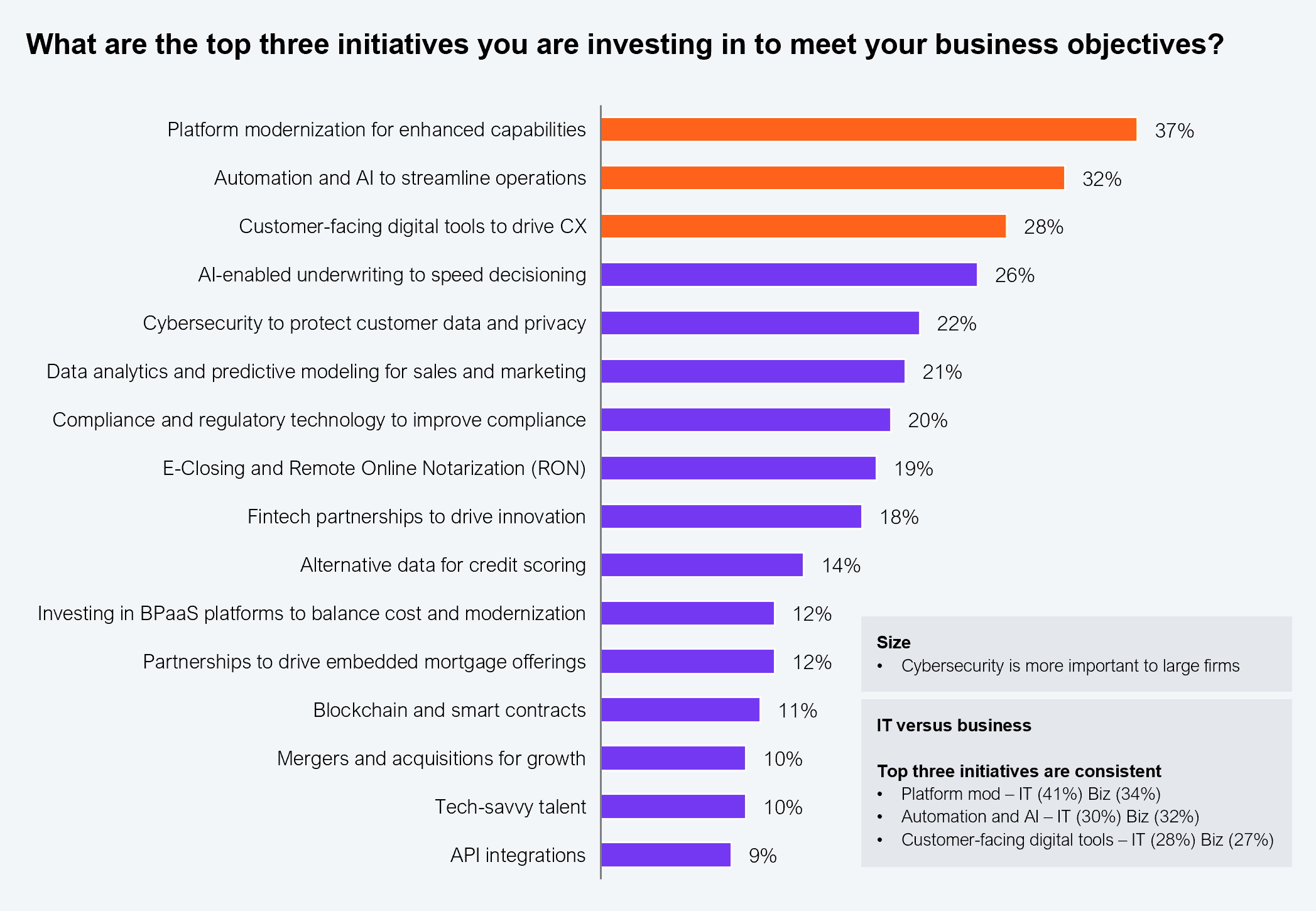
The impact of innovation is already evident in the evolution of new digital lending models. HFS asked non-bank lenders where they’re placing their biggest bets to drive business objectives—primarily revenue or loan growth, and profitability (see Exhibit 4). Top of the stack on investment priorities are platform modernization (37%), AI and automation (32%), and digital CX (28%), with AI-enabled underwriting (26%) and cybersecurity (22%) close behind. The exhibit includes a highlighted section that breaks down the IT and business split of investment priorities, almost in lockstep, showing rare alignment and signaling a shared focus for strategic growth.
Sample: 257 US non-bank lenders and ecosystem partners
Source: HFS Research in partnership with Cognizant, 2025
Platform modernization is now necessary for non-bank lenders to transform mortgage lending from labor-intensive, manual workflows into a seamless, data-driven, and digitally enabled experience. Failure to modernize only perpetuates the inefficiencies of the past—trapping non-bank lenders in boom-and-bust cycles, scrambling in downturns, overhiring in upswings, and choking on operational drag, bad CX, and stalled growth. This isn’t just about the next rebound—it’s about building infrastructure that’s flexible, scalable, and built to last. A senior executive leading intelligent automation and digital transformation at a major non-bank mortgage originator and servicer talked about modernization and breaking the grip of legacy.
Platform modernization means getting rid of the legacy baggage—processes built by who knows who, systems that can’t scale, and applications that aren’t automation-friendly. It’s about replacing what no longer serves with technology that drives efficiency and growth.
— A senior executive leading intelligent automation and digital transformation at a major non-bank mortgage originator and servicer
HFS’ analyst and executive conversations confirm what the data shows—there’s clear alignment between investment priorities and strategic focus. AI and automation taking the second spot is no shock; they power every stage of the lending operations lifecycle, from application to close. AI underwriting ranking fourth was expected—it’s a long-term profit play. What did surprise us was alternative credit data didn’t rank higher. In a world where traditional data falls short, alternative data gives lenders sharper, smarter views of borrower risk, helping firms make precise and confident lending decisions. Ignoring it is a missed opportunity for better underwriting, tighter risk control, and broader reach. As for API integration landing last, it’s not irrelevant—it’s just table stakes now. Most firms have already done the groundwork and are shifting toward tech that actually moves the needle. Leslie Peeler, EVP and COO, Cenlar, reflected on how certain modernization initiatives are now baseline expectations rather than innovation.
No one wakes up and says API integration is a focus—it’s more of a standard approach at this point. But yes, it’s happening.
— Leslie Peeler, EVP and COO, Cenlar
Agentic AI may not yet be a headline initiative for lenders, but it’s fast becoming the next chapter in the AI playbook where cognitive intelligence meets execution muscle. It fuses the reasoning power of GenAI with the precision of automation. AI, ML, and automation have long supported the mortgage tech stack, but GenAI has flipped the script. Once behind the curtain, AI is now driving the agenda, sparking a full-throttle race to define an enterprise-wide strategy. For lenders, this isn’t about chasing hype. While we envision autonomous agents running entire workflows, the reality inside leading non-bank mortgage operations is far more grounded and smarter for it. Instead of jumping straight into sci-fi territory with agent-to-agent orchestration, the focus right now is on narrow, high-impact agents that actually work. A senior executive leading intelligent automation and digital transformation at a major non-bank mortgage originator and servicer noted that agentic AI is no longer just a concept—it’s gaining ground fast, with real use cases already taking shape.
Agentic AI combines generative cognitive capabilities with traditional automation to actually fulfill tasks—these are what we call agents. We’re starting to explore this space, but not just because it’s the latest buzzword. It’s real, and the use cases are absolutely there.
— A senior executive leading intelligent automation and digital transformation at a major non-bank mortgage originator and servicer
We weren’t looking for prognostications—we wanted real, tangible actions that non-bank lenders are taking to achieve their strategic imperatives. To tease out this reality, we followed up by asking what’s actually stopping them from unlocking the value of their investments. Instead of accelerating modernization, lenders are being held back by legacy technology, tightening budgets, and data quality issues (see Exhibit 5).
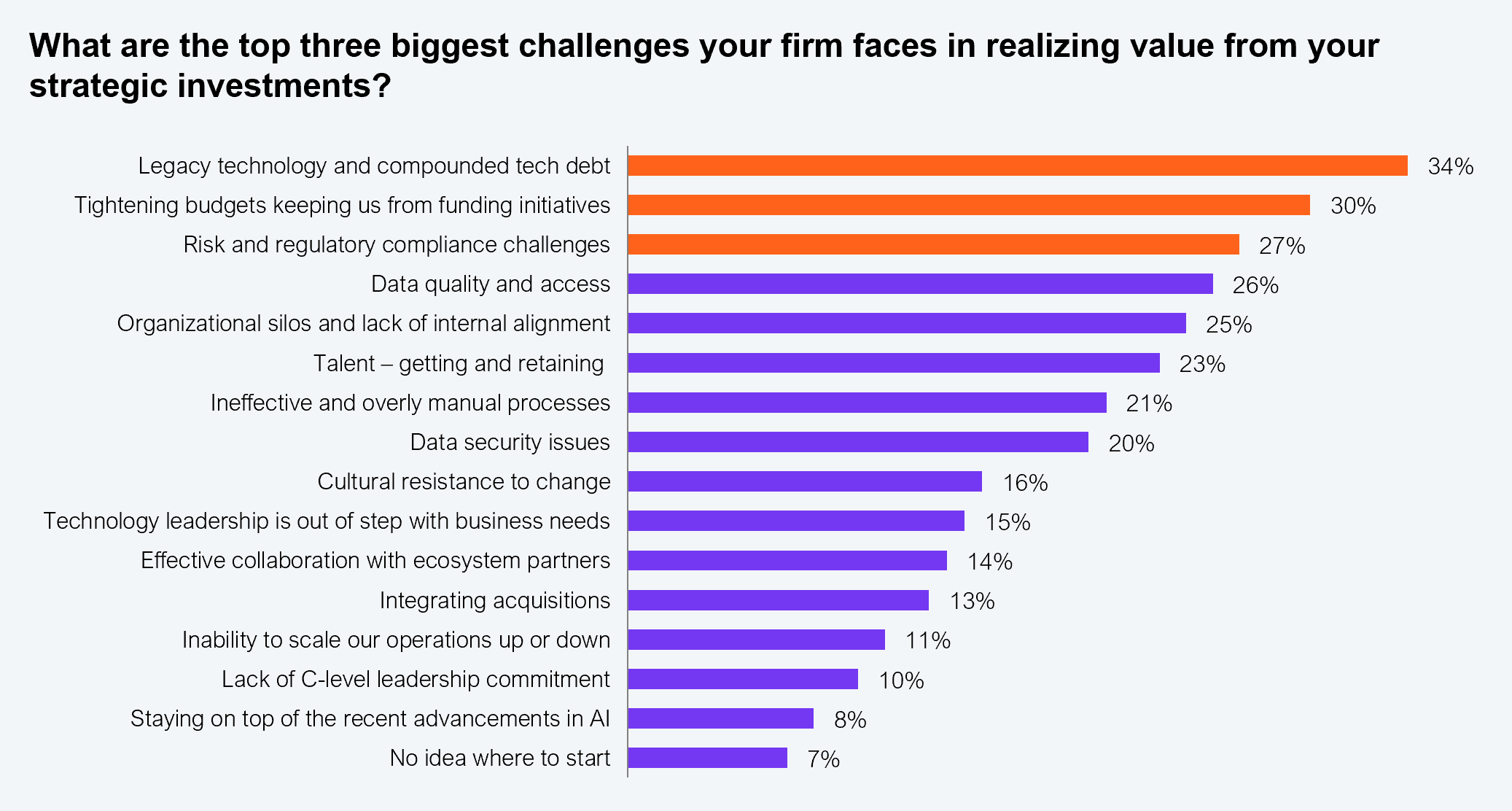
Sample: 257 US non-bank lenders and ecosystem partners
Source: HFS Research in partnership with Cognizant, 2025

Only 42% of non-bank lenders are fully ready for real-time integration with current and future ecosystem partners
42% of non-bank lenders are ready for real-time integration with ecosystem partners; the rest are still playing catch-up. Without seamless integration, real-time, data-driven underwriting stays out of reach—costing lenders customers, loyalty, and revenue. The biggest roadblock is legacy tech. Mainframe-based origination systems weren’t built for AI or real-time anything. Executives told us bluntly: platform constraints make data access slow, costly, and overly complex. This is the true cost of tech debt and a clear call to action for modernization. Competing in a data-driven future means shedding legacy.

51% of non-bank lenders are partially or not ready to meet evolving risk and compliance demands
51% of non-bank lenders are only partially or not at all ready to handle evolving risk and compliance demands. The regulatory frameworks are notoriously complex with feedback loops and approvals that inflate requirements, distort credit decisions, and drag out the ‘time to yes’. Every technology implementation now needs a compliance lens—ensure control while staying inside the lines. An executive told us they got 1,700 regulatory alerts in 2024 alone—one in four with a direct impact on their business. The sheer volumes are turning compliance into a full-time grind of monitoring, assessing, and adapting.

Investments in innovation are taking a hit. Also, deprioritizing it is a short-sighted move. Non-bank lenders live in a world of cycles, and resilience demands constant reinvention. Innovation is a competitive necessity in a price-sensitive market where borrowers routinely switch for better rates and, more importantly, a superior experience. Leaders know they can’t keep doing business the old way. Executives told us the budget is there, but only if the spend drives cost efficiency, improves CX, and proves ROI—this is still a cautious approach.
In short, non-bank lenders know the path to growth runs through digital, AI, and automation—it’s their ticket to unlocking higher revenue. But before they can level up, they must confront entrenched complexities: legacy systems, organizational silos, regulatory hurdles, talent challenge, and the ever-present struggle to refute business cases burdened by inflated costs and insufficient ROI. Until non-bank lenders address these foundational issues—namely, data, core system limitations, and constrained budgets—they will be hamstrung in their investment efforts.
Non-bank lenders clearly see the transformative power of automation and AI, consistently ranking them among their top investment priorities (we’ll explore how this plays out in the next chapters). Today, 44% of mortgage operations are automated, expected to rise to 68% over the next two years (see Exhibit 6). Manual processes currently sit at 57%, projected to fall to 32% in the same period. The direction is clear—lenders are moving decisively toward automation. But the real question is whether this shift will simply reduce costs and headcount or unlock meaningful growth.
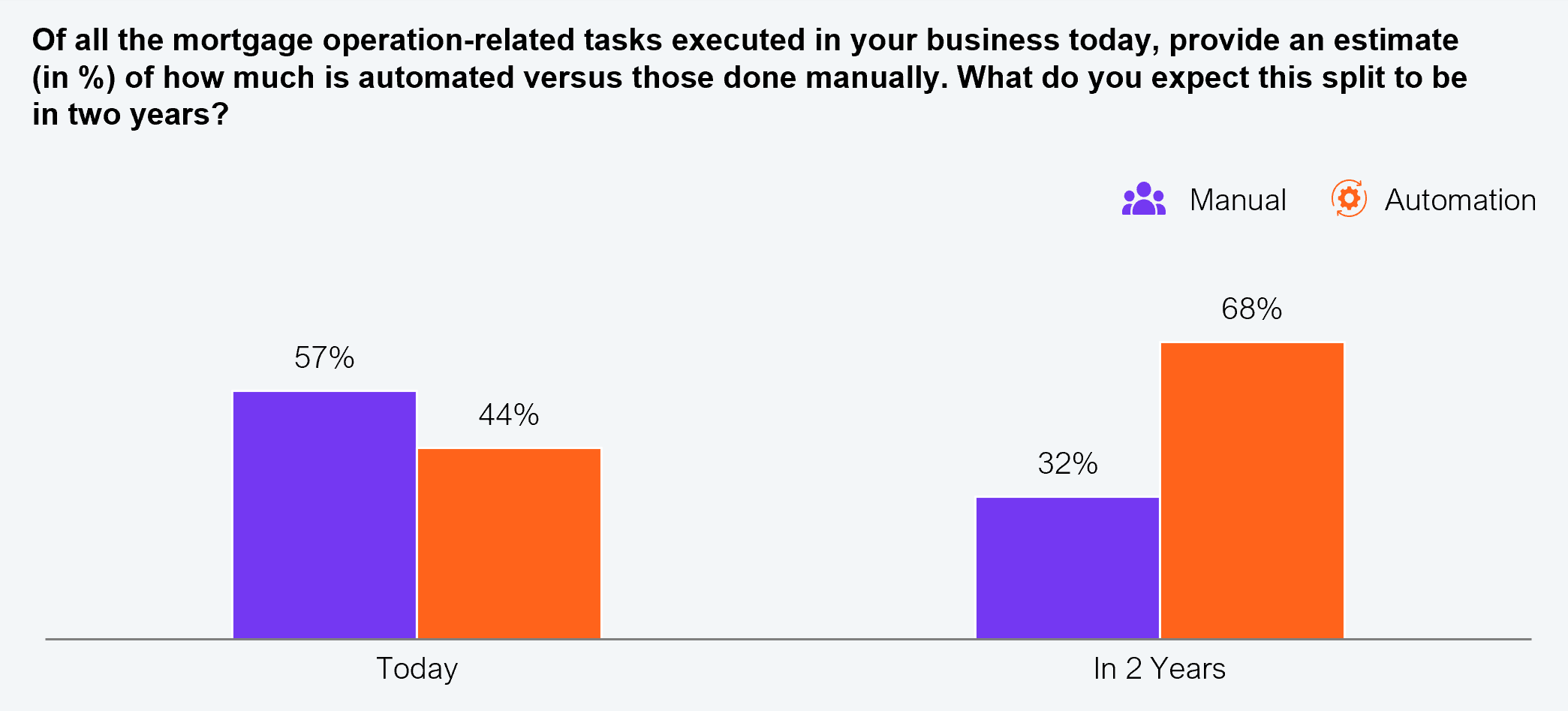
Sample: 257 US non-bank lenders and ecosystem partners
Source: HFS Research in partnership with Cognizant, 2025
Executives tell us non-bank lenders are automating the usual suspects: repetitive, predictive, and low-value tasks such as document processing, application handling, and compliance reporting. These are necessary, but basic. Efficiency is just the foot in the door. The real value lies in scaling automation beyond task-level wins to a broader strategy—blending technology, human expertise, and continuous improvement into an intuitive tech-to-ops cycle in the mortgage workflow. That’s where transformation lives, but many stop short. They automate in silos, chasing easy wins that anyone can mimic. The result—stuck in the middle, indistinguishable from the competition, and leaving serious value on the table.
As the human-automation balance shifts, we dug into what it really means for the non-bank lending workforce. On average, teams sit at 550 FTEs today and are projected to grow 9% to around 600 in two years (see Exhibit 7). But it’s not just about adding bodies. The old reflex of scaling headcount up and down with market swings is broken. This anticipated growth is a chance to rethink roles, redesign processes, and build a smarter, tech-enabled workforce where people and automation work side by side.
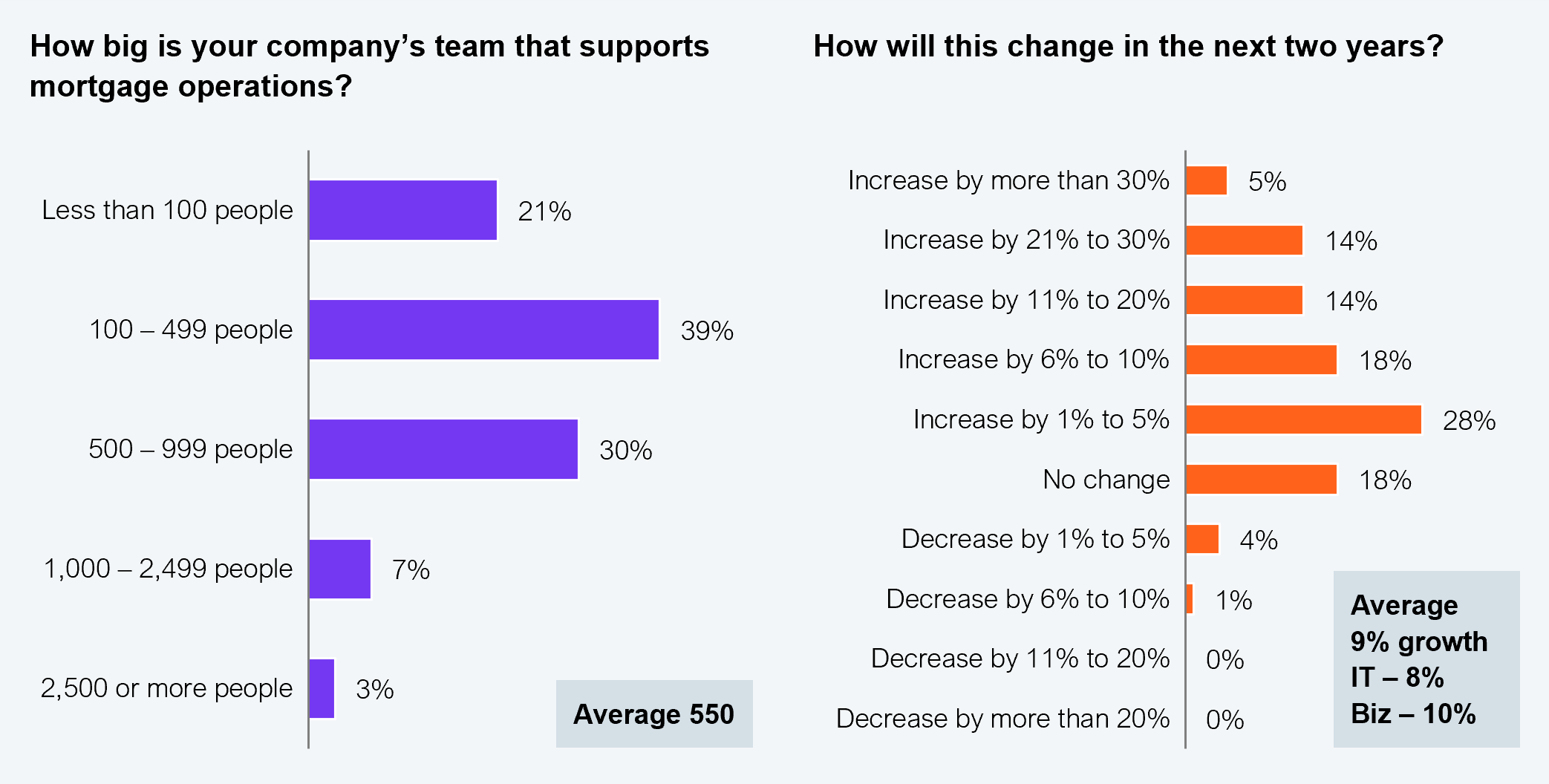
Sample: 257 US non-bank lenders and ecosystem partners
Source: HFS Research in partnership with Cognizant, 2025
Automation in non-bank lending has leaned heavily on RPA, precisely programmed bots bridging systems and streamlining manual tasks. As Priyatham Minnamareddy, Director, Digital Transformation & Intelligent Automation, Onity Group, put it: the approach is straightforward—deploy bots to take on the repetitive grunt work so teams can focus on higher-value tasks.
Our automation journey started with bots, using them to handle high-volume, repetitive tasks where efficiency is everything. The idea is simple: let the bots manage the routine work so our teams can focus on higher-value activities. It’s all about scalability without compromising quality.
— Priyatham Minnamareddy, Director, Digital Transformation & Intelligent Automation, Onity Group
RPA delivered the efficiency it promised, but it hit a ceiling. With most of the low-hanging fruit gone, lenders are now shifting their focus to agentic AI to inject predictivity, decision-making, and cognitive intelligence into operations. The interest is real, early investments are landing, and GenAI is making execution possible.
While machine learning has been around for years, training models were slow, complex, and heavily dependent on high-quality data—something most lenders didn’t have in abundance. With GenAI training, deploying models is now significantly easier, unlocking use cases in mortgage operations that were previously too complex or costly to execute. GenAI brings the cognitive lift, while RPA handles execution—giving rise to intelligent agents that operate at the intersection of decision and action.
It’s not just about deploying the technology—true adoption requires addressing the cultural barriers that stand in the way, especially as AI advances into more complex forms such as agentic AI. Within non-bank lenders, legacy mindsets and a strong preference for deterministic outcomes persist. Executives in our study pointed to the discomfort among long-tenured professionals when it comes to handing over decision-making to AI, even when the technology clearly shows promise. This hesitation is particularly acute in functions where precision and regulatory compliance are critical, making it difficult for organizations to fully embrace probabilistic models. The transition from skill-based roles to AI-augmented ones demands more than just upskilling—it calls for a fundamental shift in how roles are defined and value is delivered. As noted by Sedwin Sunny Vadukut, VP, Head of Performance Excellence at Cotality:
It’s not just about deploying AI. The real shift has been cultural—getting people who’ve spent more than 25 years of their life in mortgage operations to trust and partner with AI. We’re asking people who used to make decisions entirely on their own to now become the human in the loop—validating AI outputs, closing the feedback loop, and helping the models improve over time. This shift is as much about change management as it is about technology.
— Sedwin Sunny Vadukut, VP, Head of Performance Excellence, Cotality
That’s why, despite the rise in automation (see Exhibit 6) and the emergence of GenAI and agentic AI use cases, mortgage operations are far from fully autonomous. Human-in-the-loop oversight remains essential, especially when it comes to complex or high-stakes decisions. Those are still made by people, and that won’t be changing anytime soon.
In the last section, we laid out why 2025 must be a growth year—unpacking the core challenges, trends, priorities, and workforce shifts shaping non-bank lending. Now it’s time to get into the ‘what’—the emerging technology investments lenders are making to transform mortgage operations. We break down how these technologies are reshaping the value chain, zooming in on origination and servicing to spotlight where the real impact is happening—in essence, what’s moving the needle.
Frontier technologies are set to reshape mortgage operations in 2025. Non-bank lenders are prioritizing a formidable arsenal of high-impact technologies, aligned with the HFS AADA Quadfecta: Analytics (22%), AI – both ML (31%) and GenAI (24%), Data Platforms (26%), and Automation (29%), as illustrated in Exhibit 8. This stack of technologies is built to modernize legacy systems, automate manual work, and unlock deeper data insights. However, success hinges on seamlessly aligning the moving parts—connecting datasets across functions, embedding ML into automation, and elevating analytics to drive smarter decisions.
The trajectory of emerging tech adoption follows a familiar path: invest, pilot, implement, scale. It starts with a focused business case, then expands across the enterprise toward full adoption. Taken together—adoption and maturity—it’s clear there’s still serious ground to cover to advance the AADA Quadfecta. Automation is the expectation—it remains the golden child of mortgage technology. SaaS platforms and APIs are now essential—36% and 22% are already in steady-state use, offering a faster, leaner, more agile way to meet rising borrower expectations and launch new capabilities at speed.
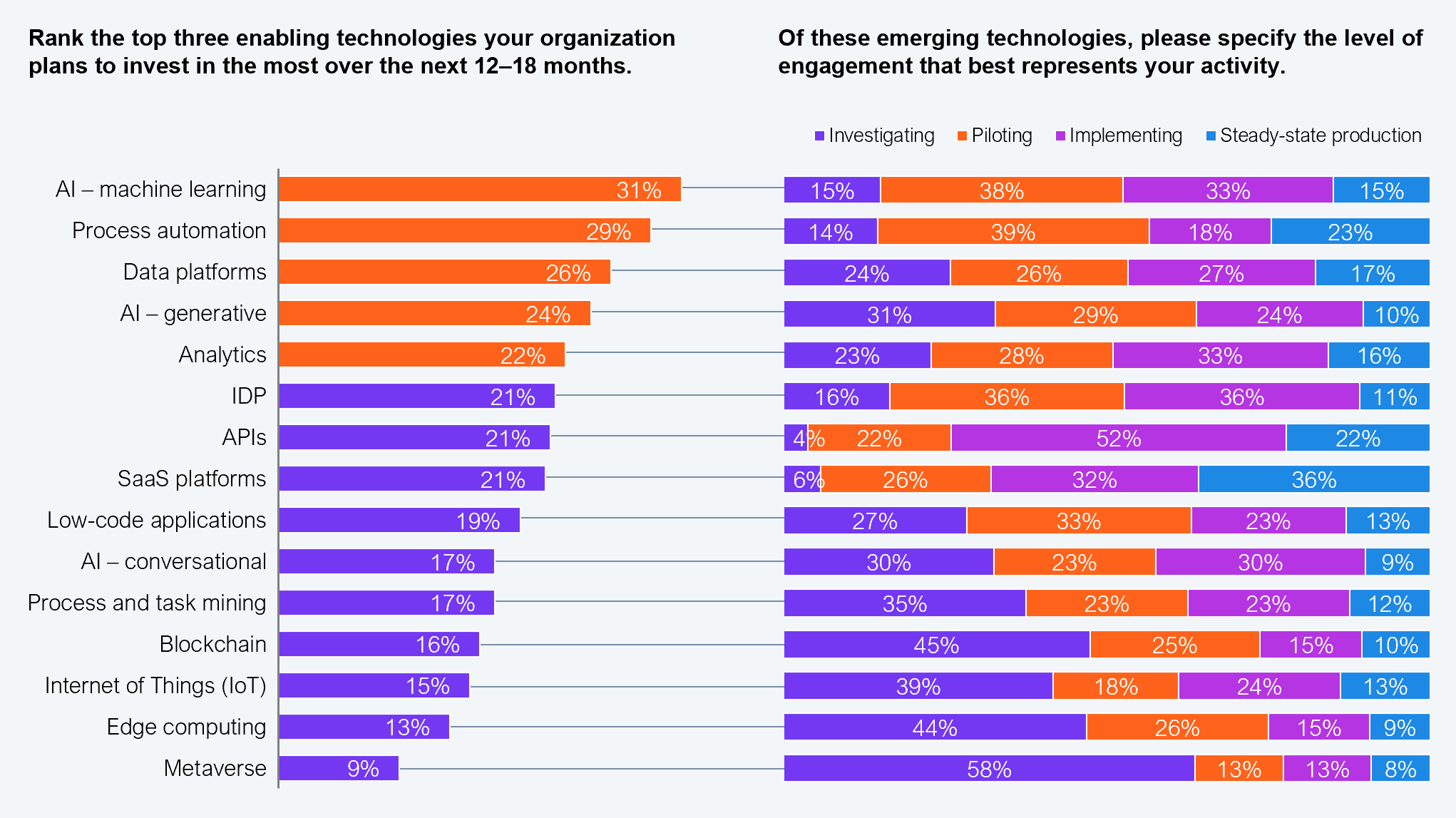
Sample: 257 US non-bank lenders and ecosystem partners
Source: HFS Research in partnership with Cognizant, 2025
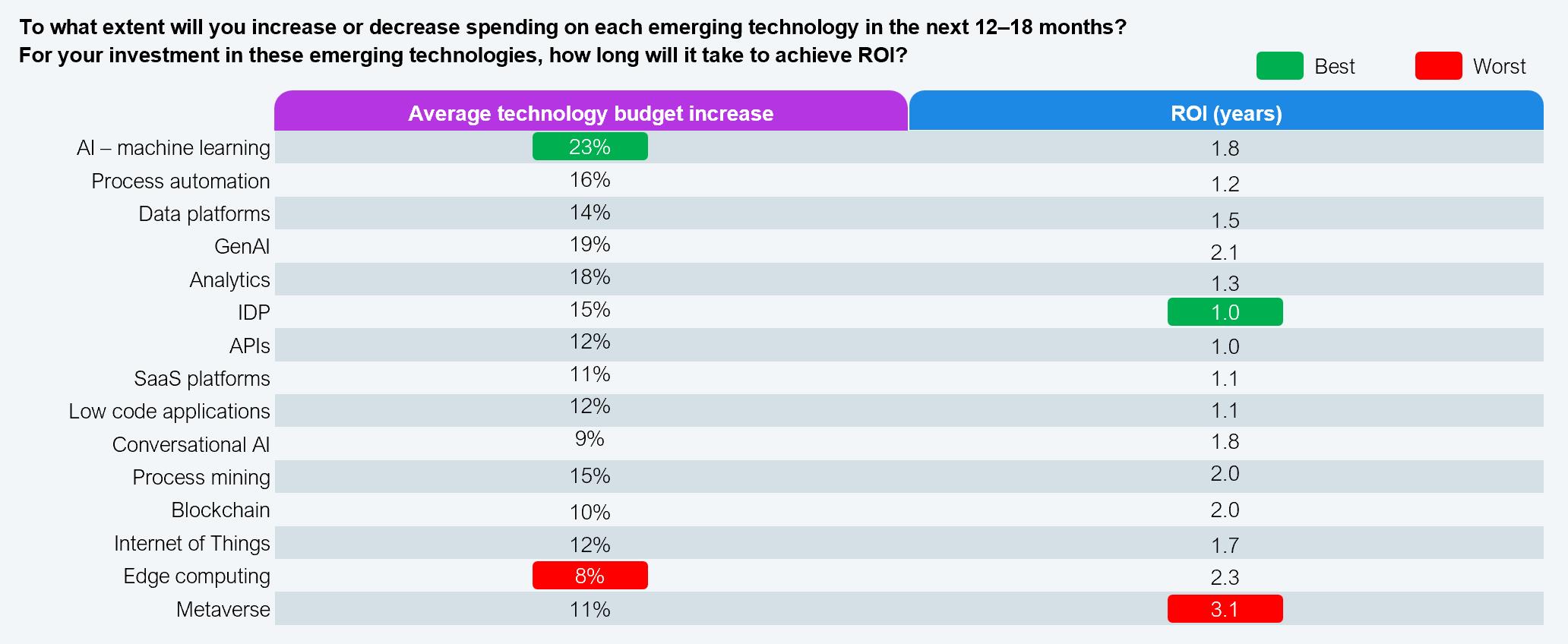
In a budget-tight environment (a top challenge, as per Exhibit 5), making a strong case for prioritization is non-negotiable. Executives in our study were clear: demonstrating ROI is critical for securing funding. With this in mind, we asked respondents where budgets are increasing and when returns are expected. The findings reveal a concentrated focus on ML (23%), GenAI (19%), and analytics (18%), with IDP as the fastest to deliver ROI, often within a year.
The case for IDP and its sister technology, optical character recognition (OCR), is compelling. These tools bridge the analog-digital divide, extracting data with speed and precision through a combination of classification, extraction, and advanced algorithms. Despite ongoing digitization efforts, analog isn’t dead for lenders and IDP excels where paper still dominates. As Priyatham put it, IDP delivers results quickly and proves value early.
Being a mortgage servicer, we kind of live and breathe documents. We introduced IDP for document classification, indexing, and extraction using OCR and other tools. We now process more than a million pages per month. It really helps us manage fluctuations in loan volumes, scaling up and down in a very efficient manner.
— Priyatham Minnamareddy, Director, Digital Transformation & Intelligent Automation, Onity Group
Sample: 257 US non-bank lenders and ecosystem partners
Source: HFS Research in partnership with Cognizant, 2025
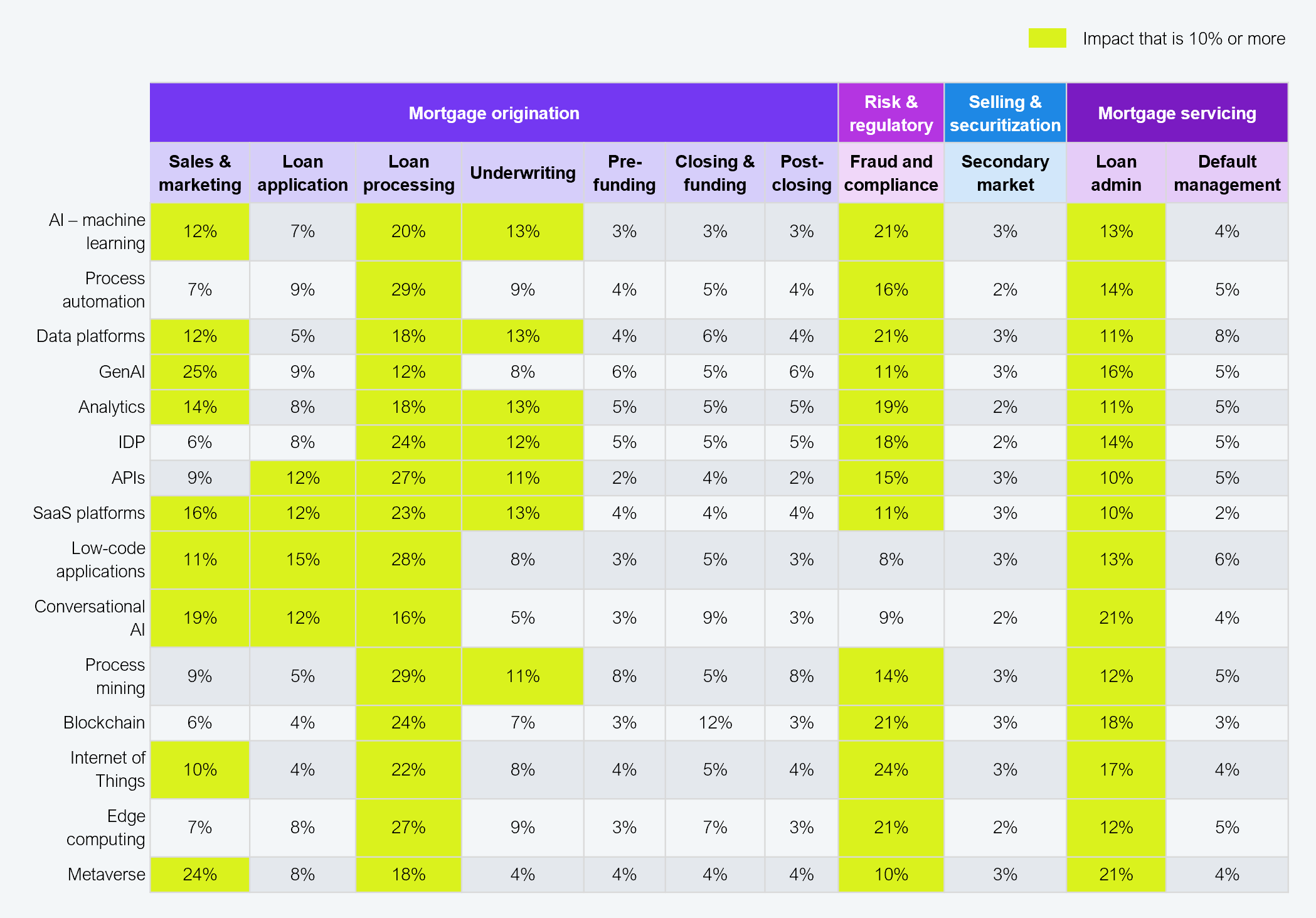
Not every technology fits every mortgage process. Exhibit 10 maps where each one delivers the greatest impact. The biggest gains (10%+) mostly appear in loan processing, administration, and risk and compliance. These labor-intensive functions see the clearest value, as technology helps untangle operations—separating routine tasks from high-value work. The takeaway is clear: emerging technologies are being applied to the lowest-hanging fruit, where impact is visible, measurable, and scalable. The link between technology and the mortgage value chain gives lenders a clear blueprint to align investment with real outcomes.
Sample: 257 US non-bank lenders and ecosystem partners
Source: HFS Research in partnership with Cognizant, 2025
Executives in our study agree that building resilience in risk and compliance is non-negotiable. It’s not just about speed but about enabling control, accuracy, and scale in the face of rising regulatory complexity. Without the right technology, compliance programs fall behind, exposing critical gaps.
At the same time, GenAI is already surpassing traditional AI in sales and marketing. The technology is leveraged to detect borrower patterns, sharpen segmentation, improve lead quality, and deliver hyper-personalized content with precision. The value-oriented approach extends well beyond sales and borrower engagement, and executives are calling out GenAI’s expanding footprint across mortgage operations. It involves reading property appraisals, flagging issues such as cracks, mold, or roof damage, and triggering inspections—no manual review needed. It’s about cutting through loan documents to auto-fill underwriting checklists, letting underwriters focus on judgment and not data entry. In call centers, it’s reactivating runoff borrowers and capturing refinance opportunities.
Moreover, agentic AI is starting to show up in the real world and not just in its full-blown, multi-agent form yet. The real progress is happening through narrow, single-agent use cases. One example cited by an executive in our study is confirming the tax payment status by syncing internal and external data. What used to take hours and multiple email chains is now handled automatically and accurately, saving time and reducing friction.
A tech-forward leader in mortgage servicing put it plainly: don’t even talk about multi-agent AI until you’ve done the groundwork. Their organization has spent nearly a decade in the AI trenches—evolving through traditional ML, migrating to Google Cloud, and building robust MLOps and security frameworks. That foundational investment is now enabling agentic AI to scale beyond operations teams, unlocking a federated approach where HR, finance, and other business units are empowered to identify and implement their own intelligent use cases.
The same call for foundational groundwork echoed loudly in our conversation with a data leader from a prominent non-bank lending institution. The message was clear: how data is structured, governed, and made usable is what makes or breaks AI. Without that backbone, AI is just another layer of noise. The data leader didn’t mince words: “Before you think about AI, think about your data. You can’t automate chaos.”
This is a reality check for an industry chasing AI headlines while quietly drowning in disconnected systems and siloed reporting—bolting on AI while their data still lives in spreadsheets and fragmented databases. Many still run analytics from the business side, with little grasp of real data modeling or architectural thinking. The result—inconsistent KPIs, unreliable insights, and AI initiatives that stall before they even start.
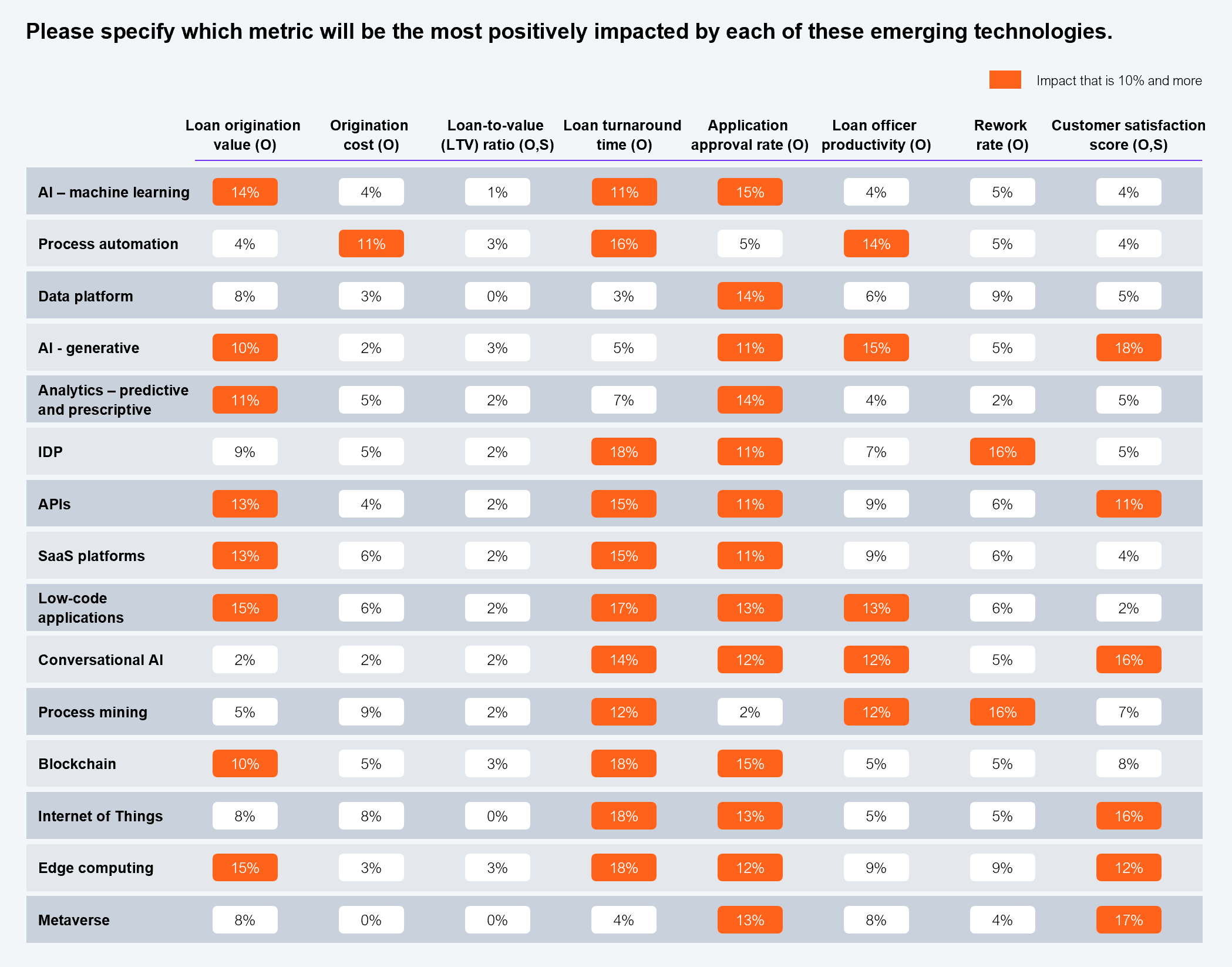
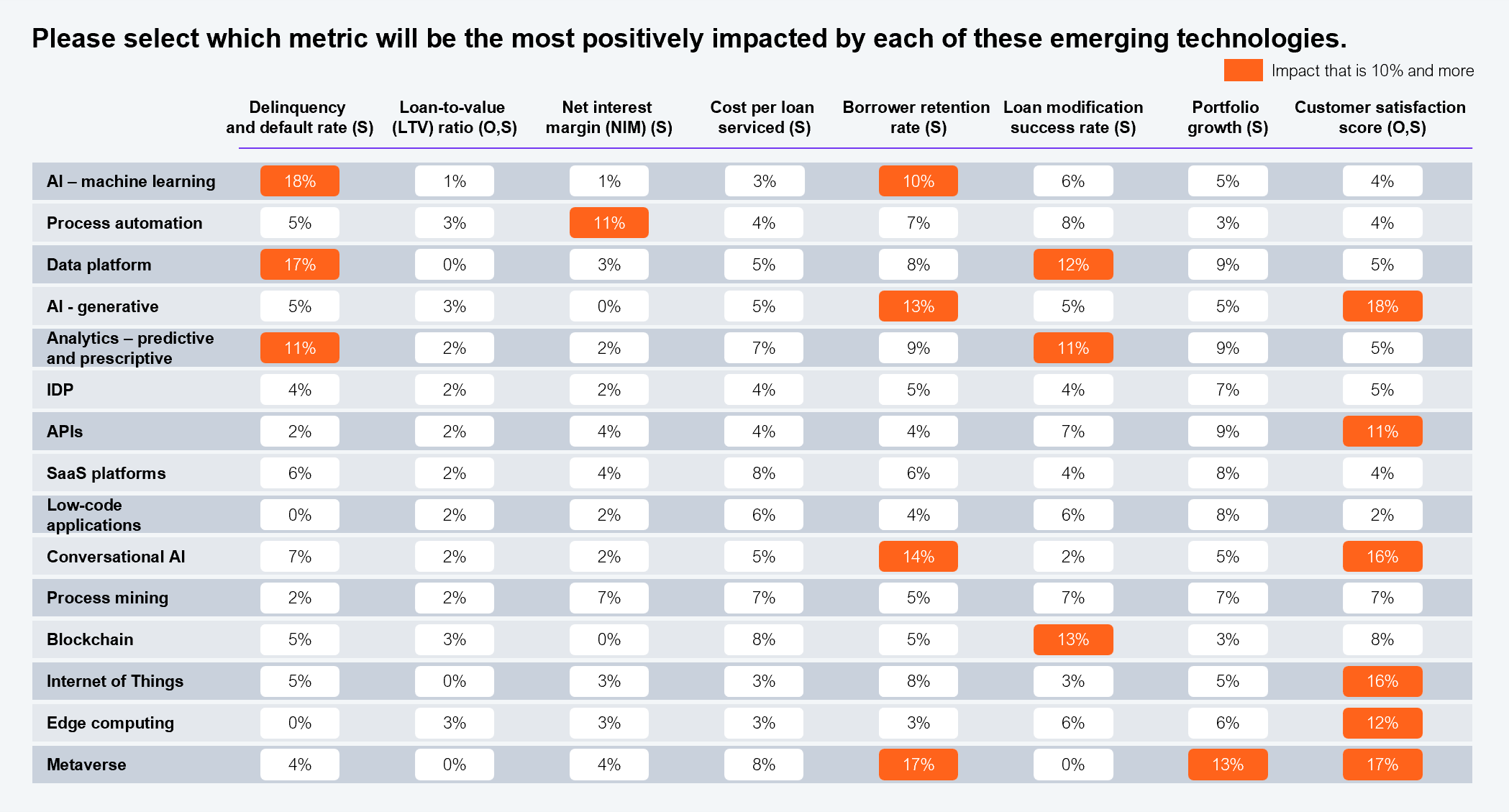
Looking at the mortgage value chain in aggregate reveals only part of the picture. To see where technology truly delivers impact, we need to break it down into the sub-processes of origination and servicing—highly transactional areas built for systematic KPI tracking. Here, technology ties directly to performance. We’ve identified eight core KPIs (see Exhibits 11 and 12) that form a homogeneous set of metrics that offer clear, consistent visibility into how originators and servicers are performing. The goal is to answer the most pressing question: what technology drives which metrics across the lending lifecycle to sustain high-performance lending?

Mortgage origination covers everything from borrower inquiry to loan funding. Our analysis shows that technology delivers the most measurable impact on two fronts: loan turnaround time (TAT) and approval rates. Faster TAT signals streamlined operations, while higher approvals reflect smarter underwriting—both critical for growth and profitability. There’s a clear disconnect between technology adoption and impact on key metrics (see Exhibit 11). Blockchain, IoT, and edge computing are still in the early days, but their performance potential is big. This suggests that nothing should be off the table. With the right intent, the right technology doesn’t just improve performance—it redefines what’s possible.
Sample: 257 US non-bank lenders and ecosystem partners
Source: HFS Research in partnership with Cognizant, 2025

Mortgage servicing is still stuck in a low-margin, cost-obsessed grind—where revenue is constantly weighed against substantial costs, particularly in compliance. The glaring whitespace in technology impact says it all: adoption is weak, and reliance on human intervention is heavy. Servicing has long prioritized cost over borrower experience. Top originators such as Rocket often retain servicing rights even after selling loan assets because they understand the value of controlling the borrower’s entire journey. Its acquisition of Mr. Cooper underscored this, gaining access to a sophisticated servicing infrastructure that, as of Q4 2024, manages over $1.56 trillion in unpaid principal balance.
In a world chasing the Amazon experience, borrowers expect seamless, end-to-end service, especially when it comes to their biggest financial decision. The biggest missed opportunity in servicing is its failure to fully embrace technology. However, firms such as Cotality, serving over 80% of all US mortgages today, are proving that tech-led servicing is not just possible—it’s the new benchmark.
The tolerance for error has disappeared. Clients no longer see mistakes as acceptable, even in high-volume, high-complexity environments such as tax servicing. The mindset has shifted: if you’re number one in the industry, the expectation is that you don’t get it wrong. Every data point matters. Every defect matters. And AI is helping us meet that bar.
— Sedwin Sunny Vadukut, VP, Head of Performance Excellence, Cotality
Sample: 257 US non-bank lenders and ecosystem partners
Source: HFS Research in partnership with Cognizant, 2025
Non-bank lenders know they can’t meet the 2025 growth targets alone. The pace and complexity of change across the lending lifecycle demand strategic partners. Lenders are pressurized to deliver seamless omnichannel experiences, launch new products, make exceptionally fast data-driven decisions, ensure transparent pricing, ensure reliable approvals, and close loans on time. Achieving that north star means engaging with the right strategic partner. These partners don’t just bring technology and tooling. They help modernize platforms, simplify legacy, scale automation, AI, and cloud, and keep lenders compliant in a shifting regulatory minefield. Engaging these partners is crucial to enable this journey at the necessary scale and pace.
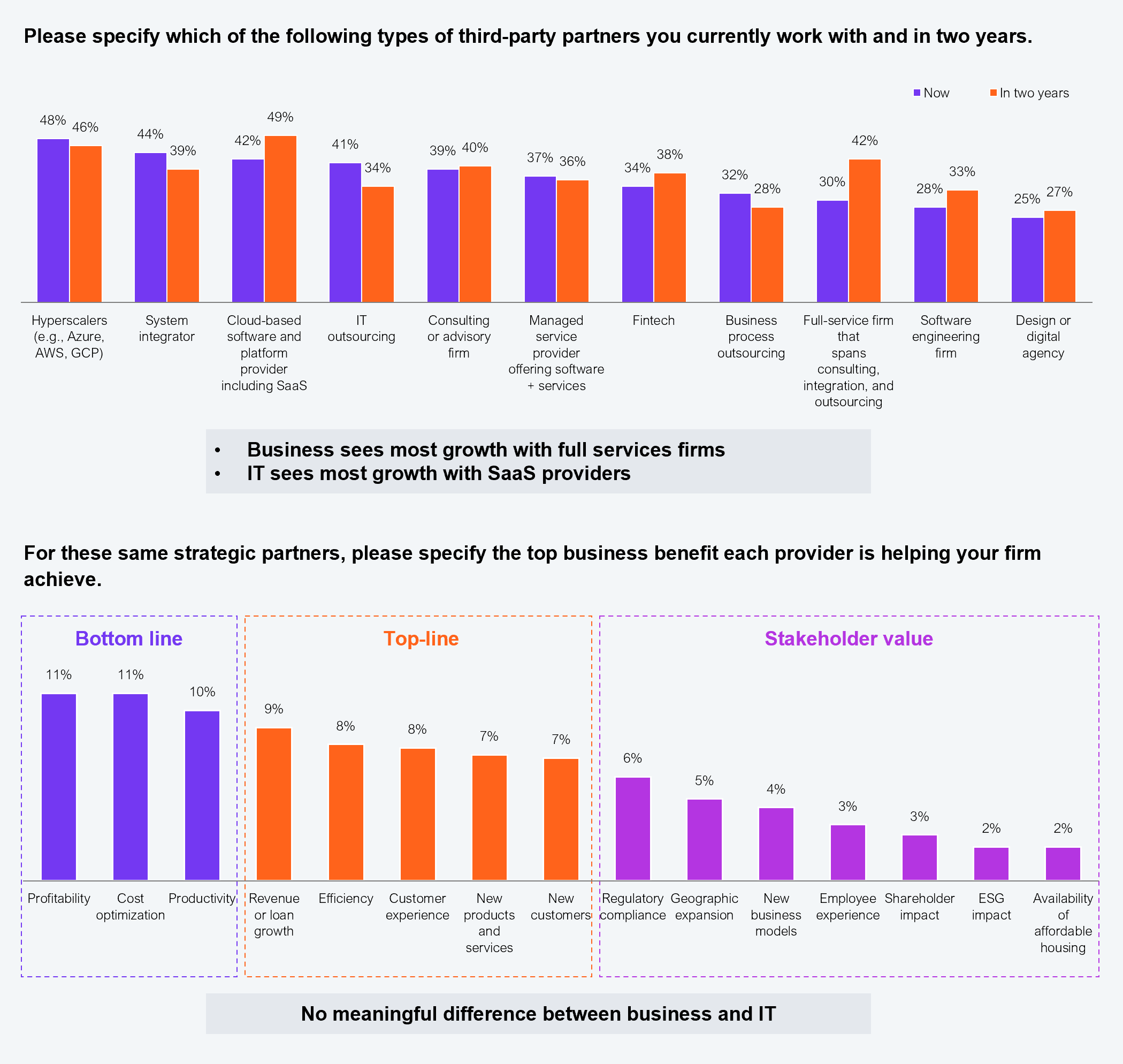
Demand for strategic partners among non-bank lenders is rising fast. When we asked who they rely on today, 48% named hyperscalers and 44% pointed to system integrators. In two years, that shifts slightly—46% will still lean on hyperscalers, while 49% plan to collaborate with cloud-based platform providers. The sustained importance of platform and cloud players underscores their role in streamlining mortgage lending, automating key stages of the loan lifecycle, and eliminating bottlenecks. Most SaaS tools now come with open APIs, seamless third-party integration, and built-in compliance, making them critical in modern mortgage operations.
Full-service firms are also gaining ground, rising from 30% today to 42% in two years. Lenders want more than just technology; they need end-to-end partners that combine domain-led advisory, technology integration and modernization, and ongoing management, anchored in lending-specific domain and a network of embedded partners. These firms are stepping into the role of ecosystem orchestrators—deftly curating fintechs, integrating next-gen technologies, and leveraging their deep understanding of disruptors’ tech postures to deliver informed, high-impact recommendations that keep non-bank lenders competitive in a rapidly evolving market. These firms are sought after even as non-bank lenders leverage their Global Capability Centers (GCCs).
But here’s the disconnect: when asked about actual business value, most responses fixated on the bottom line—profitability (10%), cost savings (11%), productivity (10%). Top-line growth (average 8%) and stakeholder value (average 4%) barely made a dent. Strategic partnerships are still being viewed through a cost lens, missing the bigger opportunity to drive real competitive advantage.
Sample: 257 US non-bank lenders and ecosystem partners
Source: HFS Research in partnership with Cognizant, 2025
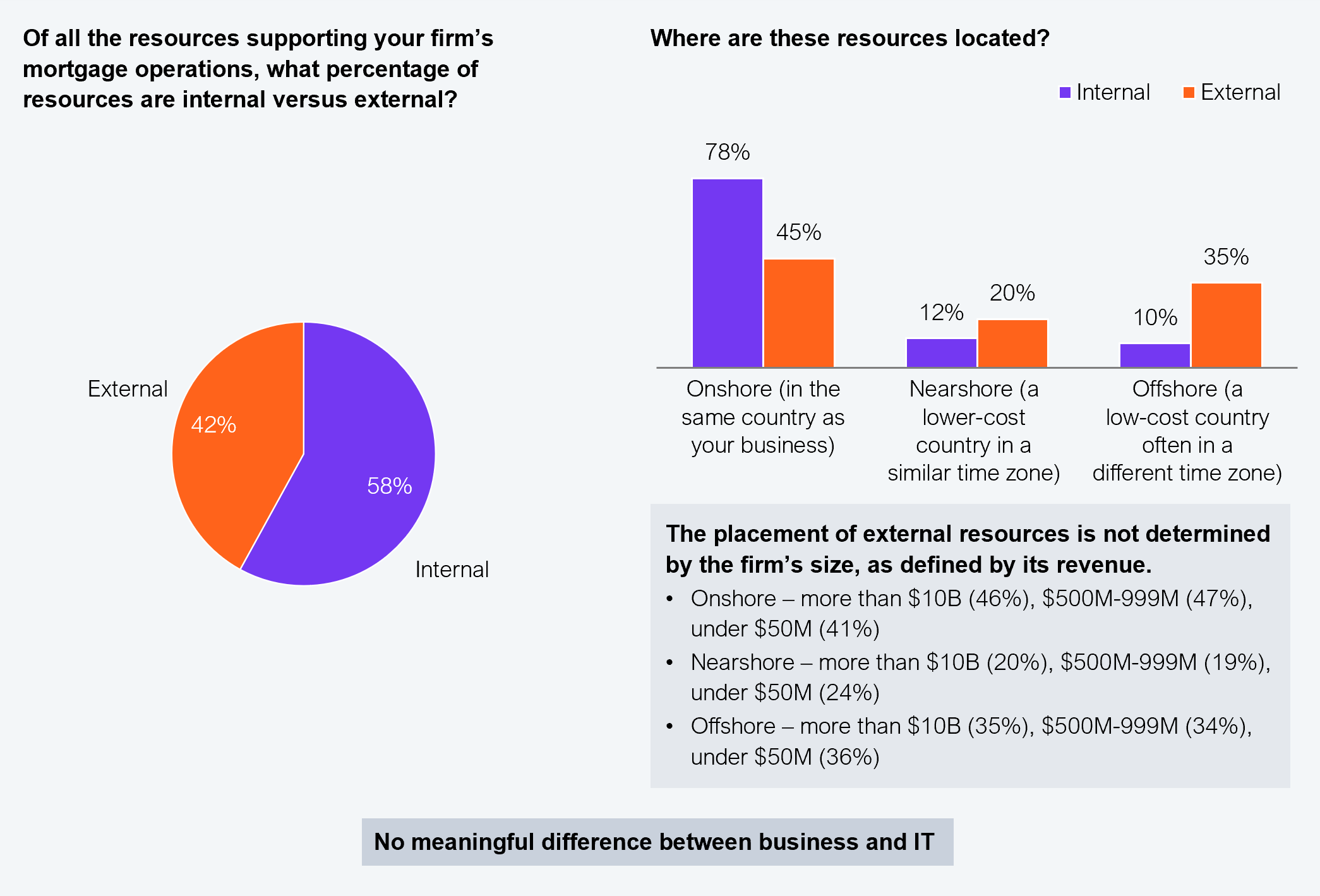
Non-bank lenders are leaning hard into outsourcing to scale and strengthen mortgage operations. Today, 42% of operations are handled externally—a clear proof of growing demand for external expertise and executional flexibility. But they’re not handing over the crown jewels. High-value, business-critical functions stay in-house, with most teams onshore and 12% nearshore, mainly through GCCs. It’s a smart hybrid play—protect core processes, data, and IP in a tightly regulated space, while using partners to stay agile and access specialized capabilities.
Sample: 257 US non-bank lenders and ecosystem partners
Source: HFS Research in partnership with Cognizant, 2025
The mortgage market has outgrown its boom-bust reflex. Non-bank lenders can no longer afford to scale with people in the highs and cut back in the lows. 2025 demands a decisive shift, anchored in platform modernization and targeted investments in automation and AI, to break free from legacy inefficiencies and cyclical constraints.
But innovation isn’t just a technology play. It’s about realigning talent, rethinking workforce models, and activating emerging technologies such as the AADA Quadfecta—Automation, AI, Data, and Analytics, to deliver measurable impact across origination, servicing, and compliance. The whitespace across the mortgage value chain is vast, but the path to value is getting clearer. Outsourcing is no longer just about lowering cost but about scaling capabilities. Strategic partners, particularly full-service firms, are stepping up to fill critical gaps, orchestrate ecosystems, and drive change at speed. For non-banking lenders, transformation isn’t optional—it’s the only way forward.
Register now for immediate access of HFS' research, data and forward looking trends.
Get StartedIf you don't have an account, Register here |
With the exception of our Horizons reports, most of our research is available for free on our website. Sign up for a free account and start realizing the power of insights now.
Our premium subscription gives enterprise clients access to our complete library of proprietary research, direct access to our industry analysts, and other benefits.
Contact us at [email protected] for more information on premium access.