
This Market Impact Report is for US lending executives, collections leaders, and fintech risk officers evaluating how to replace legacy outreach models with AI-driven, digital-first collections strategies that improve recovery rates, ensure regulatory compliance, and deepen borrower relationships.
US lenders are navigating a structural reset in consumer collections. Skyrocketing delinquencies, rising fraud, shifting repayment behavior, and tightening regulations are converging to rewrite the rules. Younger borrowers ignore phone calls and default to autopay. Frauds are growing more sophisticated. Consumers are reprioritizing debt repayment in ways that leave unsecured lenders last in line. Rising annual percentage rates (APR), regulatory scrutiny, and behavioral shifts are not just reshaping collections; they’re threatening the performance and reputation of collections businesses.
HFS Research, in partnership with Firstsource, explored how traditional lenders and fintechs leverage AI, change their strategies to reduce delinquencies, and prioritize digital engagement with customers. Alongside the survey with US lenders (conducted in the first half of 2025), we interviewed some of the leading non-mortgage and fintech lenders to uncover what’s changing, what matters most to consumers, and how fast the most adaptive lenders are rethinking collections.
The findings were clear: consumer behavior, financial stress, and fraud have fundamentally altered repayment priorities and redefined engagement channels. Legacy systems and outdated outreach models can’t keep up with evolving customer preferences, increasing friction, and risk. The future of US collections must focus on redesigning collections as a personalized, digital-first journey, rooted in real-time behavioral signals and human-centered design. Lenders must leverage AI, cloud platforms, and modular design to deliver repayment experiences that are both compliant and compassionate.
US lenders that fail to modernize collections will not just lag—they’ll lose customers, absorb regulatory penalties, and cede ground to fintechs already engineered for convenience, empathy, and speed. Survival depends on moving beyond reactive, compliance-led debt recovery and building digitally precise, human-centered collections engines. That requires embedding AI-driven insights into outreach, offering flexible repayment pathways, leveraging shared fraud intelligence, and orchestrating omnichannel engagement strategies that meet borrowers on their terms.
In the last three years, repayment behavior has shifted in ways that pushed unsecured lenders to the back of the line. They are no longer competing against a due date—they are competing for attention, trust, and notification real estate. That reality must shape everything they build next.
The signals too are clear: charge offs on cards have doubled from their low, and delinquency on consumer credit continues to climb. From 2022 to 2025, delinquency rates in consumer loans surged nearly 3%, with Gen Z and low-income borrowers most exposed. Credit card charge-offs are now over 4.5%—double the rate from three years ago (see Exhibits 1 and 2).
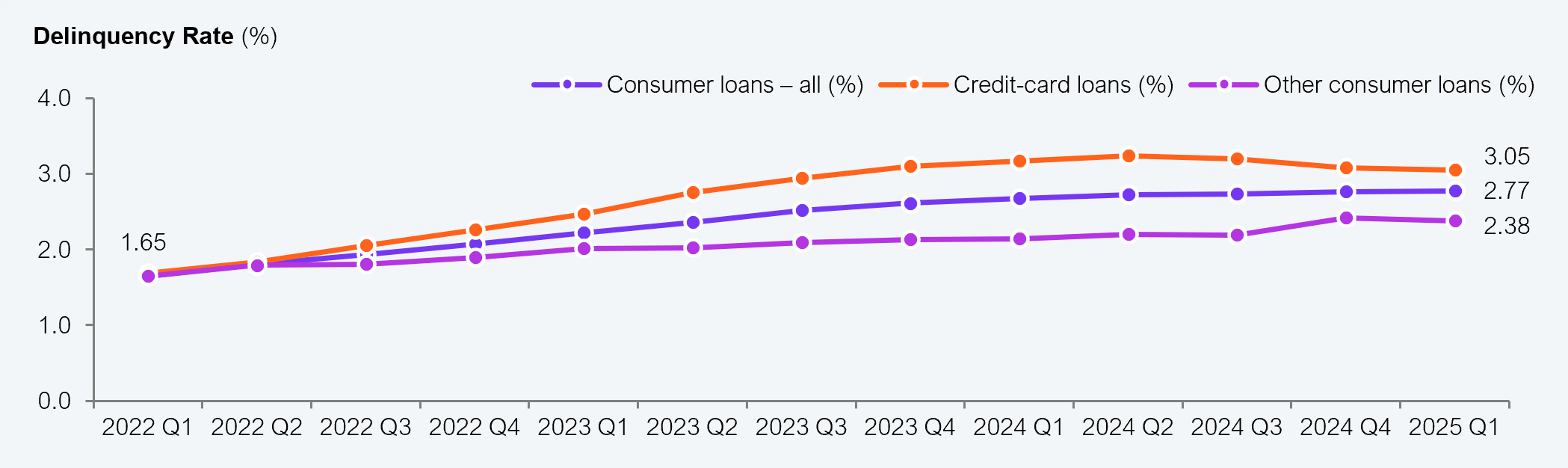
Source: US Fed Reserve, May 2025; HFS Research, August 2025
Over the last five years, we’ve seen the delinquency rates increase significantly due to economic pressures from inflation and higher interest rates, which are contributing to higher defaults.
— MD and Chief Risk Officer at a US-based fintech firm
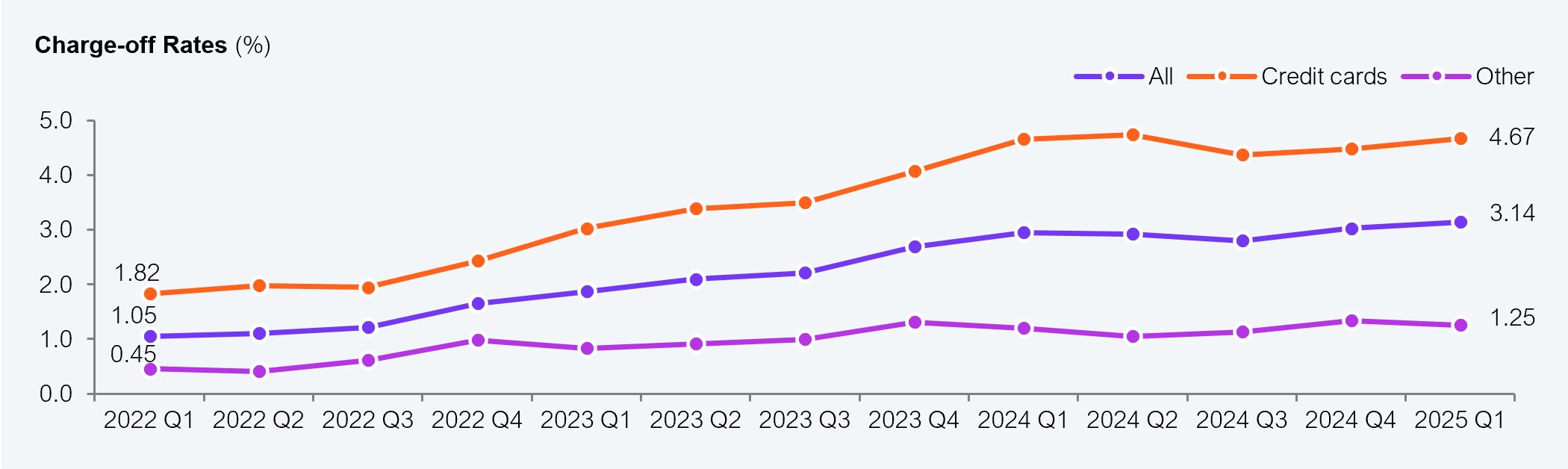
Source: US Fed Reserve, May 2025; HFS Research, August 2025
The driver isn’t a one off shock. Financial, structural, psychological, and digital factors influence consumers’ prioritization of debt repayment. Different groups have distinct repayment patterns, such as credit card users, auto loan borrowers, personal loan holders, and those using Buy Now and Pay Later (BNPL) services. Consumers fund shelter and mobility first, then select which unsecured debts to delay. In practice: rent and auto get paid, personal loans vary, and credit cards wait (see Exhibit 3).
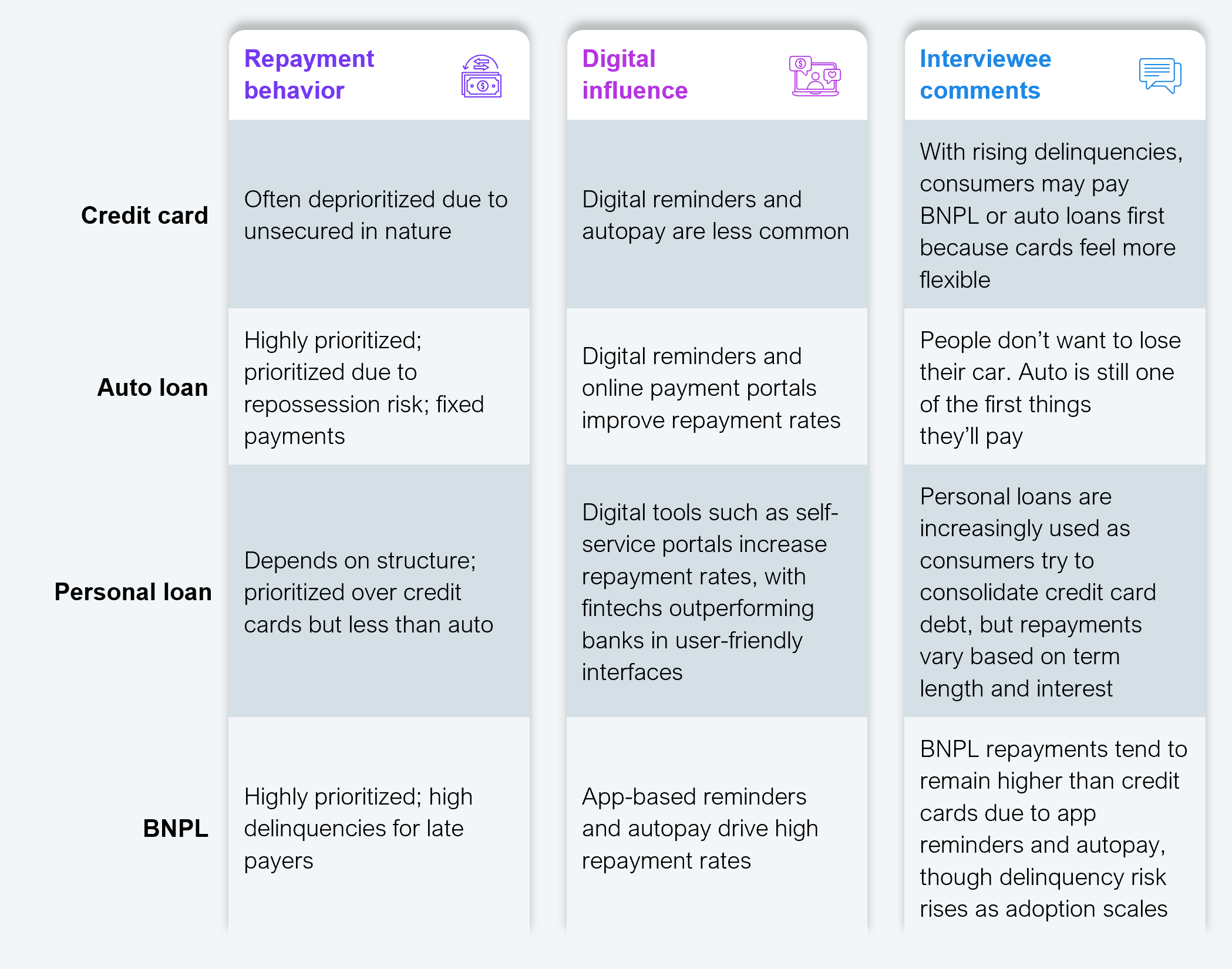
Source: HFS Research, August 2025
Consumers’ payment behavior comes from the Maslow Pyramid regarding priorities and necessities. Anything that’s related to the house, rent, and car is probably what they want to pay first.
— Vice President, Lending at the US-based investment banking firm
For lenders, the implication is simple. They are competing inside a hierarchy of necessity and flexibility, not a linear queue. That means people take longer to catch up with debt, fewer promises become payments, and each day of delay leads to losses.
Borrowers respond to low-friction pings they can control. Psychological and social stigma also impact the effectiveness of outreach methods. Text, app push, and self-service portals outperform physical notices, voice calls, and email. Digital savviness has made self-service, mobile platforms, and automated repayment options more popular than traditional methods (visiting banks, calling executives, and paying through cheques). Self-service is more than a channel shift. It’s a behavioral signal. Borrowers who avoid contact aren’t always high risk, but those who disengage digitally are. For example, over 60% of millennial borrowers prefer push notifications or chatbots, according to the collections leaders.
Even delinquent customers are more responsive to SMS than traditional outreach. Older borrowers still prefer voice and branches, while younger and mid life segments lean toward self service with human help when the stakes are high. Lenders must treat these patterns as behavioral signals, not just channel preference. The best collections teams must act like product managers, designing repayment journeys based on real-time signals and behavioral triggers.
Debt collection is under scrutiny. Key regulations such as the Fair Debt Collection Practices Act (FDCPA) and the Truth in Lending Act mandate ethical standards and limit aggressive tactics. Compliance includes upfront APR disclosures, restrictions on the frequency and timing of collection calls, and prohibitions on sharing debt information with third parties.
Every change in traditional financial institutions is difficult, expensive, and slow, primarily due to heavy regulatory compliance and internal resistance.
— VP and Head of Selective Lending at a US bank
Interviews with the lending executives revealed several changes in regulations affecting collections, particularly the increasing restrictions on lenders’ and collectors’ access to financial data through open banking APIs, which underscore consumers’ need to comprehend and manage their data use. Regulation F implemented stricter guidelines to curb harassment and unfair practices by debt collectors. Furthermore, there’s growing scrutiny of AI-driven tools regarding fairness and transparency, while the Consumer Financial Protection Bureau (CFPB) is monitoring FinTech-bank partnerships, emphasizing potential regulatory risks.
Traditional lenders have strengths, but not speed. Banks hold integrated platforms, cheaper funding from deposits, and decades of consumer trust. Branch networks and large call centers still help with frustrated customers. But trust and scale can’t offset slow change. Traditional lenders remain trapped by legacy tech batch systems, siloed CRMs, and manual interventions. If you can’t engage customers before they default, you’ve already lost the race. Younger borrowers ignore phone calls, and dated CRMs can’t personalize repayment outreach. Traditional lenders must realize that reliability without reinvention stalls progress.
On the other hand, fintechs set new expectations and introduce new risks. With instant approvals, app notifications, and BNPL, consumers expect speed, transparency, and low stigma—fueling their adoption and bringing a large share of unsecured personal loans. Thin margins, faster charge offs, and outsourced collections raised recovery challenges. As regulators tighten fintech–bank partnerships, fragile compliance practices are exposed. Multiple providers per customer also erode repayment discipline and push banks further down the line. Younger consumers often distrust traditional banks, viewing fintechs as innovative and less formal.
Interviewees mentioned that more than 50% of younger consumers utilize multiple providers, indicating their comfort with fintech platforms and ease of use. But convenience comes with cracks:
The lesson for traditional lenders and fintechs is clear: growth-at-all-costs is unsustainable without new risk, recovery, and compliance models. Collections is no longer a back-office function. It’s a frontline fight for repayment, trust, and loyalty that requires a robust digital strategy and a real-time view of customer data. Unfortunately, most lenders are hindered in their digital capabilities by legacy systems and processes that have failed to keep up with rapidly changing customer preferences, regulatory and compliance mandates, and the need to change risk and recovery strategies.
Legacy systems are no longer just an operational burden for lenders; they are an active source of risk. Every outdated platform erodes resilience across three critical dimensions: revenue risk, as slow and inefficient outreach translates into missed collections and mounting charge-offs; compliance risk, as fragmented data and siloed systems turn every customer interaction into a potential violation; and reputation risk, as younger, digital-first borrowers abandon institutions that fail to meet modern engagement standards. Modernization can no longer be framed as an optional ‘transformation project’; it must be treated as an urgent risk management imperative to protect revenue, safeguard compliance, and preserve customer trust.
A recent HFS Research survey of more than 250 US-based lending firms revealed that 36% struggle with legacy systems and 30% face data quality and access challenges. The cost of clinging to legacy now exceeds the cost of change. Decades-old cores drain capital and block AI adoption and modular innovation. To address these issues, many lenders are modernizing their technology stacks. About 39% prioritize platform modernization, and 31% invest in customer-facing digital tools, AI, and automation to enhance operational efficiency
(see Exhibit 4).
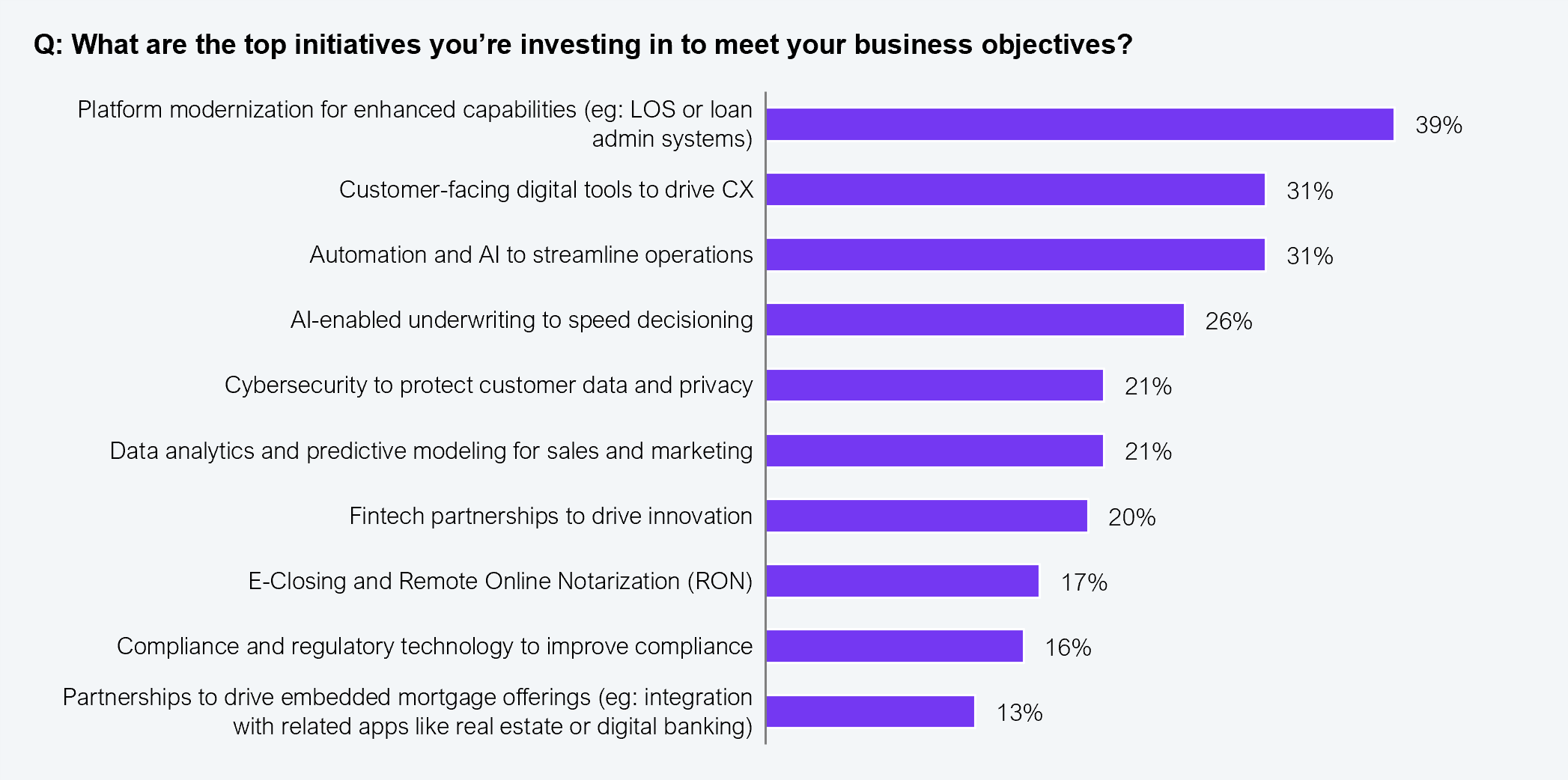
Sample: 257 US-based lending firms; total does not equal 100% as the survey was used a multi-response scale
Source: HFS Research, August 2025
Investment in technology at large financial firms isn’t consistent. Every change is difficult, expensive, and slow. Legacy systems significantly hinder AI adoption.
— VP of Lending at a US investment bank
The US debt collection leaders interviewed for the report acknowledged that collections can no longer be a blunt, transactional process and emphasized that the most effective lenders are leveraging AI and digital technologies to anticipate problems early, personalize interventions, and humanize repayment journeys. The communication channels strategy (see Exhibit 5) should be created based on consumers’ preferences and response rates, which increases engagement and reduces friction in solving repayment challenges.
The tone matters as much as the channel. For instance, an AI-driven SMS feels like a simple reminder, not a judgment. It lowers emotional resistance, increases response rates, and accelerates repayment. That means pivoting to neutral, immediate, low-friction reminders through SMS, push notifications, or chatbots to capitalize on the growing importance of technology in enhancing customer engagement and improving repayment experiences. The result: collections shift from high-cost, low-return phone calls to scalable, digital-first journeys that borrowers engage with.
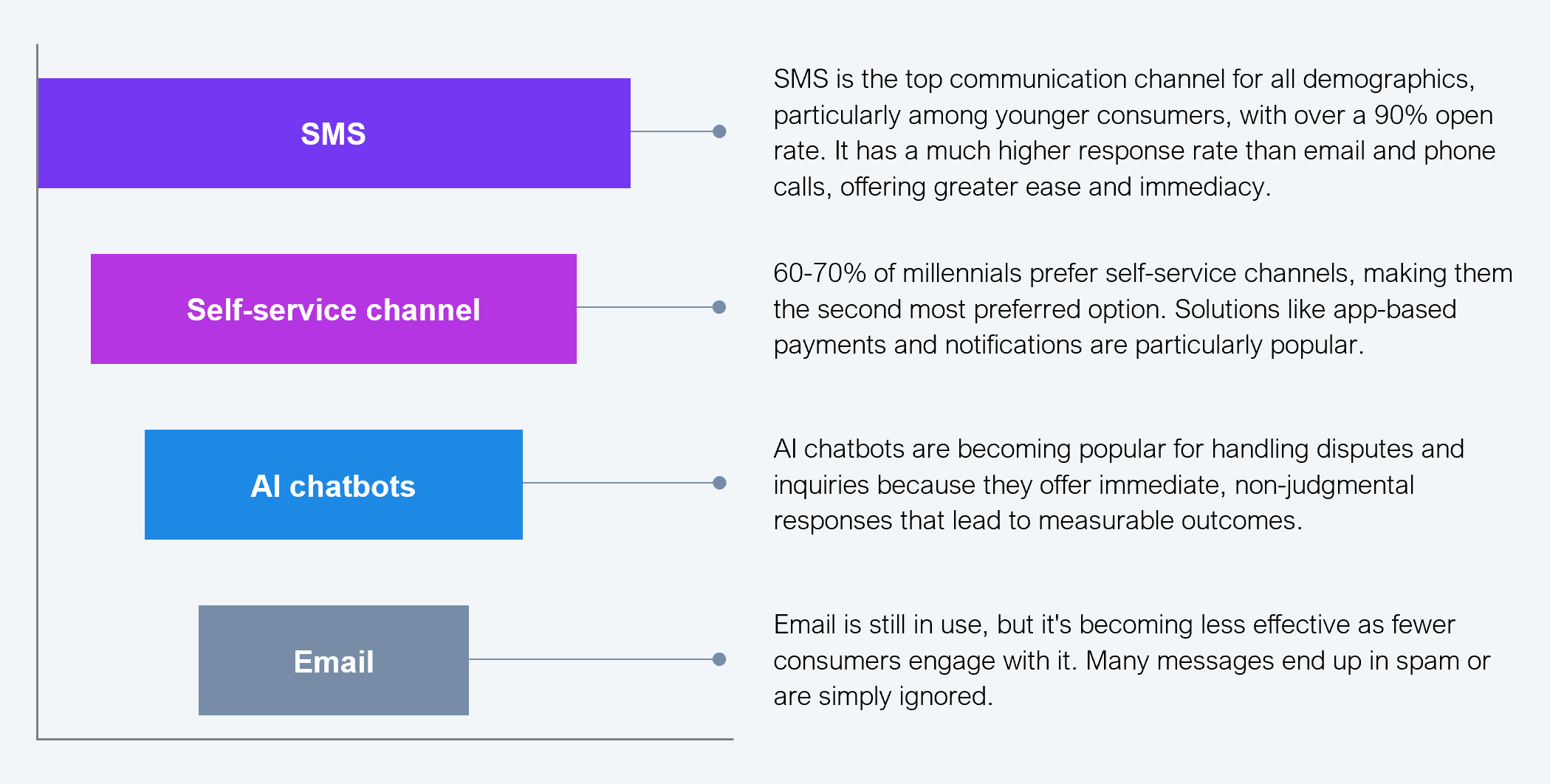
Note: The size of the block represents the indicative percentage of consumers utilizing each channel
Source: HFS Research, August 2025
SMS and AI agents’ tone is completely neutral. It’s just a reminder, not offensive. No guilt, no judgment. This lowers emotional resistance and makes it easier for consumers to respond.
— Chief Risk Officer at the US fintech firm
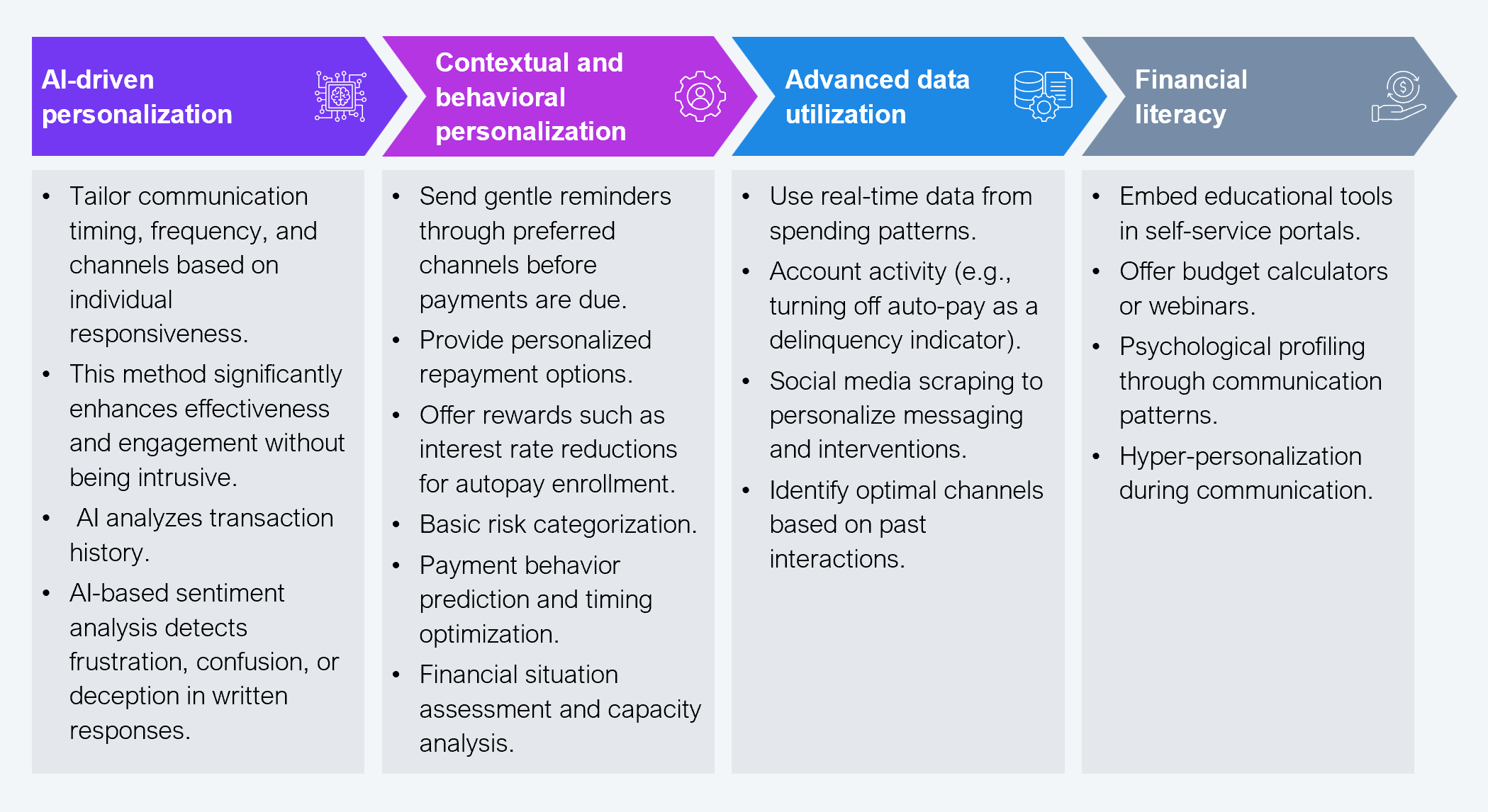
Lenders have an opportunity to transform borrower engagement by moving from basic personalization toward a holistic AI-driven journey (see Exhibit 6). Start by tailoring communication timing and tone with AI, then build on this by embedding contextual nudges such as personalized repayment reminders and incentives such as autopay rewards. Next, scale intelligence with advanced data utilization, tapping into real-time spending patterns, account activity, and social signals to predict risks and optimize channels. Finally, long-term trust can be strengthened through financial literacy tools that empower customers with education, calculators, and hyper-personalized guidance.
The executives noted that digital engagement enables early identification of delinquency. The signal is already in the data: a borrower deactivating autopay, ignoring digital reminders, or shifting channels is flashing early warnings. With the right analytics, lenders can step in before delinquency spirals.
Young borrowers tend to “set it and forget it,” using automatic payments and pay by text, while older customers insist on calling the branch so they can talk to a person. About 20–30 % of borrowers still phone the branch; the rest use auto pay or text because they “don’t want to waste time”
— AVP of a US lending firm
Source: HFS Research, August 2025
It’s important to recognize that AI models can unintentionally introduce biases from historical data as they tackle various challenges. This can result in unfair lending practices and compliance issues, making bias mitigation a crucial concern. Lenders that see ethical AI and compliance as burdens will struggle with mounting costs and delays. But those that treat it as a competitive edge build explainable AI, proactive consumer education, and empathetic digital journeys, turning regulation into resilience.
Empathy, transparency, and involvement in the customer journey are essential for success in the lending business. Many fintechs offer their customers the flexibility to make repayments during difficult times, such as job loss or unexpected family emergencies—traditional lenders can learn from this playbook. The most successful lenders reframe collections as a relationship opportunity, not a cost center. When borrowers hit tough times, they remember who offered help, not just who sent threats.
I was big on customer story because it helped us create what we can do to help them. Without customers, we have no business.
— Executive for the collections business of a large US lender
Evolving consumer protection laws are pushing collections toward softer, smarter, and more transparent strategies. Lenders must align automation with empathy, limit intrusive outreach, and empower customers with options while rigorously tracking every interaction for regulatory defense. Lenders must pay close attention to:
Today’s lenders must engage proactively and thoughtfully, understanding why customers are delinquent and demonstrating a willingness to assist. Offering hardship programs, payment flexibility, and financial literacy support isn’t just humane; it also drives higher recovery rates, improves brand loyalty, and strengthens lifetime value.
Consumers want fast feedback and flexibility. They respond if you hit them at the right time with the right message
— VP of Lending at a US-based investment banking firm
Lenders must work with vendors that manage the complete collections value chain, from early-stage first-party engagement to late-stage legal recoveries. Emphasis must be placed on combining AI insights and human empathy to help lenders understand borrower psychology at each stage of delinquency. By keeping strategy and tone consistent throughout the journey, they can achieve better recovery outcomes, ensure stronger compliance, and provide a more respectful customer experience.
Rising delinquencies, aggressive fraud, and shifting consumer expectations are not cyclical blips; they are the new operating reality. US lenders can’t rely on legacy collections playbooks built for slower economies and captive customers. They must urgently:
Register now for immediate access of HFS' research, data and forward looking trends.
Get Started


If you don't have an account, Register here |
With the exception of our Horizons reports, most of our research is available for free on our website. Sign up for a free account and start realizing the power of insights now.
Our premium subscription gives enterprise clients access to our complete library of proprietary research, direct access to our industry analysts, and other benefits.
Contact us at [email protected] for more information on premium access.

