
Business leaders, your service providers are gaining bottom line and value for AI. Are they sharing these with you?
A recent HFS study showed us that organizations use AI-ML (artificial intelligence and machine learning) to reduce operational costs (see Exhibit 1). Your service provider partners are reducing their costs with AI-ML, too. Are they passing the savings along to you? Maybe, and maybe not. In this POV, we’ll help you uncover and realize these bottom-line impacting benefits of AI-ML.
Exhibit 1: Operational cost reduction is a major driver for AI adoption
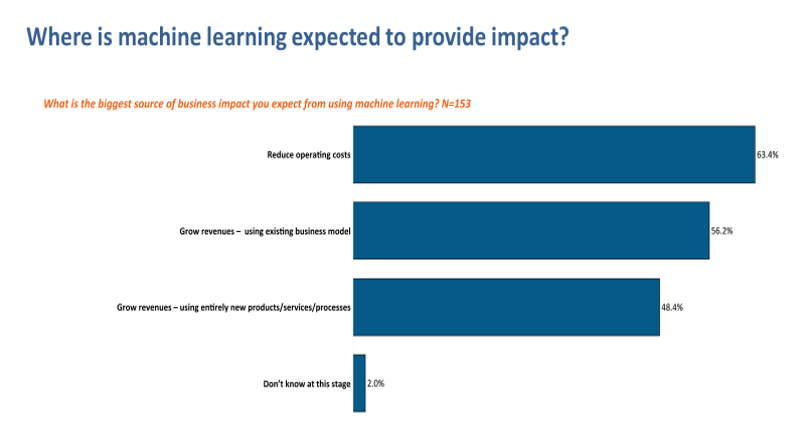
Sample: n=153
Source: HFS Research, “State of Machine Learning, 2018”
Your service providers’ operating margins are improving thanks to AI; this is the right time for you to ask all of your service partners to showcase and transfer to you the non-linear gains in service quality and cost efficiency that AI has enabled.
You might be a bit perplexed, though, about what to ask for:
To answer these questions, it’s most practical that you start with your service level agreements (SLA), which should cover the critical service value levers that monitor and govern your relationships with your providers. The SLA is the first place where your service providers and partners should display and share with you cost, efficiency, and value gains.
Take action to ensure higher value and lower costs from your service provider relationships
Demand cost-efficient, value-enhanced SLAs—AI can make them predictive, real-time, and autonomous
Raise the bar for your service provider partners in these three aspects:
HFS has crafted three action items to help you achieve an optimum SLA.
Demand predictive, real-time, and autonomous SLAs instead of traditional, reactive, post-facto, incident resolution-focused SLAs
To achieve this SLA composition:
With abundant number of AI use cases available in IT and business operations, not only do the typical response, resolution, fulfillment, and process TATs (turnaround times) become non-linearly faster and near real-time, e.g., from hours to seconds, they also become more predictive—and proactively manageable—wherever precedent patterns are available and learned by machines from historical data and knowledge bases.
This example shows how proactive, predictive, and autonomous SLA metrics could play out in a ticket resolution scenario. Traditional SLAs have five nines (99.999%) of 2-to-4–hour resolution windows for P1 tickets, 8-to-12–hour resolution for P2 tickets, and so on. When IA agents are assigned service requests or tickets, along with a contextually intelligent and dynamic orchestrator, they can instantly scale out basis work volumes, demand spikes, and infrastructure availability. As a result, they can resolve tickets in near real-time with only seconds or minutes of latency.
Where the incidents have precedence and resolutions already exist in the autonomous agents’ knowledgebase or patternbase, IA agents can accurately predict issues with fewer false positives and can sometimes resolve incidents even before they happen in a zero-incident service delivery model.
This scenario would enable these proactive, predictive, prescriptive, and autonomous SLA metrics:
Demand a new service outcome guarantee for consistency, low variance, high availability, and reliability in service quality and CSat
A unique benefit of AI is that it is consistent. AI-enabled, near-zero-touch service delivery doesn’t suffer from typical human behavioral fluctuations, fatigue, or productivity loss. If an autonomous agent can resolve a certain type of P1 incident in less than 10 seconds, it can continue to do so until the incident pattern changes and requires retraining. This improves the consistency and predictability of outcomes, the quality of service (QoS) parameters for availability and reliability, and, in turn, customer and user experience—ultimately resulting in better CSat and NPS (Net Promoter Score).
Demand new cost of service models
The cost of service delivery should decrease significantly. You must demand a partial transfer of those cost benefits back to you in addition to any gains in service quality, efficiency, and experience.
For example, consider the following scenario:
For this enterprise, these three service delivery characteristics combined could lead to a cost reduction of at least 6% to 12% on existing scope of work of service contracts.
In general, through effective AI and automation solutions deployments in service operations processes like tickets and requests classification, resolutions, recommendations, service restoration, request fulfillment, and provisioning, enterprises could realistically achieve efficiency gains of 5% to 15%.
Bottom line: Your service providers must pass the value and cost efficiency gains they are getting from AI to you.
As end-user enterprise AI leaders and teams, you must demand outcome-based, proactive, and predictive SLAs with near-zero incident frameworks and significant cost efficiencies while negotiating on services contracts.
Register now for immediate access of HFS' research, data and forward looking trends.
Get StartedIf you don't have an account, Register here |
With the exception of our Horizons reports, most of our research is available for free on our website. Sign up for a free account and start realizing the power of insights now.
Our premium subscription gives enterprise clients access to our complete library of proprietary research, direct access to our industry analysts, and other benefits.
Contact us at [email protected] for more information on premium access.

