
The travel industry is a dynamic hotbed of complexity, where aligning the ecosystem to customer experience is remarkably complicated. Airports, in particular, have a short time frame for making or breaking a passenger experience; their business operations require fluidity and agility, often starting with the supporting IT infrastructure. The ability to connect a widely disparate array of systems coming from numerous stakeholders is a complicated task, and it’s even more challenging to enable and promote a culture to support seamless processes and communications.
Enterprises undergoing transformation can learn many lessons from an airport that is in the process of completely reimagining the way its passengers—and its internal and ecosystem stakeholders—experience and interact with its operations. This POV examines the Greater Toronto Airports Authority’s journey with its services partner Wipro to create new passenger experiences through a transformation from the ground up.
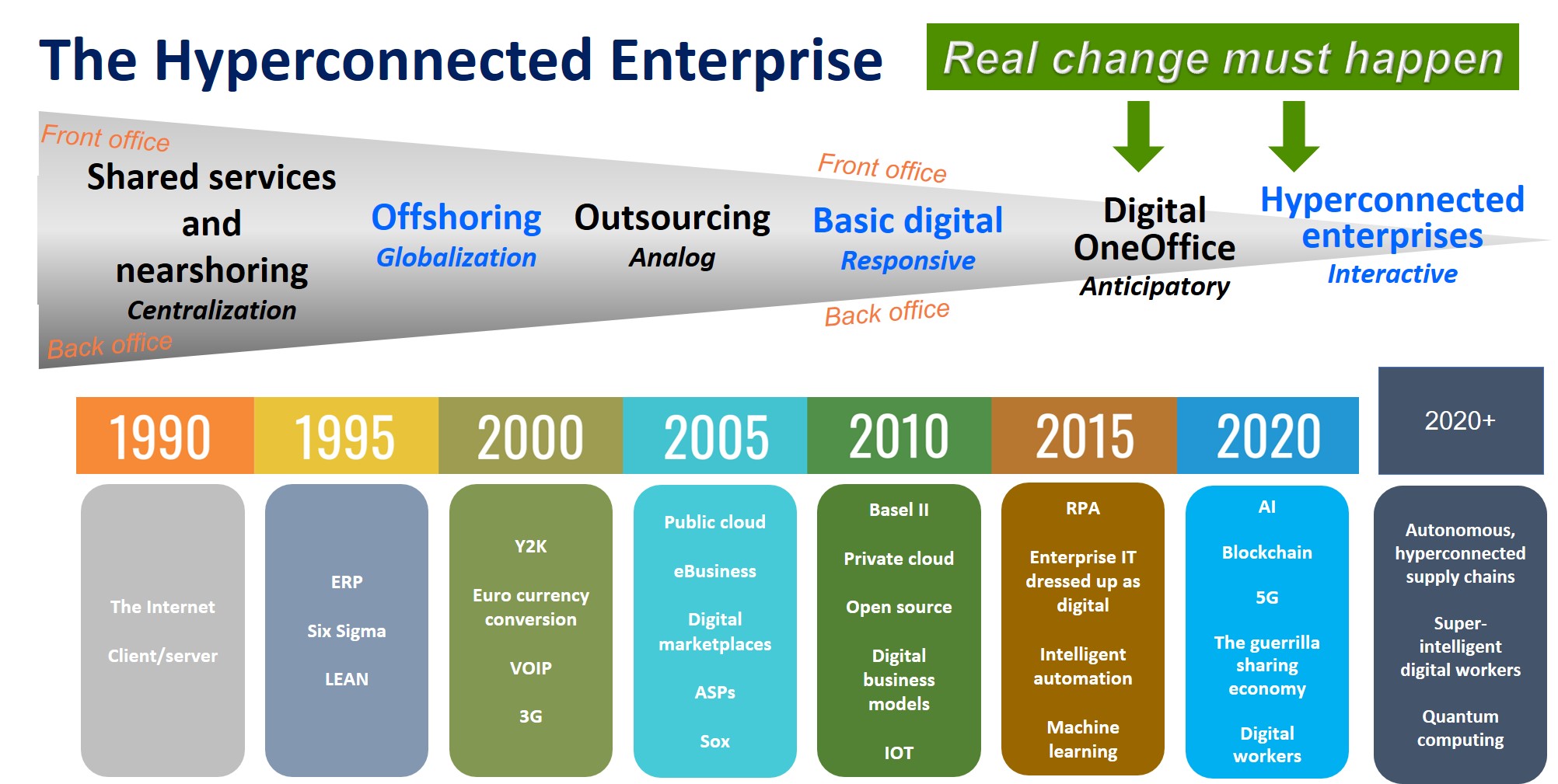
Enterprises of all kinds need an IT infrastructure that supports the business process logic and design required to run business operations as intelligently as possible. HFS Research describes the hyperconnected enterprise (see Exhibit 1) as fundamentally redesigning IT to help a business anticipate customers’ needs and quickly respond to them. Enterprises need to be as hyperconnected and autonomous as possible if they want to stand up to disruption; the complex ecosystem of an airport hub requires this kind of hyperconnectivity. Consider not only the customers (passengers) but also the airlines, retail vendors, security, and government authorities—all attempting to align for seamless operations, anticipate stakeholders’ needs, interact with each other, and get people where they want to go—while dealing with uncontrollable dynamics like the weather.
Exhibit 1: Airports need to embrace real change to become hyperconnected enterprises
Source: HFS Research, 2019
Greater Toronto Airports Authority is taking transformation to heart and putting the customer at the center
Developing the “why”: a burning platform for change
Greater Toronto Airports Authority (GTAA) operates Canada’s largest airport, Toronto Pearson International, which is in the middle of a major transformation to enable better passenger experiences. Toronto Pearson, the second largest airport for international passenger traffic in the region, serves as a gateway to North America. Sixty-five (65) airlines serving over 180 destinations operate from Toronto Pearson. In 2018, an average of 135,000 passengers traveled through Pearson Airport daily. GTAA has a unique opportunity to grow Toronto Pearson into a “mega-hub” serving over 85 million passengers by 2037.
The scope of Pearson’s reach and the demand for air travel in the region make it clear that there is a massive opportunity for growth in GTAA’s revenues and prestige. Sometimes, however, opportunity alone isn’t the burning platform for change; potentially injurious consequences can get the gears in motion. Severe system crashes in both 2010 and 2012 damaged Pearson’s reputation and caused a huge disruption at great cost. Then, in 2017, baggage system issues caused lengthy check-in delays, leading to more passenger dissatisfaction and negative media coverage. All GTAA leadership had to do was look around the airport at luggage in disarray to know that its current operations were not sustainable—and they found their big transformation “why.”
This epiphany created a ripple-effect of changes in the organization, not least of which was switching from an incumbent service provider to its current IT and business operations services partner, Wipro. GTAA chose Wipro as a partner based on its extensive experience transforming operations for airports in Delhi, Mumbai, and other cities. Wipro whittled Pearson airport’s unwieldy 150 vendors down to 90 and wrapped them into its contract with GTAA, providing a single point of accountability. With this, Wipro assumed end-to-end ownership and co-created a roadmap to transform GTAA’s IT environment, including modernizing the decaying physical infrastructure, which desperately needed revamping. The partnership quickly focused on modernizing the IT systems to provide highly available, scalable, and resilient IT capabilities to support uninterrupted airport operations. Soon, basic efficiencies improved significantly; for example, the mean time to repair was reduced by 85%.
The impact of digital: customer experiences are at the epicenter of every transformation
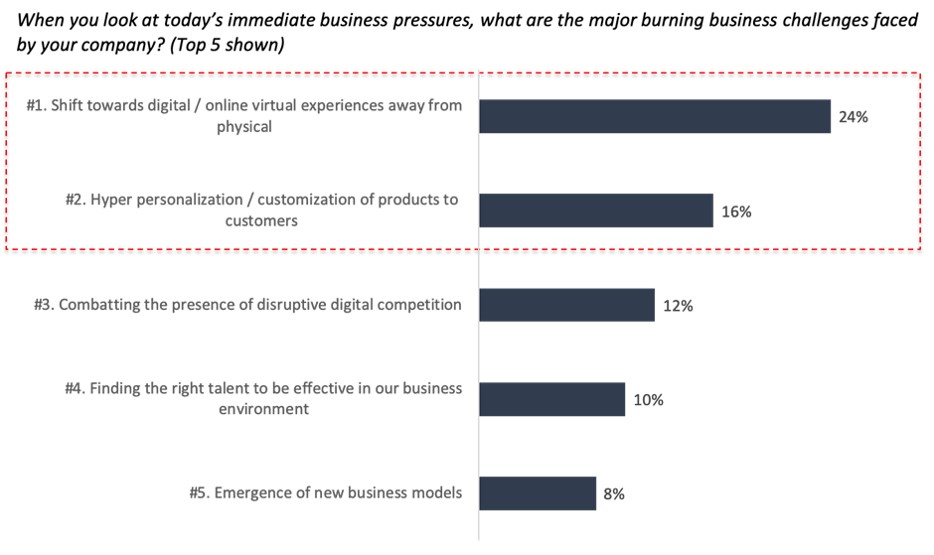
GTAA’s transformation began with its infrastructure, but it is enabling a plethora of changes to support digital experiences. Digital technology fundamentally changes how people and businesses interact—demanding different types of experiences. A recent HFS Research survey indicated that the shift toward digital and online experiences away from physical experiences was the top burning business challenge enterprises faced (Exhibit 2). This is a bit of a paradoxical challenge for airports, where the physical experience is inherent and interminable. However, the dynamic between a passenger’s digital and physical experiences needs to evolve and become seamless to fundamentally embrace a digital and hyperconnected ideal.
Exhibit 2: Airports need to shift toward digital experiences
Source: HFS Research supported by KPMG, “State of Operations and Outsourcing” 2019, n = 355 Global 2000 Enterprise Leaders
While focusing on the physical experience at the airport with improved efficiencies, GTAA recognized that a passenger’s journey starts well before he arrives at the airport. Passengers will often interact with the website and the contact center prior to their travels. As such, striking the right balance between traditional physical and digital experiences is an important part of meeting customer expectations for a seamless airport experience. Some of GTAA’s first business-oriented initiatives had a keen focus on digital customer experiences, starting with a revamped website where it updated its digital content to include an AI-enabled search. The airport also completely transformed its contact center and upgraded its systems to allow for self-service, resulting in a 40% reduction in calls and an average wait time of less than 30 seconds—down from 45 minutes.
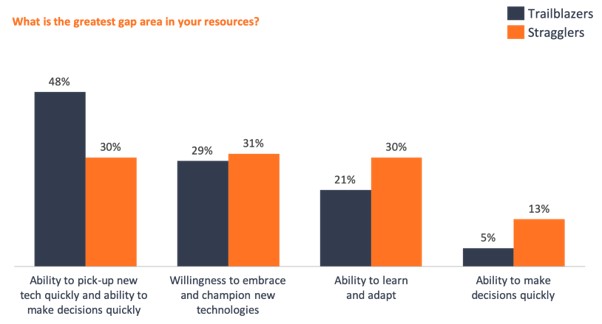
As we look toward the hyperconnected ecosystem, there are still many unknowns about the impact of emerging change agents like blockchain, AI, and IoT. Thus, transformation is not just about having technical skills, because these things are constantly changing; what’s most important is having a culture that fosters change and can embrace new technologies. In a recent HFS research study, we found that a majority of companies are struggling either with the ability to pick up new technology quickly or a willingness to embrace new technology (Exhibit 3). Those companies that are further along the path to customer-centricity (labeled “Trailblazers” in Exhibit 3) are much more concerned with technical capabilities and quickly making decisions, whereas those lagging (“Stragglers”) are more concerned with the ability to learn and adapt. These cultural issues—the willingness to embrace change and the ability to learn and adapt—can be far more challenging than addressing a gap in technical skills, but both require a talent and partnership strategy that can help address this gap.
Exhibit 3: Enterprises struggle with skill and will to compete
Source: HFS Research, 2019, n = 262 Business Leaders
In the complex ecosystem of an airport, the “will” is an incredibly challenging dynamic; getting various stakeholders to align to common outcomes and embrace changes and new technology is very difficult. GTAA found that showing its stakeholders where they can benefit from making changes is crucial. Where some of these cultural alignments started out feeling dysfunctional, things changed once the IT organization was back in shape and proving the ability to deliver on its promises and ideas. Once stakeholders such as airline agents saw the benefits to their customers, they began to support GTAA and advocate for more changes along with the transformation. The GTAA ecosystem at Pearson is getting concerted alignment toward the customer experience—and seeing the results.
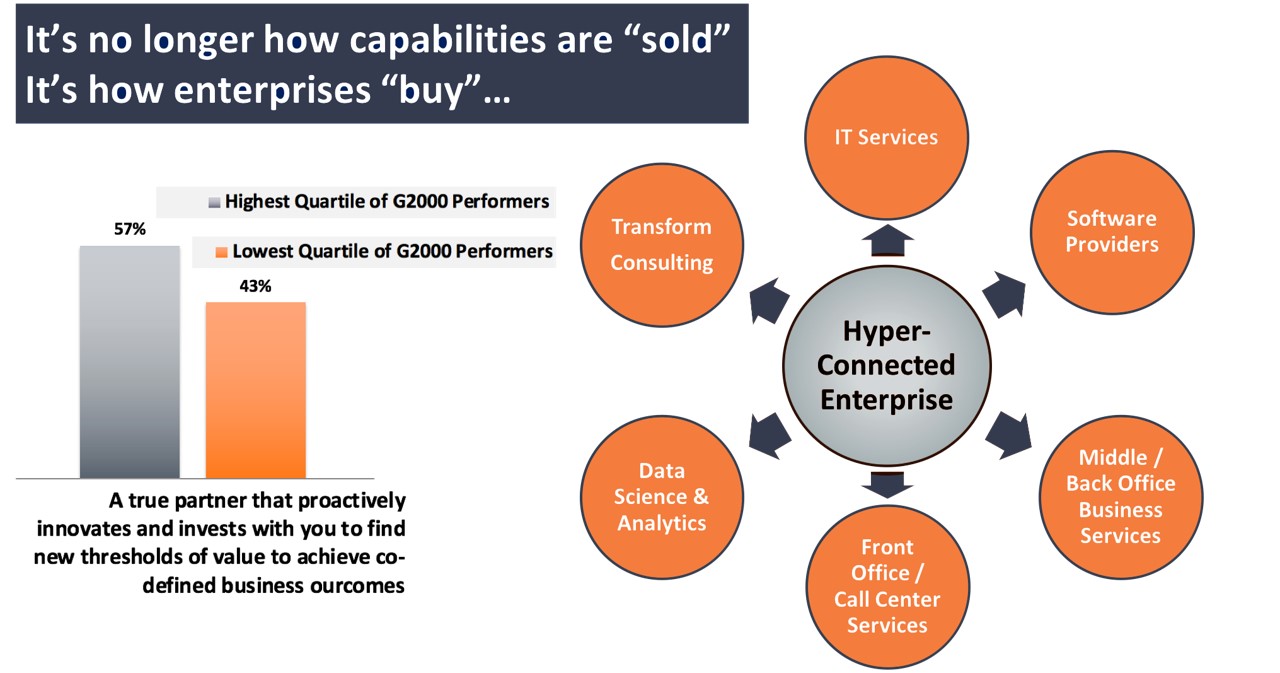
Partnerships play a big role in filling talent gaps and in helping customers evolve their culture to embrace change. HFS believes that the journey to the hyperconnected enterprise of the future is driving a shift in how companies are buying services. The highest growth organizations in the Global 2000 (as rated by financial performance) are more likely to be seeking “true partnerships” that invest in co-defined business outcomes (see Exhibit 4). GTAA cites a key ingredient of the way the partnership works is the trust between the two organizations and the resulting autonomy Wipro has been given to make decisions, also creating greater agility for change.
Exhibit 4: High-performing enterprises are more focused on partnerships that co-innovate and invest
Source: HFS Research, 2019
“The infrastructure cleanup has freed up our team to focus on the fun, exciting stuff.”
—Glenn Evitt, Director of IT, GTAA
Innovation as a discipline: Wipro and GTAA’s innovation program develops solutions that improve the passenger experience
Leveraging the right partners in the right way is a vital piece of addressing the “skill” and “will” resource gap so many enterprises face. As airports are inherently risk-averse organizations, the Wipro and GTAA team wanted to collectively create a more innovation-focused culture that allows them to think differently and pilot ideas in a safe and quick process. This has been a huge game-changer in shifting the culture at GTAA to one that embraces change. The Wipro team has done some out-of-the-box thinking to spark innovative thinking at GTAA; for example, it mocked up the airport floor at its operations center in Pune, India. The Wipro team is regularly involved in candid conversations with GTAA leadership, where people are encouraged to share ideas, thoughts, and concerns openly.
Cleaning up the decaying infrastructure and the vast improvement of efficiencies that followed enabled a shift in thinking at GTAA, which has further aided in a shift toward a culture of innovation. “The infrastructure cleanup has freed up our team to focus on the fun, exciting stuff,” Glenn Evitt, Director of IT at GTAA, told HFS.
This kind of partnership approach is already yielding results beyond efficiency and cleanup. Since the strategic partnership with Wipro, GTAA has made tremendous progress, and the IT department moved its engagement score rating from one of the lowest to the highest among all the departments at GTAA in 2018. And for the first time in its 80-year history, Toronto Pearson was rated as the Best Large Airport by ACI in North America in 2017, a rating it maintained in 2018 with the addition of Most Improved Airport title. Here are some of the innovations that led to these dramatic improvements:
“The plethora of ideas is more than we can handle, but it’s a good problem to have.”
—Glenn Evitt, Director of IT, GTAA
The Bottom Line: Once you’ve found your burning platform for change, find partners to co-innovate and invest in the skills and culture needed to support the transformation of your customer experience.
This continues to be a journey for GTAA, with an eye on the future and many plans to keep bucking their old status quo and reinvent themselves to be one of the top airports in the world for passenger experience. Next up on the docket for experience transformation at Pearson and GTAA includes experimenting with conversational AI for flight status updates and blockchain for baggage tracking. This new era of innovation for GTAA has been so inspiring, it can at times be overwhelming: “The plethora of ideas is more than we can handle but a good problem to have,” said Glenn Evitt, Director of IT, GTAA. This mindset goes to show that the hyperconnected enterprise is not some static end state to attain; it is a constantly evolving model that requires agility to continue pivoting toward becoming an experience-focused business. As the technologies we are keenly interested in today evolve, enterprises and their partners must continue to re-evaluate, sense, and predict how experiences must evolve in return—and have not only the skill but also the will to execute on a vision for those experiences.
Register now for immediate access of HFS' research, data and forward looking trends.
Get StartedIf you don't have an account, Register here |
With the exception of our Horizons reports, most of our research is available for free on our website. Sign up for a free account and start realizing the power of insights now.
Our premium subscription gives enterprise clients access to our complete library of proprietary research, direct access to our industry analysts, and other benefits.
Contact us at [email protected] for more information on premium access.


