
Challenger banks (like Monzo) and encroachments from powerful brands (like Orange) and ambitious Chinese players (like Alipay) present competitive challenges to financial services providers. Easier authentication, payment, and customer service are at the heart of modern customer experiences, and customers have high expectations. The explosion in fintech and other emerging technologies creates opportunities to radically overhaul business models and business practices. But, change is hard, talent is scarce, and an environment conducive to innovation is a culture shock for many established institutions. To successfully transform, businesses must support innovation from initial experimentation through to new ways of doing business that will become the “new normal.” HFS recently spent some time with Capgemini’s Financial Services team learning about the challenges it’s facing with its customers in this vertical.
While Capgemini’s IT services customers span major industries, its biggest vertical is financial services, comprising over a quarter, or 27% of FY2018 revenues and supporting relationships with big names globally including Wells Fargo, ANZ, Allianz, Bank of Ireland, and Lloyds. The demands on the C-suite in this vertical are high. It must balance resources to support the current way of doing things—keeping the lights on—while delivering growth, driving down costs, retaining customers, and maintaining margins. Cybersecurity must be top-notch, too. All of this—while creating a whole new way of working! Driving persistent progress in building out new business models, ecosystems, architectures, infrastructures, and customer experiences involves trying many new things, some of which will fail.
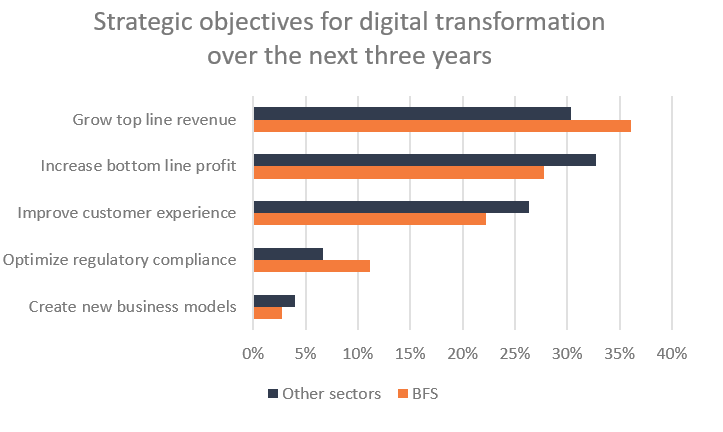
In a recent HFS survey, 368 respondents ranked digital transformation priorities. In Exhibit 1, we see the percentage of financial services respondents that ranked each item first compared to other verticals. Growing top-line revenue continues to be important for BFS firms, but taming costs ranks a close second. Compared to other industries, the priority order is telling. Any service provider helping BFS clients needs to focus squarely on helping them drive revenue.
Exhibit 1. Revenue growth trumps cost saving for BFS
Source: HFS Research, 2019
Capgemini built a single digital transformation consulting business, drawing previous acquisitions (Adaptive labs, Fahrenheit 212) and other pockets of innovation-led consulting expertise together to go beyond ideation to realization. Capgemini’s design thinking approach bolstered by acquisition is not unique—IBM’s “cognitive garage” concept is but one that is similar. And, indeed, a steady increase in engaging with start-ups directly to bring emerging technologies directly to clients is commonplace. Capgemini is, however, bringing some joined-up thinking to the table, helping its clients figure out what’s what with new technology and who’s who in start-ups and categorizing it in a useful way.
Three big challenges are apparent in banking; Capgemini’s responses to these challenges are largely in line with HFS’ views on practical routes forward:
Partnering is not embedded in financial services companies’ DNA today; it’s a new and growing challenge. Even identifying the right partners can be difficult, especially as fintech start-ups proliferate. Capgemini is developing a maturity assessment to help financial services companies navigate the world of start-ups. Do they have enough money, a good team, and a decent sales strategy? Once Capgemini qualifies a start-up, it takes a deeper look at stability and ability to scale. It categorizes start-ups and applies a rating, such as Promising or Emerging.
Capgemini is also supporting building out an ecosystem with partner system integration. TransferWise is integrating with banks’ online and mobile platforms to make its low-cost money transfer service available. Capgemini integrated a project with TransferWise at one large bank within two weeks, including the legals, commercials, and integration.
Despite all advice, silos with disjointed data are rampant throughout financial services providers’ systems, and business processes are cumbersome. Capgemini’s Cognitive Document Processing (intelligent automation) makes a start here, extracting data from unstructured data sources.
Now is the time for ambition, pragmatism, and action, especially as ecosystems come into play. In addition to the existing challenges with internal systems’ complexity and silos you need to make processes work across external systems too.
Transformation is not optional; slavishly adhering to the old rigidity or merely scratching away at the surface with a cost-cutting mentality presents greater risks.
The Bottom Line: Experimentation must go beyond cost transformation and evolve into new ways of doing business, supporting co-creation of new processes and new ecosystems. The new challenge is piecing together new applications, architectures, and infrastructures rather than developing custom solutions.
Cost transformation is the main ask that customers make of Capgemini, more than digital transformation, but the agility that’s needed to underpin constant change is still not there, so a multi-pronged approach makes sense, reinventing for agility.
Interestingly, Capgemini is working toward new business models with shared outcomes. It’s also experimenting with some new intermediary roles such as aggregation, bringing others together and facilitating participation from non-traditional players. These new intermediary roles represent a whole new way of thinking about the role of IT services suppliers as businesses transform, certainly a more progressive approach than the traditional IT services business model where time and materials is the primary pricing mechanism.
Register now for immediate access of HFS' research, data and forward looking trends.
Get StartedIf you don't have an account, Register here |
With the exception of our Horizons reports, most of our research is available for free on our website. Sign up for a free account and start realizing the power of insights now.
Our premium subscription gives enterprise clients access to our complete library of proprietary research, direct access to our industry analysts, and other benefits.
Contact us at [email protected] for more information on premium access.

