
This Market Impact Report is for HR, operations, and technology leaders designing or investing in frontline workforce strategies to reduce attrition, close the digital experience gap, and build the operational model conditions that keep deskless workers engaged.
A wake-up call from the frontline
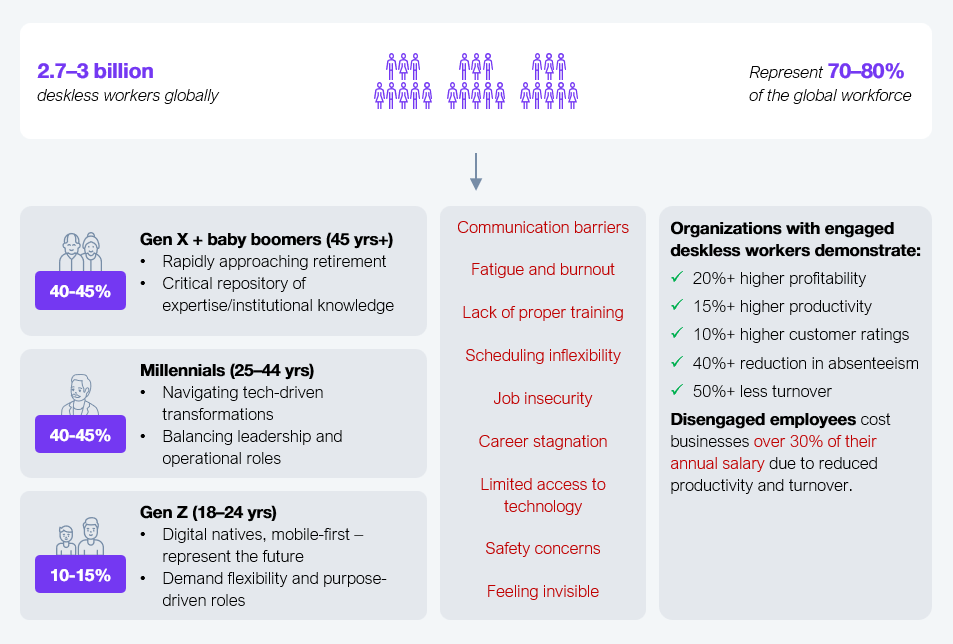
Deskless workers make up the majority of the global workforce, yet they remain digitally underserved and emotionally disconnected. Despite their critical roles in keeping operations running, their needs and experiences are often unintentionally overlooked in digital transformation efforts.
Source: HFS Research, 2025, Boston Consulting Group, Gallup
Deskless roles span industries, employment models, and generations. Millennial workers are experiencing rising levels of burnout, driven by the pressures of work and family life. Older workers, particularly baby boomers, have institutional knowledge but are increasingly at risk as they near retirement. Gen Z is entering the workforce with strong expectations around purpose, recognition, and values alignment. Addressing the needs of such a wide-ranging group requires more than generic tools or broad-brush policies (see Exhibit 1).
This report identifies the critical design levers for significantly enhancing deskless worker effectiveness. The insights are drawn from:
Three themes emerged clearly from the study:
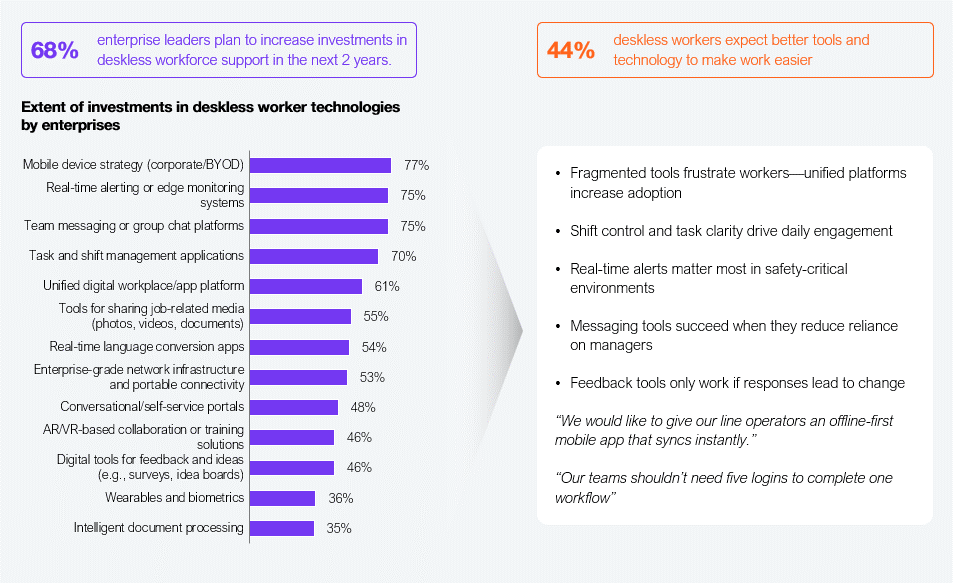
The good news is that 68% of executives plan to increase investments in deskless worker initiatives over the next two years (see Exhibit 2). These investments can deliver transformative value with a renewed focus on usability, inclusion, and experience design.
Sample: 605 Deskless Workers and 102 Executive Participants
Source: HFS Research, 2025
Ultimately, empowering deskless workers is not about re-architecting how work is fundamentally experienced and supported. It starts by putting their needs not at the edge but at the center of enterprise transformation.
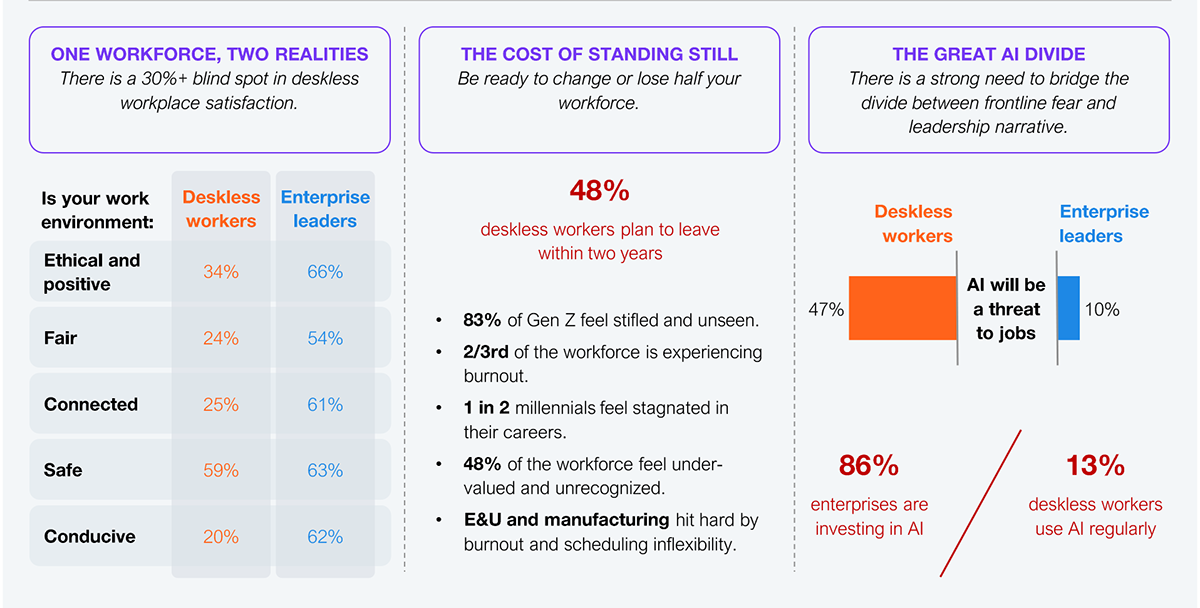
A significant perception gap (of >30 points) exists between leadership vision and frontline employees’ lived reality and satisfaction (see Exhibit 3). This blind spot spans recognition, safety, fairness, and opportunities for professional growth, reflecting a disconnect between corporate strategies and frontline experiences.
Sample: 605 Deskless Workers and 102 Executive Participants
Source: HFS Research, 2025
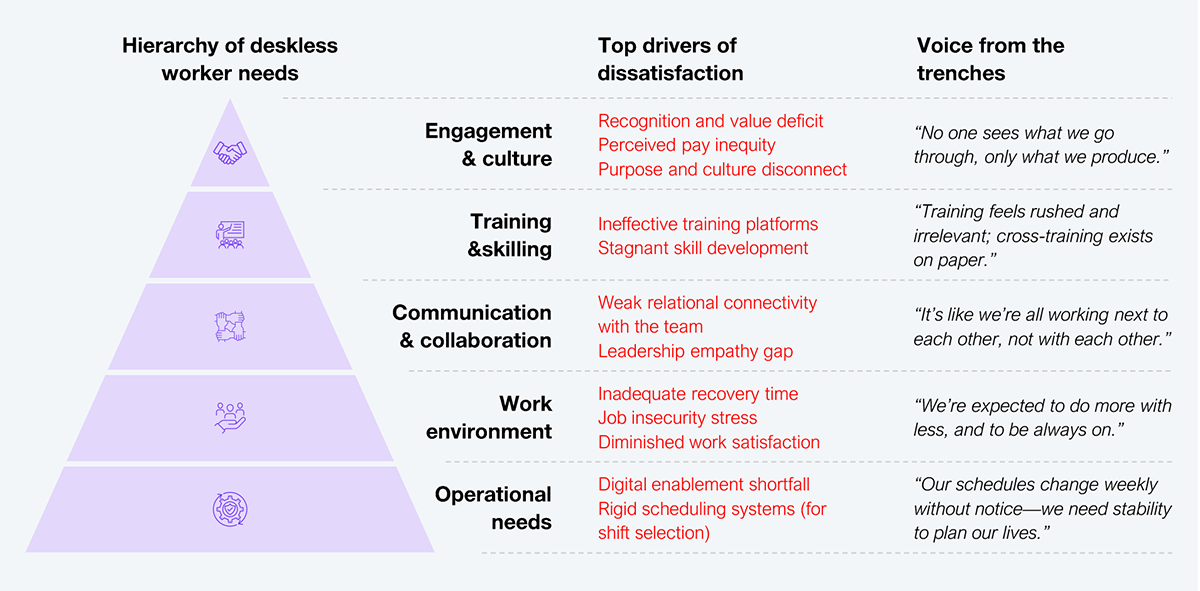
Beneath this perception gap lie deeper frustrations that often appear as surface-level issues such as scheduling conflicts and outdated tools but are underpinned by unaddressed cultural and emotional drivers (see Exhibit 4).
Sample: 605 Deskless Workers and 102 Executive Participants
Source: HFS Research, 2025
We’ve built HR systems for office workers, but forgot the people out in the fields who are also our employees.
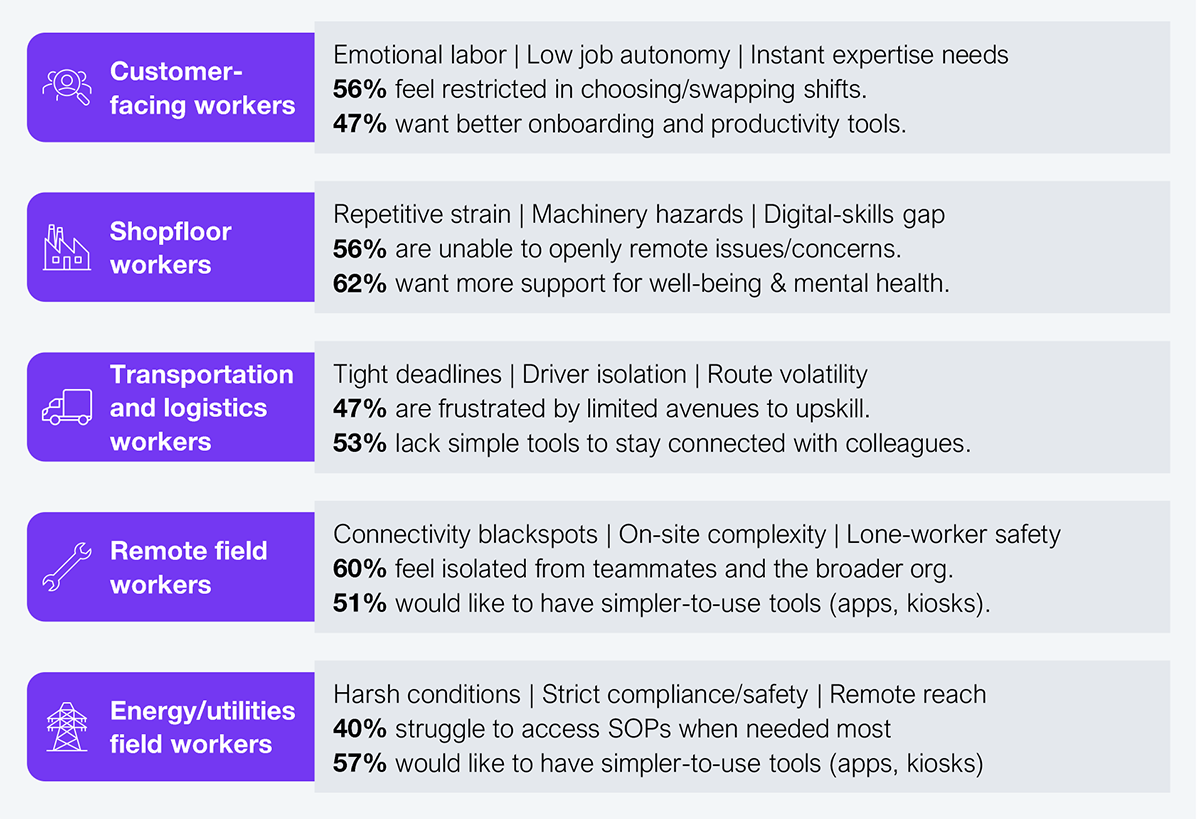
These challenges play out differently across frontline contexts—from the emotional toll on customer-facing staff to the physical risks of field technicians and the isolation of logistics workers. Each cohort faces unique pressures that require tailored support strategies.
Sample: 605 Deskless Workers and 102 Executive Participants
Source: HFS Research, 2025
One-size-fits-none. The same deskless label covers lab workers, drivers, and retail reps—but their needs are worlds apart.
These problems, while real, are surmountable. Overcoming them requires moving beyond one-size-fits-all approaches and embracing solutions tailored to diverse frontline needs. The key lies in thoughtful design and execution—for instance, simplifying workflows for younger staff while respecting and leveraging senior employees’ expertise.
Emerging technologies, particularly agentic AI, offer transformational potential when co-designed with workers. Organizations can accelerate adoption, streamline operations, and build trust by aligning AI with frontline realities, creating a foundation for measurable
business value.

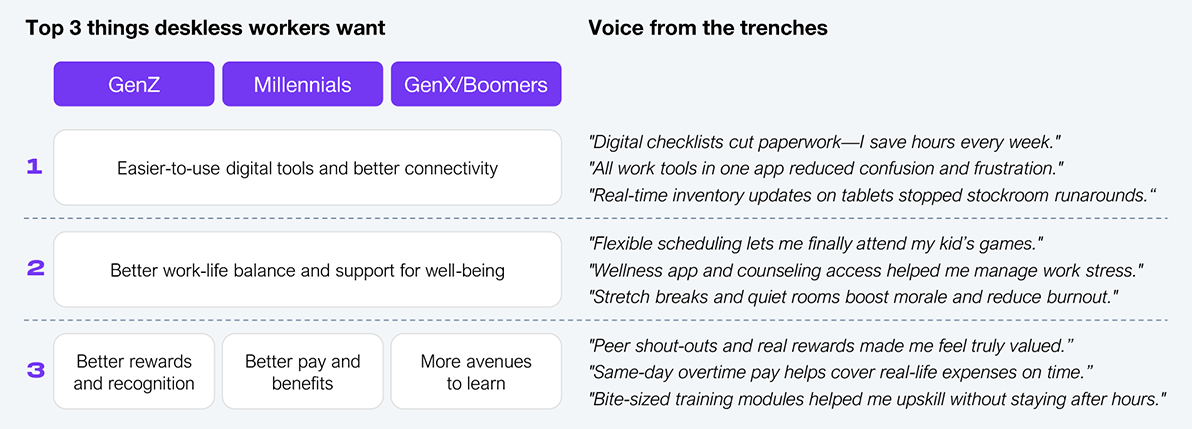
Many deskless workers still lack seamless access to digital tools, often juggling fragmented systems, multiple logins, and desktop-centric platforms that don’t fit their dynamic environments. Centralized solutions built for office-based staff rarely align with the daily rhythms of frontline work (see Exhibit 6).
We thought giving kiosks was enough, but the systems crash or require passwords no one remembers.
People trust their DoorDash app more than our internal systems.”
Sample: 605 Deskless Workers and 102 Executive Participants
Source: HFS Research, 2025
Design principle #1: Focus on experience, not access
Technology should create value by being mobile-first platforms that unify scheduling, communication, safety alerts, and training, much like trusted consumer apps. Kiosks remain valuable, but only when they are well-placed, updated, and supported by mobile or voice-enabled tools. Tools that sync in real time with shift changes and operational priorities build trust and reduce friction. Consumer-grade user experiences, such as fast logins and intuitive navigation, make adoption seamless rather than frustrating.
The Monday morning whiplash is real. You go from smart personal apps to clunky portals that slow you down.
Our people use voice assistants and order food in two taps. But at work, they’re expected to reboot kiosk terminals to check schedules.

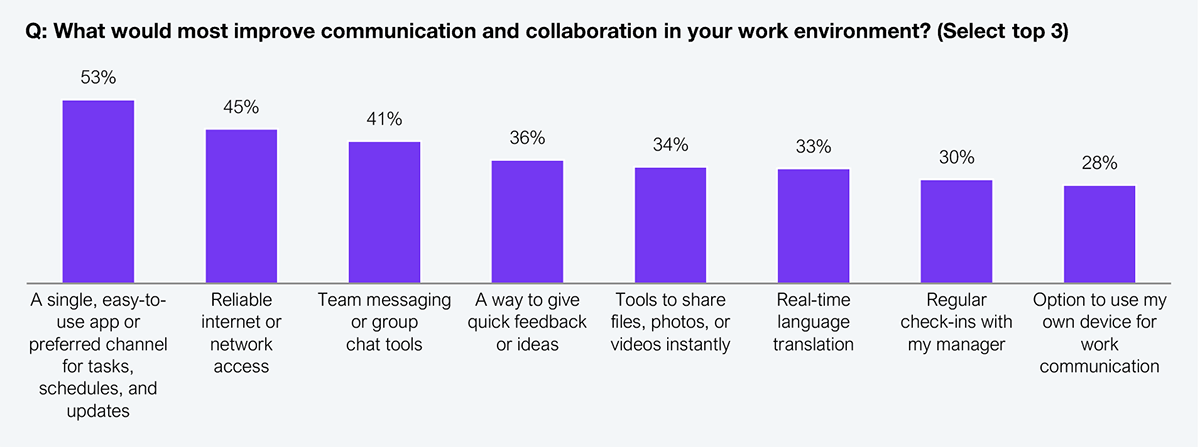
Fifty-three percent of deskless workers said they lacked easy, reliable ways to communicate with peers and managers. While many tools exist, they are often clunky, outdated, or optimized for office settings compared to the front-line roles’ fast-paced and mobile environments. Communication is frequently asynchronous or locked behind portals that are difficult to access during shifts.
Executives often believe their communication systems are effective, but workers experience friction and poor usability. When decisions are made far from the frontline and updates are pushed without room for dialog, trust and engagement erode.
We’ve created a habit of pushing, not engaging. The messages are there, but they’re not designed for people who work in 15-minute increments.
It’s not a tech gap but a design gap. We never asked what they needed.
Sample: 605 Deskless Workers
Source: HFS Research, 2025
Design principle #2: Make communication embedded, not external
To build trust and improve responsiveness, communication should be seamlessly embedded into daily workflows rather than existing as a separate channel. Updates, alerts, and feedback loops should be delivered directly through workers’ scheduling and task management tools (see Exhibit 7).
Lightweight mobile apps, voice-enabled tools, and instant notifications can ensure that critical messages reach workers in real time without disrupting their tasks. Two-way engagement allows workers to respond, share updates, and raise concerns, creating a sense of inclusion and shared voice. Platforms must mirror the simplicity and speed of consumer messaging apps, ensuring timely and frictionless communication.

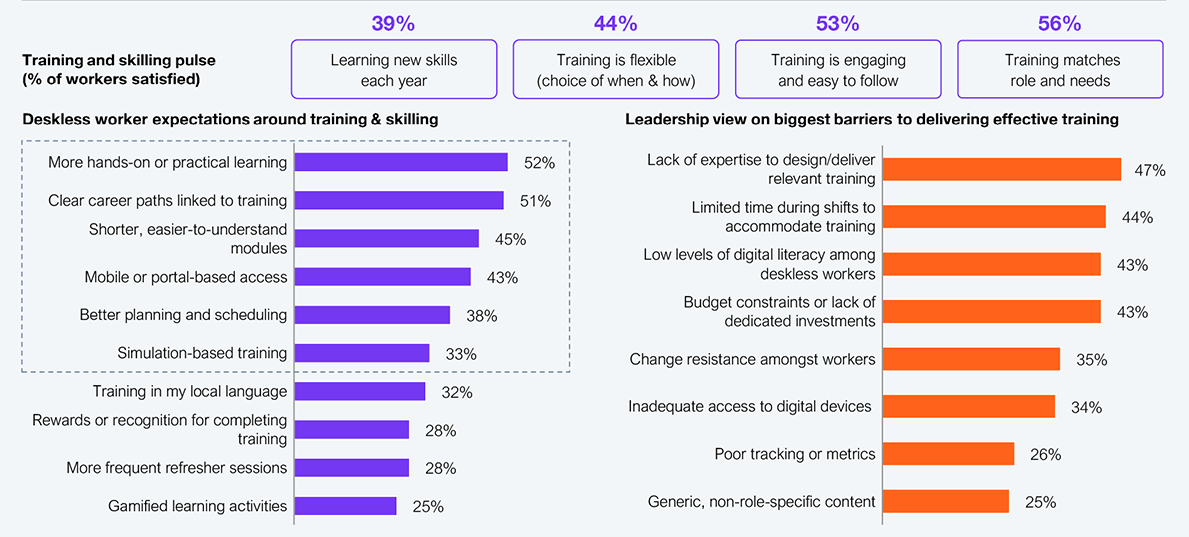
About 80% of deskless workers said training helps them stay safe. However, only 39% believe it helps them grow professionally (see Exhibit 8). Most workers describe current training as compliance-focused, outdated, and disconnected from the reality of their roles. Approaches often lack personalization or clear progression, leaving workers uncertain how learning is linked to career advancement.
Many workers said they learn more from peers than through formal systems. Long-form modules feel irrelevant or inaccessible during shifts, while the absence of clear upskilling pathways or recognition for existing skills makes training feel static and uninspiring. Without visible links to growth or day-to-day improvement, training becomes a checkbox activity rather than a motivator.
The modules are there, but they feel like homework. People learn best by watching peers, but our systems don’t support that.
Training should be more like YouTube, less like homework.
Sample: 605 Deskless Workers and 102 Executive Participants
Source: HFS Research, 2025
Design principle #3: Prioritize learning that is modular, context-aware, peer-supported, and linked to career progress
Training should evolve to dynamic, on-demand experiences that impact performance and growth. Workers want short, modular content such as video SOPs, micro-learning nudges, or quick refreshers that can be accessed
during shifts.
Peer-supported learning, where experienced workers share best practices through short video clips or collaborative platforms, can help replicate real-world knowledge transfer. Personalized learning paths that acknowledge existing skills and offer visible career progression build motivation and retention.

While AI adoption is still evolving, organizations that co-design AI solutions with workers have seen greater trust and quicker adoption. Executives often view AI as a lever for productivity, efficiency, and safety. However, frontline employees may perceive it as a form of monitoring or a threat to job stability.
The challenge lies less in the technology and more in how AI is introduced and positioned within daily workflows. Miscommunication or a lack of clarity about AI’s purpose can create resistance, even when the tools are designed to help.
When we say AI, they hear job cuts. If we started with ‘here’s how this will help you leave earlier on Fridays,’ it would land better.
We have great AI to optimize scheduling—on paper. But workers think it’s another way to squeeze productivity.
We assumed better tools mean better adoption. But adoption failed because we never showed how it made life easier.
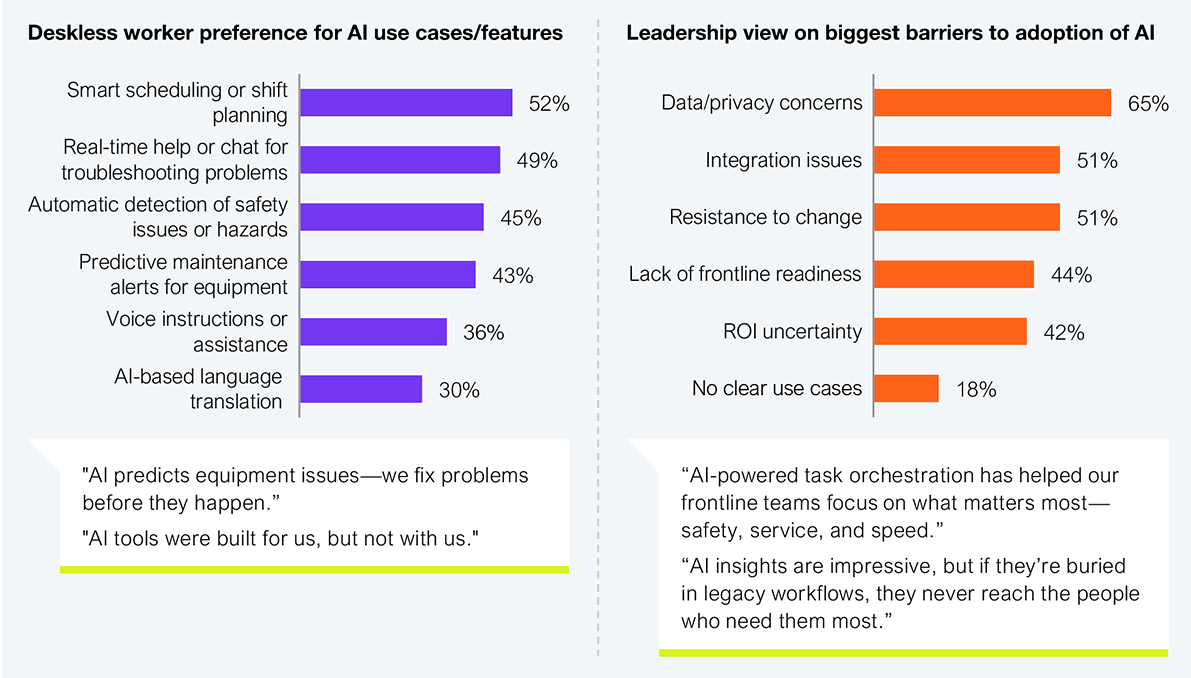
Sample: 605 Deskless Workers and 102 Executive Participants
Source: HFS Research, 2025
Design principle #4: Lead with clarity, not capability
AI adoption succeeds when organizations explain its purpose and involve workers. AI becomes a trusted partner by showing benefits such as faster tasks, fewer errors, and reduced strain.
Co-designing AI with frontline teams, from testing and feedback to interface customization, ensures it enhances daily workflows instead of disrupting them. Use cases such as scheduling optimization, safety monitoring, predictive maintenance, and voice-enabled guidance show AI’s value.
When paired with transparency, targeted training, and hands-on problem-solving, AI shifts from being viewed as intrusive to a true productivity multiplier.

Over half of deskless workers said they don’t feel recognized or supported beyond their functional roles. Recognition remains sporadic, often tied to performance metrics rather than effort, collaboration, or resilience. Many workers perceive an unequal playing field, where deskless workforce contributions are overlooked compared to office-based roles with more visibility and voice.
We’re measuring uptime and error rates—not effort, morale, or fairness. So it’s no wonder people feel invisible.
They feel more part of the customer’s culture than ours. We don’t even give them a corporate email.
Most feedback tools collect. They don’t close the loop. People notice.
These gaps in fairness, inclusion, and feedback loops shape whether workers stay engaged or start looking elsewhere.
Design principle #5: Recognition and inclusion should be intentional.
Organizations must embed recognition and inclusion into systems, workflows, and manager practices. By valuing effort, collaboration, and resilience rather than performance metrics, leaders can foster a culture where deskless workers feel genuinely connected, appreciated, and motivated to stay.
While many organizations are still catching up, a few are already modeling what ‘good’ looks like. These leading enterprises are already piloting solutions that reflect the shift toward deskless workforce-centered design:





These examples show that meaningful impact comes from localized design, integrated platforms, and an operating mindset that centers the deskless experience.
The five levers can create immediate impact, but lasting transformation depends on structural enablers. Organizations must rethink how deskless work is governed, measured, and supported across functions.
Before we build anything now, we rotate corporate teams through deskless roles to understand the reality.
An effective operating model for deskless work should focus on:
Deskless workers are not disengaged by default—they are often disempowered by design. Organizations that treat frontline roles as peripheral will face attrition, burnout, and diminishing returns on transformation investments. The cost of neglecting their lived experience is no longer operational but also reputational and strategic.
Enterprises must rewire how they structure and support deskless work to break this cycle. This means co-designing systems that reflect real-world complexity, integrating learning into daily tasks, embedding feedback loops into workflows, and ensuring technology rollouts are aligned with frontline realities.
AI can be a powerful accelerator, but only when applied transparently and purposefully to augment and not replace human judgment. Empowering the deskless workforce is not an add-on; it’s the foundation of enterprise resilience, agility, and growth. The path forward begins by putting their needs at the center of operating decisions.
Register now for immediate access of HFS' research, data and forward looking trends.
Get Started

If you don't have an account, Register here |
With the exception of our Horizons reports, most of our research is available for free on our website. Sign up for a free account and start realizing the power of insights now.
Our premium subscription gives enterprise clients access to our complete library of proprietary research, direct access to our industry analysts, and other benefits.
Contact us at [email protected] for more information on premium access.

