
For government and education organizations, taking a more holistic approach to customer interactions is imperative for both cost containment and customer experience. Many of these organizations make the mistake of their CRM platform as the central technology of their contact center, but as the shift toward digital contact center continues, mindsets must move away from this one-dimensional view. Now emerging, the omnichannel: a complex tapestry of process design and technology which enables servicing citizens in the right channel at the right time.
Just as traditional consumer expectations continue to increase, citizens expect to interact with government agencies ‘where’ (in which channel) and when they need services. This requires a fundamental design that’s based upon aligning customer and employee experience, as we outline in our OneOffice experience, to create cost-effective and customer-friendly interactions. Omnichannel must be placed at the core of customer engagement design, to ensure companies use people, processes, and technology optimally (see exhibit 1).
Exhibit 1: Omnichannel is at the center of contact center design
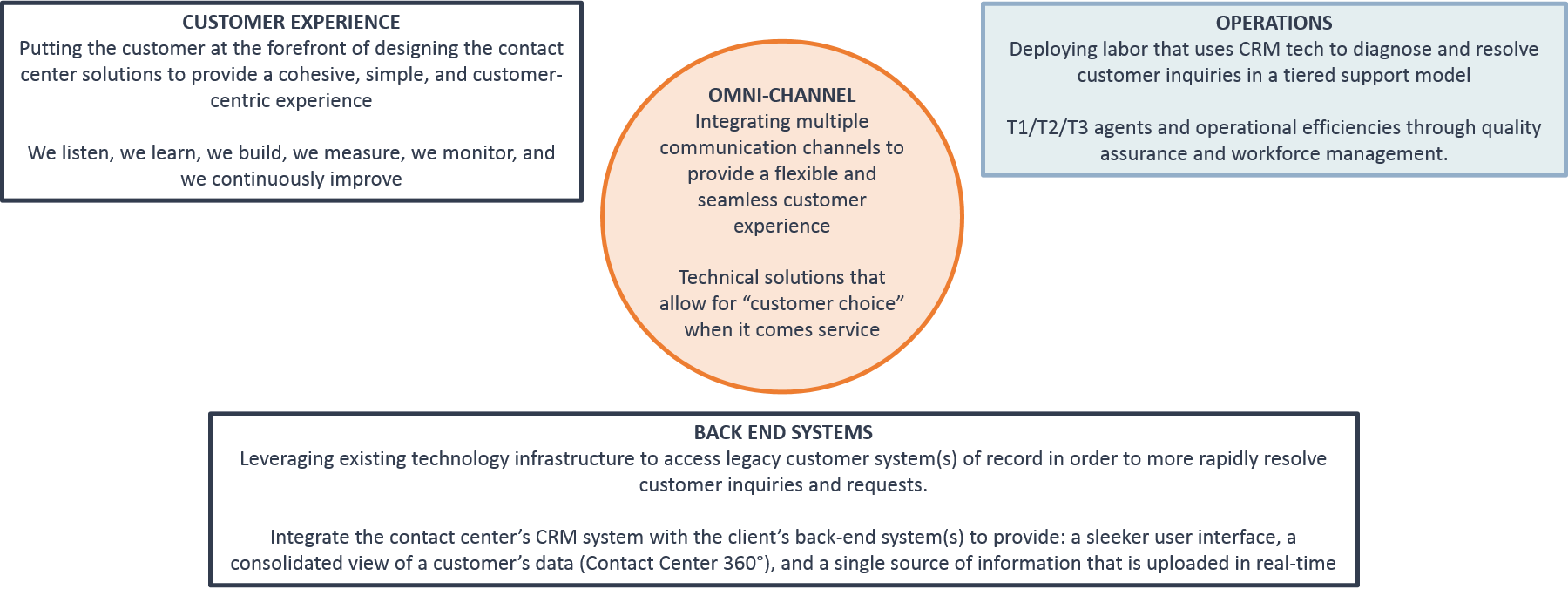
Constructing an omnichannel contact center
At the very core, you cannot have a digital contact center without modern infrastructure and telephony. Many companies are still dependent upon legacy systems where infrastructure is crumbling. So, modernizing and upgrading these systems is critical to create the agility and capability required for a modern omnichannel strategy. Another challenge is the sheer volume of requirements for an omnichannel capability. The channels and capabilities include but are not limited to: email, chat, SMS, outbound calls, inbound calls, predictive dialing, ACD, call routing, IVR, skills-based routing, chatbot, voice bot, agent experience tools and dashboards, workforce management, quality management, contact recording, contact analytics, reporting, and reporting analytics. It is crucial to understand these capability requirements to maximize value in the tools that companies have already invested in.
Business leaders are starting to realize that simply buying a CRM platform like Salesforce or Microsoft Dynamics is not an omnichannel strategy. In reality, there is a wide range of business and technology dynamics that are far beyond the core CRM functionality. Leaders sorting out their omnichannel strategy must think about:
In an ideal omnichannel scenario, the contact center is the data-driven hub of engagement. There is an agent “cockpit,” where they have all relevant information about a given customer at their fingertips. And voice is just one of the channels—the telephony is integrated with the web portal, CRM, mobile app, and other relevant back end systems so they have access to the information they need. Ultimately if customers prefer to self-serve, those options should be robust but still available to the agent. For example, say a citizen needs to provide an updated driver’s license to a government agency. The customer can upload a picture of the ID on their device and then receives a notification that the ID has been received. When and if the customer does need to call in, all of the details of that self-service interaction will be clear and visible to the agent.
There are several plug-in capabilities as well as features within the contact center infrastructure that can be enabled to address the opportunity that omnichannel strategy promises. But none of these features and functions are useful without a smart design-led strategy. We asked Marc Mancher, head of one of the largest digital contact center practices in the US at Deloitte Consulting, about how he and his team are helping clients to strategize about CX technology. “We are putting the human first in our design strategy,” said Mancher. “All of the focus has been on CRM, yet the 50,000 contact centers in the public sector actually work on an omnichannel platform, not a CRM platform. So our designers, engineers, and CX SMEs are working hard to fix this crumbling foundational infrastructure that meet citizens face to face.”
The Bottom Line: Mindset shifts will ultimately allow the public sector to stop overlooking omnichannel, and embrace it for better constituent services
Resistance to cultural change is still a top barrier to getting the most out of technology investments. Legacy mindsets have hindered digital transformation for years, but the pandemic forced organizations to embrace models that they’d questioned like work from home and cloud enablement for the contact center – thus, this has forced the shift toward an omnichannel approach to citizen experience. The rapid development of digital capabilities is mission critical right now, and organizations need help with taking the right approach and making a clear business case for adoption. In the instances where the functionality is there but not being utilized, making the case for adoption should be a win-win; but leaders must be willing to commit and embrace change.
Register now for immediate access of HFS' research, data and forward looking trends.
Get StartedIf you don't have an account, Register here |
With the exception of our Horizons reports, most of our research is available for free on our website. Sign up for a free account and start realizing the power of insights now.
Our premium subscription gives enterprise clients access to our complete library of proprietary research, direct access to our industry analysts, and other benefits.
Contact us at [email protected] for more information on premium access.


