This HFS Highlight is for OEM engineering leaders, CIOs, and manufacturing executives evaluating how to deploy agentic AI as an orchestration layer across the product development lifecycle.
Applying AI as a bolt-on solution for design, the shop floor, IT/OT convergence, and associated manufacturing functions in a fragmented fashion often results in value leaks at handoff points. Instead, engineering leaders should integrate engineering, physical, and industrial assets with AI as a unified platform across the entire product lifecycle, ensuring that no valuable information is lost in the cracks during handoffs.
LTTS’ Analyst Day on June 30 showcased this integrated approach as part of its Engineering Intelligence (EI) solution, including the launch of its Ainfonix platform. Ainfonix turns decades-old physical and digital engineering artifacts into engineering intelligence, improving the productivity and safety of industrial manufacturing plants.
The system risks breaking down when there is no handshake between engineering and manufacturing. LTTS’ EI solution brings together engineering, agentic, physical, and industrial AI through a six-layered architecture spanning environment, engineering data, foundational models, intelligence, assets, and outcomes. This architecture underpins the Services-as-Software™ approach that focuses on delivering services through AI-powered technology rather than human-intensive labor, thereby maximizing efficiency.
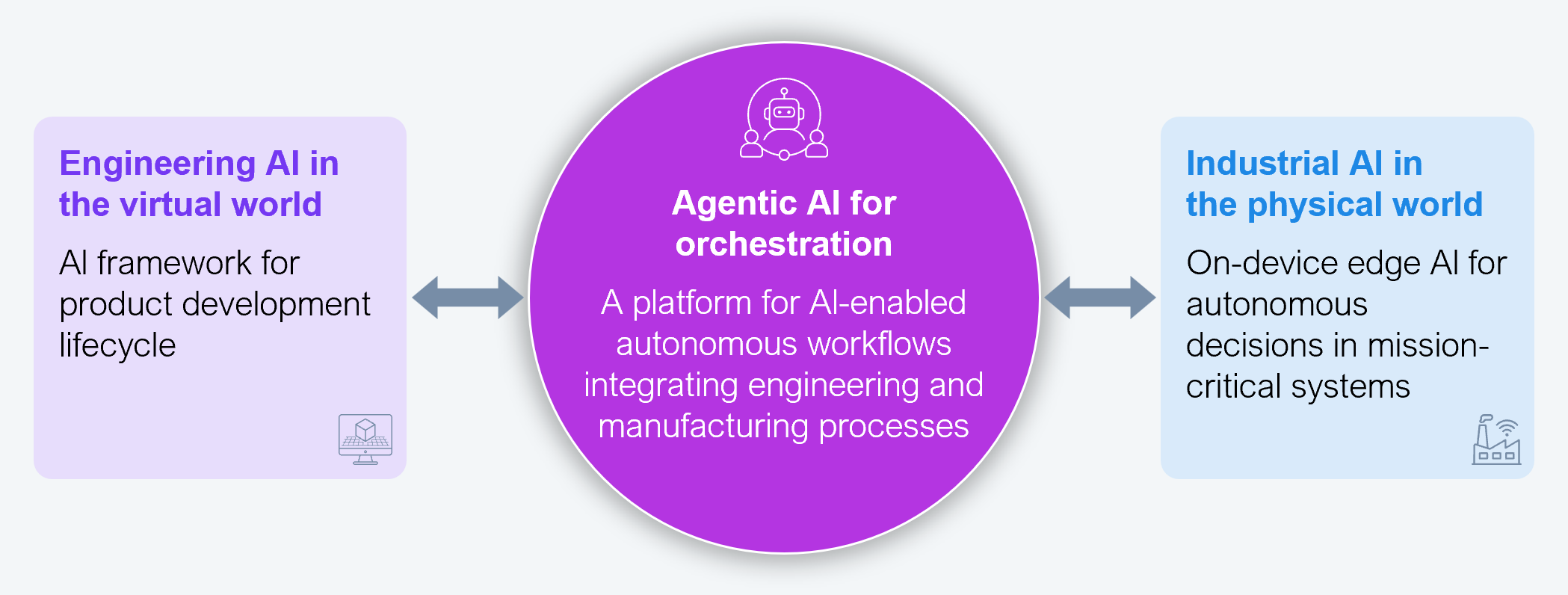
Instead of applying AI as a point solution to isolated functions, EI integrates it across all stages of the product development lifecycle. It embeds physical AI at the edge across equipment, with agentic AI orchestrating the data and workflows between them (see Exhibit 1).
Source: LTTS and HFS Research, 2026
LTTS’ EI solution integrates AI across functions through four lenses:
A good example where LTTS integrated AI into hardware and software design is automotive cockpit design. In partnership with a client, the company developed a cloud-native digital twin platform to virtualize the cockpit, reducing dependency on hardware and driving 70% faster software development.
For software-defined vehicles (SDV) or products, LTTS combines its proprietary platforms and accelerators with deep physical and digital engineering depth, supported by teardown and testing labs. It partnered with an electric vehicle (EV) client to design a software-defined platform, helped another re-architect its legacy architecture to a service-oriented design, and supported others in testing, software feature development, and integration. These are the capabilities that the automotive industry needs in their SDV journey, where partnering with such engineering service providers is important.
In the OT space, LTTS’ predictive maintenance solution combines physics-based models with sensor data processed at the edge to improve asset performance monitoring. Beyond operations, it combines EI with systems expertise and agentic reasoning to automate test development, enabling multi-agent-led transformation of requirements into validated, reusable test assets through governed orchestration.
In manufacturing, the ideal state of AI-driven autonomy is the lights-out factory that uses industrial or physical automation to enable minimal human involvement in day-to-day operations. Achieving this requires expertise across the full physical AI stack spanning energy, chips, infrastructure, models, and applications. However, compute chips are the weak link in that five-layer cake, making partnership essential to scaling operations.
LTTS has been addressing this challenge through its partnership with SiMa.ai for its hardware and software solutions and physical AI expertise. At the same time, such partnerships must ensure fair and transparent risk sharing in areas such as supply chain disruptions, sharing of intellectual property rights, cybersecurity threats, pricing, and software compatibility issues in the long term.
With the partnerships in place, the real differentiator is LTTS’ approach to deploying the lights-out factory. While greenfield lights-out factories are already operational and serve as reference models for future projects, most manufacturers face the challenge of modernizing existing operations.
LTTS is addressing this by targeting specific production areas rather than going for full-scale transformation. It embeds AI, semiconductor design, and edge computing to integrate hardware, firmware, and AI models, delivering end-to-end chip-to-system intelligence with higher levels of deterministic performance, reliability, power efficiency, and safety in hazardous environments. This approach helps reduce complexity, variety, and chip costs, allowing manufacturers to choose partners that best meet their requirements.
Engineering leaders considering the lights-out factory should first ask for a visual model to decide which sections are suitable for autonomous work and which require humans. Governance, explainability, and edge latency must be evaluated early before proceeding with the physical implementation.
Most enterprises are buying AI for disparate functions: engineering, shop floor, products, and IT/OT integration for the enterprise, leaking ROI through gaps between the functions and their handoffs. LTTS’ bet is that value lives not just in these functions but between them, and that agentic orchestration stitches them together. This not only reduces the cost of new product development and ongoing operations but also shortens the cycle time without compromising on quality.
Register now for immediate access of HFS' research, data and forward looking trends.
Get StartedIf you don't have an account, Register here |
With the exception of our Horizons reports, most of our research is available for free on our website. Sign up for a free account and start realizing the power of insights now.
Our premium subscription gives enterprise clients access to our complete library of proprietary research, direct access to our industry analysts, and other benefits.
Contact us at [email protected] for more information on premium access.