This HFS Highlight on Asana’s Analyst Summit is for CIOs, enterprise architects, and transformation leaders evaluating which platforms can coordinate work across humans and agents.
Every enterprise software provider is becoming an agent provider. For CIOs, that creates an architecture problem: agents are abundant, but the context and coordination that make them useful are not.
Agents now arrive from every direction, embedded in platforms, built by employees, shipped within specialist tools. A dozen is a technology project. A thousand changes how the enterprise operates. Deciding what context those agents use, what they access, and who owns the outcome can no longer be confined to individual applications. It is architecture now, and that makes it a CIO problem.
Asana’s Analyst Summit this August brought that into focus. AI Teammates, Command, StackAI, Service Management, and Client Management look like separate product moves. But together they point to a bigger bet: coordinating work across humans and agents using Work Graph™, Asana’s own map of goals, people, tasks, and dependencies as the foundation.
For CIOs, that makes Asana worth a deeper look. A company known for work management is arguing that organizational context belongs alongside data, identity, applications, and governance in the enterprise AI architecture.
The SaaS era already ran this experiment. Enterprises bought applications one problem at a time, then spent years reconnecting fragmented data and workflows. Agent sprawl risks repeating the pattern at machine speed.
As agents multiply, four things become critical: context, so agents understand the business objective; accountability, so autonomy does not erase human ownership; governance, so permissions hold across systems; and cost control, so someone knows what the fleet is spending.
Any platform claiming to coordinate agentic work should pass those four tests. Can it provide organizational context, preserve human accountability, govern activity across systems, and make the economics visible?
That is Asana’s opening. It spent years helping organizations coordinate goals, ownership, dependencies, and handoffs. Now the actors doing that work are changing, and the CIO’s job is shifting with them (see Exhibit 1).
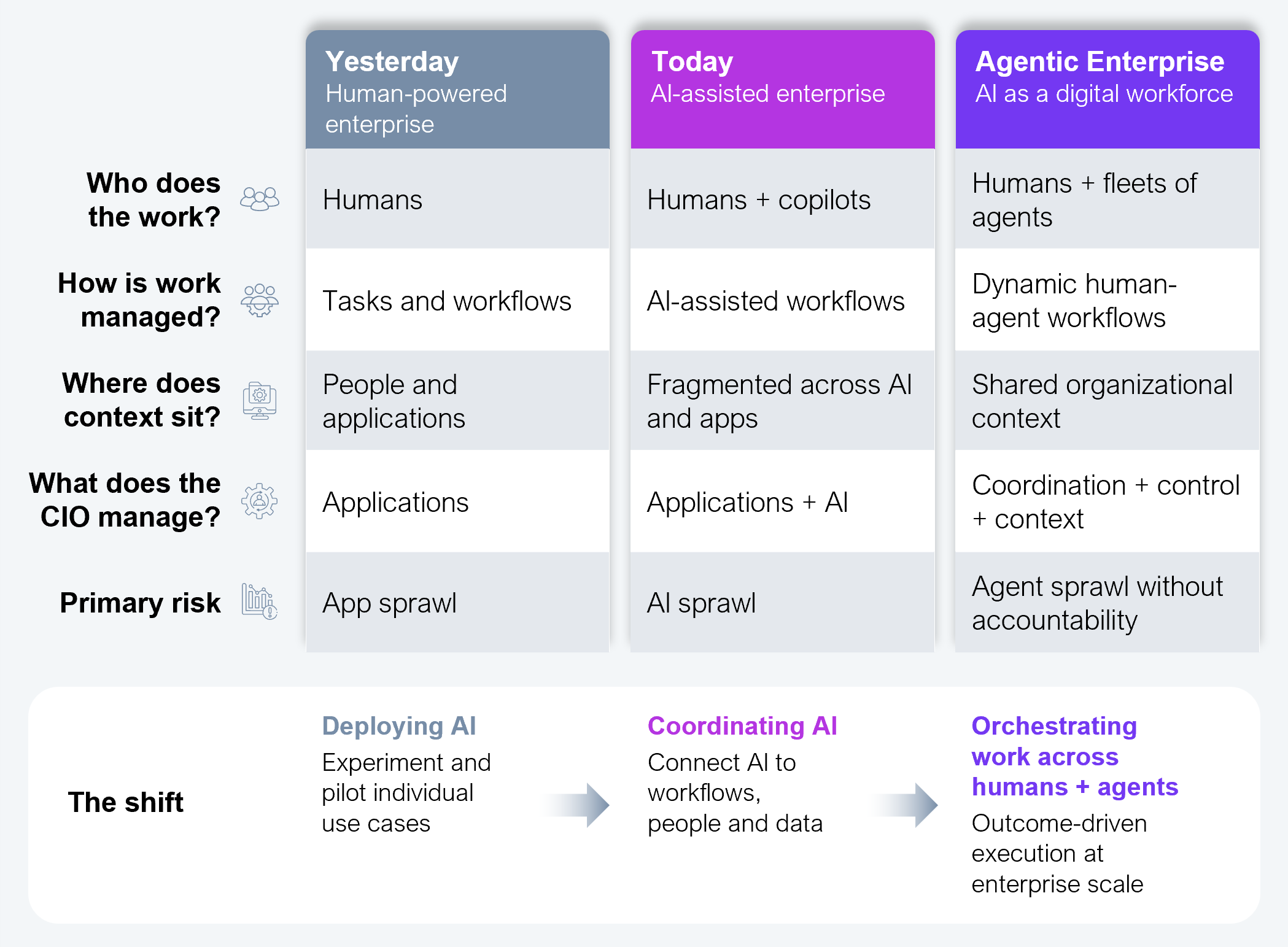
Source: HFS Research, 2026
A coding agent understands a repository, a service agent a ticket, and an AI assistant a document. However, none of them understands why the work matters, what objective it supports, or who owns the outcome.
That gap is what makes Asana’s Work Graph™ interesting. It connects projects, tasks, goals, and portfolios so humans and agents can navigate their relationships within access controls. Your agents do not need everything the enterprise knows, only enough context to understand what it is trying to accomplish.
Every major platform owns a slice of context: Microsoft productivity and identity, Salesforce the customer, ServiceNow operational workflows, and Atlassian development. Asana’s bet is that organizational intent is another layer: what are we trying to accomplish, who owns it, and how does the work connect?
That does not make Asana the coordination layer. But as agents become interchangeable, the context around their work becomes a valuable control point.
IT could reasonably view Asana as one of several applications for managing projects. Agentic AI changes that calculation.
Command takes Asana deeper into product and engineering, Service Management into IT service workflows, and Client Management into professional services. StackAI adds cross-system execution, and AI Teammates put machine actors into everyday work.
Command is the tell. Specialists such as Jira dominate software development, but coding agents could change the basis of competition. As producing code gets easier, the scarce work shifts to deciding what to build, providing context, coordinating execution, and owning what ships. That makes Command a bet on owning outcomes, and only incidentally a feature fight with Jira.
StackAI makes the proposition more credible because execution extends beyond Asana into Salesforce, Oracle, AWS, and DocuSign.
For enterprise buyers, that means evaluating Asana not against other work management platforms, but against the systems already providing identity, customer, service, development, and AI context.
Asana is also blurring the line between software that manages work and software that does it. AI Teammates act on workflows; StackAI executes across enterprise systems, pushing Asana toward the HFS Services-as-Software™ model.
But giving an agent a broken process does not transform it. Sometimes, automation just makes the mess move faster. HFS research found that 85% of enterprise leaders say that process, data, technology, and talent debt limit AI value, while more than half have no funded initiative underway to resolve it. Asana can address parts of that debt, but software alone cannot fix broken processes, skills gaps, or resistance to new ways of working.
As the technology does more of the work, Asana’s partner ecosystem matters more. Work Graph™ can explain how work happens today. It cannot decide how work should happen tomorrow.
Enterprises will have plenty of agents. Far fewer will have all the four things that turn agents into coordinated outcomes, and that gap is the real constraint.
Asana has a credible right to play. Work Graph™ captures context around work, and its portfolio takes that foundation deeper into IT. Whether it earns a central position is still open.
Register now for immediate access of HFS' research, data and forward looking trends.
Get StartedIf you don't have an account, Register here |
With the exception of our Horizons reports, most of our research is available for free on our website. Sign up for a free account and start realizing the power of insights now.
Our premium subscription gives enterprise clients access to our complete library of proprietary research, direct access to our industry analysts, and other benefits.
Contact us at [email protected] for more information on premium access.