This HFS Research Highlight is for manufacturing engineering and business unit leaders choosing partners for new product introductions.
New product introductions (NPIs) face failure rates of 20% to 50%, depending on the industry, according to sources such as the PDMA (Product Development and Management Association). Manufacturers’ business unit and engineering leaders leading frequent NPIs, especially those with unknown markets and technology uncertainties, should outsource end-to-end innovation to specialist product engineering and semiconductor design service providers to ensure success. The launch of the iPad as a new product category in 2010 was successful when Apple positioned the tablet as a segment between laptops and smartphones, but every new product does not need to be as successful as the iPad. The recent analyst day organized by such a service provider, eInfochips, offered a glimpse into how the team delivers product engineering through project-based billing models and what sets it apart from others.
NPIs and their associated innovation and engineering are complex, competitive, and require industry-specific nuances at all stages of a product’s lifecycle. General Motors’ Cruise robotaxi, Siemens’ Gamesa onshore wind turbines, and Samsung’s Galaxy Note 7 smartphone are recent examples that led to recalls, upgrades, and even discontinuations due to design, manufacturing, and quality issues, as well as insufficient testing across diverse scenarios. Suppliers and partners play a key role in successful NPIs, avoiding such situations. On the other hand, car makers have partnered with niche service providers to successfully implement software-defined vehicle initiatives.
eInfochips’ focused approach limits its scope to four industries: medtech (its fastest-growing customer segment), mobility (including automotive and aviation), industrial and consumer products, and high-tech or silicon design (including hyperscalers and data centers). Within these industries, eInfochips focuses on edge intelligence embedded in devices. These devices need to be integrated with the rest of the enterprise—the ERPs and CRMs. This enterprise IT landscape is a secondary priority for eInfochips, even though there is significant work, albeit at lower margins.
eInfochips chooses products with high engineering design complexity and low volume. The intellectual property remains with clients while contract manufacturers make the products. The products are branded with the client’s brand name, and the eInfochips name stays one level below the finished product.
An example in avionics is a smart speaker in business-class flight seats. The audio pitch changes according to the surrounding noise levels; it distinguishes human voices and adjusts accordingly. In medtech, a remote health monitoring device with video capabilities and attachments that measure critical parameters, such as heart rate, became a success during the pandemic. Advanced driver assistance systems (ADAS) and autonomous driving are examples in the automotive domain. Multi-sensor fusion for security and surveillance, which relies on vision and other sensors, is an example of an industrial application.
AI is the underlying technology behind these innovations, where the initial requirements were not fully clear, leaving some creative leeway for eInfochips to define and implement solutions using emerging technologies.
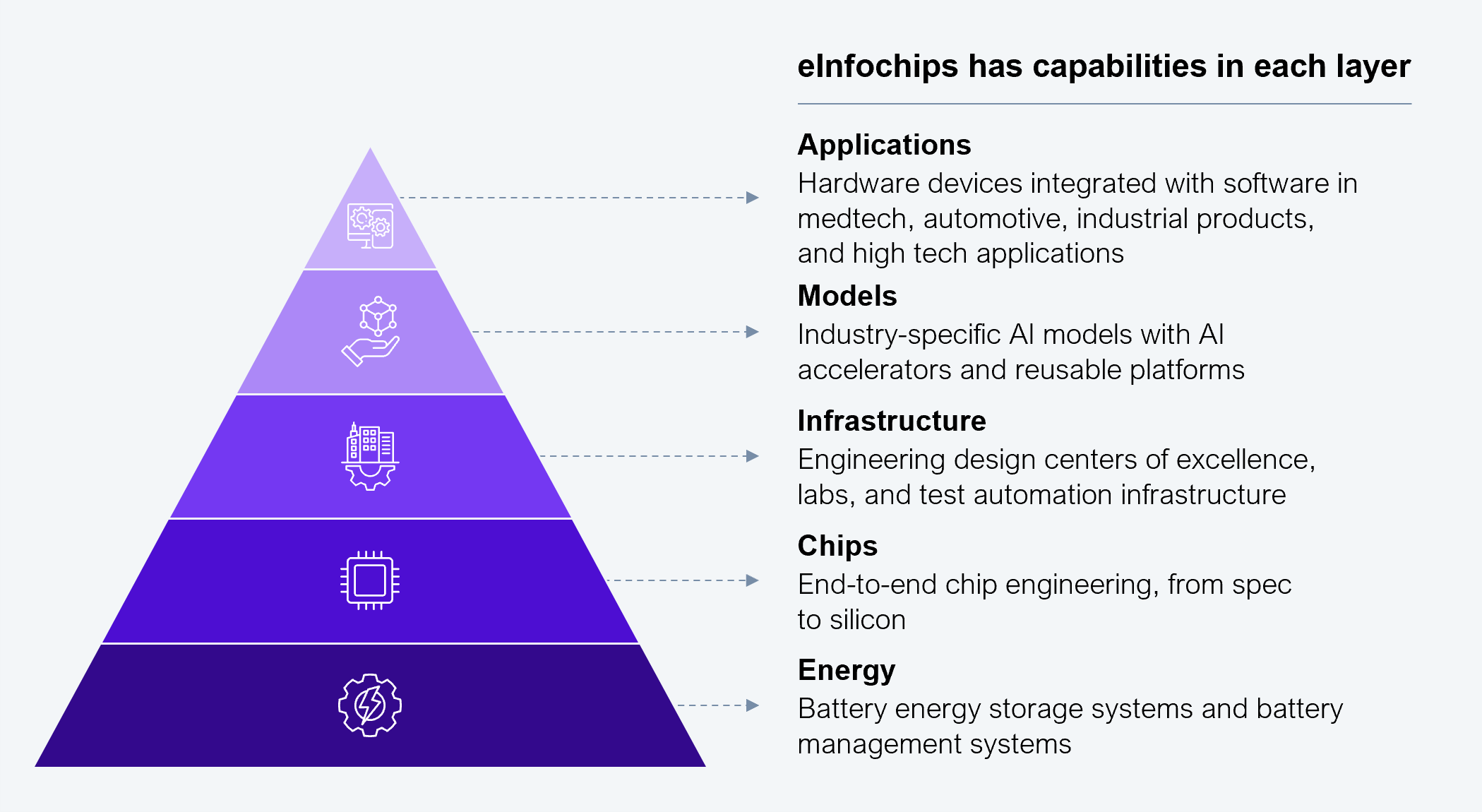
As products increasingly rely on software for critical functionality, physical AI is the way forward, with AI embedded at the edge for autonomous decision-making. To eliminate weak links, engineering service providers must be strong in all five layers of the physical AI tech stack: energy, chip, infrastructure, and models, topped by applications.
eInfochips plays a role with specific capabilities in each layer of the physical AI cake (see Exhibit 1). Its new focus for growth is on ASIC or custom chips, physical AI (where machines infer and take decisions), robotics embedded with AI, and the electrification of devices such as automobiles, along with the charging infrastructure required to charge them. One way to look at these physical AI markets is as an umbrella opportunity encompassing chips, robotics, and electric devices.
Source: HFS Research, 2026
eInfochips covers the entire product value chain, including designing chips, embedding intelligence, building devices, and powering them. Applications, at the top of the pyramid, are the strongest area of its four focus industries.
Manufacturers should be choosy in selecting vendors or partners for innovation and NPIs. Trust and deep domain knowledge are table stakes in the competitive world we live in today. Partners who take accountability for the entire product lifecycle, with significant capability across all layers of the tech stack, are more important than those with lower billing rates.
Register now for immediate access of HFS' research, data and forward looking trends.
Get StartedIf you don't have an account, Register here |
With the exception of our Horizons reports, most of our research is available for free on our website. Sign up for a free account and start realizing the power of insights now.
Our premium subscription gives enterprise clients access to our complete library of proprietary research, direct access to our industry analysts, and other benefits.
Contact us at [email protected] for more information on premium access.