This HFS Highlight is for COOs, functional leaders, and enterprise AI decision makers assessing what the IBM and OpenAI partnership changes about scaling frontier AI in core operations.
Enterprise COOs and functional leaders are moving beyond siloed use cases toward autonomous operations to deliver the scale, speed, and business impact they need. And frontier model partnerships are central to that shift. HFS Pulse data finds that 51% of enterprises expect their primary model vendor to become strategically important or mission-critical for core operations within three years. But access to those models will not deliver value alone. The real challenge is converting model capabilities into execution that delivers measurable ROI.
The IBM and OpenAI partnership, announced on August 13, enables that shift by pairing frontier models with IBM’s enterprise execution layer. Embedding OpenAI into IBM Consulting Advantage, which includes Process Studio and Context Studio, brings process design and industry knowledge to AI workflows, translating frontier model capabilities into enterprise execution.
HFS research finds that 71% of enterprises cite model quality as a key factor when selecting their primary model vendor. But quality alone does not determine whether a model can deliver enterprise value. Security and governance (43%), integration with the existing technology stack (38%), and cost economics (35%) are also important considerations. As frontier models become more capable, these factors increasingly determine how effectively enterprises can operationalize AI within their existing processes (see Exhibit 1).
This is where the IBM-OpenAI partnership becomes relevant. OpenAI brings frontier-model capability, while IBM addresses the governance, integration, enterprise context, and delivery capabilities that determine whether that intelligence can translate into operational value.
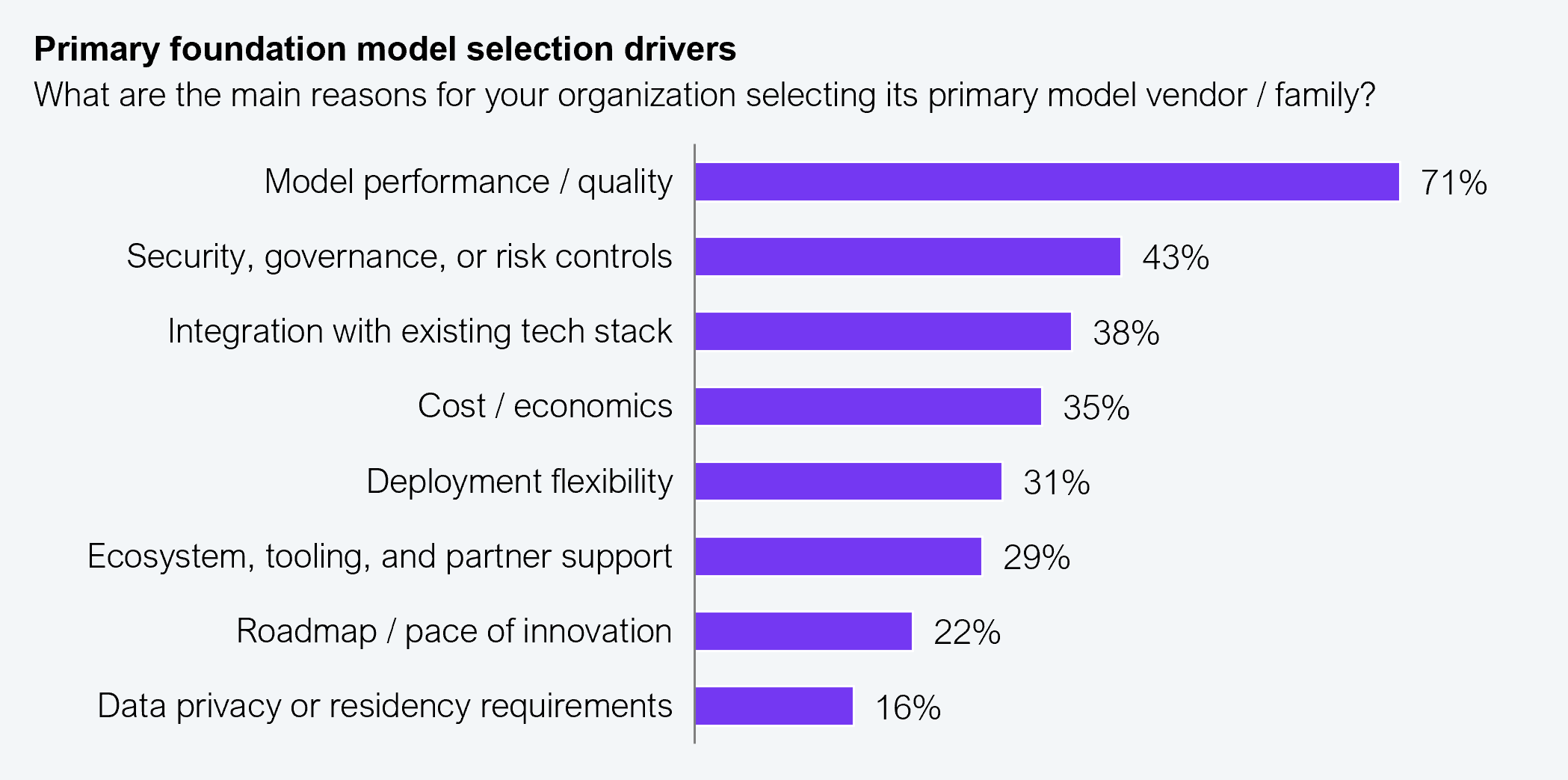
Sample size: 167 senior enterprise leaders from organizations with $1 billion+ in annual revenue with at least one foundation model in production
Source: HFS Research Enterprise Pulse Study, 2026
IBM can move the conversation from model access to workflow redesign by supplying the right context through consulting relationships, process assets, and domain knowledge. The opportunity is substantial: 46% of enterprises expect the greatest impact from their primary model vendor in legacy modernization or in data, analytics, and decision support, followed by 20% in business workflow automation, and 17% in software engineering and application delivery. IBM already holds enterprise relationships, modernization capability, and domain expertise across all three (see Exhibit 2).
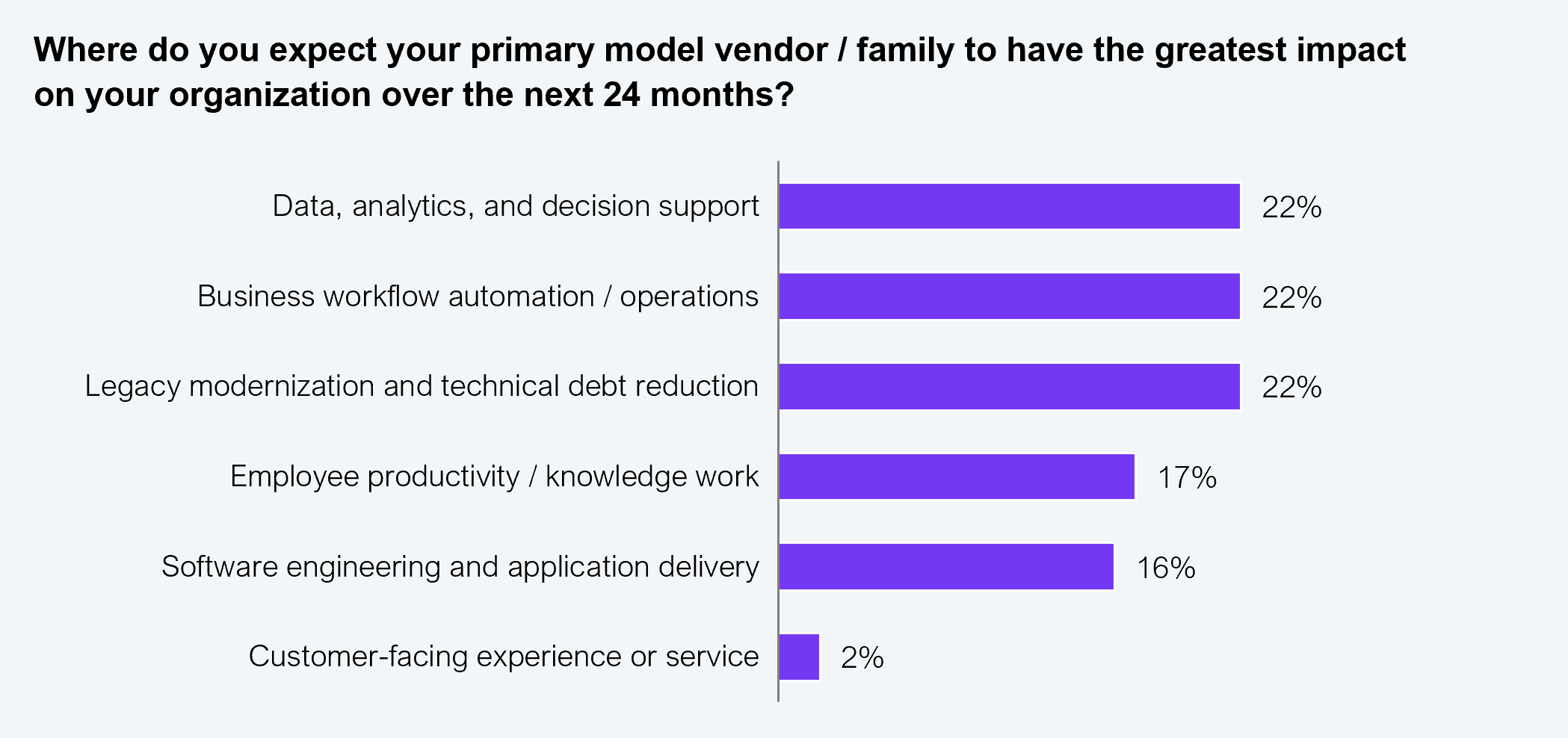
Sample size: 167 senior enterprise leaders from organizations with $1 billion+ in annual revenue (respondents who identified a primary foundation model vendor)
Source: HFS Research Enterprise Pulse Study, 2026
Data security, privacy, and regulatory exposure are the leading concerns about deeper reliance on a dominant model vendor, cited by 35% of enterprises, ahead of lock-in at 17% and unclear economics at 16%. IBM and OpenAI made that central to the partnership. They are extending their collaboration through OpenAI Daybreak and IBM Autonomous Security to address cyber defense, application layer vulnerabilities, model risk, and governance gaps. By embedding security and governance into the deployment architecture instead of adding a control layer afterward, IBM can help OpenAI enter environments, particularly in highly regulated industries, where model capability alone is insufficient.
Consulting Advantage already supports Anthropic and Google models. OpenAI expands that by positioning IBM as an orchestration layer rather than a channel for one model family, allowing it to match models to workloads, risk profiles, latency, and cost. Forward-deployed units bring model, engineering, process, and domain expertise closer to the workflows being redesigned, exposing constraints earlier. Moreover, the dedicated OpenAI Practice would give IBM the capacity to scale that through repeatable methods and knowledge transfer.
The partnership broadens IBM’s capabilities, but the value depends on how they are assembled around a defined operating problem. Enterprise buyers should test that in five areas:
Many major providers now have some form of frontier model partnerships and describe a similar forward-deployed motion. The real differentiator is how well they can embed these partnerships into their transformation delivery to drive outcomes.
For COOs and functional leaders, that means looking beyond model benchmarks and practice size. What matters is whether providers like IBM can assemble these capabilities into a coherent, repeatable operating model around business intent. The OpenAI partnership gives IBM most of the components required for intent-native delivery. Its advantage will depend on how consistently it can turn them into outcomes at scale.
Register now for immediate access of HFS' research, data and forward looking trends.
Get StartedIf you don't have an account, Register here |
With the exception of our Horizons reports, most of our research is available for free on our website. Sign up for a free account and start realizing the power of insights now.
Our premium subscription gives enterprise clients access to our complete library of proprietary research, direct access to our industry analysts, and other benefits.
Contact us at [email protected] for more information on premium access.