 Contact Us
Sustainability, in all its environmental, social, and governance (ESG) forms, is increasingly driving business and IT decision-making—and businesses are setting themselves various targets at varying levels of ambition. Enterprise customers are starting to prioritize sustainability in their technology projects and services contracts—but decisions must still be made within cost, data regulation, and performance constraints. Climate change is a massive data problem—so it makes sense that technology is part of the solution—as are the data, people, and providers that underpin businesses’ operations. This Highlight report examines Google Cloud Platform (GCP) as one example—among many others we’ve covered—that’s combining its technology and services to drive sustainability internally and for its customers. The ecosystem of sustainability services and technology providers—that includes GCP’s cloud competition and service provider partners—will be beyond vital in making sustainability native to every business, everywhere, and achieving real sustainable change.
We need scalable sustainability solutions that meet the scale of the climate crisis
Despite a growing ecosystem, comparatively few off-the-shelf technology or service provider solutions exist for sustainability. For example, in calculating the climate risk for financial investment decisions, analytics and machine learning (ML) models still need to be highly tailored. GCP’s operations and innovation work with implementation partners and enterprise leaders is a massive opportunity to build blueprints that align sustainability with improving IT and business process—that can then be replicated throughout industries that all need to make sustainable transitions.
Customers are increasingly expecting providers to bring sustainability to the table in contract and project discussions—but decisions are still made within cost, data regulation, and performance constraints
While the carbon footprint of cloud projects is being prioritized more and more over cost by customers in contracts and early project discussions, a variety of opportunities and constraints determine just what options are available when it comes to choosing the most sustainable datacenter location:
Within these opportunities and constraints, often customers can boil a decision down to hosting their data and operations in a region (for example, Europe or the US)—but within that region, there’s flexibility. GCP can then help shift data and operations to the lowest-carbon cloud locations within these geographic and performance constraints.
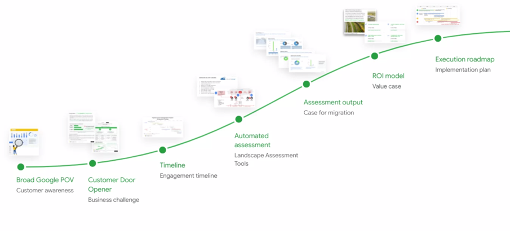
With sustainability often being a high-level corporate conversation, as well as an operational challenge, GCP has developed a roadmap to meet execs’ sustainability demands of projects. Starting by benchmarking customers’ existing operations using GCP and third-party data, the opportunity to reduce emissions through cloud and other tools becomes clearer. GCP also has a model to estimate the CO2 impact of cloud migration decisions that teams can work through (see Exhibit 1).
Exhibit 1: Google Cloud’s customer roadmap for IT sustainability
Source: Google Cloud, 2021
Google Cloud’s customer cases are the platform to replicating sustainability and cloud benefits throughout any industry
The opportunity for GCP and the whole ecosystem is that the core principles of the use cases below are widely applicable to any industry. The need to make IT and business operations more sustainable is a universal must; cloud and combined emerging technologies have the potential to improve operations and accelerate innovation around sustainability goals.
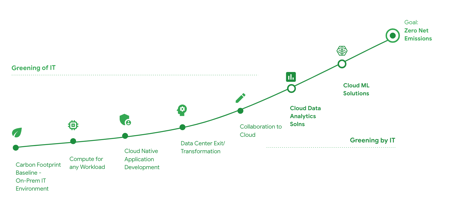
The sustainability of operations can be improved through more informed migration, architecture, and general cloud decisions to reduce the environmental impact of IT operations; for example, this might involve running operations on datacenters powered by high levels of renewable energy, underpinned by “load optimization” (running non-critical operations when renewable energy is plentiful). On the innovation front, computing power and the availability of data can feed ML and analytics models to discover new solutions and improve decision making. Exhibit 2 outlines Google’s view of the adoption curve that most customers follow as they explore cloud solutions to reduce their carbon footprints.
Exhibit 2: Google’s view of the customer adoption curve for sustainability-improving cloud solutions.
Source: Google Cloud, 2021
Some of GCP’s enterprise examples include:
The Bottom Line: Google Cloud is one giant in a growing ecosystem of sustainability services and technology providers that must make sustainability native internally and for customers. Understanding both the constraints and benefits of improving the sustainability of IT and business operations is one step towards replicating what we’ve discussed here throughout enterprises in all industries.
Register now for immediate access of HFS' research, data and forward looking trends.
Get StartedIf you don't have an account, Register here |
With the exception of our Horizons reports, most of our research is available for free on our website. Sign up for a free account and start realizing the power of insights now.
Our premium subscription gives enterprise clients access to our complete library of proprietary research, direct access to our industry analysts, and other benefits.
Contact us at [email protected] for more information on premium access.

