Highlight Report

HFS Highlight: Newly launched Insurance Primer report points to the industry’s precarious balancing act ahead

HFS recently launched our inaugural Industry Primer, focused on the insurance vertical. The Industry Primers offer a comprehensive view of industry trends, including the HFS Industry Health Index, sector-specific business drivers and challenges, enterprise adoption trends for IT and business process services, supply-side trends in offerings and capabilities, and perspectives on the adoption and impact of emerging technologies.


We discuss one of the key findings of the Primer in this Highlight – the insurance industry’s need to carefully balance business and financial risk in the post-COVID environment.


Global insurance markets had been growing sluggishly, pre-pandemic


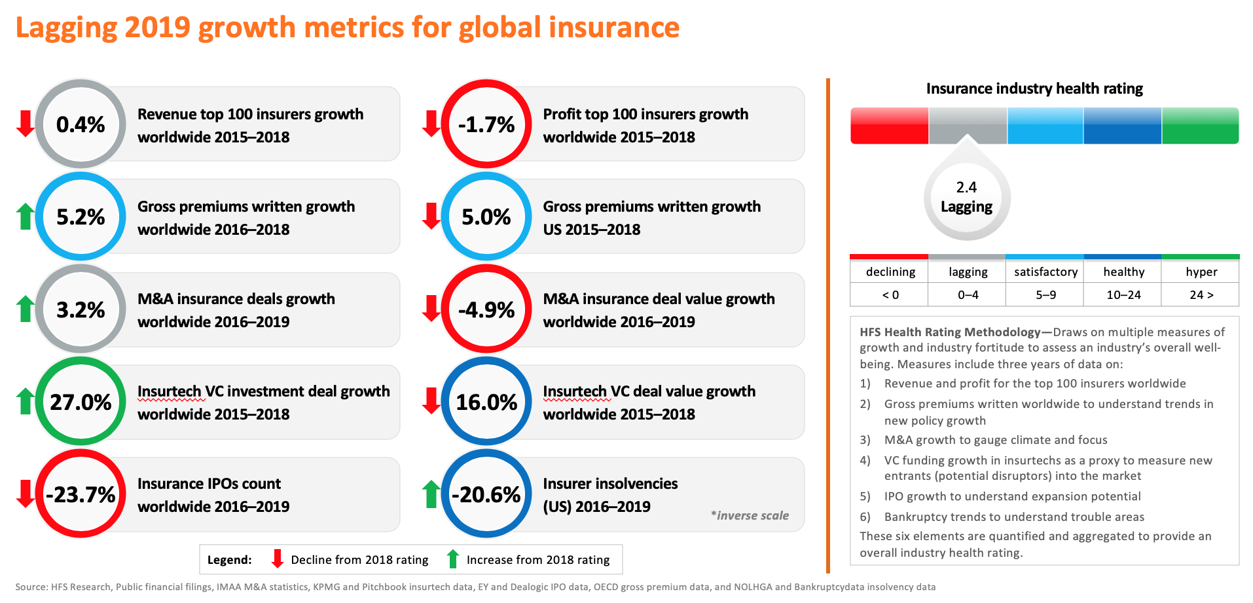
Whether dealing with life and annuities, property and casualty, reinsurance, commercial, or personal lines, this much is common for the insurance industry—change is coming, and the next decade for the industry will be radically different than the last. New players will come to the forefront with new business models, and truly forward-thinking traditional carriers will be able to adapt and survive, and perhaps even thrive, in the digital age. To cut through the hype around the state of the insurance industry, HFS has developed its health rating approach—a methodology that draws on multiple measures of growth and industry fortitude to assess an industry’s overall well-being. The high-level findings indicate that insurance as a whole is lagging growth (see Exhibit 1).


Exhibit 1: Global insurance markets continue to register lagging industry growth


Some of the input metrics that significantly impacted this score include:


  • Insurance revenue and profit growth— Between 2015 and 2018, aggregate revenue at the top 100 global insurers grew 0.4%, representing slow gains. However, profit is still struggling with aggregate performance of a 1.7% decline over the same period.
  • Insurance M&A activity— After a massive peak in 2018 with 905 deals announced worth $114 billion, global insurance M&A insurance deal net value has gone for a toss. In 2019, 878 deals were announced worth just $51 billion. Major deals themes included a focus on scale and geographic expansion, business modernization and efficiency, and technology-enabled specialization. There was also an emphasis on divestiture to streamline focus. Insurtech M&A activity has only been a minor element of invested capital thus far, but we expect the pace to pick up as companies seek to differentiate through innovation.


Other metrics that impacted the insurance health rating negatively include a slower rate of IPOs, while we instead saw hyper-growth in VC funding for insurtech, and satisfactory growth in gross written premium, reflecting increased sales.


Business disruption due to the pandemic is already forcing many market changes for insurance carriers


The anemic industry health rating for the global insurance sector pre-pandemic already suggested that change was critical. The pandemic has hastened some of the sector’s shortcomings placing a fine point on what works and does not work from a physical versus digital context. Key observations include: 


  • Mass uncertainty is going to impact investments. Invested assets make up significant leverage for most insurance segments, particularly life insurance. As global markets continue to be volatile due to the pandemic, carriers will face asset shocks from their investments. These factors were also observed by credit rating agency Fitch Ratings, prompting them to move all insurance sectors to a negative outlook.
  • Each market segment will face its own set of direct and indirect consequences from the pandemic. Carriers need to make planning and risk decisions for multiple scenarios and timeframes for each of these business lines.
    • For example, auto insurance carriers are already seeing the positive impact of customers staying off the roads. The initial reaction has been for carriers to pledge $10 billion in paybacks to policyholders, preempting legislative mandates to give consumers relief in this area. However, this puts renewals at a risk-based on consumers’ willingness to drive when quarantines lift. 
    • Life and annuities need to adjust their business mix. NAIC has guided carriers in the US to offer more annuities to offset potential losses due to claim spikes for life insurance, while also grappling with lower life insurance sales due to quarantines. 
    • Similarly, other P&C insurance segments are starting to see accelerated claims as well as litigation activity due to the pandemic. Business disruption coverage is one contentious area where states are awaiting US legislation on whether carriers are liable to pay claims for business disruption due to COVID-19 related reasons. Other specialty areas such as travel, short-term disability, and long-term care are highly impacted areas, and carriers will need to balance their financial risks on one hand and customer trust and retention on the other in these challenging times. 
  • Belt-tightening from an operations standpoint is the one thing carriers can control. Uncertainty is a tough pill to swallow for an industry built on taking calculated risks to come out profitable. While carriers continue to figure out the next moves from a business mix and risk standpoint as things change, one thing they can control is their bottom line. For over two decades, insurance carriers have steadily relied on offshoring and outsourcing as the key lever to lower operational costs. Cost savings are more than likely to make a come-back as the number one priority in the post-COVID world. The next levers to pull are surely operational efficiencies and straight-through processing as a result of applying emerging technologies such as smart analytics, AI, automation, and blockchain.


The Bottom Line: The insurance market can benefit from more operational efficiency, but ultimately needs to make itself relevant to customers’ changing insurance needs


One of the data-centric findings in the HFS Insurance Industry Primer revolved around the plans for digital transformation. We found that insurance carriers are more focused on increasing bottom-line profit than the cross-industry average. Insurance carriers across P&C and L&A segments continue to operate on wafer-thin margins, with profits barely eclipsing the cost of equity to them. It is no wonder that cost containment is among the top priorities.


However, carriers need to press onward toward digitizing customer-facing processes, providing interfaces and portals for better communication, and data exchanges across policyholders, brokers, and other intermediaries. Hyper-personalization continues to be a priority as many insurtechs change the type and duration of risks covered, and concepts such as just-in-time and pay-per-use insurance gain traction. Similarly, digital competitors, including tech giants like Amazon, fast-moving incumbents, and disruptive insurtechs, are putting significant pressure on carriers globally. HFS expects these priorities to become even more relevant in the post-COVID 19 world. Bottom-line improvements may help carriers buy time as economic conditions remain uncertain, but ultimately they need to rethink existing business models and products to create net-new market growth.

Sign in to view or download this research.

Login

Register

Insight. Inspiration. Impact.

Register now for immediate access of HFS' research, data and forward looking trends.

Get Started

Download Research

    Sign In

    Sign up for a free
    research account

    With the exception of our Horizons reports, most of our research is available for free on our website. Sign up for a free account and start realizing the power of insights now.

    Digests/Newsletters: Overviews of the latest news, insight, and research by HFS.

    HFS Events: Exclusive invitations to HFS webinars, roundtables, and summits, bringing together key industry stakeholders focused on major innovations impacting business operations.

    By registering you agree to our privacy policy.

    I hereby consent that HFS Research can process my personal data.

    Premium Access

    Our premium subscription gives enterprise clients access to our complete library of proprietary research, direct access to our industry analysts, and other benefits.

    Contact us at [email protected] for more information on premium access.

    Help

    If you are looking for help getting in touch with someone from HFS, please click the chat button to the bottom right of your screen to start a conversation with a member of our team.

    [email protected]

      Contact Ask HFS AI Support