
Do you think RPA adoption is solely the purview of the world’s biggest banks and insurers? If you did, you would be wrong. True, there are lots of highly visible banking and insurance RPA use cases out there, but there is marked progress in other industries, too. In our recent study, we asked 590 decision makers from multiple industries, globally, the following question: What is the current state of adoption of the following intelligent automation (IA) technologies in your organization? While the results varied considerably, there are clear similarities amongst industry peers. You must build a clear understanding of how RPA is being adopted in your industry, or risk falling behind your competitors.
The possible answers spanned the gamut of intelligent automation: computer vision, machine learning (ML), robotic process automation (RPA), artificial intelligence (AI), cognitive and smart virtual assistants (chatbots++), natural language processing (NLP), and smart analytics.
In this POV, we’re zoning in on a subset of the data with a snapshot of RPA progress by industry vertical in 2019. Analyzing the responses provided insight about who’s where with RPA in each industry we covered. Spoiler alert—banking and insurance took an early lead, but other industries are hot on their heels.
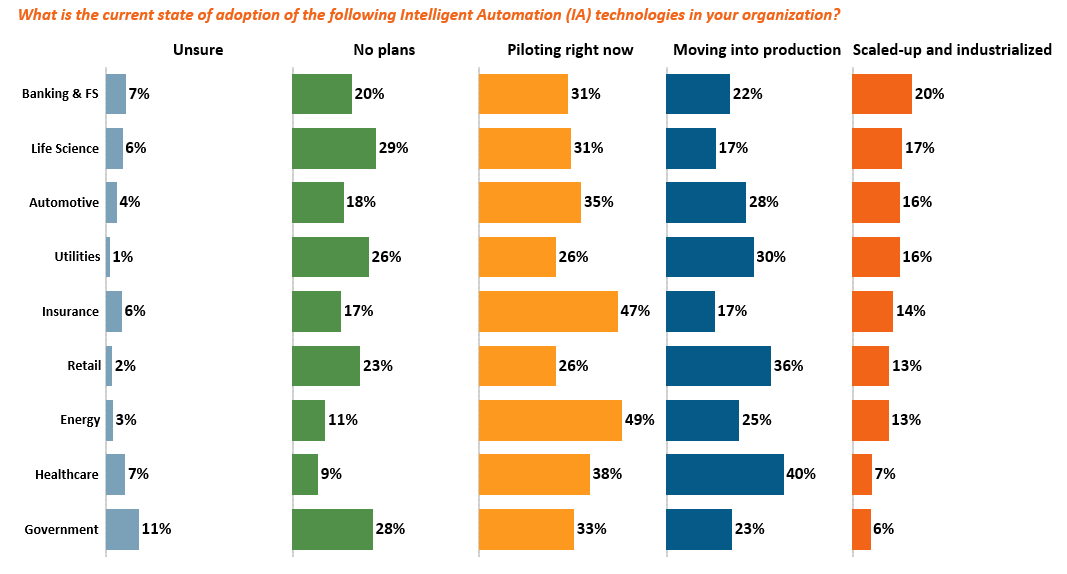
28% of Government organizations have no plans to invest in RPA, lagging the global average with Lifesciences and Utilities firms
If we combine the “unsure” responses with “no plans”, we can see who is not currently active in RPA implementation, or, for active industries, where it’s not yet hitting the collective mindshare. Decision makers need to be more curious and explore their challenges to figure out whether or not RPA can help them achieve goals. This is especially so in the government vertical, where 11% are unsure and 28% have no plans.
While life sciences (6% unsure, 29% no plans) and utilities (1% unsure, 26% no plans) lag in visible activity, too, both of these industries have made more RPA progress.
Energy and healthcare are the most active in piloting and moving to production phases, which seems promising, but their higher engagement and exploration activity and use cases moving into production do not, in this case, translate into the highest levels of scaled up activity. These verticals lag behind the rest, alongside government.
Exhibit 1: RPA adoption across industries shows banking and financial services leading a growing pack of scaled-up and industrialized RPA users
Source: HFS State of Intelligent Automation, 2019
Retail, utilities, and healthcare are getting over the hump between piloting and production, with between 30% and 40% moving into production
Piloting is most prevalent across the board, but three industries show more activity in moving into production than they do at the pilot stage: retail, utilities, and healthcare. These industries are slightly ahead in getting over the stall point that so many encounter when attempting to move beyond pilots and into production. They are each incentivized to progress to their next incarnations.
Banking retains the pole position with scaled up and industrialized RPA
As Exhibit 1 shows, banking and financial services (BFS) presents as the most advanced in terms of scale and industrialization. Other research on RPA platforms shows that BFS is the industry with the most use cases cited by vendors; we see an interesting mix of both back–office and industry–specific use cases. Traditional banks have disruption hot on their heels, which is whetting their appetites for the risks inherent with emerging technologies.
The most frequent use cases we see for RPA are industry-generic back-office processes such as accounting and invoicing, very often with an ERP on one end. While RPA in the back office will help with cutting costs, it is not likely to enable differentiation. RPA is also unlikely to impact the top line from the confines of the back office. It’s time to think bigger, explore RPA’s possibilities in core business processes, and support the customer experience, too.
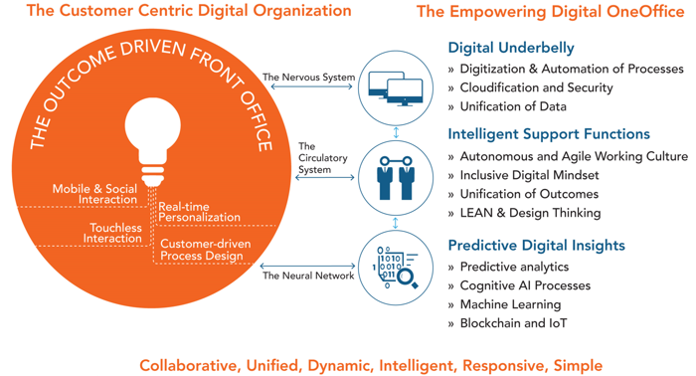
Exhibit 2: HFS’ Digital OneOffice Framework
Source: HFS 2018
It’s challenging for buyers to distill hype from reality in the world of RPA, the art of the possible from the actually possible, and which use cases were deployed from ones that were abandoned—and many have been abandoned. We need more RPA implementation stories to inspire those still on the fence.
The Bottom Line: RPA gets interesting when it’s being applied to industry–specific processes, not just generic back–office functions that cross all industries.
Looking forward, we anticipate some progress in “integrated automation,” which is automation that goes beyond the piecemeal (usually task) automation we see today. Integrated automation will unify parts of organizations with processes and data flows that span what is typically siloed. Ideally, relevant data will inform business processes in real-time and each process execution will create more useful data to inform and trigger other processes. That’s what we envisage with the Digital OneOffice Framework.
So, it’s all eyes on the financial services vertical, rich with organizations that were first out of the gate with RPA, then intelligent automation and AI. Will this head start with RPA see them also leading in the transition toward OneOffice and integrated automation (as envisaged in RPA is dead. Long live Integrated Automation Platforms)?
Register now for immediate access of HFS' research, data and forward looking trends.
Get StartedIf you don't have an account, Register here |
With the exception of our Horizons reports, most of our research is available for free on our website. Sign up for a free account and start realizing the power of insights now.
Our premium subscription gives enterprise clients access to our complete library of proprietary research, direct access to our industry analysts, and other benefits.
Contact us at [email protected] for more information on premium access.

