
A range of applications for the internet of things (IoT) in the insurance sector includes developing usage-based pricing models, precise and dynamic risk assessment, and new process efficiencies; crucially, insurance firms’ goals match these applications. Despite this, service providers are lagging demand, whether you look at it from the angle of our IoT services or insurance services Top 10 reports. The first step in meeting clients’ IoT needs is revamping providers’ partnerships. Providers must collaborate with vendors and leading insurers to build or co-develop solutions and go-to-market (GTM) strategies that meet insurance clients’ needs, whether or not they have internal expertise in IoT technology or the insurance vertical. Only 14% of insurance IoT use cases are in production, so not partnering early will mean lagging those who do with limited partnership opportunities available.
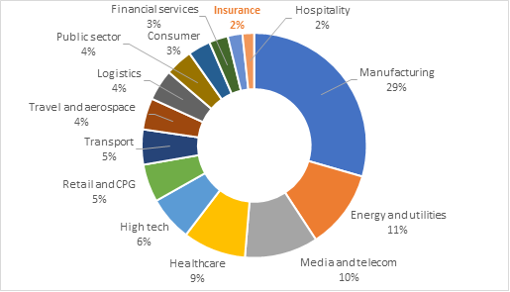
HFS’ 2019 IoT Services Top 10 provides a vertical breakdown of IoT providers’ engagements (see Exhibit 1). Manufacturing, unsurprisingly, leads the way as it strives toward Industry 4.0; insurance, however, is at the bottom of the pile. HFS recently called on insurance firms to better-invest and partner in the IoT sphere, with the industry having only reached the production environment in a handful of cases (14%, to be precise)—this doesn’t match what we see in their cloud, blockchain, and artificial intelligence (AI) endeavors. With few use cases reaching production, mature partnership opportunities are limited.
Exhibit 1: Insurance is lagging at the bottom of the IoT provider vertical pile.
Percentage of IoT project engagements
Source: HFS IoT Services Top 10 2019
IoT device data (whether from wearables, drones, or telematics) allows risk to be assessed based on consumers’ individual usage in real-time. Real-time, individually assessed risk could improve customer interaction and achieve end-to-end ownership of the insurance value chain to spark new commercial models (such as demand-driven variable pricing) and improve efficiencies. For example, see our look at IBM’s IoT work, which, in combination with blockchain, shows promise to simultaneously improve safety and cut insurance premiums.
Analytics based on IoT data also offers improved precision in assessing, managing, and, therefore, pricing risk. Risk is dynamic and doesn’t only change at the point of contract renewal. Analytics with real-time and historical data can further improve fraud monitoring, preventive maintenance, and early interventions.
The IoT can enable and strengthen industry partnerships between insurers, providers, original equipment manufacturers (OEMs), and technology vendors. In the automotive sector, for example, monitoring engine performance or tire wear is not only beneficial for the insurer, but it can also offer peace of mind for the customer (who can avoid long-term costs) while providing valuable data for the OEM.
Despite the IoT’s potential, few service providers are cracking it. Throughout the insurance value chain, new product development was by far the least mature segment of providers’ capabilities in our 2019 Insurance Services Top 10, which echoes our IoT providers’ lack of enthusiasm for the insurance sector.
This lack of urgency is all the more obvious when examining how many of our surveyed insurance clients’ top priorities were firmly in the remit of the IoT:
Tech Mahindra has a higher percentage of insurance projects than most providers. Wellness-as-a-service focuses on cloud-based integration of IoT device data topped with analytics and visualization to monitor health indicators. Telematics solutions for auto-insurers allow usage-based personal and commercial insurance; their insurance industry-specific analytics pack combined with platform-as-a-service (PaaS) solutions completes the aforementioned device, platform, data, and technology requirements.
Wipro’s insurance-based IoT intellectual property has yielded a smart vehicle platform connecting OEMs, dealers, insurers, and consumers to push new revenue opportunities (like usage-based insurance). Wipro’s smart building platform aims to improve claims servicing and risk monitoring, while its smart healthcare platform can achieve similar benefits plus preventative care.
Accenture’s R&D splurging is filtering into its insurance arm. Accenture and home insurance provider Achmea developed a platform that, in combination with IoT devices and a website, connects stakeholders such as neighbors and police to help each other in the event of burglaries. Service fees provided Achmea with a new revenue stream.
Insurer Progressive’s work with vendor TrueMotion and other partners has facilitated multi-way data flow and new opportunities for all involved. We also briefed with TrueMotion, whose leveraging of smartphone sensor technology lets automotive insurers better-detect and upload data on drivers, their driving, and crashes instantly. Insurers get a vetted technology partner and an improved ability to predict risk and manage premiums, attract new customers, and improve claims management processes. TrueMotion also brings the platform to assimilate the data and provide a range of additional services, for example, talking frazzled drivers through the necessary steps after an accident. The relationship between the insurer and the customer becomes a continuous dialogue rather than a once-per-year renewal.
Two main groups of partners exist for providers to meet insurance clients’ IoT needs:
Providers must lock in early these partners with the IoT technology, infrastructure, and industry knowledge needed to ensure they have the right sensors, platforms, and data (and know how to use it). Providers can take their partnerships with IoT vendors and insurtechs, plus internal IoT expertise, to co-develop solutions and IP before refining their GTM within the industry for insurers’ value and continuing relevance in the market.
Register now for immediate access of HFS' research, data and forward looking trends.
Get StartedIf you don't have an account, Register here |
With the exception of our Horizons reports, most of our research is available for free on our website. Sign up for a free account and start realizing the power of insights now.
Our premium subscription gives enterprise clients access to our complete library of proprietary research, direct access to our industry analysts, and other benefits.
Contact us at [email protected] for more information on premium access.

