
The insurance model leaves insurers with the burden of repair and replacement pay-outs—it’s a high-risk industry. Pressure on margins is increasingly making insurance a cut-throat game. Ultimately, some things can’t be helped, such as natural disasters, but as new technologies like the internet of things (IoT) emerge, so do new methods of preventing claims. If insurers hope to protect their profit margins, they must realize that the cost of enabling a predict-and-prevent model using IoT is significantly cheaper than ignoring the inevitable. To do so, insurers must find the right IoT provider—one that can take care of the sensors, platform, and most importantly, the data. All three factors must work in harmony for insurers to fully realize the potential value of IoT.
The insurance industry undervalues IoT compared to other change agents—a painful oversight given the potential cost savings
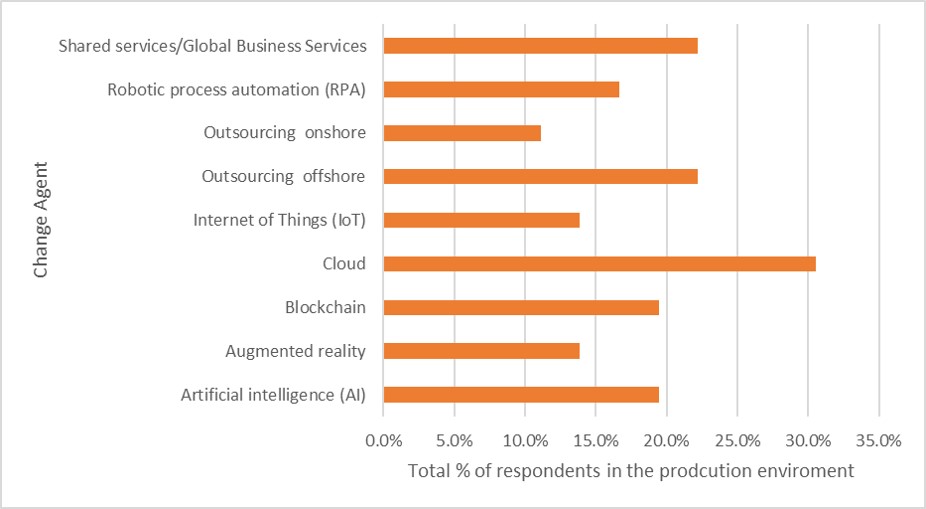
The HFS’ annual Industry Digital Transformation survey (a survey of the G2000 used to power HFS’ industry research) asks a mixture of business and IT leaders about their plans for digital transformation. Exhibit 1 shows which change agents insurance firms currently have in the production environment, and shockingly IoT is far behind the likes of cloud, blockchain, and AI. While it’s easy to understand the temptation to over-hype technologies, by focusing less on IoT, insurers risk missing the opportunity for considerable cost savings for themselves and their customers. In today’s insurance market, where the pressure on margins is continuously increasing, every penny counts (research shows that average net profit margin fell from 22.03% to 9.51% in December 2018).
Exhibit 1: Insurance firms invest heavily in the likes of cloud, blockchain, and AI at the expense of IoT
Source: HFS Research, 2019
IoT already has a range of applications in the insurance industry, which means the time to invest is now
Several insurers have already invested in IoT technology and are reaping the benefits. One of the most prominent examples is health insurers deploying wearable technology to generate new patient data. United Healthcare does this by offering its customers an Apple Watch and allowing them to “Walk-it-Off” as payment—the company claims that current program participants walk an average of almost 12,000 steps a day as opposed to the 5,200 steps logged by the average American adult. Not only does this allow an insurer to better assess risk based on correlation data, but it also encourages its customers to be more active, which will ultimately result in fewer claims.
However, the opportunities don’t end there. Previous research from HFS has discussed how IoT could both play a pivotal role in motor insurance and drive down claims in manufacturing, while other research has found that the UK alone sees £1.8 million paid out every day for “escape of water” claims. Imagine a simple IoT sensor that could detect leaks as soon as they begin, allowing insurers to prevent a sizable claim. An IoT implementation like this makes it easy to see that IoT is much more than just hype in the insurance industry and that it could significantly reduce the number of claims for a wide range of insurance products. Put simply, IoT is an essential ingredient in the future of insurance if industry leaders hope to continue attracting customers while increasing their own profit margins.
On the other side of the coin, IoT providers are pushing partnerships with insurers
In a recent briefing to HFS analysts, Bosch Service Solutions, which is well established in the IoT space, explained that the insurance industry is its next frontier. The company’s mobility and travel services are already mature, and it showcased an integrated concierge service plus roadside tracking and assistance solutions. The potential of incorporating IoT into insurance is clear, whether via the introduction of pay as you go insurance or the introduction of predict and prevent capabilities.
Several startups are investing in the technology, and one has already established an impressive list of partners, including the likes of Travelers, Liberty Mutual Insurance, and Hippo. The startup, Notion, has developed an assortment of “peel and stick” sensors that can detect the water leaks, opened doors and windows, alarms, and even temperature changes. The information from the sensors is transferred to a customer’s smartphone, providing an immediate alert to a water leak or an open door. Customers can then inform the necessary parties such as emergency services before a problem worsens—once again reducing the cost of claims.
The Bottom Line: Insurers need to build reliable IoT partnerships to develop a predict-and-prevent model, protecting their profit margins and increasing customer engagement.
Finding an IoT provider with the ability to offer the newest sensors is one thing, but leveraging the data is where the true benefit lies. Notion provides an innovative example of this—by transferring the data to a smartphone app, its customers can easily use the information. It also creates new opportunities for customer engagement, a welcome change in an industry that interacts little with its clients. While introducing IoT to a range of insurance products can’t completely eliminate the possibility of claims, it does have the potential to significantly reduce the quantity and size of them—offering substantial cost savings to insurers. Insurers cannot afford to miss this opportunity for cost savings in an industry that is being transformed by technology-fueled disruptors.
Register now for immediate access of HFS' research, data and forward looking trends.
Get StartedIf you don't have an account, Register here |
With the exception of our Horizons reports, most of our research is available for free on our website. Sign up for a free account and start realizing the power of insights now.
Our premium subscription gives enterprise clients access to our complete library of proprietary research, direct access to our industry analysts, and other benefits.
Contact us at [email protected] for more information on premium access.

