This Market Impact Report is for chief digital officers, chief innovation officers, VPs of analytics, and business unit leaders in consumer goods evaluating how to break out of AI pilot purgatory and scale AI into enterprise-wide business value.
(AI) has emerged as both a promise and a paradox—a technology lauded for game-changing potential, yet too often relegated to piecemeal pilots that never scale. In our conversations with 15 senior business and technology leaders across the consumer goods spectrum, we heard a striking duality: genuine excitement about AI’s capacity to unlock new value, juxtaposed with persistent frustration at its inability to move beyond ‘pilot purgatory.’ At the heart of this disconnect lies a misalignment between technological capability and organizational readiness—a gap that, if left unbridged, risks turning AI into another unfulfilled promise. This report lays bare the key dynamics shaping AI’s journey from proof-of-concept to production in the consumer goods industry and outlines how companies can break out of pilot purgatory into platform-led productivity by 2030.
HFS Research conducted in-depth interviews with 15 consumer goods executives (including chief innovation officers, chief digital officers, VPs of analytics, and business unit leaders across marketing, supply chain, R&D, and operations) to understand the state of AI adoption. Approximately 85% of the insights in this report come directly from these interviews, supplemented by about 15% from external research and industry examples. The interviews spanned a breadth of company sizes and product segments, providing a well-rounded view. We assured anonymity to encourage candor, so quotes are presented without naming the company or individual (aside from general descriptors).
The findings reveal that while most consumer goods firms are stuck in pilot purgatory, a minority have cracked the code to scale AI. We refer to this elite group of AI front-runners as ‘the 15% Club’—those few who consistently turn pilots into production and real business value. The sections that follow explore what differentiates these 15% Club leaders and how others can emulate their success.

Roughly 70% of AI projects languish in the pilot or proof-of-concept stage, and only about 15% ever make it to scaled production use. Despite hundreds of experiments (one cosmetics maker launched 40+ AI pilots in two years), very few have been industrialized into the fabric of the business. Those who succeed—‘the 15% Club’—demonstrate that the barriers are not the technology itself but the surrounding processes and organizational silos (see Exhibit 1).
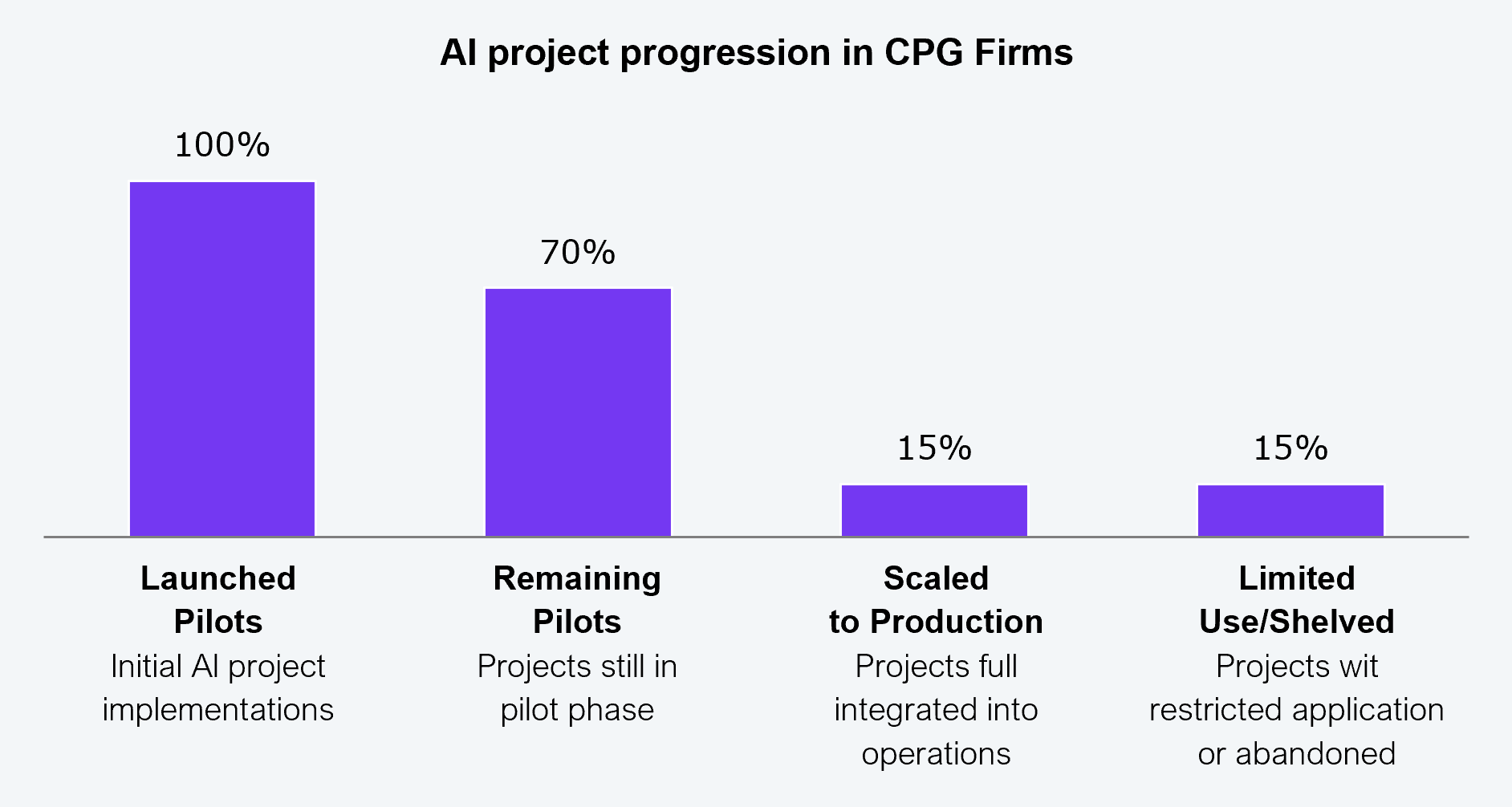
Source: HFS Research – Interviews conducted with senior consumer goods executives across the US and Canada

Companies making headway have put formal AI decision-making structures in place—e.g., cross-functional AI councils or Centers of Excellence—and even created new leadership roles (some appointing a chief AI Officer or equivalent) to drive AI holistically. These leaders align AI projects to strategic business goals, redesign workflows to accommodate AI, and measure success against business KPIs (growth, margin, customer experience) rather than just technical metrics. For example, one cosmetics company’s CIO rolling out Microsoft 365 Copilot to 15,000 employees, not just for productivity’s sake but as a digital literacy catalyst—seeding a culture of AI-readiness for bigger initiatives to come. This broad AI literacy is perceived as the foundation for the next leap: moving from assisted tasks to autonomous, ‘agentic’ workflows that handle multi-step processes with minimal human input.
Source: HFS Research – Interviews conducted with senior consumer goods executives across the US and Canada

Traditionally, IT owned the tech budget, but today, roughly 60% of AI investment is led by business units (marketing, sales, supply chain, R&D, etc.), with only ~40% coming from central IT. Business leaders directly fund AI in their domains—for instance, a chief marketing officer investing in a content-generation AI platform or a supply chain VP funding an AI-driven demand forecasting tool. However, many consumer goods firms lack flexibility and are stuck in archaic annual budget cycles. If a breakthrough AI opportunity arises mid-year, teams often must wait for the next funding cycle—a rigidity leaders cite as ‘cultural and process debt’ impeding agility. Leading firms are introducing more flexible funding mechanisms (innovation funds, off-cycle approvals) so that promising ideas aren’t shelved for 12+ months and tying AI project funding to outcome-based milestones to ensure resources flow to initiatives that deliver value (see Exhibit 3).
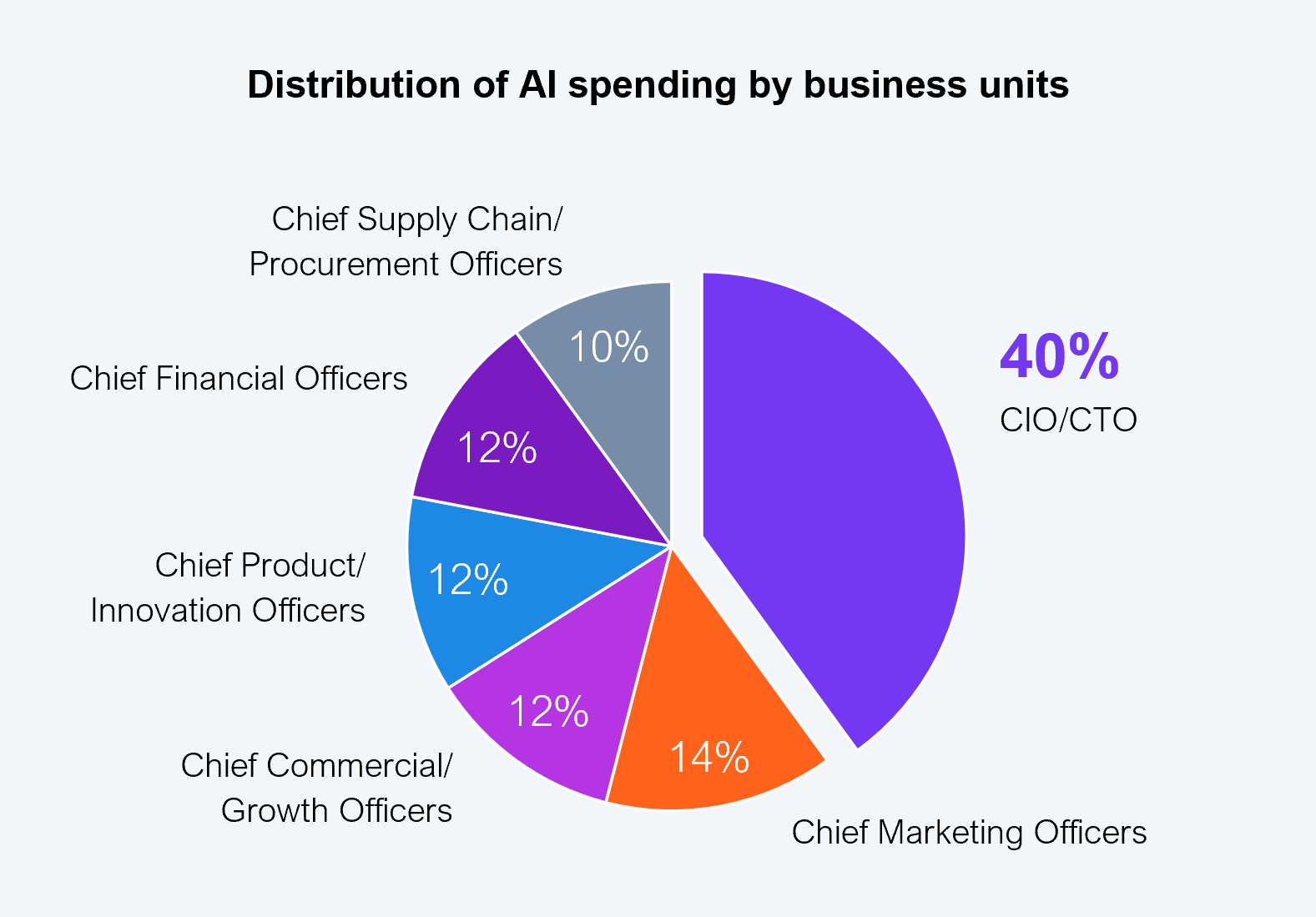
Source: HFS Research – Interviews conducted with senior consumer goods executives across the US and Canada

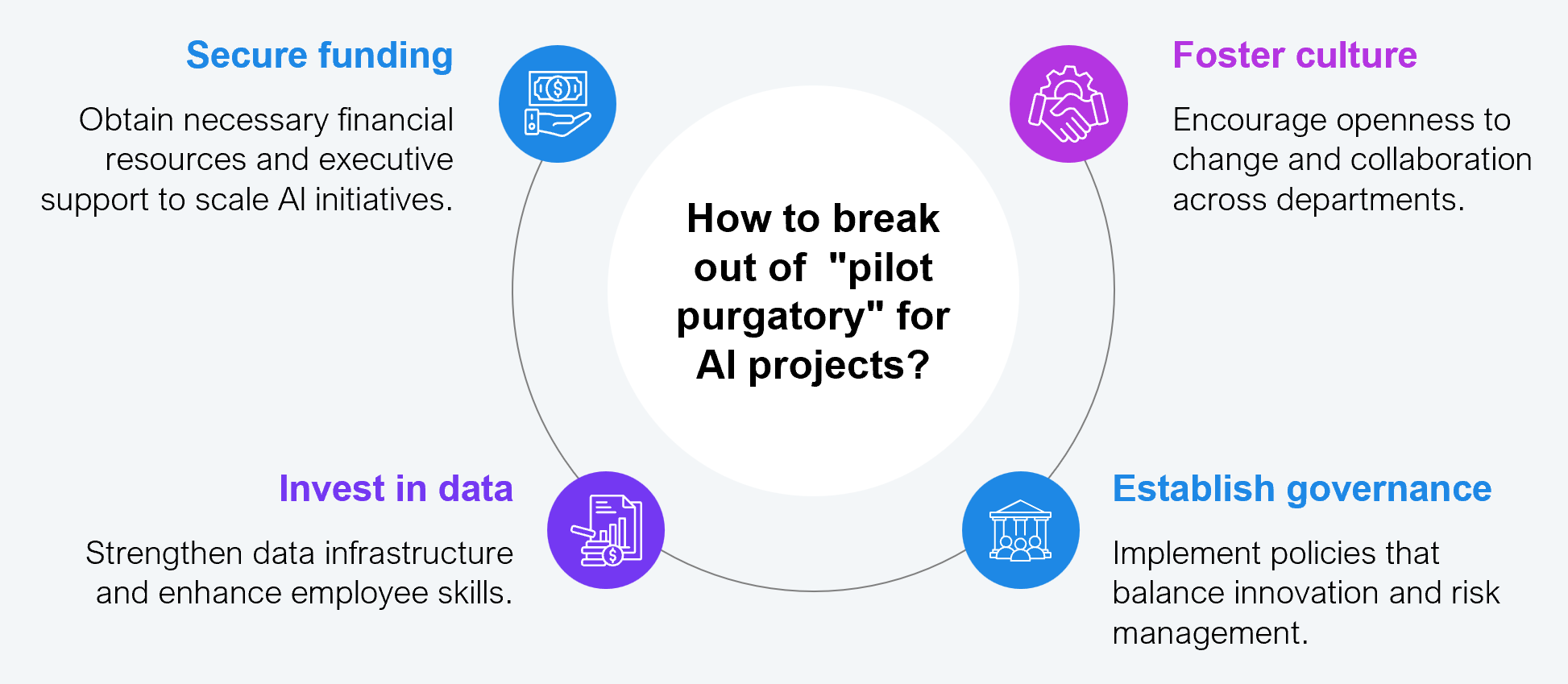
Nearly 80% of companies admitted that past AI efforts were funded as ‘leftover’ additions to other projects rather than dedicated investments. This sporadic support results in pilots dying on the vine when initial funds or enthusiasm runs out. Common challenges include siloed efforts (pilots done in one function don’t get visibility or adoption elsewhere), lack of process change around the AI (expecting old workflows to accommodate new AI tools magically), and cultural resistance or apathy. In many consumer goods firms, AI has not yet reached the boardroom agenda. It’s treated as a side project in the trenches while top executives focus on immediate fires (e.g., inflation or supply disruptions). Additionally, workforce anxiety (‘will AI automate my job away?’) lurks as an unspoken inhibitor to adoption. Companies that break out of this pilot trap do so by addressing these human and organizational factors head-on—securing executive sponsorship, fostering a culture of experimentation (with accountability), and planning for change management from the start (see Exhibit 4).
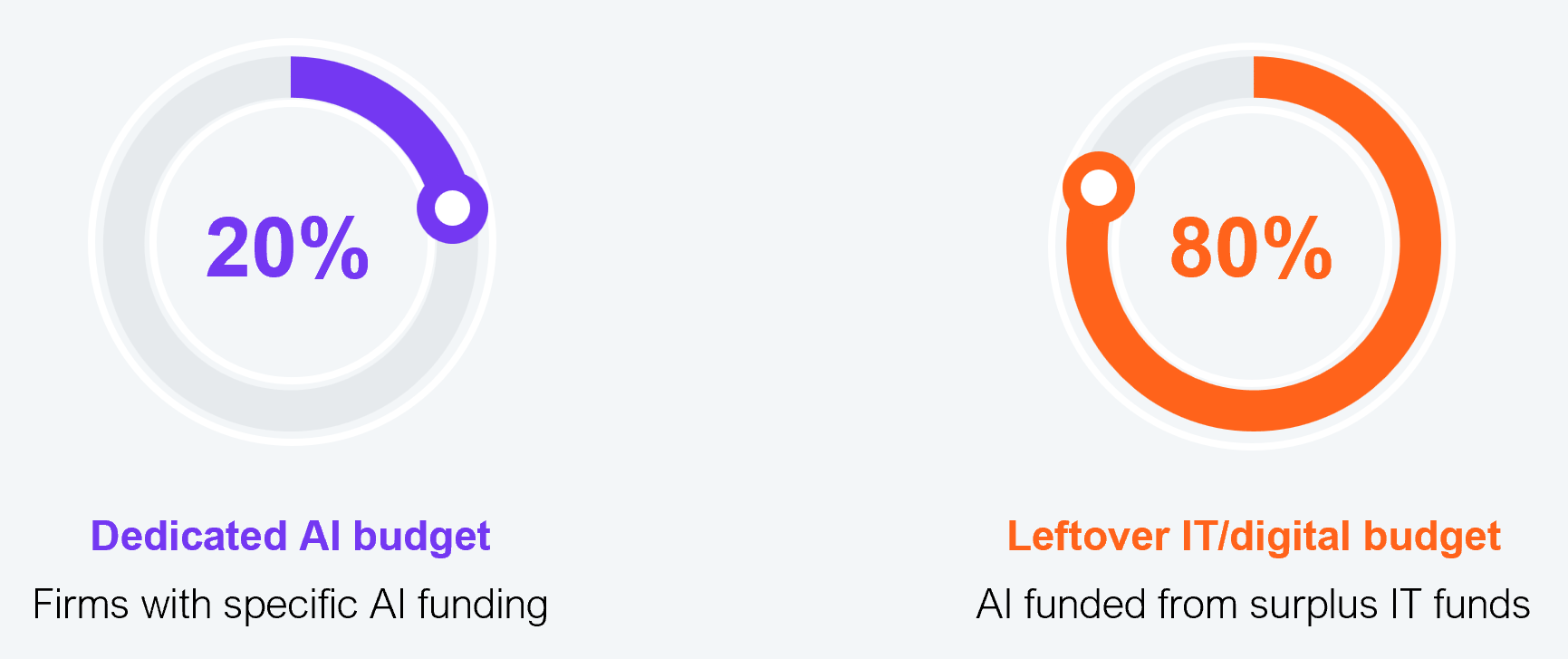
Source: HFS Research – Interviews conducted with senior consumer goods executives across the US and Canada

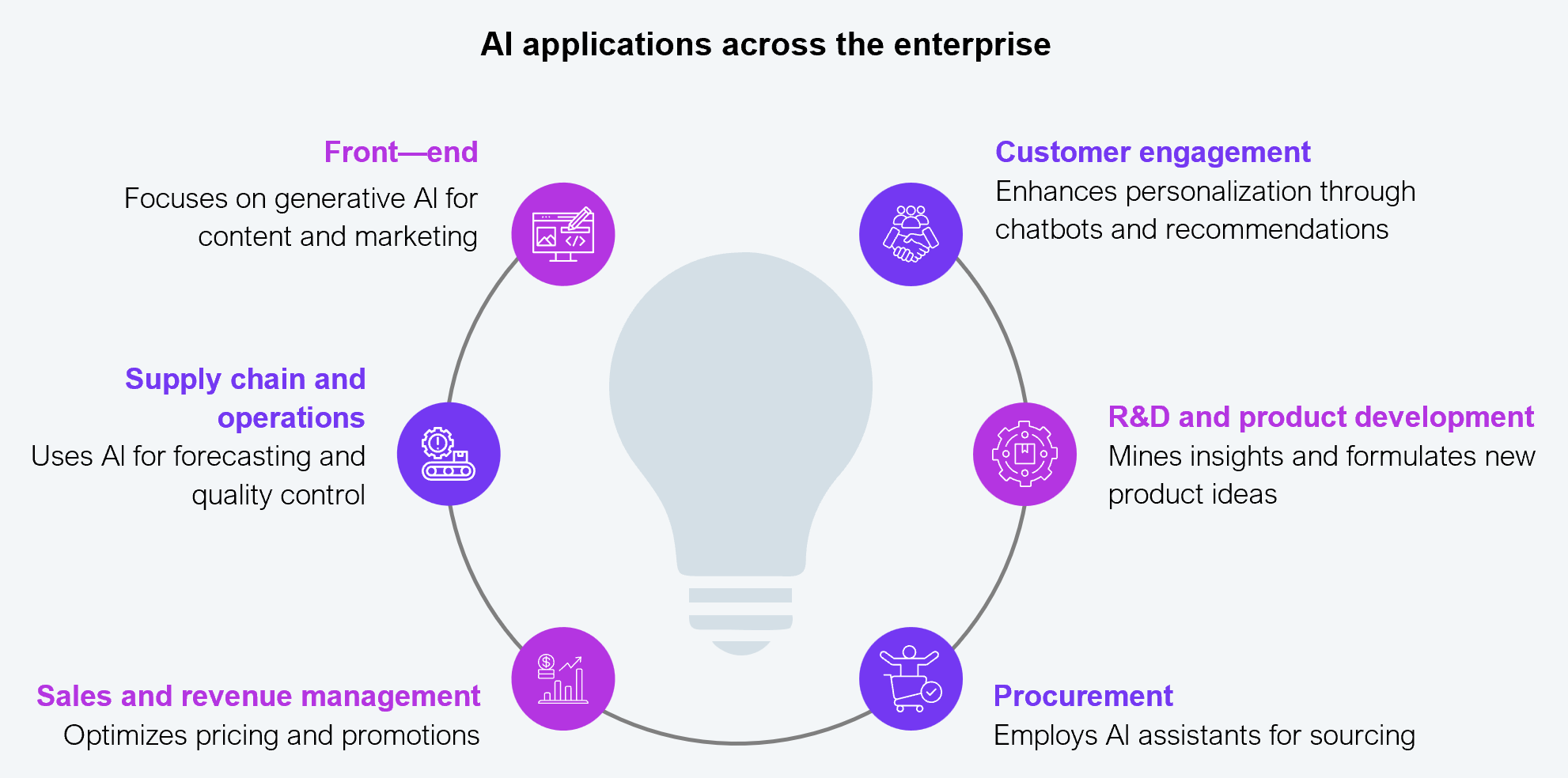
Our study uncovered AI projects in everything—from product R&D to supply chain optimization and retail execution. On the front end (commercial side), generative AI (GenAI) for content creation and marketing personalization has been a standout success so far. Several firms are using tools such as GPT-4 and image generators to produce marketing copies and visuals at scale. One global beverage company now auto-generates 100% of its e-commerce product images using AI, drastically reducing creative bottlenecks. Another consumer goods firm uses AI voice-cloning to automatically dub marketing videos into 90 languages, cutting localization time by 50% and expanding global campaign reach by 25%. These content-centric pilots are relatively easy to scale enterprise-wide, especially with ready-to-use platforms (e.g., Adobe’s Firefly) lowering the barrier. On the operations side, many are experimenting with AI in demand forecasting, pricing and revenue management, and even new product development (one beverage company’s machine learning model suggested novel flavor combinations that helped speed up its product innovation pipeline by 20%). While not all experiments will stick, consumer goods are broadening the aperture of AI applications and importantly, starting to define success in business terms such as faster time-to-market, higher conversion rates, or cost savings rather than just model accuracy (see Exhibit 5).
Source: HFS Research – Interviews conducted with senior consumer goods executives across the US and Canada

Companies are leaning on external technology and service providers to accelerate AI adoption. This ranges from big tech cloud and AI platforms (Microsoft, Google, AWS, OpenAI) to niche startups, data specialists, and consulting and IT services firms for implementation and change management. There’s a notable shift toward outcome-based partnerships, where vendors are expected to tie their fees to tangible business results instead of traditional licensing or hourly rates. One consumer goods executive noted that they want their service providers to ‘have skin in the game’, for example, by sharing in the value or efficiency gains the AI solutions deliver. At the same time, companies are wary of vendor lock-in and hype. They voice concerns about big tech providers pushing one-size-fits-all solutions and intellectual property ownership when third parties build AI models using consumer goods’ data. Leading consumer goods mitigate this by involving procurement and legal teams early, insisting on clear agreements (who owns the algorithm, how data is handled), and often using a multi-partner strategy to avoid over-reliance on any single vendor. Service providers that understand the consumer goods business context and are willing to be flexible in contracting are emerging as true long-term partners.

Consumer goods firms are piloting agentic concepts in low-risk areas (such as internal reporting or sandboxed supply chain planning) and always have a human in the loop. Companies are establishing guardrails (e.g., requiring human approval for AI-driven decisions, vetting AI outputs for bias) to gradually build internal confidence. The consensus is that human oversight remains non-negotiable in the near term. – Fully self-driving enterprise AI is still a few years away, pending more mature technology and, importantly, greater organizational trust.

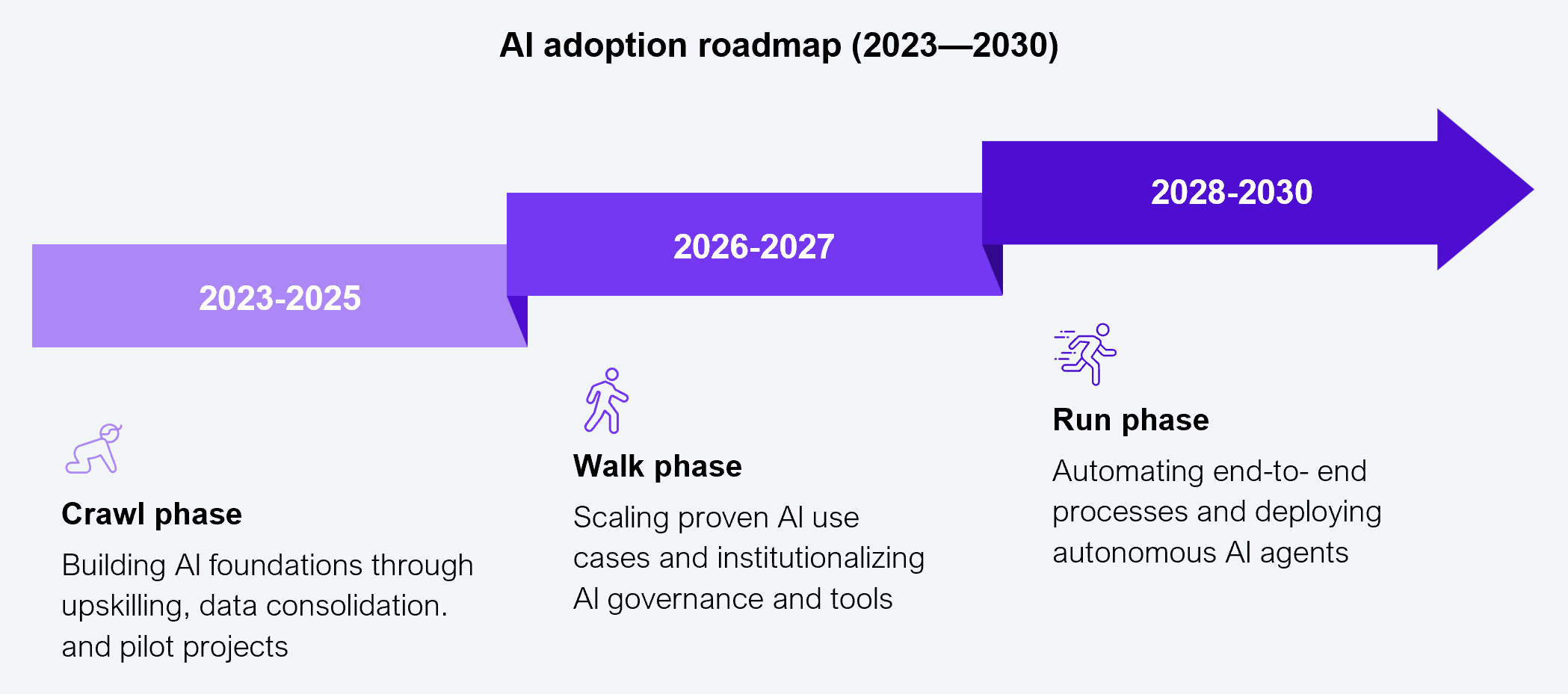
Unlike past tech waves where companies might draft rigid 5-year plans, with AI, most are adopting a dynamic, phased roadmap. In the current ‘crawl’ phase (2023–2025), firms are focused on building foundations—upskilling employees with AI literacy programs, consolidating data infrastructure, and running pilots to identify what works. The ‘walk’ phase (2026–2027) is expected to produce a few proven use cases that get scaled enterprise-wide (for example, if an AI forecasting tool succeeds in one division, it will be rolled out company-wide). This stage also involves institutionalizing AI—establishing governance, standard tools, and perhaps dedicated AI budget lines. The ‘run’ phase (2028–2030) is when companies anticipate making bold moves with more agentic and advanced AI: automating whole end-to-end processes (order-to-cash, marketing content supply chain, etc.) and introducing AI agents into daily operations where appropriate. Importantly, these roadmaps are flexible—leaders are ready to adapt as AI technology (and external factors such as regulations) evolve. In short, the companies that break out of pilot purgatory and make AI a strategic, well-funded, and well-governed enterprise capability will be the ones to outcompete their peers by 2030 (see Exhibit 6).
Source: HFS Research – Interviews conducted with senior consumer goods executives across the US and Canada
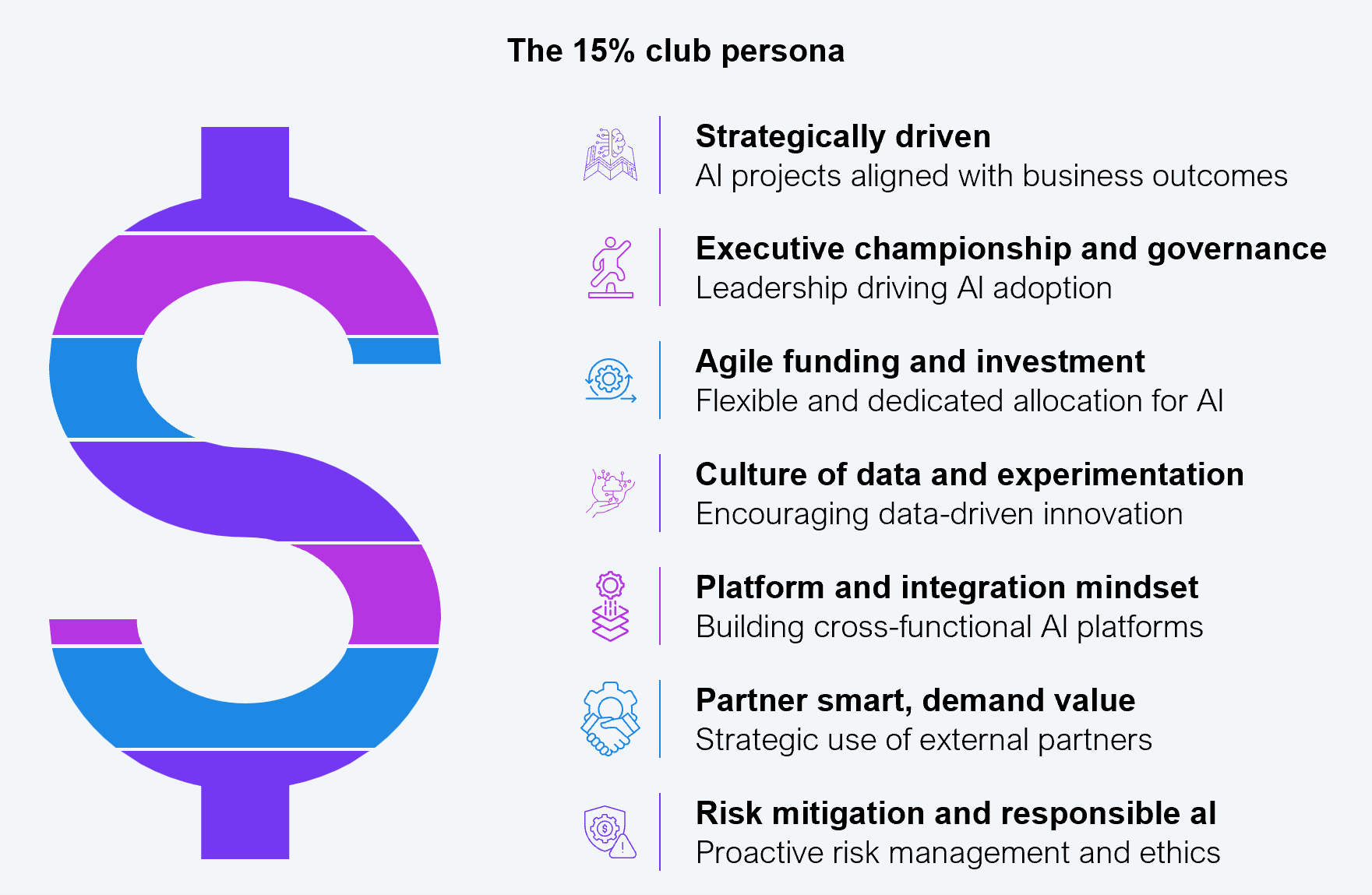
Who exactly are the members of ‘the 15% Club’ and what do they do differently? Based on our research, consumer goods organizations that consistently succeed with AI share a distinct persona and set of behaviors. These leading firms (and their executives) are characterized by a blend of visionary leadership and pragmatic execution that sets them apart from the pack (see Exhibit 7).
They are the trailblazers setting the example for harnessing AI at scale in consumer goods. Key traits of the 15% Club companies include:
Source: HFS analysis of the North American consumer goods market
These traits combine to create an organization primed to execute on AI. A member of the 15% Club is essentially a consumer goods firm that has aligned its people, processes, and technology to unlock AI’s value at scale—turning the technology into a source of competitive advantage.
In the following sections, we dive deeper into the specific findings from our study, which illustrate these themes in detail and provide examples of how consumer goods companies are navigating the journey from pilot to production.
Consumer goods companies have no shortage of AI initiatives—our research uncovered projects ranging from advanced marketing personalization to supply chain automation to R&D optimization. Many firms are still in experimentation mode, trying a bit of everything to see what sticks (see Exhibit 8).
Only 15% of our pilots move on—the remaining 85% die on the vine. We’ve realized it’s not because the technology failed but because we didn’t change the process around it or secure the cross-functional buy-in. Without process and org changes, it [AI] won’t move the P&L.
— IT and Analytics Lead, Global Cosmetics Company
This quote encapsulates the core issue: technology might prove itself in a pilot, but scaling requires organizational change (process redesign, people alignment, executive sponsorship). Many consumer goods simply aren’t setting up that broader change management when they embark on the AI pilot.
On the front end, generative AI for marketing content is a particularly hot area. Companies use tools such as OpenAI GPT-4 and Jasper for copywriting, Midjourney and Stable Diffusion for image generation, and platforms such as Adobe Firefly to create promotional assets.
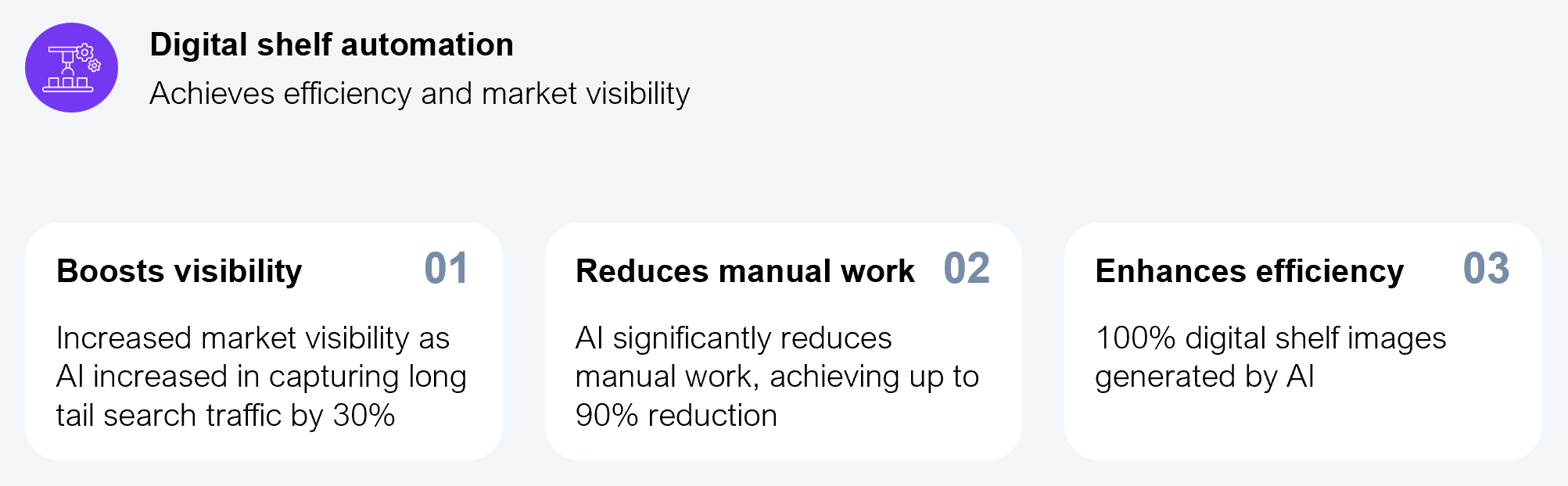
One global spirits manufacturer’s digital marketing team now auto-generates all e-commerce product images using AI, freeing designers to focus on higher-level creative work. It has achieved a 90% reduction in manual imagery creation by using generative AI for its digital shelf content, which translated to more than 30% increase in long-tail search capture for its products online.
Source: HFS Research – interviews conducted with senior consumer goods executives across the US and Canada
In customer engagement, AI chatbots and recommendation engines are being piloted to enhance personalization (albeit in the early stages). On the supply chain and operations side, firms have tested predictive demand forecasting, automated ordering (e.g., using systems such as Blue Yonder), and computer vision for quality control on production lines. In R&D and product development, AI is mining consumer insights and even formulating new product ideas—one beverage company mentioned using machine learning to suggest novel flavor combinations and predict which new products might succeed, contributing to a 20+ percentage point boost in new product launch speed in their pipeline. Sales and revenue management teams are exploring AI for smarter pricing and trade promotion optimization, such as ‘revenue growth management’ analytics, to decide the ideal promo mix by region. At the same time, procurement functions have begun deploying AI assistants for supplier interactions (one firm built a chatbot to handle supplier RFI queries, speeding up responses by 30%).
In this early adoption phase, defining ROI and business value is a work in progress. A consistent theme from the interviews is that AI’s financial return on investment is hard to pin down when use cases are nascent. Many interviewees described using proxy metrics to justify projects—for example, improvements in forecast accuracy, content output volume, or cycle time reduction—while direct profit and loss (P&L) impact is often extrapolated or projected rather than directly measured. Only a handful could point to specific dollar revenue added or cost savings realized solely from AI.
That said, the mindset is shifting toward demanding ‘hard’ business metrics from AI. The most convincing internal cases are those linked to operating or growth KPIs that the business already cares about (e.g., an improvement in demand forecast accuracy, an increase in e-commerce conversion rates, or a reduction in call center volume). As one senior leader from a global beauty brand noted, tying AI results to P&L outcomes is crucial to winning funding:
We treat AI not as a standalone experiment but as one building block—without process and org changes, it won’t move the P&L.
— VP, Global Beauty Products Company
In other words, leading firms integrate AI into broader initiatives (e.g., an end-to-end supply chain transformation or an e-commerce overhaul) so that AI’s contribution can be measured in the success of that larger effort. Some consumer goods leaders are even redefining success metrics for AI to focus on business outcomes. A distribution firm employed AI automation in order processing and freed up the equivalent of 2 full-time employees. Other tangible wins include cycle-time improvements in product development (launching new products 20–30% faster using AI insights), direct cost savings (hours of work eliminated, lower spend on external agencies due to AI content tools), and revenue upticks from better-targeted promotions. Notably, the most reliably successful AI use cases to date are in content generation and personalization, where quick wins in efficiency and output quality have been achieved at scale.
Moving forward, we see consumer goods firms refining their ‘AI success’ dashboards. Instead of celebrating the number of pilots or technical feats, the focus is shifting to adoption rates (e.g., how many employees or business units are actively using AI solutions), efficiency gains (person-hours saved, throughput increased), and innovation metrics (number of new product ideas generated, speed of experimentation).
For now, though, successful AI initiatives are those that measurably speed things up, improve outcomes, or save costs in a business process—and the leaders in this 15% Club are diligent about documenting these wins to build momentum for further scaling. They use early victories as proof points to secure buy-in for larger deployments, effectively creating a flywheel: small successes lead to bigger investments, which lead to larger successes.
As consumer goods organizations move beyond ad-hoc experiments, many are realizing the need for formal governance and decision-making structures for AI. Who should decide what AI projects to pursue? How do you ensure a business unit’s cool pilot becomes a company-wide asset, not just a siloed tool? How do you manage risk and ethics consistently?
The rise of AI councils and steering committees. Several companies have established cross-functional AI governance bodies. These go by various names: AI Council, Digital Innovation Committee, Automation Center of Excellence (CoE), etc. Their common purpose is to bring stakeholders from different functions together to oversee AI strategy and deployment. For instance, one global confectionery company formed an AI steering committee under the CTO, pulling in leaders from marketing, HR, supply chain, and other departments. Another firm mentioned an Innovation Council that evaluates and prioritizes AI projects across the enterprise. These bodies typically meet regularly (monthly or quarterly) to review pilots’ progress, decide on scaling certain projects, allocate resources, and set guidelines. Crucially, they help break down silos: a pilot in one department gets visibility to others—avoiding duplicate efforts and encouraging the reuse of AI solutions across the company. They also serve as a forum to address issues such as data sharing between departments for AI purposes or to set company-wide policies on AI (for example, guidelines on using generative AI tools). As one CTO described:
We set up an AI CoE, but quickly found it can’t deliver in isolation. Now we have an AI Council with reps from each business unit—ideas flow up from each function, and the council allocates budget and help. It’s a bit slower than everyone doing their own thing, but in return, we scale the good stuff much faster across the company.
— CTO, Global Confectionery Manufacturer
Dedicated leadership roles for AI. Some forward-leaning consumer goods are creating new roles or redefining existing ones to give clear ownership of the AI agenda. The idea of a Chief AI Officer (CAIO) reporting directly to the CEO was floated by a few interviewees as a needed step—although only a couple of companies have formally appointed one so far. In several cases, however, an executive effectively fills that role without the title. For example, the CIO of a cosmetics company took on the mantle of driving AI enterprise-wide, essentially acting as a CAIO by leading the 15k-employee Copilot rollout and spearheading an ‘AI literacy’ culture change. In another case, an executive jokingly renamed himself ‘GenAI Global Solution Owner’ after attending an AI course at Harvard to signal his new mandate to push AI solutions enterprise-wide. This kind of personal leadership and evangelism can effectively rally the organization. The trend is toward explicit accountability: whether via a formal CAIO or a de facto AI lead, companies are designating point people responsible for AI outcomes (business value delivered), not just AI experiments. One interviewee noted that having a single throat to choke (or back to pat) for AI progress focuses the effort and avoids diffusion of responsibility.
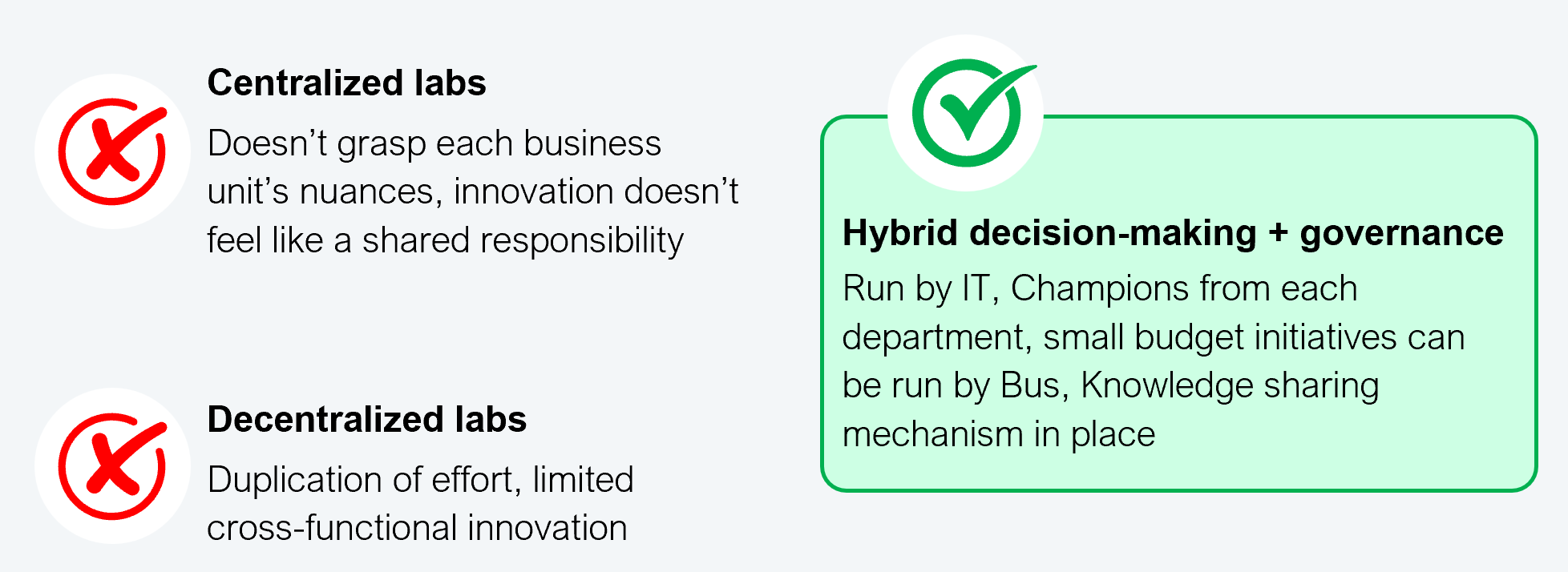
Centralized vs. decentralized decision-making—finding the balance. A key governance question is how much AI efforts should be centralized. Some companies initially tried a centralized approach—for example, setting up an innovation team or AI center of excellence that had to approve and manage all AI projects. This ensures standardization and avoids chaos, but it can also become a bottleneck. One executive warned that creating a separate innovation sub-org was counterproductive in their case. It created a sense that ‘AI is being handled by that team over there,’ leading business units to disengage or wait passively for solutions. Moreover, a central team might not grasp each function’s nuances, resulting in one-size-fits-all solutions that don’t fit anyone. On the other hand, a purely decentralized approach, one where each function or brand does its own AI with no coordination, leads to duplication (e.g., five different chatbot projects sprouting in five departments) and missed synergies (no shared data or platforms, difficulty scaling successful pilots company-wide).
At first we tried a separate ‘Innovation Lab’ to drive AI. Honestly, it became an ivory tower. The core business folks nodded politely and went back to doing things their old way. We learned that AI innovation has to happen in the business units. Now we push the ideas down – every function must have an AI initiative – and we support them rather than owning it all centrally. The top team just makes sure it fits the bigger picture and that we don’t run off the rails ethically.
— VP of Innovation, Leading Consumer Products Company
The emerging best practice is a hybrid governance model followed by the 15% Club. A central guiding team sets standards, provides common platforms (approved AI tools, enterprise data lakes, etc.), and captures cross-company learning, while individual business units have the autonomy to innovate within that framework (see Exhibit 2). In practical terms, this might mean:
Many interviewees stressed they did not want to create an onerous new bureaucracy for AI. Often, they piggyback on existing governance structures. For example, if the company already has a digital transformation steering committee, AI is added to its agenda rather than spawning a brand-new committee. Or the IT governance board (which usually includes business leaders who approve big tech projects) might expand its scope to cover AI initiatives explicitly. The downside to bolt-on approaches is that those bodies might be too high-level or meet too infrequently, potentially slowing decisions. Some companies solved this by having a working group beneath the central committee—e.g., an AI working group that meets bi-weekly to sort out details and then reports to the monthly executive committee meeting.
Determining decision rights and evaluation criteria for AI projects is another aspect of governance. We heard that companies are developing more objective frameworks to decide which ideas get funding and attention. For example, one firm uses a scoring system that rates AI proposals on business value, technical feasibility, and strategic alignment, ensuring pet projects don’t get through unless they score well. Another employs a stage-gate process similar to product development: Idea → POC → pilot → scale, with criteria at each stage (e.g., a pilot must demonstrate at least a 5% improvement in a key KPI to graduate to scale deployment). The AI Council or committee oversees these gates, ensuring their teams aren’t pushing forward without evidence of value. The goal is to move away from decisions based on the highest-paid person’s opinion(HIPPO ) or shiny-object syndrome to decisions based on data and results.
Some organizations are embedding AI into existing decision processes instead of treating AI separately. For instance, when approving any new IT system or business initiative, leadership now asks, “Have we considered AI/automation as part of this? Could AI make this project better?” This forces AI thinking into regular budgeting and planning. A few interviewees mentioned that each department is expected to report on how they are leveraging AI as part of quarterly business reviews—essentially making AI progress a standard agenda item, which drives accountability and keeps AI in focus at the executive level.
In summary, AI governance in consumer goods is evolving from informal and siloed to more structured and cross-functional. Companies are realizing that AI, to scale, cannot remain a skunkworks—it needs ownership at the top, involvement across departments, and integration into existing management processes.
Historically, AI spending in consumer goods was an offshoot of IT spend. In the early phase of AI adoption, most firms did not have dedicated AI budgets. Funding typically came as part of larger IT projects or general digital transformation programs. For example, an ERP upgrade might include a machine learning module, or a CIO might use some discretionary funds to sponsor a few AI proofs-of-concept. In nearly 80% of companies we studied, AI efforts to date were financed by simply carving out portions of existing budgets—essentially reallocating money from other initiatives to cover the AI experiments. The consequence was that AI was often treated as secondary: if crunch time came, those funds could be (and often were) pulled back to core needs. One interviewee noted that ‘the AI pilot is the first to go’ whenever there was a budget cut, since it wasn’t explicitly protected. This ‘leftover funding’ status is a big reason AI didn’t get the consistent investment or attention neededto scale.
Recently, we have seen a significant shift in who is funding AI. Business units and functional leaders are increasingly investing in AI out of their own departmental budgets rather than relying on IT alone. Based on our interviews, we estimate about 60% of AI-related spending now happens outside the central IT budget. In other words, marketing, sales, supply chain, R&D, and even finance teams are directly funding AI tools and projects to meet their specific needs.
In many consumer goods firms, business-led AI investment has overtaken IT-led investment, reflecting a democratization of who drives AI. For example:
This decentralization of AI spend is a positive sign. It means business leaders see enough value in putting skin in the game. However, it raises the need for greater coordination. When everyone starts funding their AI projects, companies risk fragmentation (lots of siloed tools that don’t talk to each other) and duplication of effort. The governance mechanisms discussed in Section 2 become critical to ensure that, for instance, marketing’s AI initiative and Supply Chain’s AI initiative can share data or algorithms where it makes sense or at least learn from each other. Several companies mentioned they are now tracking total AI spend across the enterprise by creating an ‘innovation’ or ‘digital’ budget category that rolls up investments from different departments. This helps leadership see the big picture and avoid over-investing in one area while neglecting another.
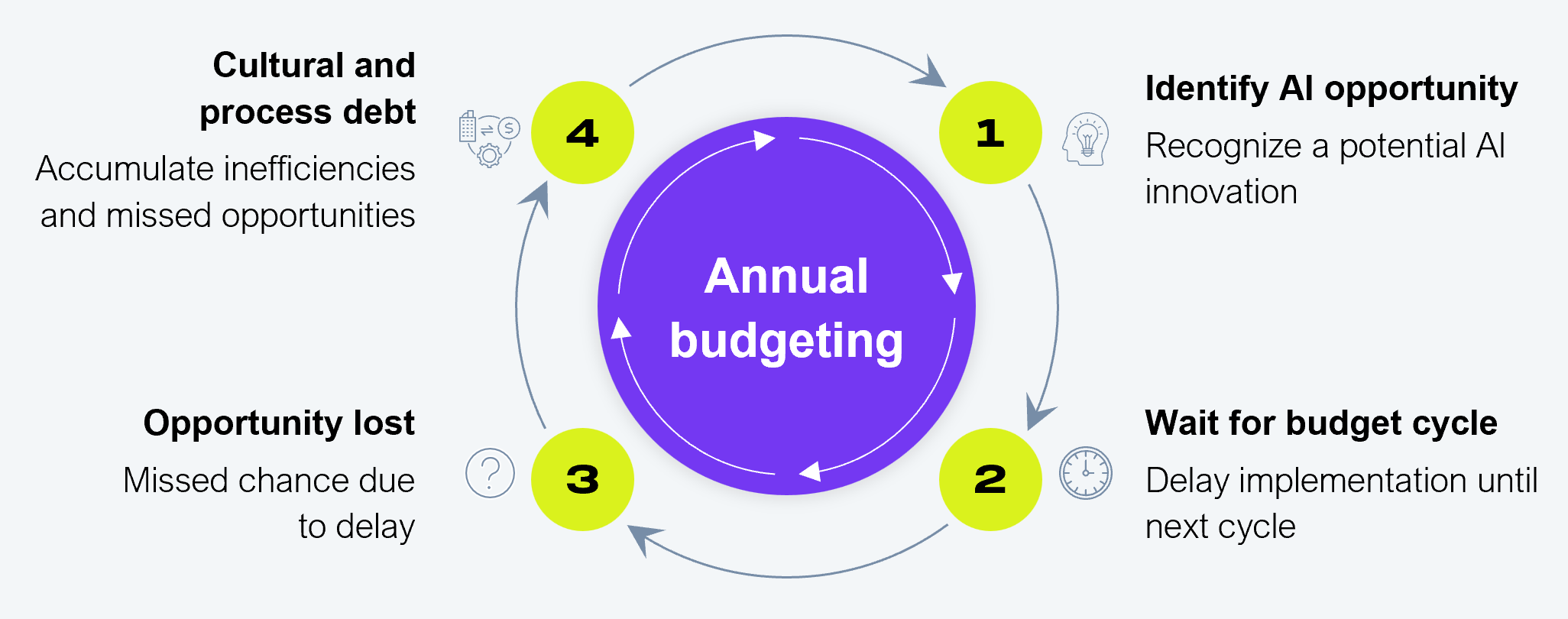
Another challenge is that many consumer goods firms remain stuck in annual budgeting cycles that are not well-suited for the fast pace of AI innovation.
Even if a ground-breaking discovery happens after budgets are set, every department must wait for the next cycle to get funding
— ‘ridiculous’ but true” – Senior Executive, Beverage Company
In a traditional model, budgets are set once a year, and there’s little room for new projects to get funding outside that cycle. If a promising AI pilot emerges in Q2 and shows great potential, teams might have to wait until next year’s budget to scale it, by which time momentum is lost. Leaders in our study identified this as a form of organizational inertia holding back AI. One executive called it ‘process debt’—legacy budgeting processes that make the company less agile (see Exhibit 9).
Source: HFS Research – Interviews conducted with senior consumer goods executives across the US and Canada
The 15% Club firms are experimenting with ways to introduce flexibility in funding for AI:
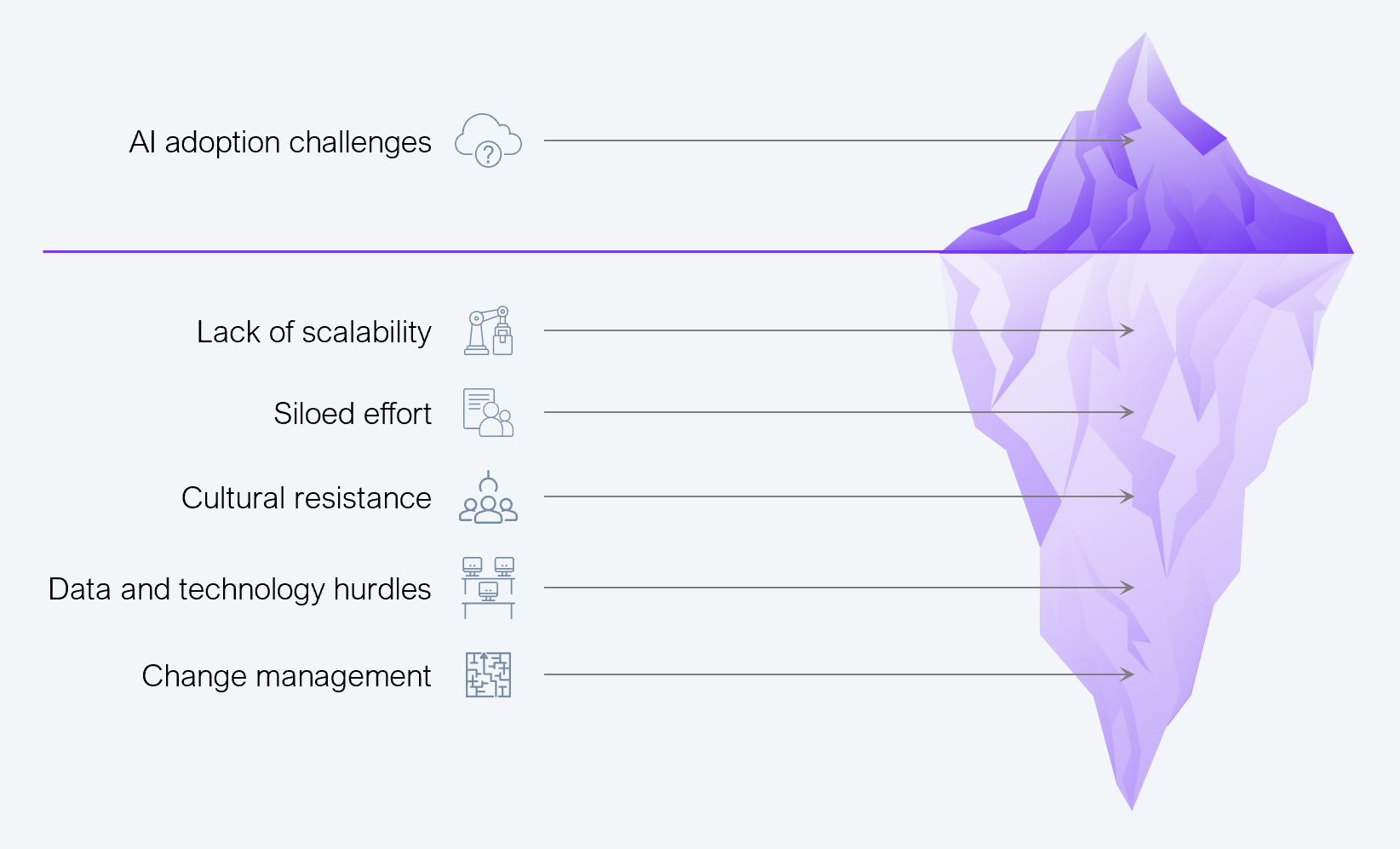
The interviews surfaced a common set of internal challenges—organizational, cultural, technical, and strategic—that firms must overcome to realize AI’s potential. This section examines why so many AI projects struggle to break out of pilot mode and what’s impeding progress beyond the technology itself (see Exhibit 10).
Source: HFS Research – Interviews conducted with senior consumer goods executives across the US and Canada
‘Pilot purgatory’ and lack of a path to scale. As noted earlier, 70–85% of AI pilots never make it into broader production use. Why? A recurring refrain is that pilots are often run in isolation. A team might implement a cool AI prototype for demand forecasting or a marketing campaign, but it remains a one-off demo. It’s not integrated into core systems or workflows, other departments aren’t aware of it, and when the small pilot budget is exhausted, the project withers away.
We launched over 40 AI POCs in the last two years—but only five ever made it into sustained production.
— IT and AI Lead, Global Cosmetics Co.
The effort required to scale—funding a full rollout, integrating the AI into enterprise systems, retraining staff, changing business processes—is grossly underestimated during the pilot.
Siloed efforts and poor cross-functional alignment. Many AI initiatives originate as bottom-up projects by individual functional teams. For example, a marketing team might try a generative AI tool to create social media content, or a supply chain team might build a local inventory optimization model. These can be significant grassroots innovations, but if other stakeholders (IT, data management, legal, and other business units) aren’t in the loop, the pilot hits a wall when it needs to integrate or scale. A marketing AI that generates content at scale might need IT’s support to connect to the content management system and might need legal’s input to ensure brand compliance—if those stakeholders weren’t involved from the start, the pilot stalls when it tries to go enterprise-wide. Additionally, regional or business unit silos pose challenges: One global firm noted that varying digital maturity in different geographies made it hard to roll out an AI solution consistently. What worked in a tech-savvy market might not work in a less mature market without significant adaptation and local buy-in. The companies stuck in pilot purgatory often lack mechanisms to share learnings across silos or to coordinate AI efforts—so they end up with a dozen small AI wins that never add up to considerable value.
Cultural resistance and leadership posture. AI in many consumer goods companies is still not a boardroom priority. It’s something happening in the trenches, driven by tech enthusiasts, while top executives focus on more immediate business fires (inflation, supply disruptions, retailer negotiations, etc.).
We’ve treated AI as an add-on—leftover budget, leftover leadership time. As a result, it never reaches the boardroom as a strategic topic
— IT Procurement leader, Leading Printed Items Company
In such environments, AI lacks an executive champion who can knock heads together and push teams to adopt new ways of working. There’s also often a ‘not invented here’ syndrome: ideas or algorithms suggested by outside partners (consultants, vendors) sometimes face internal pushback from IT or analytics teams who feel unless the idea came from them, it’s not good. This can sabotage external solutions that might actually be quite viable.
Another cultural aspect is tolerance for failure (or lack thereof). Some organizations still have a low appetite for experimentation—if an AI pilot doesn’t yield quick wins, people get discouraged, and leadership loses interest. By contrast, the 15% Club companies foster a culture where learning from failure is acceptable and expected.
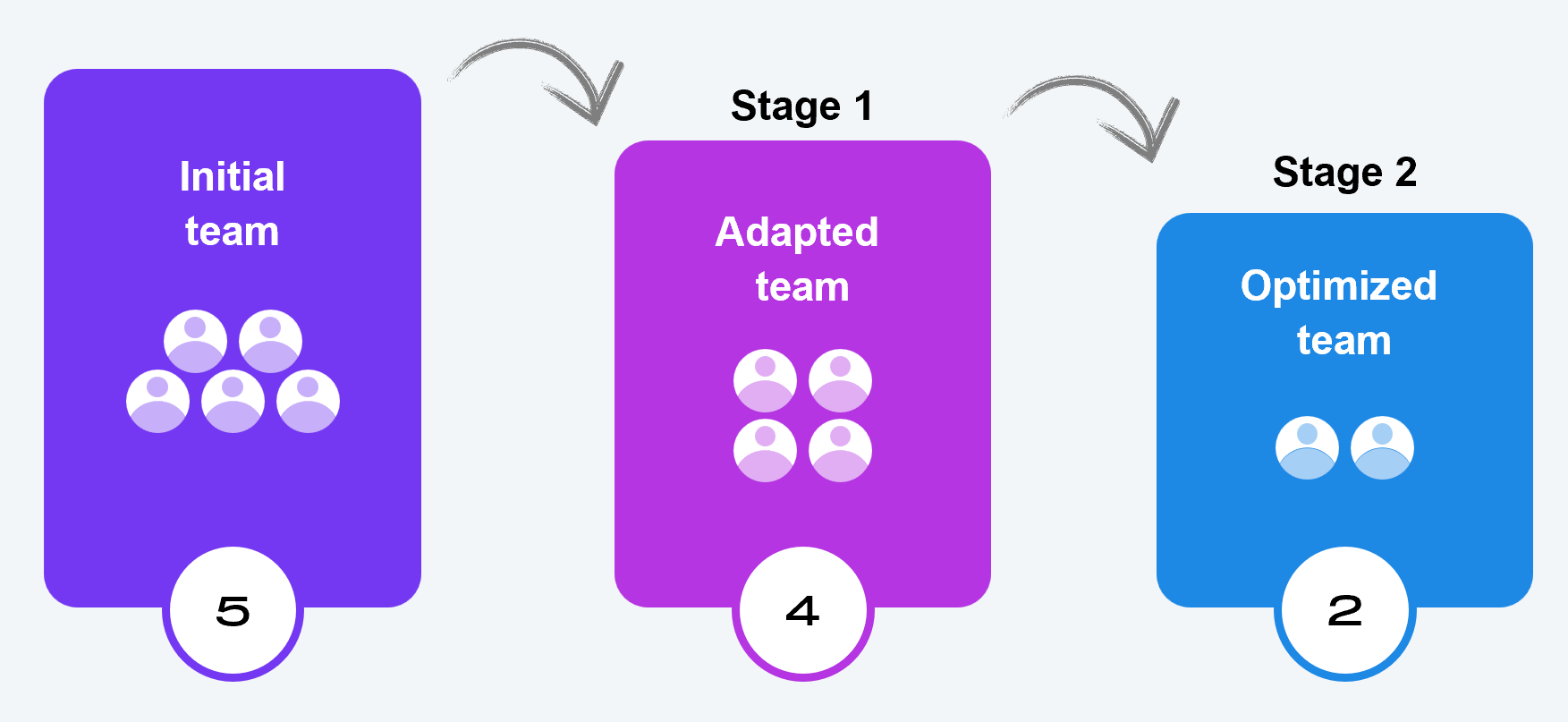
Workforce impact elephant in the room. The fear (often unspoken) of how AI will affect jobs. In the short term, most firms publicly emphasize using AI to augment employees, not replace them. Indeed, several interviewees gave examples of reskilling programs and co-working with AI, such as training marketing staff to use AI tools so they can produce more content rather than cutting headcount. However, as AI-driven efficiencies accumulate, it inevitably raises efficiency questions.
There was a telling example from one company: A brand marketing team of five people was asked to adopt generative AI tools for content creation. Four team members enthusiastically embraced the tech and became vastly more productive—so much so that the fifth member (less adept with the tools) became redundant. Initially, this looked like a win-win (doing more with the same team) until management realized that even five augmented people were more than needed for the output now. That prompted a hard discussion about whether to repurpose or eliminate a role (see Exhibit 11).
Source: HFS Research – Interviews conducted with senior consumer goods executives across the US and Canada
Scenarios like this are starting to play out, and many organizations don’t yet have a clear strategy for managing it. It creates an undercurrent of anxiety that can make employees less willing to support AI projects (why would I help automate something if it might jeopardize my job?). The 15% Club firms are proactive in addressing this—some openly acknowledge that roles will evolve and have put upskilling and job transition programs in place. Others have involved HR in AI initiatives from the beginning to monitor the impact on organizational design. But many others are kicking this can down the road, which could become a bigger cultural barrier as AI scales.
Data and technology hurdles. While this report focuses on organizational aspects, it’s worth noting that technical challenges do exist and contribute to pilot purgatory. Common issues include; data being locked in silos or of poor quality (the model worked on a clean dataset in pilot, but in the real world, data is messy and scattered), IT infrastructure can’t support production-scale AI workloads (e.g., lack of API endpoints, real-time data pipelines, or computing power in the right places), and difficulties integrating new AI tools with legacy systems. One interviewee lamented that their pilot algorithm worked well, but integrating it with their 20-year-old ERP system was so complex that the project lost steam. Tech debt in legacy systems can thus indirectly stall AI. Leading firms tackle this by running pilots in environments that are as realistic as possible (using real data, interfacing with at least some live systems) to uncover integration issues early. They also invest in modern data platforms and cloud services to make scaling easier. However, firms that treat AI pilots as completely standalone often get a rude surprise when trying to productionize them.
Change management and talent. A final barrier to highlight is the people capabilities required to scale AI. Many consumer goods lack sufficient in-house data science and engineering talent. They might have a small central team, but not enough to support dozens of initiatives across functions. This creates a bottleneck where only a few projects can progress. Additionally, even when external partners are brought in to build a solution, the internal teams may not have the skills to take it over. So, the AI sits on the shelf after the consultants leave. Top performers address this by aggressively hiring or training for key roles (ML engineers, product managers for AI, etc.) and by insisting on knowledge transfer from partners.
Moreover, scaling an AI solution often requires process change and training for end-users. If salespeople are not trained to trust and use the new AI pricing recommendation tool, it doesn’t matter that it was deployed—they’ll ignore it, and the impact will be nil. Change management must accompany each AI rollout: communicating the purpose, training users, tweaking processes to incorporate the AI outputs, and setting new performance metrics. Many AI pilots fail to scale because this change management effort wasn’t planned or resourced.
The 15% Club companies distinguish themselves by proactively tackling these challenges. They treat AI not just as a technology deployment but as a change program for the business. They secure executive air cover, involve all stakeholders early (business, IT, risk, HR, etc.), invest in data foundations, and have a plan for scaling from day one of a pilot (see Exhibit 12). Those still stuck in pilot purgatory often realize—sometimes too late—that they needed to address these ‘soft’ issues all along.
Source: HFS Research, 2025
In our study, the Marketing and Digital Commerce domain emerged as the clear front-runner for early AI wins. Generative AI, in particular, has been a game-changer for content creation, personalization, and customer engagement.
A consumer goods firm mentioned deploying an AI voice-cloning tool to automatically dub their product videos into different languages. They produced marketing videos in 90 languages using AI, cutting localization time by 50% and expanding global campaign reach by 25% without a proportional increase in cost. In both cases, these pilots started small (a few products or a single brand’s campaign) but quickly scaled to broader use once the quality was proven because the value proposition was clear—faster content generation at lower incremental cost, which is a big deal in competitive consumer markets.
It’s no surprise that content-centric and customer-facing pilots are among the first to scale. They tend to have lower barriers to entry (thanks to many ready-made AI tools), and their impact is quickly visible. A marketing team can A/B test AI-generated content and immediately see an uplift in engagement metrics, making it easier to justify rollout. Also, the risk of failure is relatively contained—if an AI-generated image or copy isn’t great, you simply don’t use it; it doesn’t jeopardize operations or safety.
It’s clear marketing is ahead because the inputs and outputs of the work are highly digital (text, images, customer data), and the ROI can be quickly demonstrated in engagement metrics. Also, off-the-shelf solutions abound, from Adobe’s Sensei and Firefly to various MarTech AI startups, making adoption easier without heavy IT lifts. Large consumer goods with massive content libraries are weaponizing that content with AI to out-personalize competitors.
Our strategy is to use off-the-shelf AI wherever possible. We went with pre-integrated vendor models rather than spend a year building our own. Budget cycles penalize long bespoke builds—by the time it’s done, business priorities have shifted. A good SaaS solution can get us 80% there in a fraction of the time.
— Head of Digital Innovation, Wholesale Distributor
Beyond marketing, we heard of promising experiments in supply chain and operations, although these have been a bit slower to scale fully. Several supply chain teams are piloting AI for demand forecasting and planning optimization. For example, one company used a machine learning model to predict out-of-stock retail situations and recommend production adjustments. The pilot showed a noticeable accuracy improvement over the baseline forecast but scaling it company-wide required integrating the model into the existing planning system and retraining planners—work that is underway. In manufacturing, some are using computer vision to detect product defects on the production line (an AI camera spots flaws that human inspectors might miss). These use cases often demonstrate technical success but need capital investment and process changes to implement broadly (e.g., installing cameras on every line globally).
Sales and commercial teams are experimenting with AI for pricing and promotion. One consumer goods in the food sector piloted an AI tool for revenue growth management (RGM)—essentially a system that sifts through sales data to find the optimal combination of pricing and trade promotions for each region (e.g., which product should get a 10% discount vs 15%, in which channel, to maximize revenue without hurting margin). The AI could churn through years of sales data and factor in external variables (holidays, weather, competitors’ moves) to fine-tune decisions previously based on intuition. The pilot in one region showed a low single-digit percentage revenue lift and improved promo ROI. The company is now scaling it to additional regions with the help of a consulting partner. While a few percentage points may not sound dramatic, in a low-margin, high-volume business, that’s very significant in dollar terms.
R&D and product innovation functions are tapping AI to sift through consumer feedback and trends. We heard of a cosmetics company using AI to analyze millions of online reviews and social media posts to identify unmet customer needs and generate ideas for new product concepts. They credited this AI-driven insight with guiding the successful launch of a new skincare line that addressed a common consumer pain point found via the data. Another firm is using formulation AI—algorithms that suggest recipe or formula tweaks to achieve desired product attributes (taste, texture, shelf life), which has accelerated its development cycle. These kinds of AI applications don’t necessarily replace scientists or innovators, but they give them a powerful tool to augment their creativity and decision-making, leading to faster experimentation.
AI use in HR and Corporate Functions is relatively nascent, though some are trying AI in talent analytics or resume screening. Finance is starting to use AI for forecasting and anomaly detection, but mostly in pilot stages. The epicenter so far has been where the business directly interacts with consumers or manages complex operations—marketing, sales, supply chain, and product development.
An interesting trend is the idea of ‘functional champions’ for AI. Some companies have appointed an AI point person in each department (as mentioned in governance) whose job is to spur experimentation in their area and share results. This has led to friendly competition internally, e.g., the head of marketing AI showcases how they used a gen AI to cut content costs by 30%, which nudges the head of supply chain AI to come up with an equally compelling win in their domain, and so on. By publicizing these wins, leadership hopes to create momentum and cross-pollination of ideas.
No consumer goods company is undertaking the AI journey alone—an ecosystem of technology and service partners is pivotal in accelerating (or sometimes impeding) AI adoption. Our research made it clear how a company manages its external partnerships can significantly influence its success with AI.
On the technology side, consumer goods are leveraging a range of external AI tools and platforms. Nearly every firm mentioned working with one or more of the big cloud providers—Microsoft (Azure OpenAI and MS Copilot), Google (GCP AI tools), or Amazon (AWS AI/ML services)—as foundational elements of their AI stack. These platforms offer scalable infrastructure and pre-built AI services (such as image recognition and natural language processing APIs) that can be plugged into solutions. Additionally, many are experimenting with niche AI startups for specific capabilities; for example, using a service such as Jasper.ai for marketing copy generation, Rask AI for video dubbing use case, or a supply chain specialist tool such as Blue Yonder for demand planning optimization. This ‘let’s borrow vs build’ approach allows consumer goods to pilot quickly without reinventing the wheel.
If a cloud service can do something (translate text, recognize an image, optimize a route), we’ll use that rather than build a custom model—unless we think our proprietary data gives us a unique edge.
— Transformation Leader, a Leading beverage Company
In other words, they focus their own data science efforts only on problems truly unique to them and otherwise stand on the shoulders of tech giants and innovators.
Larger consumer goods firms involve their procurement and IT security teams in vetting these niche solutions, especially startups, to ensure they meet data privacy and security standards. Some companies run pilots with startups in a sandbox environment before wider use to validate the tech and the vendor’s stability. Interestingly, a few companies also mentioned academic collaborations—partnering with universities or joining industry research consortia to tap into cutting-edge AI research (one had an innovation lab linked to a university’s AI center, which helped feed them talent and ideas). This is less common but illustrates that leaders are casting a wide net to source AI innovation externally.
Service providers (consulting, IT services, systems integrators) are crucial, especially for companies that don’t have massive internal AI teams. Many consumer goods rely on consulting partners for things such as solution implementation, change management, and even strategy development around AI. For example, a company might bring in Cognizant or Accenture to help integrate an AI solution into their CRM system, run training workshops for employees on new AI tools, or redesign a business process to incorporate an AI step. In our interviews, several executives credited external partners with helping them navigate organizational hurdles blocking AI. One described how they hired a consultancy to run an AI awareness workshop for senior executives, which ‘demystified the tech and alleviated a lot of fear at the top.’ Another brought in an external expert to moderate discussions about the workforce impacts of automation, which helped defuse tensions and got leadership alignment on a reskilling plan. These examples show that service providers often act as change agents and educators, not just tech implementers.
Service providers also supplement talent gaps. Several firms have staff augmentation arrangements, e.g., a few data scientists from the provider working side by side with the internal team, building models, and simultaneously upskilling the internal folks. One strategy mentioned is a ‘co-creation’ model: Use consultants to jump-start an AI project and build version 1.0 of the solution, then hand it off to internal teams to own and continue developing. This way, the company isn’t dependent long-term, and its people learn by doing.
However, the consumer goods also expressed evolving expectations from their partners. There’s a clear shift toward outcome-based engagements. Instead of paying service providers purely by the hour (which, as one exec pointed out, incentivizes throwing more people at a problem), they are pushing for contracts where at least part of the fees are tied to results—for example, a bonus for hitting a specific efficiency target, or a gain-share model where the provider gets a small percentage of the business value created. A global IT leader at a spirits company described their vision for this change:
We work extensively with [our service providers]…we shouldn’t think about effort in terms of people hours. You should think of cost as a function of value delivered….now we should look at what value they provide, and based on that value, we should be paying.
— IT Procurement Leader
In essence, consumer goods companies want their partners to have ‘skin in the game’ and focus on innovation and reusable solutions rather than just billing more hours. Some providers are responding by bringing in frameworks, accelerators, and even outcome-based pricing for AI projects.
That said, it’s not all rosy—the interviews surfaced a few concerns about external vendors and partners that consumer goods are wary of:
To address these concerns, consumer goods leaders are becoming more hands-on in managing their partner ecosystem. They involve procurement to negotiate flexible contracts. They set joint governance with vendors (such as steering committees, including vendor reps and client stakeholders for critical projects). In many cases, the GSIs act as an orchestrator, bringing the best technology, ensuring data governance, and handling change management. They also provide an objective perspective—for example, advising a consumer goods firm on which AI tool is genuinely best for their needs, rather than a vendor trying to sell its tool. In this way, a trusted service partner can help the company navigate the noisy AI market and avoid common pitfalls (like buying a fancy tool that nobody uses).
The 15% Club companies are differentiating themselves by leveraging partners for speed and expertise while retaining control over their destiny:
The leaders treat partners as extensions of their team, closely aligned to business goals and temporary enablers—ultimately aiming to build their capability. As AI becomes more central to competitive advantage, consumer goods recognize that they can’t outsource their brains but can certainly augment them with the right external help.
The concept of ‘agentic AI’—AI systems that can act as autonomous agents, making decisions and carrying out tasks with minimal human intervention—came up in almost all our interviews.
Everyone is in exploratory mode—running small proofs of concept or watching developments in other industries—but no one wants to be the first to let AI completely drive the bus in core areas such as supply chain planning or customer interactions.
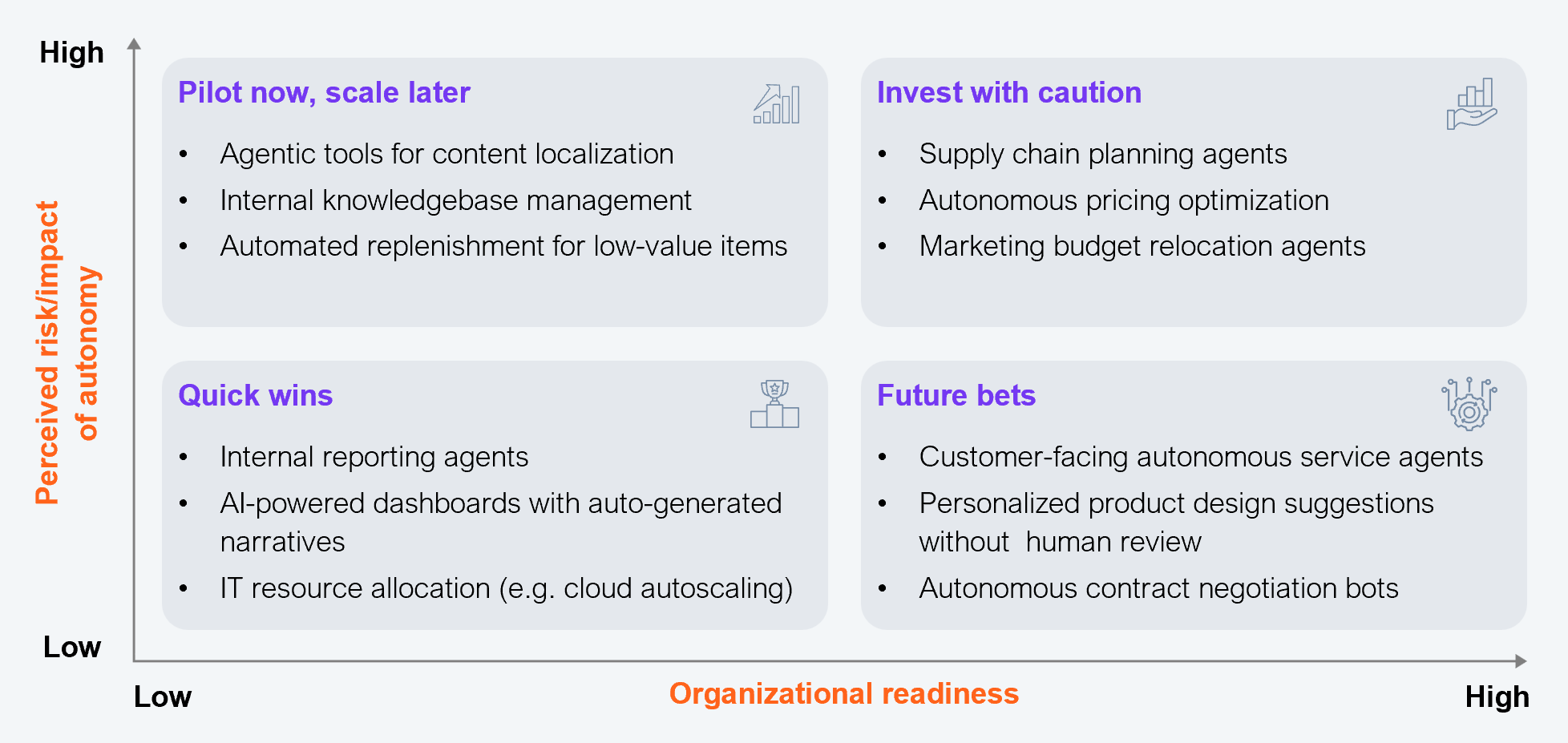
That said, most leaders see agentic AI as an eventual progression of their AI journey. The consensus is that we are on a path from today’s assistive AI (which provides recommendations or automation for sub-tasks) to more autonomous AI that can handle multi-step processes. Many are planning for this adoption in select areas where the risk is manageable. Examples of areas mentioned include:
HFS has arrived at an Agentic AI opportunity matrix (see Exhibit 13) basis inputs received from all the interviews and our ongoing research in the consumer goods industry.
Source: HFS Research, 2025
The cultural acceptance of agentic AI is a big hurdle. It’s one thing for an algorithm to suggest an optimal price; it’s another to let it set the price automatically. Managers and executives must become comfortable relinquishing a degree of control. One way trust is built is by the AI proving itself in narrow tasks first. For instance, a procurement bot that automatically reorders packaging material when stock drops might earn trust if it consistently does that one job well; over time, its authority could expand.
We also observed that regulatory and ethical considerations temper the pace here. In consumer goods, if agentic AI were to be used to influence consumer choices or personalize products, companies must be mindful of emerging AI regulations (e.g, the EU’s AI Act) and consumer privacy expectations. A misstep by an autonomous marketing agent (imagine it targeting a sensitive consumer segment inappropriately) could have reputational fallout. So, the risk-reward calculus is being carefully evaluated for each potential agentic use case.
Many consumer goods are in the process of laying the groundwork for agentic AI, even if they’re not deploying it yet. This includes:
The companies winning with AI aren’t just experimenting with tools—they are rearchitecting their businesses to make AI executable, fundable, and measurable on an ongoing basis. Perhaps the biggest shift in strategy is moving away from one-off projects toward building common AI platforms and capabilities that the whole enterprise can use. For example, instead of each division spinning its own customer analytics pilot, consumer goods might invest in a central customer data platform with AI services that marketing, sales, and customer service can all plug into. This platform mindset means AI becomes a shared resource and a core part of the infrastructure rather than a series of disconnected efforts.
Another hallmark of future-ready AI strategies is continuous planning. Traditional 5-year plans struggle to stay relevant in the face of rapid AI advancements. Most of our 15 interviewees said they deliberately avoid a rigid long-term AI roadmap. Instead, they set high-level ambitions (e.g., ‘by 2025, have AI integrated into all key customer touchpoints’ or ‘automate 50% of planning processes with AI by 2030’) and then manage the journey dynamically. One reason cited: ‘a static roadmap won’t do justice’ given how fast AI tech is evolving. So, governance is more about continuous evaluation and iteration than executing a fixed plan. Leadership provides a north star and guardrails (for instance, a principle that ‘we prioritize AI projects that enhance productivity in core operations’ or an ambition to ‘develop internal AI talent pipeline’) but leaves room to pivot as new capabilities emerge or as business conditions change.
Most companies are effectively following a ‘Crawl – Walk – Run’ maturity model for their AI adoption, whether explicitly articulated or not:

Focus on building foundational capabilities. This includes upskilling employees (running broad AI literacy and training programs, hiring key AI talent where needed), consolidating and prepping data infrastructure (ensuring data from various sources is accessible and of good quality), and executing pilot projects to identify what works and what doesn’t. It’s a period of learning and establishing the basics. Many firms are in this phase right now—laying down data platforms, experimenting with use cases, and establishing initial governance and policies. They are also keeping an eye on external factors in this phase: for example, monitoring emerging AI regulations (e.g, the EU’s proposed AI Act) to ensure compliance frameworks are ready and considering macroeconomic or geopolitical shifts (trade changes, economic swings) in their AI models so those models remain robust. Sustainability is entering the conversation, too; e.g., using AI to optimize energy usage or reduce waste aligns AI efforts with broader ESG goals.

By this time, companies expect to have a few proven generative and agentic AI use cases that delivered value in the crawl phase and will be focused on scaling those across the enterprise. For example, if an Agentic AI-driven demand forecasting tool worked well in one business unit or region, the company will allocate budget and resources to roll it out globally or across all divisions. The walk phase is also about institutionalizing advanced AI: Putting in place standard tools and platforms (if not already done), formalizing the AI governance structures and policies (e.g., an ethics board, security protocols for AI), and potentially setting up dedicated AI or automation budgets at the corporate level. It’s during this phase that AI moves from ‘some cool projects’ to an accepted part of the business toolkit.

This is where advanced and agentic AI capabilities start coming to the forefront. Companies anticipate that by around 2028, AI technology (and their internal comfort level) will have matured enough to enable bolder, transformative moves. This could include automating entire end-to-end processes (for example, an ‘order-to-cash’ process that goes from customer order to invoice with minimal human involvement or a ‘marketing content supply chain’ that plans, creates, and disseminates content automatically based on performance data). It also might include introducing AI agents into daily operations—not in a broad sense of running the whole company, but targeted agents that manage specific tasks or decisions autonomously. Essentially, the run phase is about harvesting the fruits of the foundations laid earlier: AI is deeply embedded and drives significant portions of work, and the organization is reaping efficiency and innovation benefits at scale. Companies in this phase will likely be revisiting their operating models—for instance, reorganizing teams because AI handles certain tasks and focusing human roles on higher-level judgment, strategy, and creativity that AI cannot (yet) replicate.
One interviewee emphasized that their AI roadmap is reviewed every six months, not set in stone for years. They incorporate new developments (say, a breakthrough in generative AI) and adjust course if needed. They also factor in external ‘wild cards,’ for e.g., if a major new competitor emerges using AI in a novel way or if regulation suddenly prohibits a certain AI practice, they’re ready to respond.
In crafting future AI investment strategies, consumer goods are also considering how to scale the supporting capabilities. It’s not just about the algorithms but also IT infrastructure (ensuring they have enough cloud computing resources, network bandwidth for IoT sensors streaming data, etc.), data governance (so that as data usage explodes, privacy and accuracy are maintained), and talent (making sure that as more AI is deployed, there are enough people who know how to use it, interpret it, and maintain it). Some companies are creating internal ‘AI Academy’ programs to continuously train employees, knowing that the skills needed will change over time.
To sum up, the future-ready consumer goods organization is one that treats AI not as a one-time project but as a continually evolving capability—much like an ongoing journey of improvement. They have a vision for 2030 (AI as a core driver of growth and efficiency, possibly with autonomous elements), but they navigate there with frequent course corrections and learning along the way. The journey is broken into manageable phases, each building confidence and capability for the next.
That means getting your house in order—establish the governance, fund the journey, upskill your people, and tackle the cultural issues. It means focusing on business outcomes and integrating AI into the core of how you work. And it means learning from those who’ve done it well. The good news is that it’s not too late for today’s laggards to change course. The next few years will be defining. Those who learn from the 15% Club, invest with intent, and embed AI into the fabric of their business will join the club.
Register now for immediate access of HFS' research, data and forward looking trends.
Get StartedIf you don't have an account, Register here |
With the exception of our Horizons reports, most of our research is available for free on our website. Sign up for a free account and start realizing the power of insights now.
Our premium subscription gives enterprise clients access to our complete library of proprietary research, direct access to our industry analysts, and other benefits.
Contact us at [email protected] for more information on premium access.