Many attempts to scale AI beyond pilots fail when they hit the debt hurdles—technical, process, cultural, and data—caused by legacy systems operating in the background. During research for the recently published HFS Horizons: Legacy Application Modernization Services, 2025 report, it became clear that this is already playing out in the market. To become an AI-driven enterprise, CIOs must undo the shackles of legacy, and to do that, they must embrace AI as the orchestrating layer behind legacy application modernization (LAM), as it alters the economics of modernization. Those that evolve will gain a significant competitive edge over their peers, and those that don’t will remain stuck in an endless cycle of debt.
Copilots helped automate fragments of the modernization life cycle, but they never changed the life cycle itself. Agentic platforms now do. Across large portfolios, enterprises report 40%–60% productivity improvement, 30%–50% faster modernization, and up to 30% cost reduction. The economics are unforgiving: every quarter you delay adopting agentic-led modernization, your technical debt compounds and your AI-readiness gap widens. Legacy modernization is no longer an IT hygiene project; it’s a competitive moat for AI transformation.
Copilots accelerate single tasks, but agentic platforms can automate the discovery, documentation, refactoring, and testing phases end-to-end, turning what once took months of manual reverse-engineering into hours of self-learning automation. They move from assisting humans to autonomously coordinating discovery, refactoring, and deployment. That’s the inflection point that redefines the economics, speed, and operating models for modernization programs (see Exhibit 1).
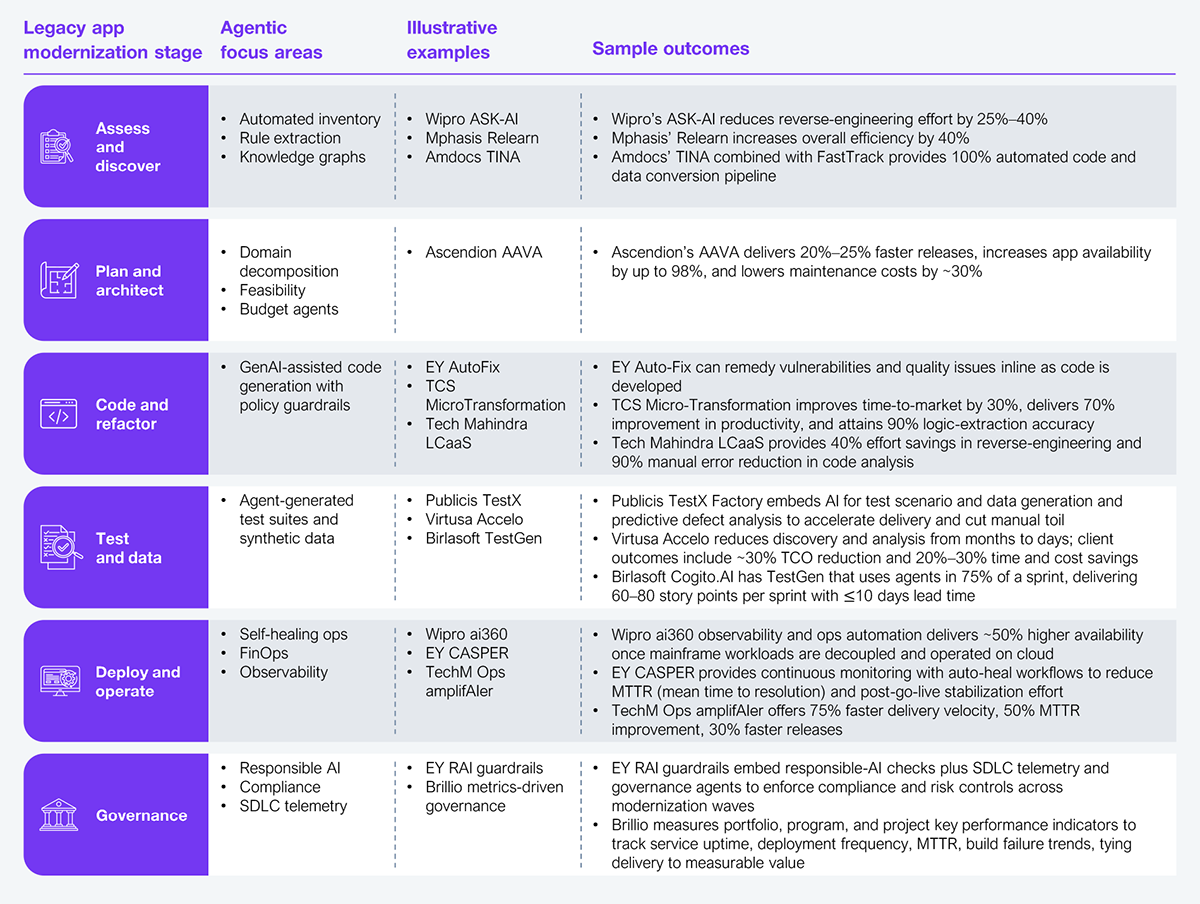
Source: HFS Research, 2026
AI cannot thrive in tightly coupled architectures. To deliver AI at scale, CIOs must modernize for decoupling, clean data, and API-first design. “AI readiness equals modernization” should be the survival strategy, not just a slogan. Re-architecting with agentic systems isn’t about cost efficiency; it’s about making modernization self-evolving.
Simultaneously, legacy skill shortages and high run costs are forcing CIOs to consider AI-augmented delivery models, as these enable faster reverse engineering, knowledge capture, and effective and efficient tech debt resolution at scale. Even if half of the vendor claims hold up under validation, the case to adopt AI-driven LAM becomes non-negotiable.
But don’t take the system integrators’ (SIs) word for it! Ask for evidence to substantiate claims. Dig into these key points:
Embracing AI-driven LAM requires enterprises to lay some groundwork, as it needs a mindset change in how services are assessed, bought, and governed. Enterprises must shift sourcing criteria from cost arbitrage to tools and ecosystems. Providers’ evaluations must focus on orchestration ability, not just AI headcount or copilots.
Commercial models must pivot from time-and-materials to outcome- and value-based constructs. Provider incentives must be tied to measurable outcomes beyond common key performance indicators, such as lead time, quality, and cost. Governance frameworks must define AI ownership, human-in-the-loop protocols, and risk boundaries across human-agent workflows. Talent strategies need to redefine roles to incorporate skills like agent supervision, prompt design, and AI observability.
CIOs must own this pivot because the next generation of cost, speed, and resilience advantage will belong to those who rebuild around agent orchestration, not automation. Agentic AI represents the next stage of arbitrage on modernization services. For CIOs, it’s not about who has the flashiest AI demo; it’s about who can deliver a governed, explainable, telemetry-backed modernization factory. The winners in this cycle will be those who treat agentic AI not as automation, but as a new operating model for business transformation itself.
Register now for immediate access of HFS' research, data and forward looking trends.
Get StartedIf you don't have an account, Register here |
Register now for immediate access of HFS' research, data and forward looking trends.
Get Started