Point of View

NRF’s Big Show: Put experiences at the heart of retail strategy

The retail world is swarming with big, fantastic ideas. There’s no better showcase for these ideas than the National Retail Federation’s (NRF) Big Show, which was held January 13-15, 2019. It brings together the best and brightest folks in retail for a giant gathering of the minds. Augmented and virtual reality (AR/VR), IoT, blockchain, 3D printing, and digital voice assistants are just a few of the technologies that participants discussed and powerfully displayed in action at the booths around the expo floor. But, conversations heard around the halls tell a deeper, more meaningful story about these technological advances.


We’ve been talking about customer experience (CX) for many years, but a new reality is emerging around shared, collective experiences—and making them better and more intelligent—not just for the retail customer, but the employee/associate experience, partner, and supply chain experience. There is an understated, unspoken mandate to make the entire retail ecosystem frictionless and more intelligent. In short, the retail world is prepping itself for the emerging hyper-connected economy, where the directive is not just about customer experiences but about creating value across a connected ecosystem of stakeholders.  Retailers today are realizing that investing in a focus on this ecosystem is imperative to survival in the near future.


Digital transformation is about creating experiences, not about technology


HFS defines digital transformation as the transformation of an entire organization to deliver compelling and engaging customer experiences, leveraging interactive technologies, intelligent automation, and smart analytics. This transformation entails a top-to-bottom rethink of what it means to operate in real time in a digital business environment. It requires fundamental changes to the way an organization operates, from its front to back office, and through all the touchpoints with its customers, partners, and employees. Retailers seem particularly aligned with this definition, as evidenced by our conversations with retailers from all angles of the ecosystem and backed up by our survey data. A recent HFS survey found that 86% of retailers think of the impact of digital as “creating engaging customer experiences,” where a larger cohort of respondents leaned much further toward defining digital as being about investing in technology (46%).


Exhibit 1: Digital is about experience, not technology, for retailers

Q: Which of the following statements most closely resembles your leadership’s view of the impact of digital?
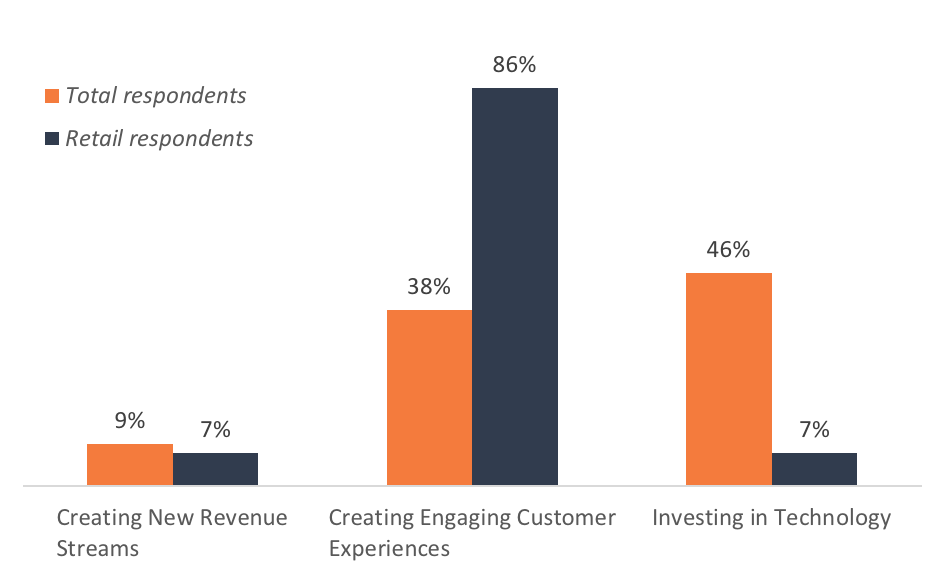
 

Source: HFS Research 2018 Sample: C-Level Enterprise Executives = 395


Perhaps retailers are more in sync with digital experiences out of necessity; after all, retail has arguably been the most disrupted industry within the last 10 to 15 years and continues to change rapidly. A recent HFS survey found that 38% of retailers expect their competitors to be a different set of companies in 2020 than they are today. Those that acknowledge the new competitive realities have worked diligently to transform their business models and their cultures toward customer centricity. On the flip side, we’ve seen dozens of examples of the demise of those retailers unwilling or unable to transform, including 2018 bankruptcy casualties such as Sears, Nine West, and Brookstone. So, for retailers, the writing is on the wall: get focused on experiences or become irrelevant.


Creating meaningful experiences is at the heart of retail aspirations


Bill Gates said: “The first rule of any technology used in a business is that automation applied to an efficient operation will magnify the efficiency. The second is that automation applied to an inefficient operation will magnify the inefficiency.” As Kate O’Neill, keynote speaker at our HFS FORA December event, astutely pointed out, the same concept applies for meaningfulness; if you apply automation to a meaningful process, it will amplify the meaningfulness. It seems that as an industry, retailers have become laser-focused on finding what is meaningful to their stakeholders, what matters to them, and what kind of experiences they want. Here are some of the ways the discussions at NRF demonstrated how retailers are working to evolve and optimize these experiences:


  •  Cultivate an experience that fits your company and business model: On a panel moderated by HFS, retailers mused about what meaningful experiences mean to them and their businesses and how they’re changing. An apparel retailer described the elevated expectations of customers frequenting their stores for special-occasion wear and the company’s decision to develop a video-chat solution to plug a gap in the customer experience. Another consumer packaged goods (CPG) company described the challenge of having an impact on the end-consumer through the business to consumer (B2C) model but described how the company is using purchasing data to help its business to business (B2B) customers make better decisions and create more personalized offerings for its customers. We also had the chance to catch up with the omnichannel lead at a global sportswear retailer, who described the changing competitive landscape that is forcing all retailers to rethink who their competition is and mandating that retail manufacturers build a more extensive direct-to-consumer reach—one that requires an ecosystem reaching beyond their traditional model. Each of these examples requires collaboration and shared objectives across the ecosystem.


  • Creating in-store experiences is even more relevant than ever—but you have to make them meaningful: Retail brick and mortar closure announcements are ubiquitous, but expansions and redesign of physical spaces are becoming just as common. But the in-store experiences look much different than years ago; now, to be competitive, they need to be ones that matter to customer, using physical experiences to garner loyalty and brand affinity, whether or not the customer makes a purchase in-store or online. We saw many examples of technology enabling those experiences:
    • Wipro: Its booth featured holograms that brought products to life with 3D imagery, and AR tools that could scan a clothing item or even just a tag, and “dress” an avatar with your measurements in that item, even suggesting alternate backgrounds for the fitting session to help imagine the setting for a certain outfit.
    • Infosys: Its booth showcased AR tools in a mobile app that leads a customer through the store to find the item they are searching for, and analytics to help suggest other items that might be of interest.


These examples go back to design—are these experiences things that help the customer make the right decision, get to the product they need faster, or otherwise improve their experience?


  • Design and technology need to fuel the associate experience: The most expensive and critical design challenge facing retailers that are creating these in-store experiences is putting the right information and data in employees’ hands and then empowering them to use it. Retailers are keenly aware of the need to attract and retain the right talent in their stores, and they are making investments to support this effort. While many examples of associate experience were present across the software and solutions presented at NRF, one that stands out is Sutherland Global’s Storecasts, an analytics solution that analyzes where successful transactions occur and where the roadblocks are. Along with this tool and dashboard view comes a feature called the “Store Coach,” a (human!) retail expert who can help Sutherland’s clients identify the pain points and opportunities for better associate and customer experiences. Sutherland is tapping into its work at home network to deliver on the Store Coach solution.


  • Reimagine your supply chain to support the hyper-connected retail experience: Many retailers compete on convenience—and speed is a vital aspect of that, so (intelligently) speeding up the supply chain will support a better customer experience. The retail supply chain today is still full of manual, basic decision points that don’t necessarily need human intervention because they are predictable and repetitive. Thus, automating elements of the supply chain can go a long way toward enabling more speed as part of a better way of servicing the customer and moving employees away from mundane tasks. This kind of design can promote a frictionless experience across the whole supply chain to speed up and improve operations.


The bottom line: Putting experiences at the heart of retail strategy will enable success in the hyper-connected economy


When HFS attended NRF Big Show ’17, the industry was just starting to hint at how some of these technologies can drive the OneOffice vision. It’s two years later, and the future of retail is here and now and getting ready to set sail into the hyper-connected economy. The technology has been around, but it is now evolving and becoming less expensive and more accessible for those who want to experiment with POCs that drive value and enable competitive advantage. Those who stay alive, survive, and thrive in the coming years will depend upon today’s vision, investment in, and design for experiences across the retail ecosystem.

Sign in to view or download this research.

Login

Register

Insight. Inspiration. Impact.

Register now for immediate access of HFS' research, data and forward looking trends.

Get Started

Download Research

    Sign In

    Sign up for a free
    research account

    With the exception of our Horizons reports, most of our research is available for free on our website. Sign up for a free account and start realizing the power of insights now.

    Digests/Newsletters: Overviews of the latest news, insight, and research by HFS.

    HFS Events: Exclusive invitations to HFS webinars, roundtables, and summits, bringing together key industry stakeholders focused on major innovations impacting business operations.

    By registering you agree to our privacy policy.

    I hereby consent that HFS Research can process my personal data.

    Premium Access

    Our premium subscription gives enterprise clients access to our complete library of proprietary research, direct access to our industry analysts, and other benefits.

    Contact us at [email protected] for more information on premium access.

    Help

    If you are looking for help getting in touch with someone from HFS, please click the chat button to the bottom right of your screen to start a conversation with a member of our team.

    [email protected]

      Contact Ask HFS AI Support