Data Viewpoint

Partner breadth is easy to have and is no longer a differentiator

This HFS Data Viewpoint, Partner breadth is easy to have and is no longer a differentiator, is for sourcing executives, CIOs, and healthcare technology leaders evaluating which service provider partnerships signal real capability rather than baseline market credibility.
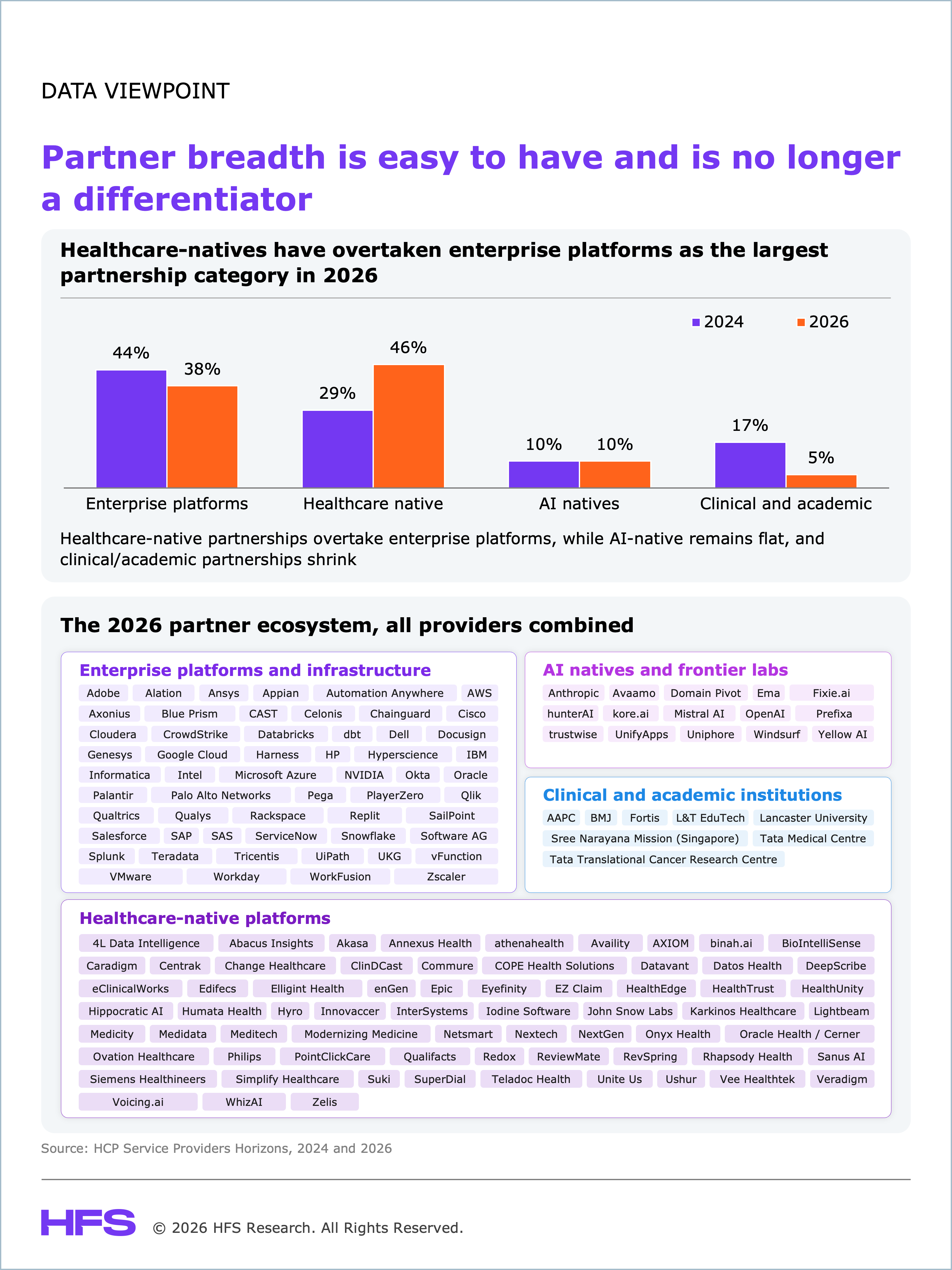
Data Viewpoint graphic from HFS Research combining a grouped bar chart with four categorized lists of named partners. The bar chart, headed "Healthcare-natives have overtaken enterprise platforms as the largest partnership category in 2026," compares the share of partnerships across four categories in 2024 (purple bars) versus 2026 (orange bars). Enterprise platforms fell from 44% in 2024 to 38% in 2026. Healthcare native partnerships rose from 29% in 2024 to 46% in 2026, becoming the largest category. AI natives held flat at 10% in both 2024 and 2026. Clinical and academic partnerships dropped from 17% in 2024 to 5% in 2026. A caption below the chart reads: "Healthcare-native partnerships overtake enterprise platforms, while AI-native remains flat, and clinical/academic partnerships shrink." Below the chart, a section headed "The 2026 partner ecosystem, all providers combined" lists named partners across four categories. Enterprise platforms and infrastructure includes: Adobe, Alation, Ansys, Appian, Automation Anywhere, AWS, Axonius, Blue Prism, CAST, Celonis, Chainguard, Cisco, Cloudera, CrowdStrike, Databricks, dbt, Dell, Docusign, Genesys, Google Cloud, Harness, HP, Hyperscience, IBM, Informatica, Intel, Microsoft Azure, NVIDIA, Okta, Oracle, Palantir, Palo Alto Networks, Pega, PlayerZero, Qlik, Qualtrics, Qualys, Rackspace, Replit, SailPoint, Salesforce, SAP, SAS, ServiceNow, Snowflake, Software AG, Splunk, Teradata, Tricentis, UiPath, UKG, vFunction, VMware, Workday, WorkFusion, and Zscaler. AI natives and frontier labs includes: Anthropic, Avaamo, Domain Pivot, Ema, Fixie.ai, hunterAI, kore.ai, Mistral AI, OpenAI, Prefixa, trustwise, UnifyApps, Uniphore, Windsurf, and Yellow AI. Clinical and academic institutions includes: AAPC, BMJ, Fortis, L&T EduTech, Lancaster University, Sree Narayana Mission (Singapore), Tata Medical Centre, and Tata Translational Cancer Research Centre. Healthcare-native platforms includes: 4L Data Intelligence, Abacus Insights, Akasa, Annexus Health, athenahealth, Availity, AXIOM, binah.ai, BioIntelliSense, Caradigm, Centrak, Change Healthcare, ClinDCast, Commure, COPE Health Solutions, Datavant, Datos Health, DeepScribe, eClinicalWorks, Edifecs, Elligint Health, enGen, Epic, Eyefinity, EZ Claim, HealthEdge, HealthTrust, HealthUnity, Hippocratic AI, Humata Health, Hyro, Innovaccer, InterSystems, Iodine Software, John Snow Labs, Karkinos Healthcare, Lightbeam, Medicity, Medidata, Meditech, Modernizing Medicine, Netsmart, Nextech, NextGen, Onyx Health, Oracle Health / Cerner, Ovation Healthcare, Philips, PointClickCare, Qualifacts, Redox, ReviewMate, RevSpring, Rhapsody Health, Sanus AI, Siemens Healthineers, Simplify Healthcare, Suki, SuperDial, Teladoc Health, Unite Us, Ushur, Vee Healthtek, Veradigm, Voicing.ai, WhizAI, and Zelis. Source: HCP Service Providers Horizons, 2024 and 2026.

Our latest HFS Horizons: HCP Service Providers study shows that having a large partner ecosystem is no longer a meaningful differentiator. Most service providers now showcase an extensive list of technology alliances, healthcare platforms, and AI vendors, making partner count a weak indicator of capability. Our analysis highlights four trends.

  • Hyperscaler partnerships have become table stakes. AWS, Microsoft Azure, Google Cloud, Salesforce, ServiceNow, Databricks, and other enterprise technology vendors appear across nearly every provider profile. These partnerships remain essential because clients expect providers to demonstrate capabilities in cloud, data, and AI. However, because almost every provider has access to the same ecosystem, these alliances have shifted from being a competitive advantage to simply meeting the minimum expectations for market credibility and ceased to be partnerships. They are vendor relationships, and providers should present them as such, not as differentiation.
  • Healthcare partners are now the biggest group. Healthcare-focused partners now represent the largest category of partnerships (46%, up from 29% in 2024), overtaking enterprise technology vendors. These partnerships span electronic health records (EHR), revenue cycle management, interoperability, clinical AI, digital health platforms, and payer-provider collaboration. Companies such as HealthEdge, Zelis, Redox, Innovaccer, and Datavant appear repeatedly because they provide access to specialized healthcare workflows, data, and domain expertise that cannot be replicated through generic cloud partnerships alone. Building deep relationships across this ecosystem requires significant investment, industry knowledge, and customer trust, making it considerably harder for competitors to imitate and worth scoring on certification tiers, live integration counts, and named implementations.
  • AI startup ecosystem appears crowded. Almost every provider now highlights partnerships with AI startups. However, most of these relationships involve widely available voice AI, chatbots, coding assistants, or automation technologies accessible to the broader market. AI natives accounted for just 10% of named partners across both cycles, so the ecosystem has not deepened even as AI came to dominate provider messaging. Frontier AI laboratories and model developers remain concentrated among only a handful of providers, though that is unlikely to hold as those models reach every provider through hyperscaler marketplaces.
  • Academia remains structural whitespace. Universities, research institutes, and academic medical centers account for just 5% of partnerships, and the absolute number has not moved in two years. These organizations play a critical role in clinical validation, real-world evidence generation, medical research, and peer-reviewed innovation. As healthcare clients increasingly demand evidence-backed AI and measurable clinical outcomes, providers without these relationships stay in the transactional bucket, and their value proposition has reached a ceiling that adding more technology logos cannot address.
The Bottom Line: The conversation around service provider partnership has shifted. What matters now is who providers partner with, why those partnerships exist, and how deeply they are integrated into client outcomes.

Sign in to view or download this research.

Login

Register

Insight. Inspiration. Impact.

Register now for immediate access of HFS' research, data and forward looking trends.

Get Started

Download Research

    Sign In

    Sign up for a free
    research account

    With the exception of our Horizons reports, most of our research is available for free on our website. Sign up for a free account and start realizing the power of insights now.

    By registering you agree to our privacy policy.

    I hereby consent that HFS Research can process my personal data.

    Digests/Newsletters: Overviews of the latest news, insight, and research by HFS.

    HFS Events: Exclusive invitations to HFS webinars, roundtables, and summits, bringing together key industry stakeholders focused on major innovations impacting business operations.

    Premium Access

    Our premium subscription gives enterprise clients access to our complete library of proprietary research, direct access to our industry analysts, and other benefits.

    Contact us at [email protected] for more information on premium access.

      Contact Ask HFS AI Support