
The 2008 financial crash impacted the banking and financial services industry more than it did any other vertical. But what may be startling is that the banking industry still struggles to make sense of the new status quo in the global economy, despite the cataclysmic impact it had on so many financial institutions. News reports circulate daily of banks struggling to make sense of the new regulatory environment, or EU banks failing to replicate the recovery of their US counterparts.
Service providers must come to this BFS market, still wrestling with this decade-old economic crash, equipped with a strategy and toolset that addresses the industry’s challenges head-on, if they are to remain relevant in this market.
We won’t win any awards for noting that the banking sector was bloated to unsustainable levels before the 2008 crisis, and its part of this legacy that is forcing executives in the sector to identify new and innovative ways of reducing costs. The problem goes beyond headcount; a large part being the archaic processes that institutions have failed to revitalize, many of which could keep Lean consultants busy for generations. In a recent candid conversation, a BFS leader revealed that an exercise to find out which areas of the business actually touched and improved the customer journey left them with a list of barely half of the company—frightening results!
Providers must come to clients with a clear vision how they can partner with them to rewire their legacy processes and operating models, especially when so many are under existential pressure from digital competition and have little breathing space. This challenge is already proving too complex and time-consuming for some institutions. We’re already hearing about challenger banks being set-up within existing financial institutions to test out fresh operating models, technology platforms, and processes—and once proved successful, more assets and customers are transferred from the mothership. Simply-put, some BFS institutions are so mired in legacy that it may make more sense to simply start afresh than plow hundreds of millions into fixing decades of redundant technology, obsolete processes and a broken culture that may never be fixable.
Internal challenger banks aside, there is also an important and quickly growing ecosystem of FinTechs and start-ups looking to leverage their innate agility to bring fresh services and approaches to consumers. Financial regulations make direct competition with too-big-to-fail banks an impossibility to some – such as the initial capital needed, often in tens of millions to be classified as a bank – so many are moving into an additive or supplementary state, layering services over the top of traditional models.
This shift from challenger to supplementary force serves the service provider community well. Already many have courted FinTechs and start-ups to build up experience, leverage technologies, or simply to buy into a growing market capability. Providers must leverage these approaches directly and also bring in lessons and experiences to support traditional banking clients.
Our research shows that the banking sector is feverishly looking to automation as a salve for the wounds inflicted during the financial crisis (Exhibit 1). 50% of banks are looking to make significant investments in Robotic Process Automation (RPA) this year, as our State of Operations study, conducted with the support of KPMG, details:
Exhibit 1: 2019 Investment intentions: “Humans-plus-Bots” now the norm as Global 2000 Enterprises turn to automation to drive efficiencies
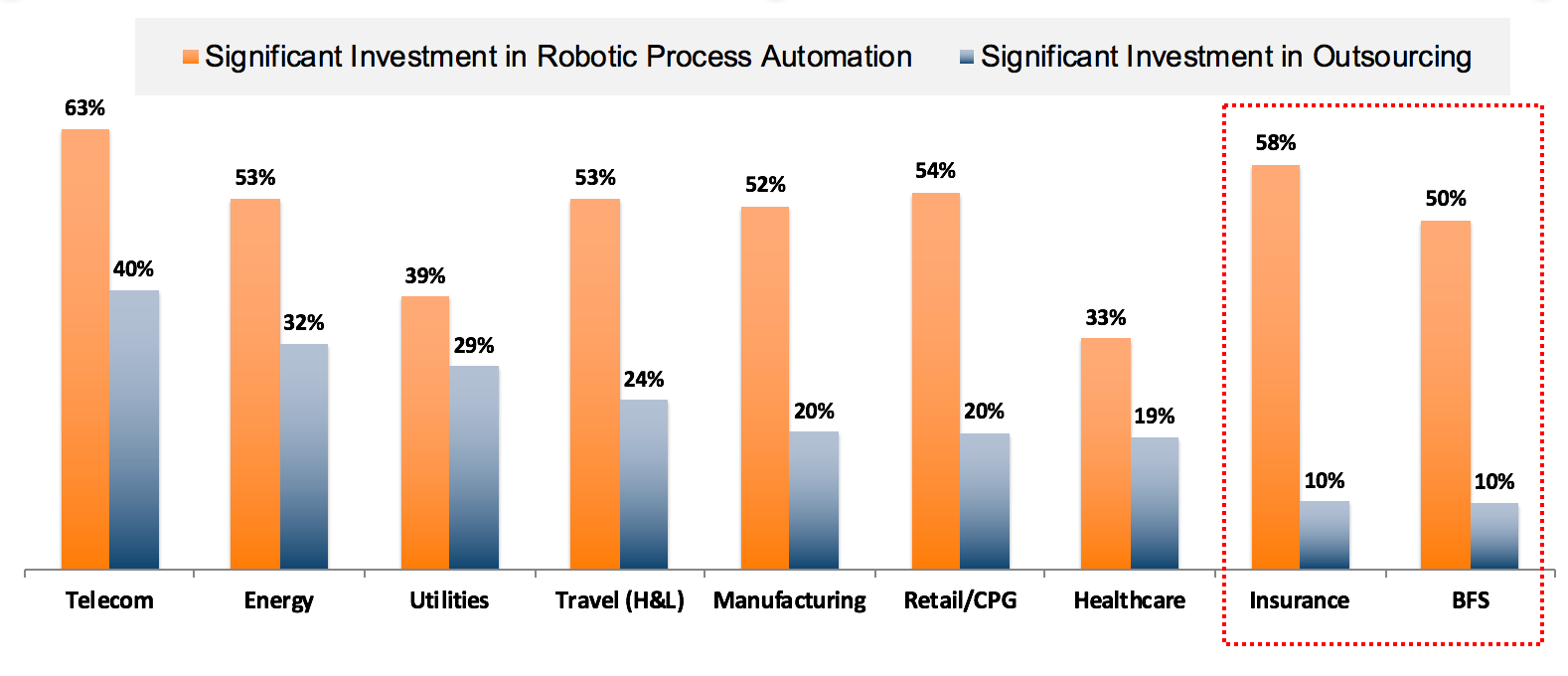
Source: HFS Research supported by KPMG, “State of Operations and Outsourcing” 2019
Sample: Global 2000 Enterprise Leaders = 381
Conversations with executives see this demand packaged in two large areas. First and foremost, it enables cost-saving measures—not through the direct replacement of FTEs, but by giving hours back to the business. Removing low-value activities through automation is enabling back-office functions to do more without adding additional layers of cost.
Second, it is enabling institutions to eke out more life from existing capital investments in a market with limited appetite at the senior levels to invest heavily in technology. Many have a sunk-cost in technology that they are not willing to write off yet. Pulling in RPA, for example, will stave off major system overhauls. The adage of changing a tire while the car is still driving is true for this market, not because of the pace of change alone, but because the driver can ill-afford to pull over and buy better tires. Providers should come armed with a toolbox of capabilities and be prepared to use them to “ring fence” creaking IT systems to buy executives more time and others to drive transformation. A full toolbox is necessary. As an automation leader at IBM recently said at an HFS event, “If a plumber came to your house to repair a leaking sink and only had a hammer, you wouldn’t invite them back”.
To many, the prospect that the banking sector is still suffering may seem like just desserts after the heady pre-crash exuberance. But the reality is this is a market that the global economy desperately needs to be healthy – when banks fail, the rest of the economy crashes fown with them. Service providers must play their part in bringing the sector back from the brink—and in the process tap into one of the largest revenue generators in the market—by coming armed with the tools and vision to solve the challenges traditional and archaic processes, operating models, and technology stacks bring.
Register now for immediate access of HFS' research, data and forward looking trends.
Get StartedIf you don't have an account, Register here |
With the exception of our Horizons reports, most of our research is available for free on our website. Sign up for a free account and start realizing the power of insights now.
Our premium subscription gives enterprise clients access to our complete library of proprietary research, direct access to our industry analysts, and other benefits.
Contact us at [email protected] for more information on premium access.

