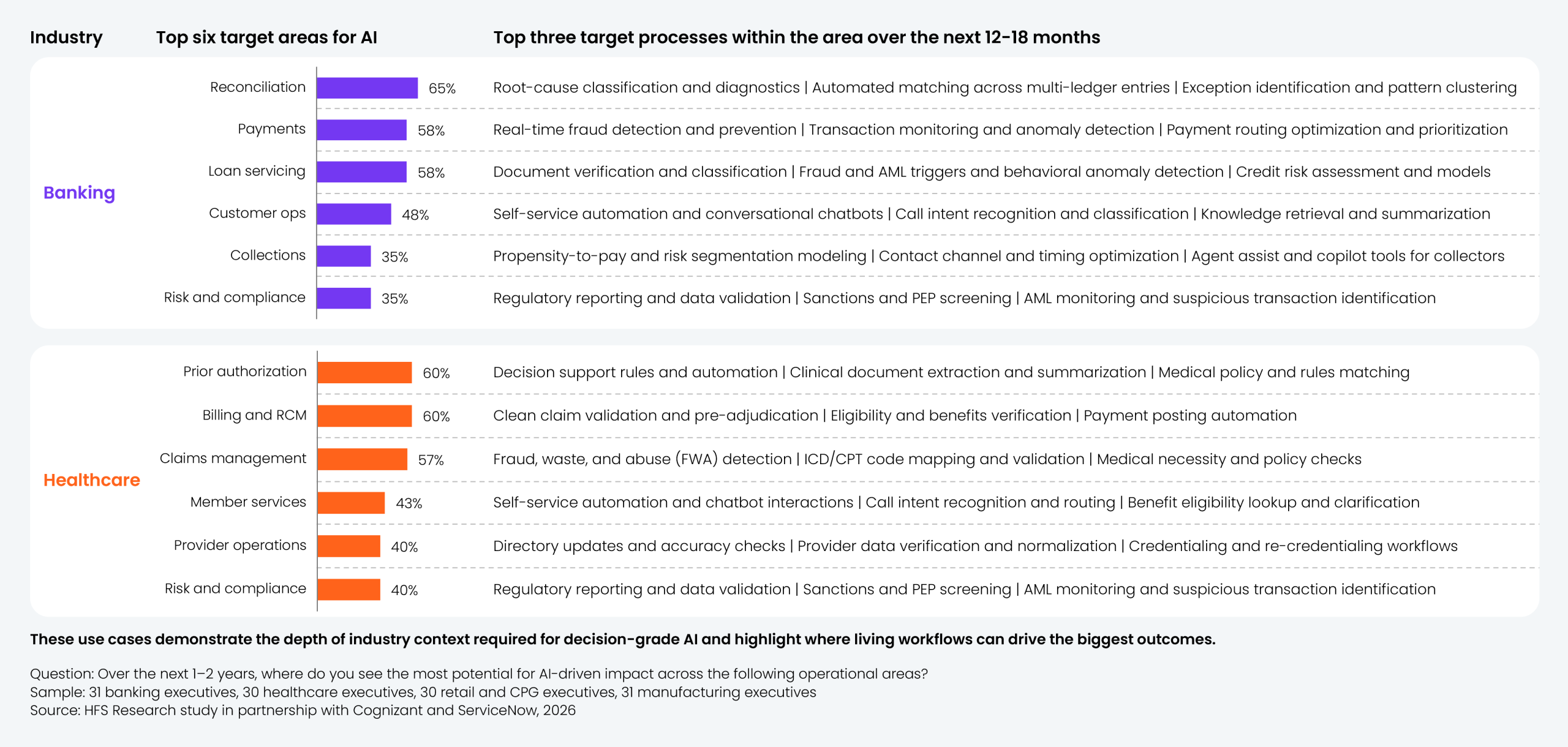
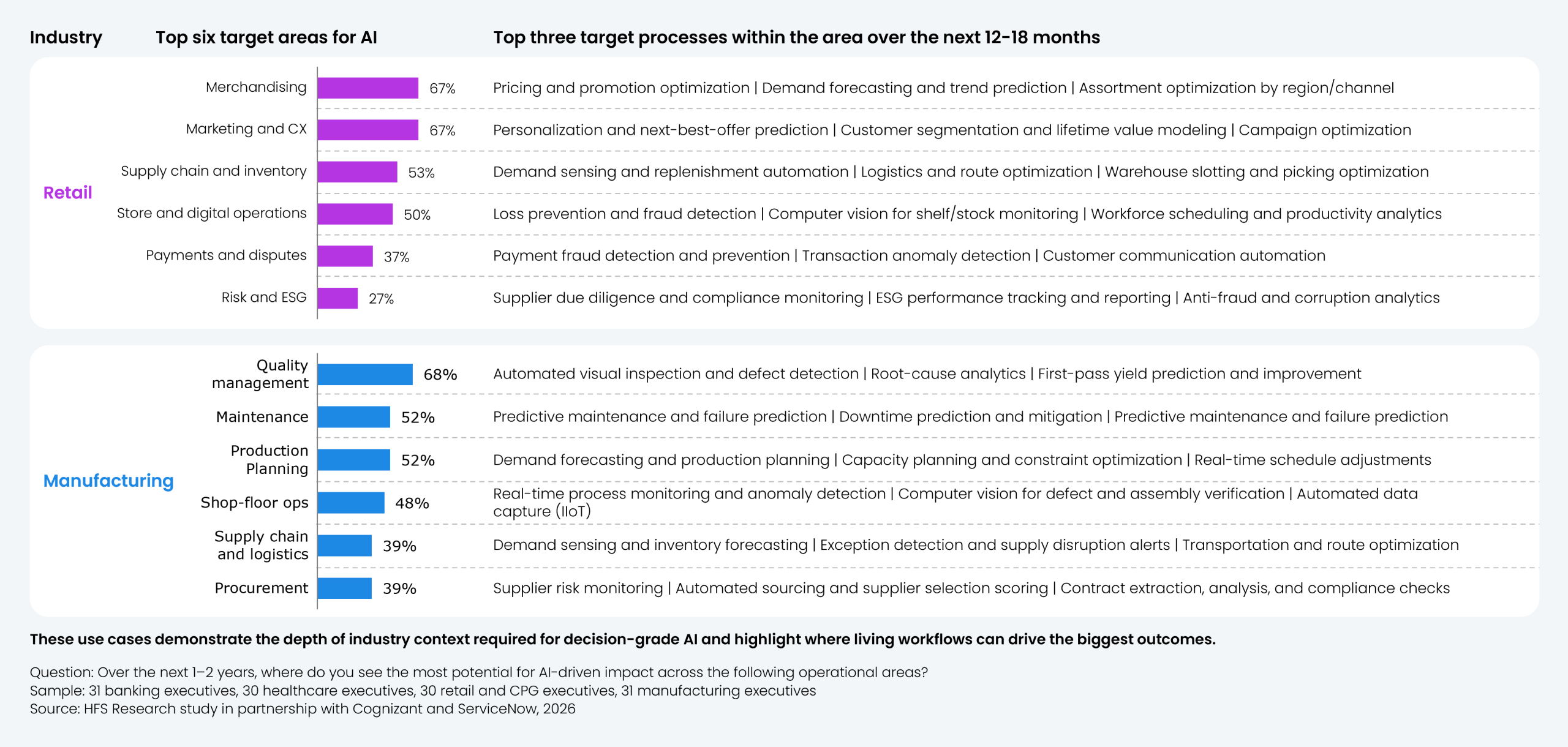
This HFS Research Take 5 report, produced in partnership with Cognizant and ServiceNow, is for business and process owners across banking, healthcare, retail, and manufacturing evaluating how to close the context gap that keeps enterprise AI stuck in pilot phases and unable to deliver decision-grade outcomes in core operations.
Executive summary
New research finds that AI value will remain stalled until enterprises operationalize an industry- and business-context-first operating model driven by business and process owners.
Enterprise AI investments are growing, but enterprise AI value is not. Most organizations remain stuck in pilot phases, especially within core operations. The issue is contextual, not technical. AI struggles without access to the domain-specific business logic, regulatory rules, and exception handling that are deeply embedded within enterprise workflows. Business and process owners now face the challenge of making this context accessible to AI.
To scale, AI must evolve from generic tools into industry-context-driven, workflow-native systems. This evolution requires infusing domain-specific logic into operational workflows and strengthening the systems, data, and governance layers that make context usable and value trackable.
HFS Research, in partnership with Cognizant and ServiceNow, surveyed 122 business and process leaders across the Global 2000 to understand how organizations are adopting and scaling AI within core workflows, and where verticalized, domain-specific AI can drive stronger outcomes.
The survey uncovered five key takeaways:
-
-
AI has not delivered intelligent workflows
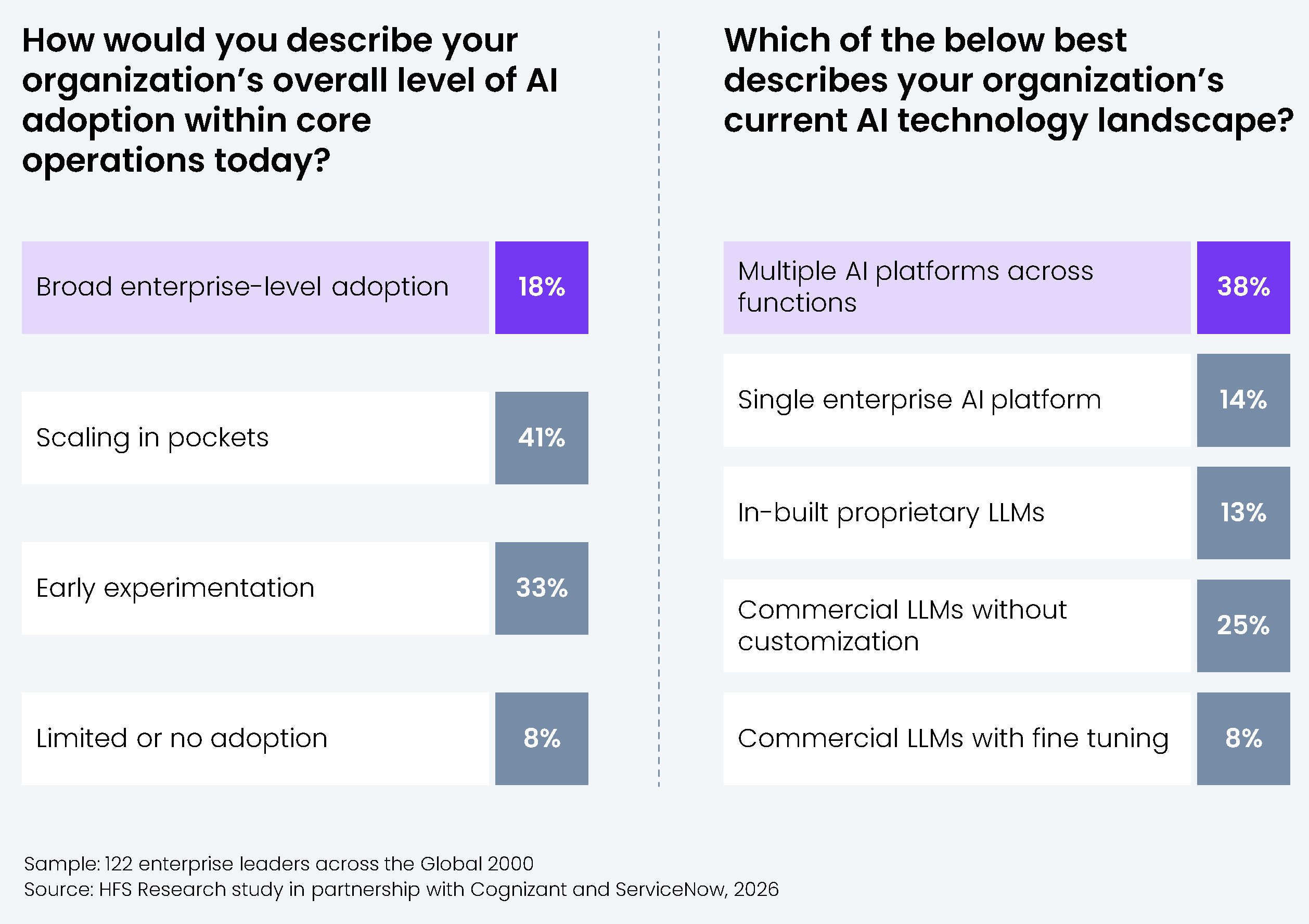
Fewer than 20% of enterprises have scaled AI, despite about 40% already using multiple platforms and investing in tools and proprietary LLMs.
-
The industry and business “context gap” impedes decision-grade AI
More than half of all leaders are not satisfied with the outcomes delivered within core operations, given the generic and bolt-on nature of prevailing tools.
-
Workflows must evolve into adaptive systems for contextual AI
More than 75% of leaders prioritize domain-specific context, data layers, and regulatory compliance, underscoring the need for verticalized AI that replaces static workflows with probabilistic, adaptive, runtime pathways.
-
Data fragmentation is a key blocker
One in two enterprises struggles with fragmentation, privacy, security, and compliance constraints while attempting to scale AI within core operations.
-
Governance must evolve to link oversight with business value
Only one in three enterprises has a governance framework that goes beyond basic policy controls.
The Bottom Line: Enterprises cannot scale AI value through model sophistication or pilot volume; the priority must shift to contextual relevance grounded in industry depth, workflow integration, and decision-grade governance.
Fewer than 20% of enterprises have scaled AI, despite 38% already using multiple platforms and investing heavily in tools and proprietary LLMs.
- Enterprise AI is failing because the core workflows on which AI is applied are complex, governed by domain-specific logic, regulatory nuance, exception paths, and decision thresholds that generic solutions cannot navigate.
- Consequently, AI collapses in the last mile, where decisions rely on business context decisions and carry financial, operational, or compliance consequences.
- In banking, this can be the difference between fraud and a payroll anomaly.
- In healthcare, it’s the difference between a valid claim and a nuanced clinical rule violation.
- In retail, it’s the difference between a stockout caused by demand, promotions, or supplier behavior.
- In manufacturing, it’s the difference between a harmless vibration and a potential failure.
- These are not edge cases that off-the-shelf horizontal AI solutions can address.
More than half of all leaders are not satisfied with the outcomes delivered within core operations, given the generic and bolt-on nature of prevailing tools.
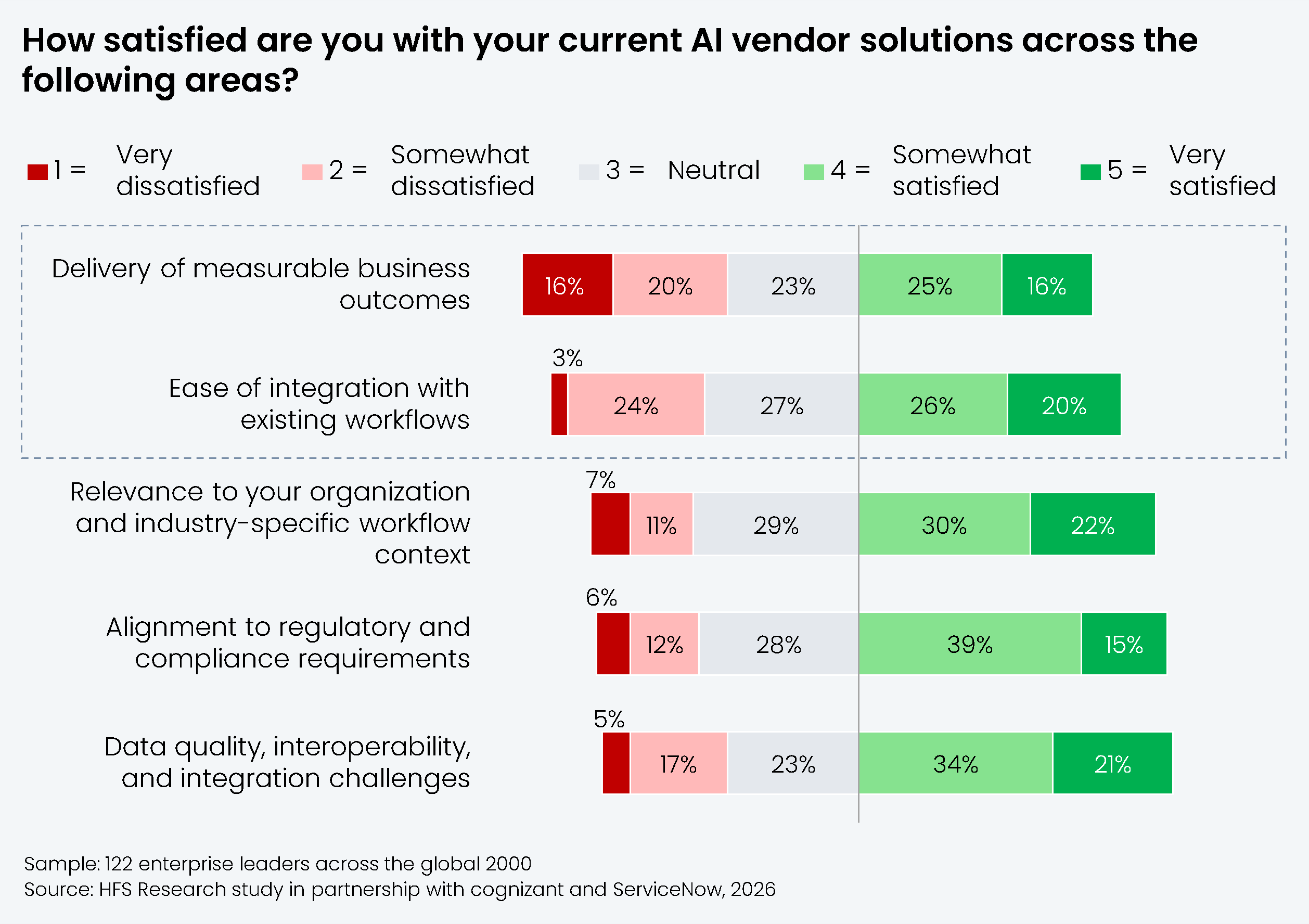
- AI ambition is rising across enterprises, yet scaled value remains elusive, highlighting a significant context gap that must be closed to translate investment into real operational impact.
- Context refers to rules, thresholds, exceptions, regulations, handoffs, and escalation pathways that must be understood to drive business-critical decisions. It varies by industry, sub-industry, and within enterprises.
- Context is not implicit in AI tools. It must be deliberately constructed by combining workflow design, expert rules, structured data, and integrated decision systems. For example,
- An AI model that flags a payment anomaly without recognizing it’s a scheduled multi-party payroll transfer risks triggering false fraud alerts and compliance interventions.
- A customer service copilot that drafts a resolution without understanding warranty entitlements, refund policies, or jurisdiction-specific language can create downstream legal exposure.
More than 75% of leaders prioritize domain-specific context, data layers, and regulatory compliance while evaluating AI solutions.
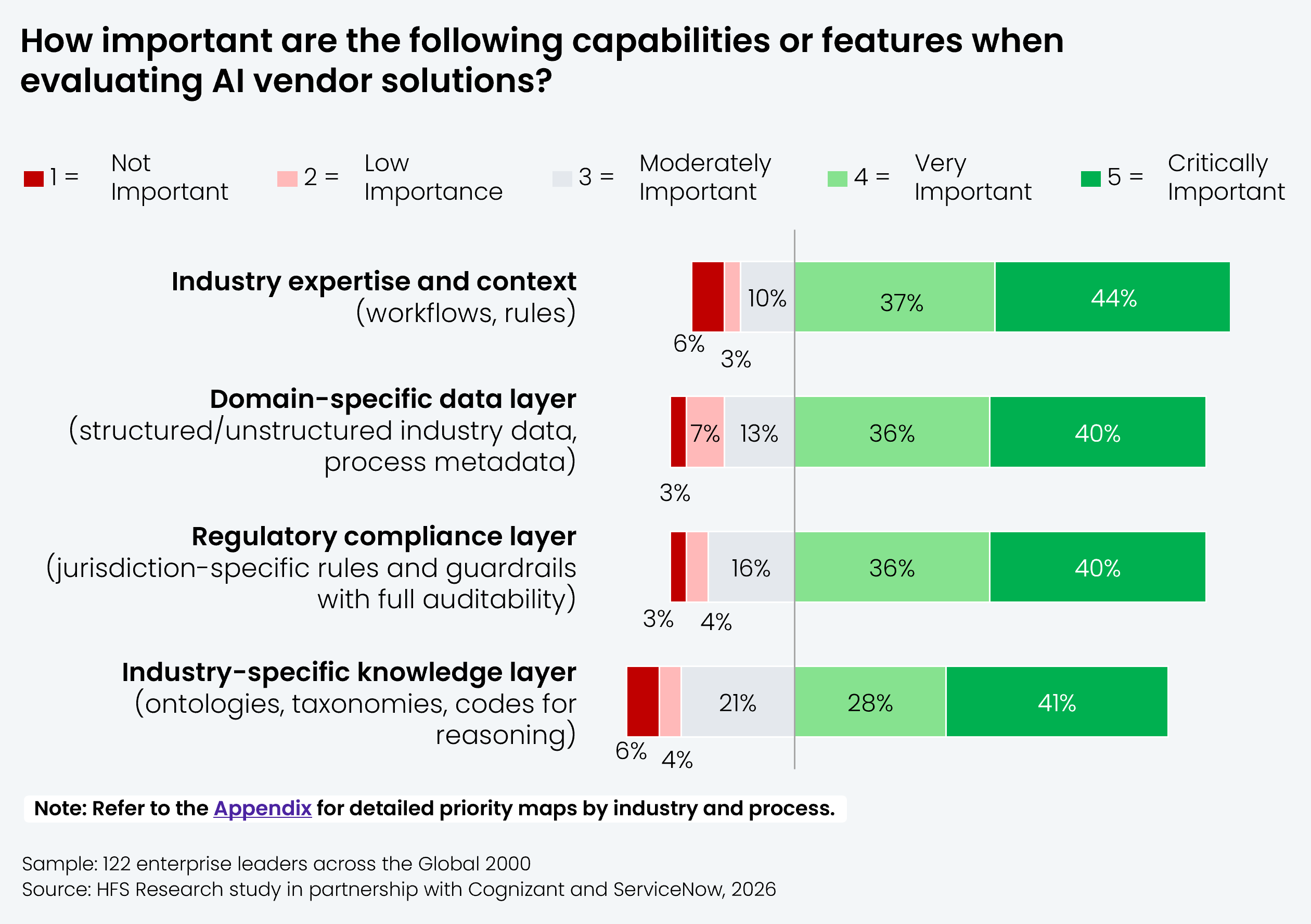
- AI must be embedded inside workflows, not added around them, so they evolve into adaptive systems that enable customized, verticalized intelligence in logic-rich processes.
- Enterprises must codify rules, exceptions, escalation paths, and compliance into process design to transform workflows into operating systems that support dynamic, context-aware decision-making.
- AI solution evaluation must shift from model sophistication to contextual fit, prioritizing logic layers, workflow integration, and domain-specific data models that reflect how real operations run. For example,
- CRM and CX leaders in retail and consumer packaged goods need AI that understands complaint triage, resolution logic, and service-level timing, not AI that generates personalization prompts.
- Claims leaders need AI that interprets medical policy and detects exceptions, not AI that just predicts denial probabilities.
- Manufacturing leads need AI that correlates production anomalies with asset history and maintenance cycles, not AI that just flags sensor spikes.
One in two enterprises struggles with fragmentation, privacy, security, and compliance constraints while attempting to scale AI within core operations.
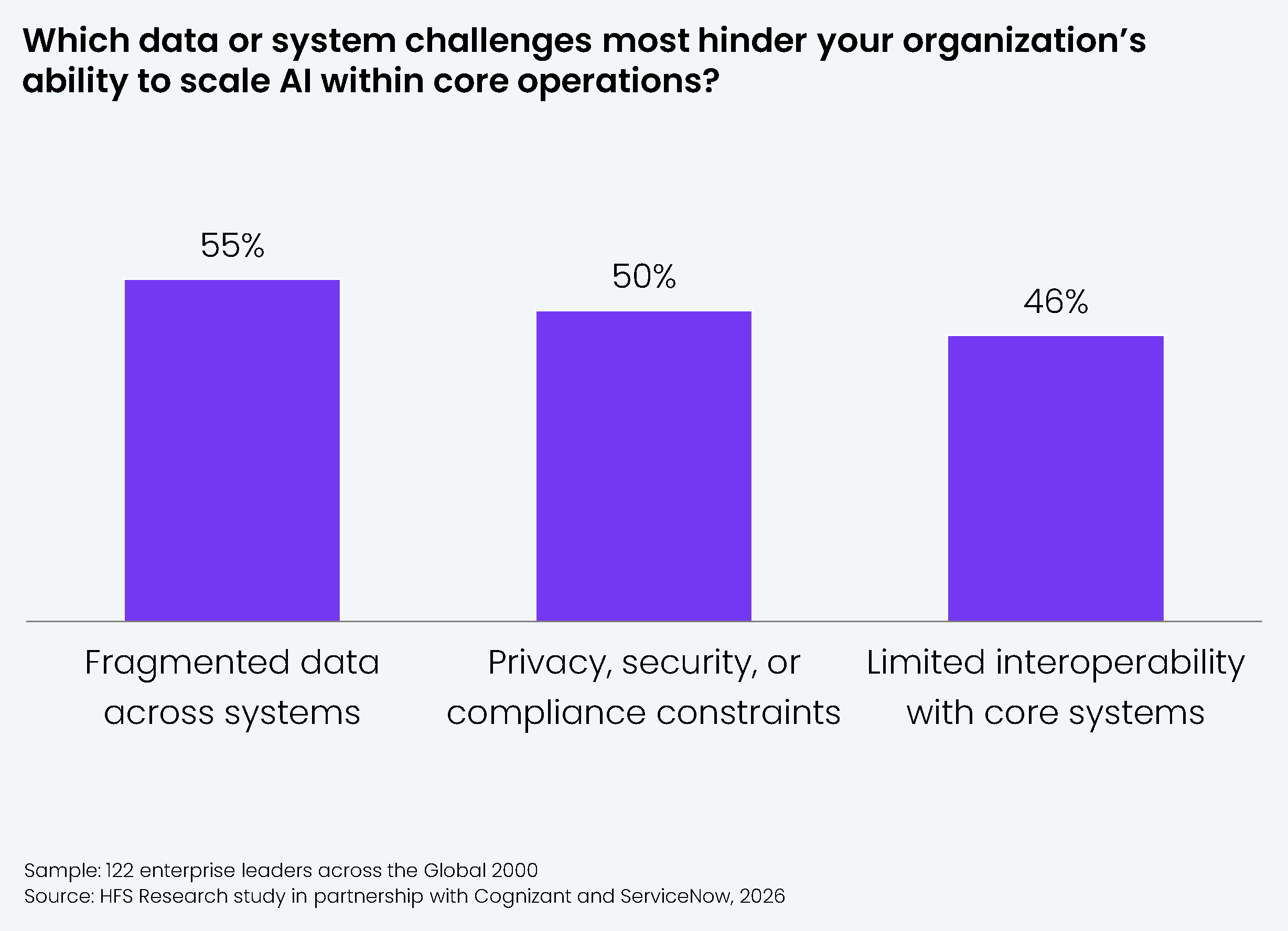
- Contextual AI cannot scale without a strong data + governance control plane that activates, steers, and monitors workflow intelligence.
- This fragmentation is magnified in highly regulated industries such as banking, healthcare, retail, and manufacturing, where context depends on lineage-accurate and policy-aligned data.
- Foundational gaps persist. More than half of leaders cite data fragmentation along with privacy and interoperability issues as the biggest blockers to embedding AI in core workflows.
- Enterprises need shared metadata, standardized taxonomies, normalized exceptions, and clean system-of-record access; without this foundation, even advanced AI cannot operate with precision.
Only one in three enterprises has a governance framework that goes beyond basic policy controls.
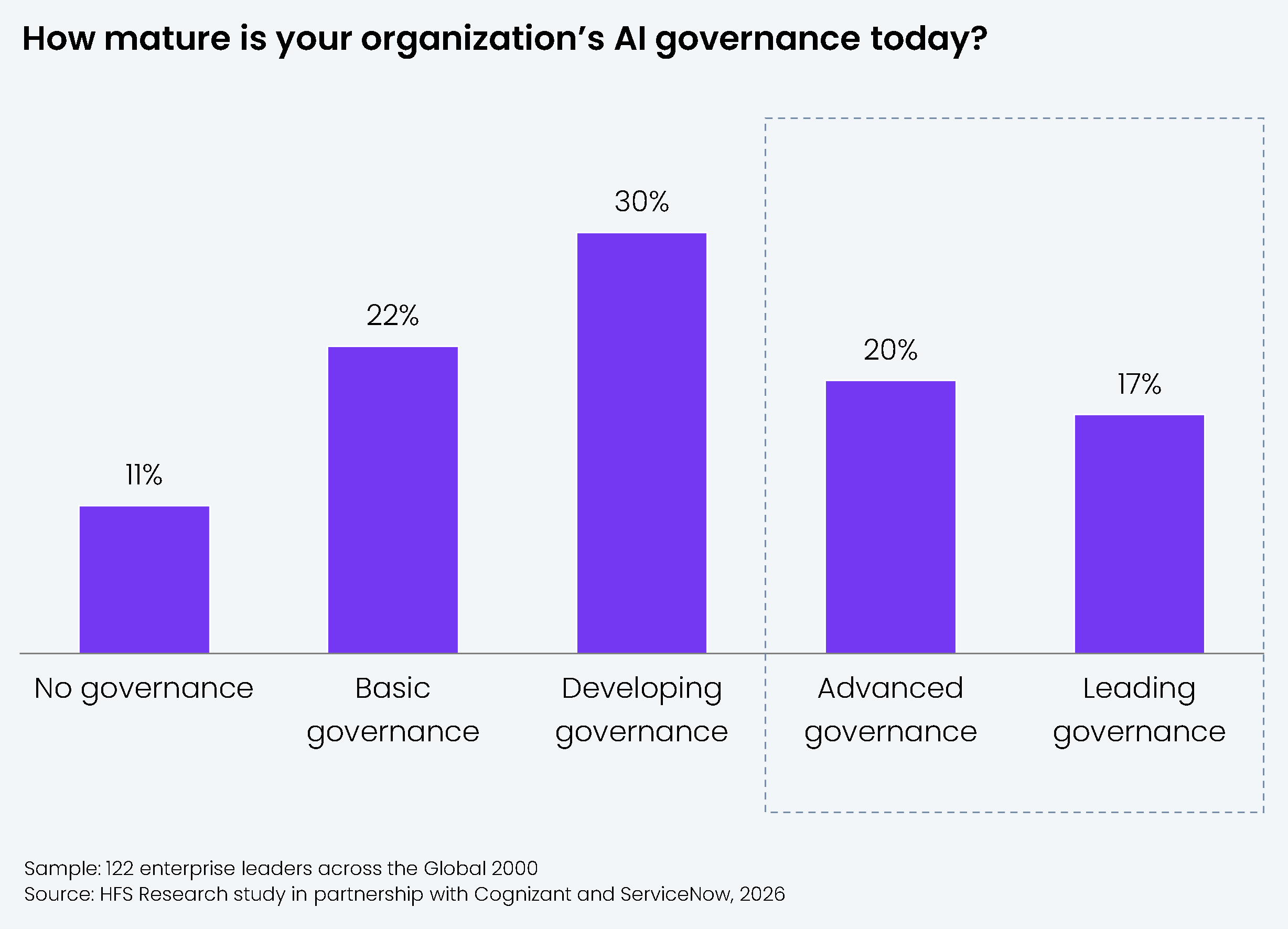
- Governance must shift beyond technical risk to ensure AI decisions consistently align with enterprise policies, thresholds, and human oversight.
- Few have defined who governs thresholds, exceptions, or escalation paths, leaving gaps in the safe and consistent execution of AI.
- Mature governance links AI to measurable KPIs and adapts them as systems learn.
- Banking: False-positive reduction in fraud alerts, exception-accuracy rates.
- Healthcare: Clean-claim rates, clinical-rules compliance.
- Retail and CPG: Order-resolution accuracy, demand-signal integrity.
- Manufacturing: Downtime-prediction precision, first-pass-yield impact.
- Enterprises increasingly require adaptive KPIs and metrics that automatically recalibrate baselines as AI systems evolve to reflect system learning and change.
The Bottom Line: Enterprises cannot scale AI value through model sophistication or pilot volume.
The priority must shift toward contextual relevance, workflow integration, and decision-grade governance.
Business and process leaders must take ownership of building industry-specific, contextual AI into the enterprise fabric. They are closest to the sector-specific rules, thresholds, and exceptions that define real work, and they must ensure that AI systems reflect these realities.
To move from pilots to production within core operations,
- AI must be embedded in enterprise workflows, not bolted on beside them.
- Context must be built as a capability spanning process logic, domain expertise, structured data, and system integration.
- Governance must focus on decision quality and measurable outcomes, not just technical oversight.
- Partners must bring more than platforms. Enterprises need complementary capabilities to operationalize contextual, enterprise-grade AI.
-
-
Technology partners must provide the workflow backbone, domain-aware logic layers, secure data, governance controls, and AI components to be embedded natively within end-to-end processes.
-
Service orchestrator partners must bring deep operational expertise, industry context, process redesign skills, and the ability to build and scale human+machine operating models that align AI decisions with business outcomes.
Context isn’t a model feature. It’s the result of an operating model that orchestrates industry data, process, governance, and expertise into how decisions are made.
Top AI priorities sit in highly contextual, regulated workflows