
If you continue to ignore the business benefits and social impact of sustainability, your enterprise runs the risk of losing public goodwill, employee morale, and competitive edge in its markets.
Sustainability is not a constraint; as the world demands new, sustainable standards, C-suites must realize that talking a good game is no longer enough. Top-level strategies must have sustainability ingrained if enterprises hope to realize the $12 trillion per year they might generate (according to The Business & Sustainable Development Commission, co-founded by Unilever).
World-class enterprises are already deeply involved in sustainable development partnerships—a critical move towards reaching the UN’s Sustainable Development Goals, and the space keeps expanding with the growing role of emerging technologies. Many enterprises have historically acknowledged the prize but not acted—it’s time to get your act together or miss out on the value that others are currently realizing.
The UNSDGs cover 17 world-scale environmental, social, and economic challenges. In the spirit of the hyperconnected enterprise, the final goal, No. 17, emphasizes the importance of effective partnerships to make the preceding 16 achievable and sustainable in themselves.
Exhibit 1: The 17 UN Sustainable Development Goals
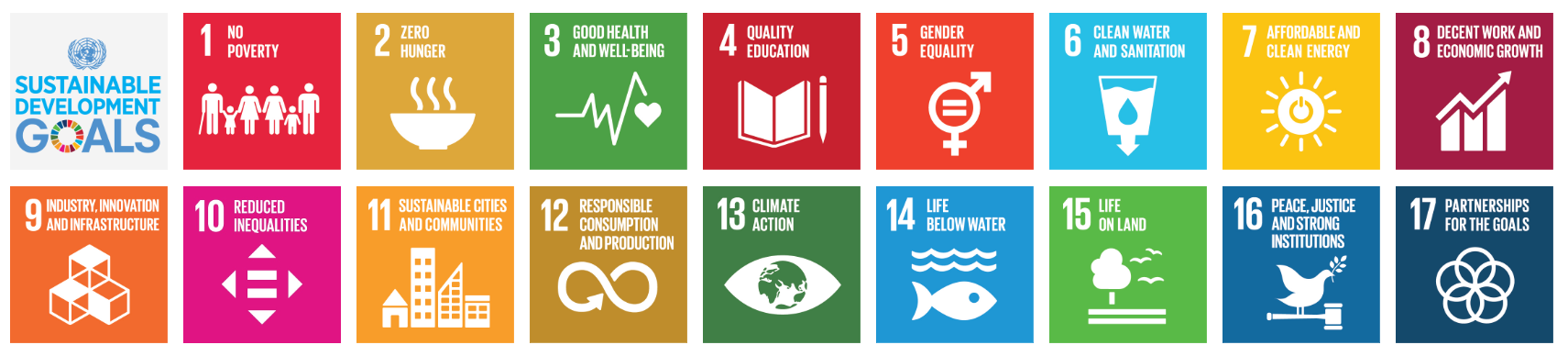
Source: United Nations
Sustainable development is quickly moving into the upper echelons of business and politics. Unilever, for example, believes that the SDGs will create market opportunities of $12 trillion a year through:
We can expect the 2020 US presidential campaign to include a battle around climate change, which will impact enterprises. Elizabeth Warren has already championed the “Green New Deal”—a framework for climate, justice, and economic sustainability that features bold targets such as 100% renewables in the US within 10 years, a smart grid coordinated with emissions from the agriculture and manufacturing sectors, and job guarantees for those working toward this transition.
Of course, they may have to deal with the odd “climate change is a hoax” challenge. Paraphrasing Andrew Wheeler, Trump’s head of the EPA, speaking recently at Cambridge University: “the website has an archive of climate science… but sometimes the button doesn’t work.”
Sustainability still wrestles for space with “more pressing” issues like automating back-office processes and boosting shareholder returns. PwC research highlights how 72% of businesses now mention the UNSDGs in their annual or sustainability reports, but only half mention the goals in their strategies.
Despite this, thought leaders are putting a lot of faith into new technologies, frequently citing AI. PwC proposed 80 AI applications covering 6 goals, while McKinsey more optimistically promote AI as a solution for all 17. The World Economic Forum even touts humble IoT as a potential route to achieving sustainable bliss; use cases stretch from energy and resource efficiencies to disaster relief.
GirlEffect spans many regions in Africa and Asia, designing mobile platforms to improve young girls’ lives. They promote individuals’ power to achieve change, committing to safeguarding all children and young people. Two-thirds of the global population has a mobile phone, but in low and middle-income countries women are 23% less likely than men to use mobile internet; GSMA predicts that two-thirds of new mobile subscribers will be women over the next five years—closing the “gender mobile gap” will be a key driver of economic growth. GirlEffect’s case is clear and has attracted high-profile enterprise partners such as Facebook, BBM (formerly BlackBerry Messenger), UNICEF, and the Bill & Melinda Gates Foundation. In addition to the humanitarian angle, globally increasing mobile adoption develops both a customer base and talent pools for the future in some of the fastest growing markets around the world.
Shining Hope for Communities (SHOFCO) utilizes simple platforms to lift people out of poverty in Kenya’s most impoverished communities. An exponential rise in poverty has accompanied an equally rapid population growth. SHOFCO promotes access to education, healthcare, and affordable clean water; it strives to provide children with opportunities to thrive. Mastercard, Huawei, GE, Barclays, and many famous foundations and NGOs are driving SHOFCO’s ambition to scale—as with GirlEffect, developing education, economic, and social mobility from the ground up in these rapidly growing markets benefits communities and businesses.
SafetiPin maps safe routes through cities in developing countries using advanced analytics to make use of data commonly ignored by city authorities. The United Nations is a key partner along with small tech players; the company is currently looking for major tech partners to scale across the globe. The enterprise case for investment is achieving reach—enterprises can boost their presence within a developing market, connecting with new customers and talent pools, for something other than soulless profit.
Simprints integrates biometrics into existing mobile tools and workflows in developing countries, improving the measurability of progress toward the UNSDGs. Its partners include arm, NGOs, and charities combined with support from Google, Microsoft, and others; its “effective ecosystems harness the unique potential of each actor to create real impact.” Similarly, to SafetiPin, building a technological presence and expertise in new markets will only benefit the companies that take the opportunity. Many enterprises look to scale technologies with incorporated biometrics; partners that understand a location, technology, and market will be of real value.
The Bottom Line: CXOs must ingrain sustainability into company strategy to realize its business value—partnerships can act as an accelerating first step
Enterprise leaders need to stop seeing sustainability as a prison cell that constrains profit. It can create real business value by lowering costs, growing customer bases, improving employee, partner and customer perception and mitigating risks, to name but a few benefits. Sustainable development partnerships will also engage governments, companies, and new customers throughout the world as enterprises aim to scale in their increasingly hyperconnected ecosystems.
The drive toward sustainable business value starts with CXOs putting their money where their mouths are and incorporating sustainability into top-level strategy—CXOs should ensure focused KPIs, quality, and monitoring just as they do in financial and other business matters. Leading enterprises are forming partnerships to hammer home sustainable development and capture the resulting business value. Take a leaf out of their books before being left as the odd one out who’s not doing their bit.
Register now for immediate access of HFS' research, data and forward looking trends.
Get StartedIf you don't have an account, Register here |
With the exception of our Horizons reports, most of our research is available for free on our website. Sign up for a free account and start realizing the power of insights now.
Our premium subscription gives enterprise clients access to our complete library of proprietary research, direct access to our industry analysts, and other benefits.
Contact us at [email protected] for more information on premium access.

