This Market Impact Report is for IT and business leaders looking to accelerate software delivery by combining low-code development with generative AI.
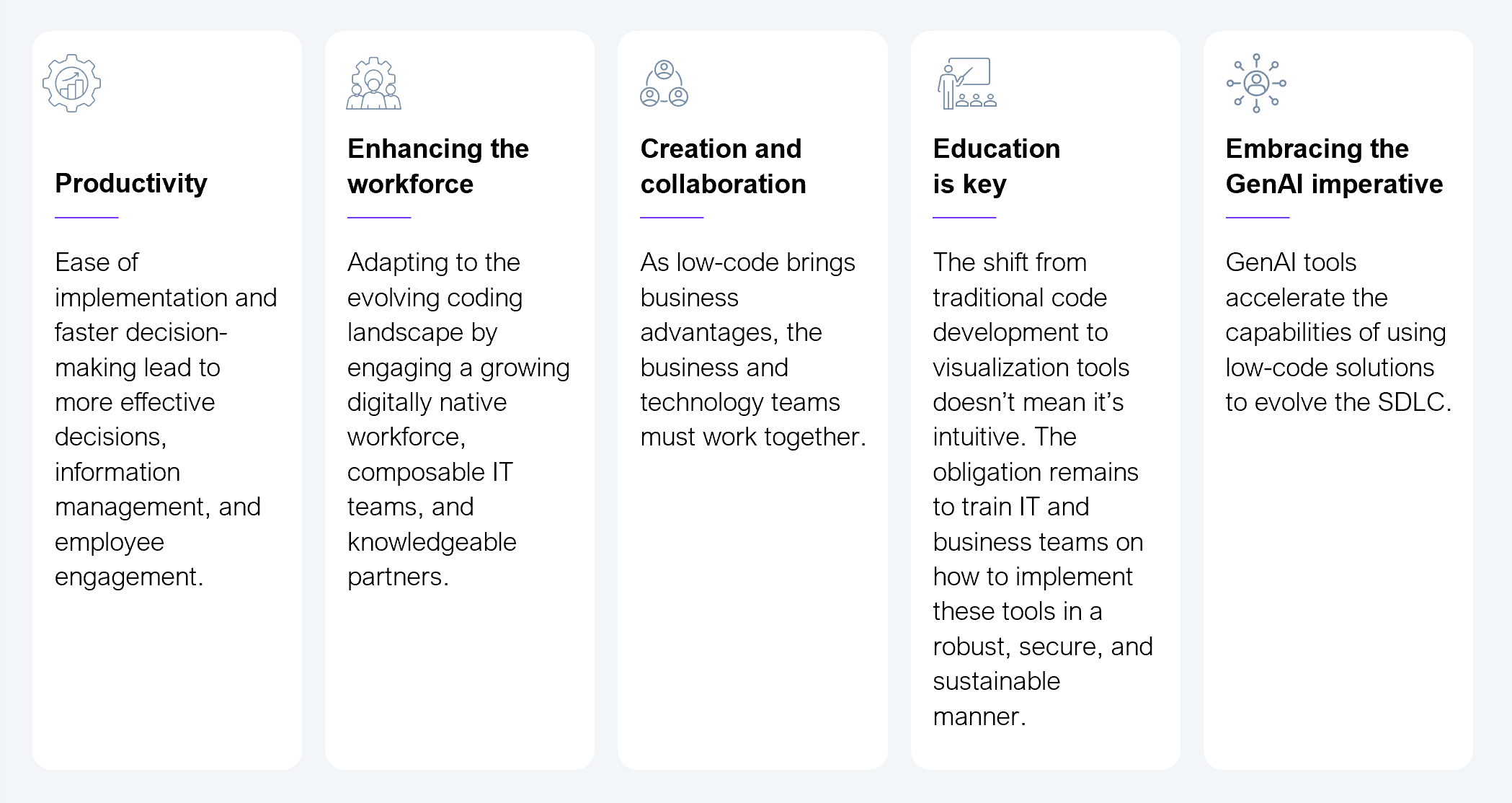
Low-code development continues to change how we create, automate, and deliver competitive advantage with software. In our study with Infosys, HFS found companies are better equipped to accelerate the software development lifecycle by harmonizing their low-code efforts with their IT services partners. After surveying 200 business and technology decision-makers about their usage, challenges, and outcomes of low-code, we identified five important takeaways:


The world of software development consists of multiple programming languages, a range of platforms, and constant changes and upgrades. Programmers spend hours learning the language and subsequently implementing the software. As a result, traditional programming can be time-consuming, require expansive coding, and be expensive.
Low-code technology simplifies software development by providing a visual development environment and pre-built modules, enabling users to create applications with minimal hand-coding. It accelerates the development process, reduces the need for extensive programming knowledge, and enables faster deployment of applications, making it accessible for both professional developers and non-technical team members collaborating with their software engineering support teams.
With the advent of generative AI and subsequent implementation of generative coding, the software development landscape will witness significant change in the coming years. HFS Research, with support from Infosys, surveyed 200 enterprise leaders to get their perspectives on low-code development and its motivations. Several themes developed we believe can help technology leaders on this journey (see Exhibit 1).
Source: HFS Research, 2024

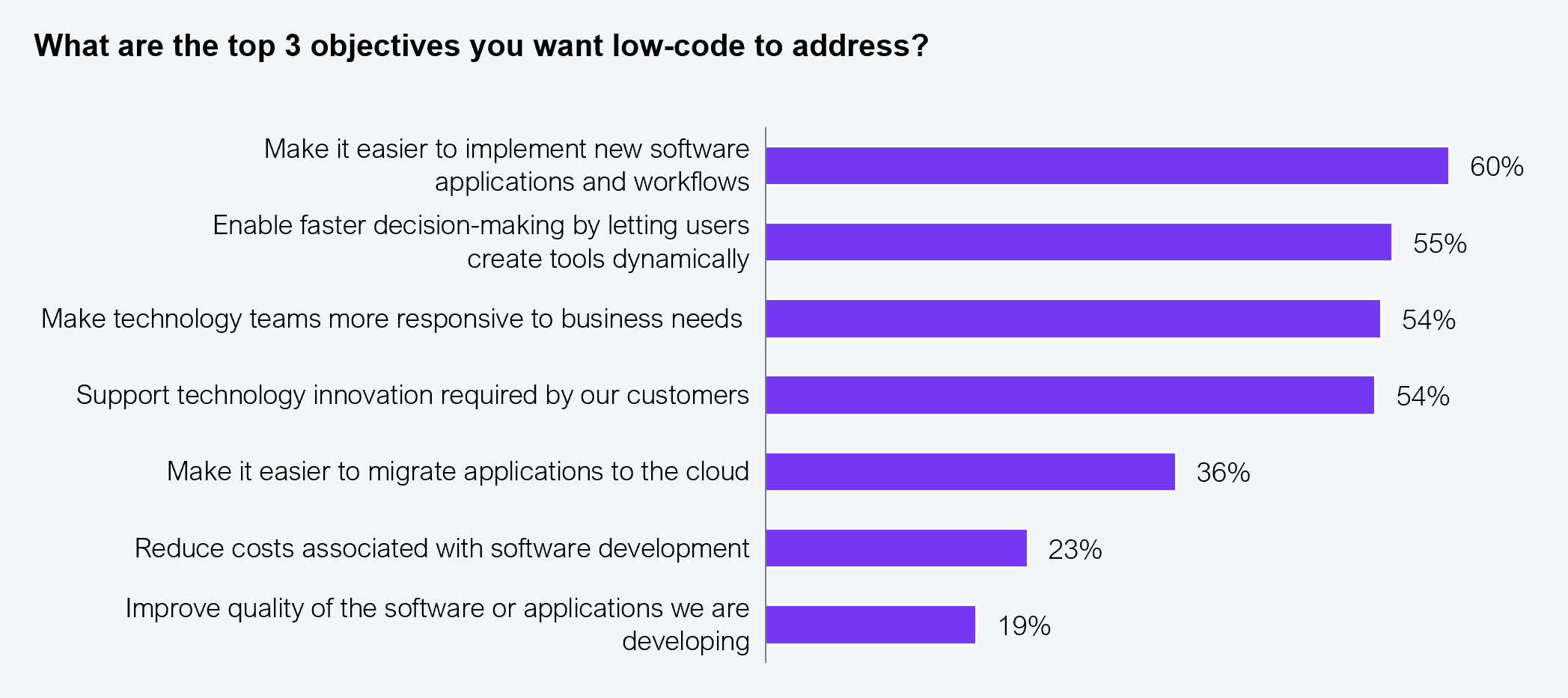
The top objectives executives expect low-code development to address include more straightforward implementation of new software applications and workflows, faster decision-making through dynamic tool creation, making technology teams more responsive to business needs, and supporting technology innovations customers require. Reducing cost isn’t seen as a top low-code objective, which will pivot attention toward innovation, making it a value play instead of a cost play.
Source: HFS Research, 2024, n=200
Business and IT misalignment is a significant reason enterprise transformation initiatives fail. The differing priorities among business and IT teams are due to the groups’ disparate objectives. While 64% of business leaders say making tech teams more responsive to business needs is a top-three objective, just 49% of tech leaders share that opinion.
Enterprises with significant revenues and internal IT teams want more straightforward software and workflow implementation. 76% of respondents from companies with >$20 billion in revenues and more than 500 employees said it is a top-three objective.
Among companies that invest significant amounts (>$500 million) in software engineering, the need to support technology innovation is the key objective, with 72% citing it. These responses reiterate the importance of using low-code technology as a vital tool for driving further innovation.

There are four types of coding available today:
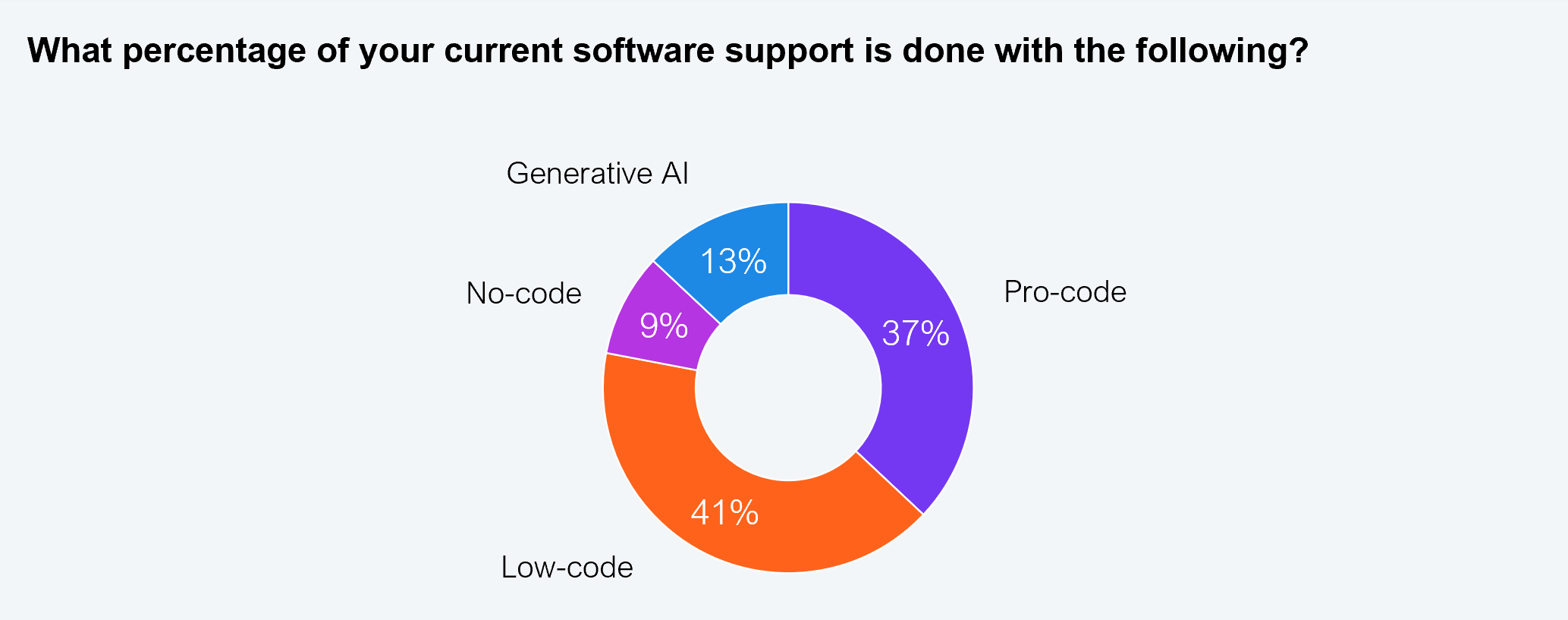
Most enterprises use a mix of different types of code for their current software support activities. Pro-code, low-code, no-code, and GenAI tools are increasingly used in rotation in software engineering toolkits.
Source: HFS Research, 2024, n=131
Of the four methods, no-code is the least widely adopted, with 54% saying it is used for no more than 10% of all software support, and 20% saying they have never used it.
Low-code makes up a significant share of usage, with 41% saying it’s used for 25% to 49% of software support and 19% saying it is used for more than half of their software support.
While still in its early stages, generative code has seen significant uptake, with only 6% saying they have never used it and 34% having used generative code for just 1%-9% of their operations. This shows they are in the early stages of the journey. In comparison, 23% use it 10-24% of the time, and 15% use it 25%-49%.
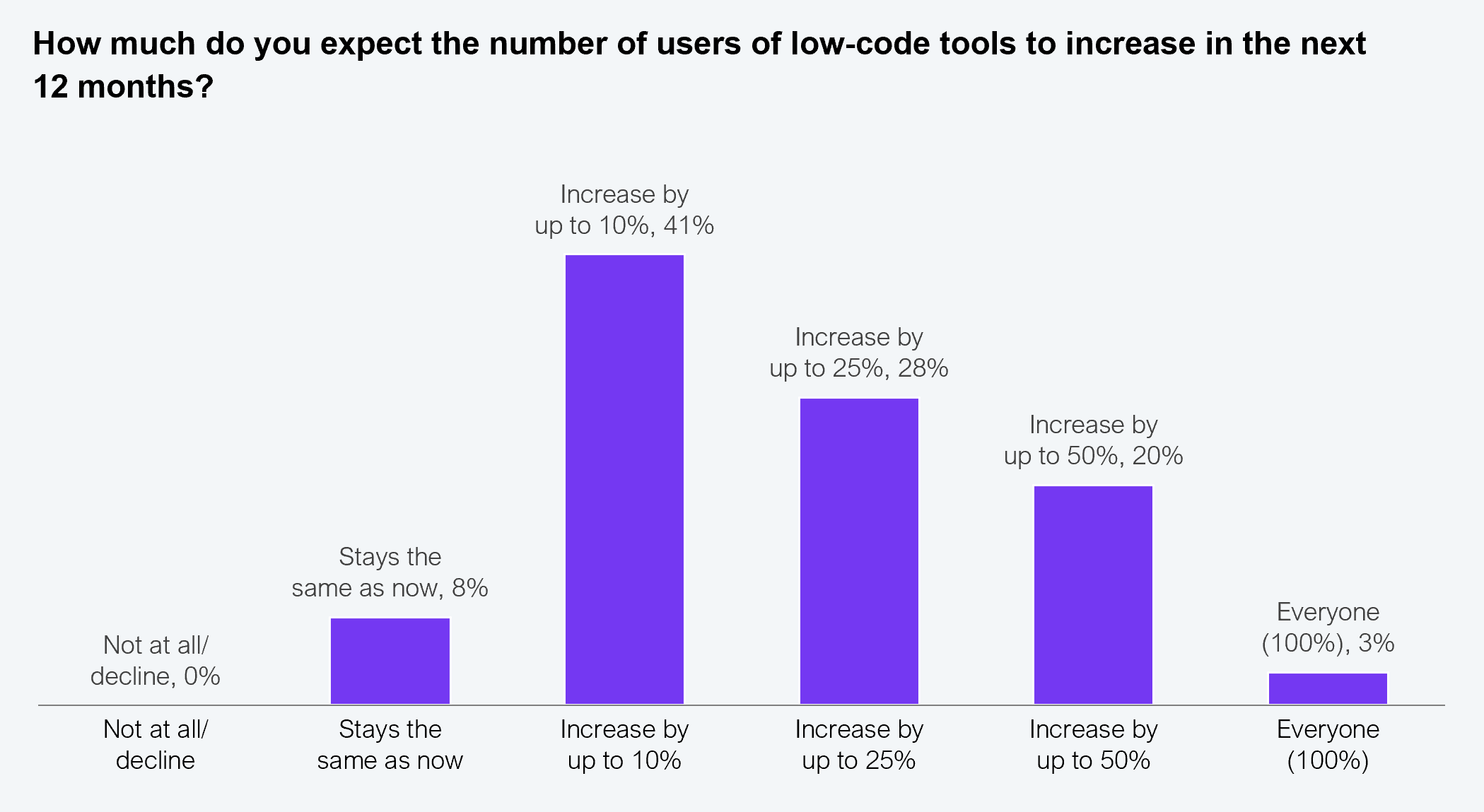
In the next 12 months, low-code technology adoption is expected to grow. 41% of respondents expect modest increases of up to 10% of respondents, while 28% expect usage to increase by up to 25%. 20% of respondents expect adoption to increase by 50%. The figures show that low-code is becoming an enterprise imperative.
Source: HFS Research, 2024, n=200
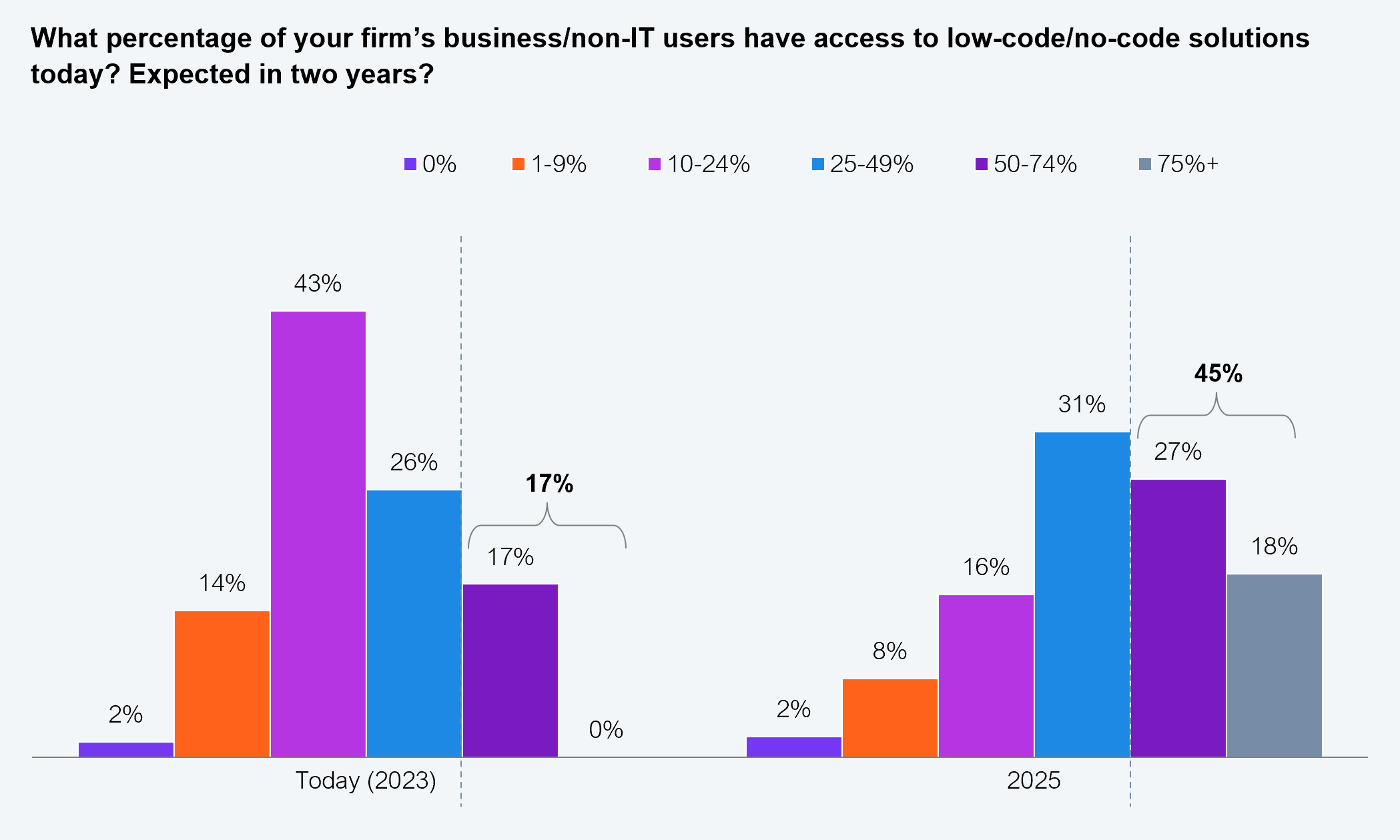
The proliferation of low-code and no-code solutions among business and non-IT users is expected to increase significantly in the next two years. Only 17% of organizations provide access to low-code or no-code solutions to more than half of business and non-IT users. This figure is expected to grow to 45% in two years, highlighting the power of low-code and no-code solutions in democratizing software development.
Increasing comfort using low-code in business and technology collaboration efforts may drive this significant growth. However, it underscores the urgency of engaging with your services and software engineering partners to develop policies, training, and support models for the increased software-enabled capabilities resulting from this shift.
Source: HFS Research, 2024, n=200
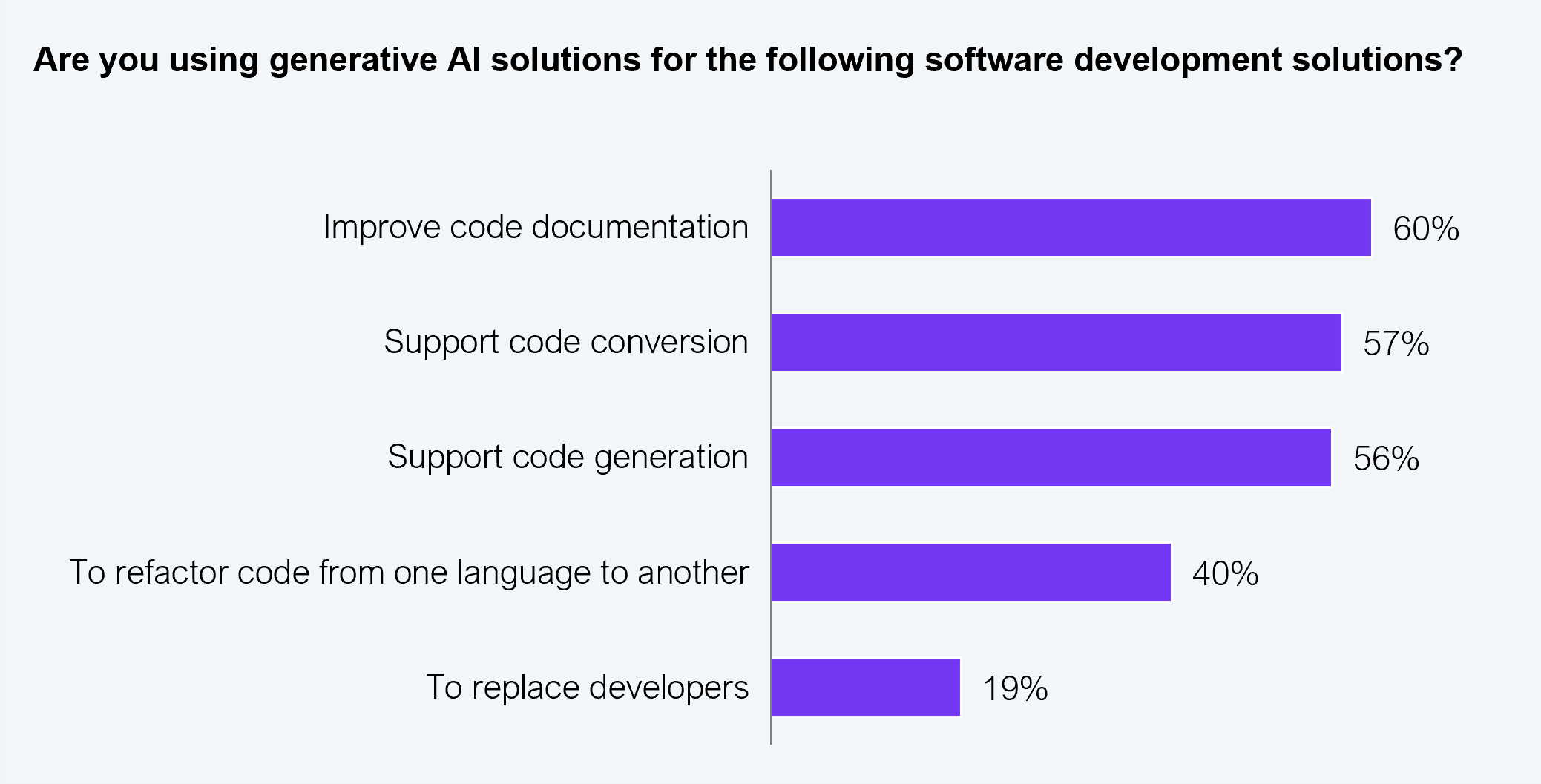
Software development has emerged as one of the critical areas that generative AI will disrupt. Using a combination of low-code and GenAI solutions, developers’ time spent discovering, documenting, and refactoring routine code can be significantly reduced, freeing time for more productive tasks. It also helps update source code, workflow, and integration documentation and assists with error detection that typically comes later in the SDLC.
One of the key approaches HFS has seen in firms we have interviewed as part of our ongoing research is the establishment of a “community of practice.” A CoP creates a framework for collaborating, publishing, and managing solutions emerging across a company’s application portfolio.
The benefit of establishing a CoP is it can be monitored by a combination of IT, super users, and GenAI tools. These administrators can collectively monitor a low-code-generated app’s quality, adoption, usage, workflow, automation, and more. By setting thresholds on these three qualifiers, a human-in-the-loop model can be used to address a solution with high business potential (or risk) in the CoP while ignoring those solutions that don’t meet these criteria.
A CoP is about facilitating contribution and triggering the proper work for the IT team and centers of excellence (CoE), which must remain abreast of but not inhibit innovation.

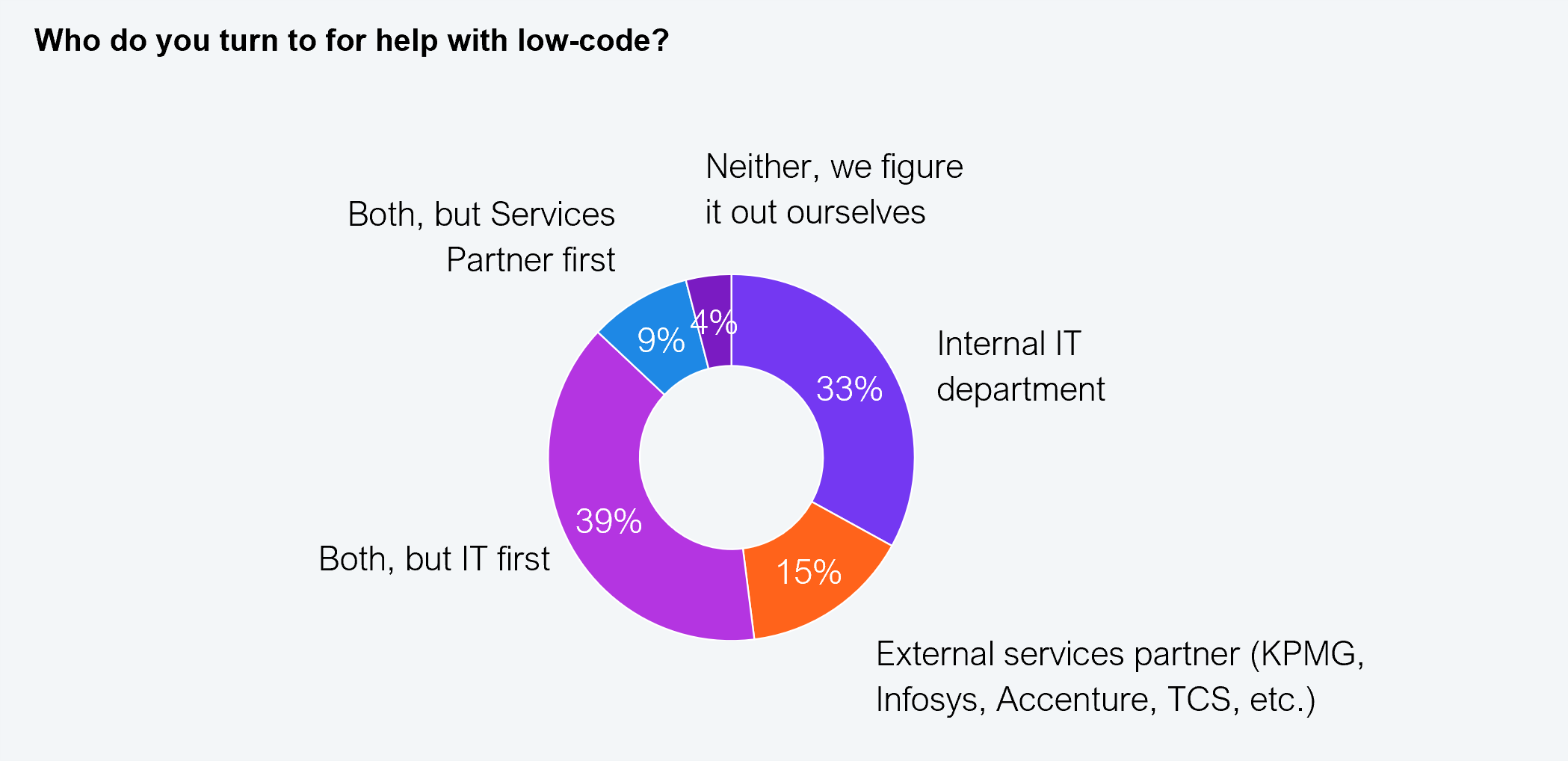
As with any technology, adequate support is crucial in helping drive satisfaction among employees using the technology. The study shows that Internal IT teams must be equipped to deal with queries around low-code, as they are typically the first port of call. 33% of the respondents said they turned to their IT department exclusively, and a further 39% said they accessed their internal IT and external services partner but with IT first. That means more than 7 in 10 respondents contact their internal IT teams for support with low-code.
Source: HFS Research, 2024, n=69 Business decision-makers
Providing support for low-code also offers an opportunity for service partners, as not every enterprise will be willing to invest in training its IT team on low-code. While 48% of respondents reach out to professional IT service partners, only 9% have service partners as their first source of help. This low uptake enables service providers to increase their footprint in providing low-code support services. If they can offer services cost-efficiently, enterprises can spend more with service partners instead of expanding their IT teams.
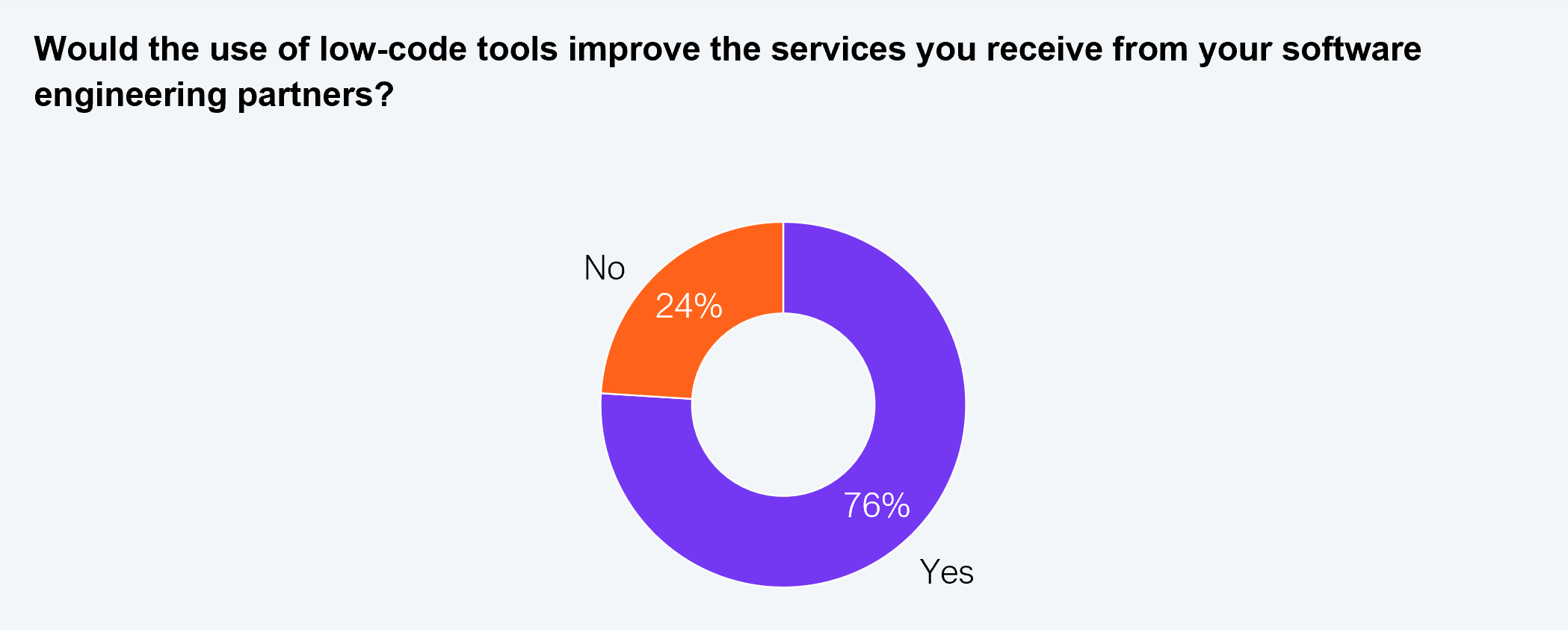
While internal IT teams are called upon first, companies overwhelmingly indicate their partner’s use of low-code solutions is critical to application modernization and software engineering efforts. More than 75% of business and IT leaders told HFS that using low-code to deliver services is important, see Exhibit 7.
Source: HFS Research, 2024, n=200
While companies are turning to low-code in record numbers, the biggest challenge continues to be readiness and training. 91% of all respondents indicated that while these tools are easier to use than traditional coding, IT and business teams require training. Coding is still coding. Rigor must be applied to ensure that once scoped, built, and delivered, low-code software conforms to business needs and can be supported by IT and the firm’s services partners.

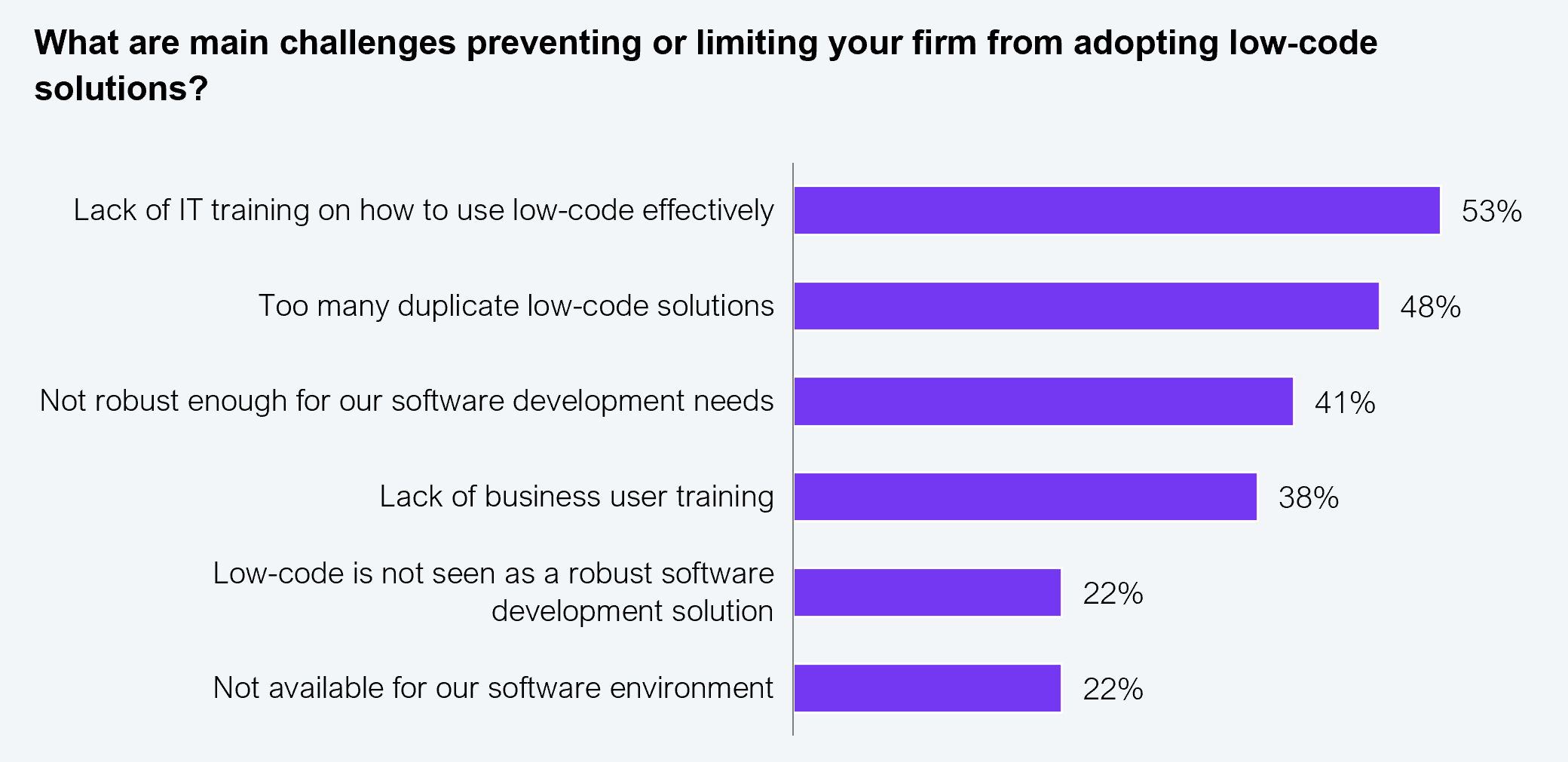
When asked to choose three main challenges preventing or limiting the adoption of low-code solutions, 53% cited the lack of IT training on using it effectively, followed by too many duplicate low-code solutions by 48%, and lack of access to talent or skills by 47%.
Source: HFS Research, 2024, n=200
With training for business and technology teams as the leading challenge, another critical area of focus is the concern about having too many low-code solutions in their organization. As many software vendors offer their take on low-code solutions and the existence of dedicated low-code platforms, there is an indication that this fragmentation of choice should be a focus area for the IT department and its partners.
Rather than allowing multiple platforms, HFS advises IT leadership, the firm’s CoE, and its primary software engineering partner to define which tools to prioritize as a best practice. From our interviews with global multinationals, the typical target is to have no more than five low-code solutions and for these to be part of a CoE best practice policy for specific architecture, integration, and platform support and development needs. While not all software vendors will benefit, the ability of the business to show and maintain success with low-code will be predicated on doing this homework early in their journey, not later.
The success of any technology depends on how well users adopt the available solutions on which they are trained. Based on the numbers above, HFS recommends firms define the solutions needed for front-office versus back-office application development, isolate one or two solutions for cross-architecture development and integration, and focus on building solutions that can connect across its application architecture, not those optimized for a single application or usage.
One way to assess your application architecture from legacy code to the usage of modern low-code solutions is to have your applications team and partner work together using GenAI tools to evaluate and discover. This model has quickly gained acceptance to augment the firm’s or its partner’s ability to scan code, applications, custom-built workflows, and application process integration (API) solutions to gain a clear view of the forest for the trees. Where billions of lines of code would have taken forever to assess, GenAI takes just days to collect and present this data to developers and teams.

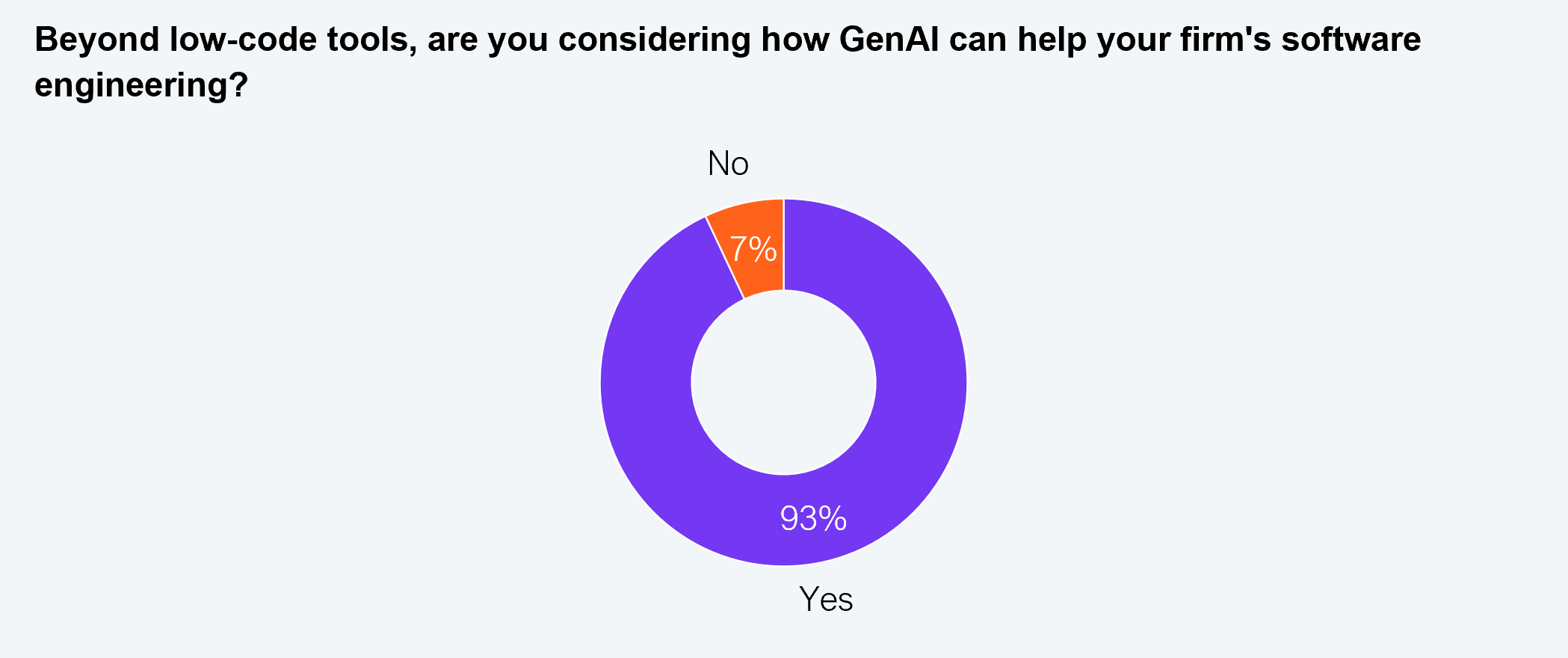
GenAI is top of mind for all companies today. We are now moving to the implementation stage of GenAI, with an overwhelming 93% of enterprises considering how it can help with software engineering. Combining the assessment, discovery, documentation, and refactoring of legacy software code into modern solutions with documentation accelerates the importance of having a well-thought-out low-code practice.
Source: HFS Research, 2024, n=200
As our interviews show, these tools aren’t expected to replace developers. Rather, by supporting the early stages of the SDLC (assess, design, generate, convert), GenAI tools are seen as a way to automate many software development tasks. This is important as it frees technical resources from internal and external teams to focus on the more complex needs when modernizing code to support business needs.
HFS sees this as a watershed moment when application teams in a business finally rise from the codification of business needs into rigorous swim lanes and instead have the time to explore how the business needs the insights from these tools to deliver the revenue-creating opportunities it is pursuing.
Source: HFS Research, 2024, n=200
This serves as a wake-up call for low-code service providers to showcase how their GenAI tools/capabilities are relevant to their low-code clients, as 47% state that they aren’t aware of low-code service providers with GenAI tools that are pertinent to their enterprise. This lack of awareness makes it vital for vendors to showcase how their tools can solve business problems instead of trying to sell technology capabilities.
Over the past decade, low-code platforms have evolved to provide a range of users the capabilities to create applications, automate tasks, streamline processes, and participate in technology-led innovations. Low-code has established itself as the means to democratize the development and customization of software to build applications. Over the past several years, GenAI tools have further amplified low-code software development and modernization.
A synergy has quickly developed between low-code and GenAI as platforms to discover, assess, develop, customize, and support the SDLC. With the addition of AI, these combined platforms quickly reshape application development by fusing an increasingly digitally fluent workforce with proven engineering skills. This combination accelerates a firm’s ability to work with its partners and internal teams to enhance business readiness through more timely and effective design and delivery of software applications that can drive outcomes.
One partner HFS is watching with interest is Infosys. The IT services and advisory firm is using the combined power of low-code and generative AI tools to change how developers approach programming. Building on decades of software engineering skills, frameworks, and digital engineering expertise, Infosys is using its deep understanding of code syntax and logic to meld both model-based and prompt-based application development. Using both approaches interchangeably is a paradigm shift with the potential to further extend software programming fluidly across how Infosys works with its clients.
This approach brings technology teams and the syntax of applications, data, and code closer to the business syntax of the client’s operations teams. By looking at the problem from the start from a business point of view, the outcomes can be achieved more accurately. The vendor refers to its offering as Infosys FluidITy. FluidITy leverages its beginnings in democratized low-code and no-code while embracing GenAI as a force accelerator for the SDLC.
Infosys’ FluidITy solutions provide IT leaders with low-code platforms that are proven tools for creating autonomous processes that drive efficiency and innovation. Adding GenAI solutions enhances low-code platforms with intelligent decision-making, machine-based feedback loops, and deep code integration that create self-healing processes. The platforms can learn and self-adjust from past performance, thus increasing agility and adaptability to changing business needs.
By adopting the skills and experiences of low-code with the new functionality and capability of generative AI, firms can empower end users to automate and streamline their daily work, leading to increased productivity and efficiency. By weaving AI into the core of low-code platforms, technology teams can create rich, intelligent experiences that become an integral part of their work journey. These capabilities enable technology and business teams to empower users with intuitive interactions, personalized insights, and automated tasks, adapting dynamically to their needs, preferences, and behavior.
HFS believes that low-code platforms’ balance of speed, flexibility, and scalability makes them compelling for enterprises across developer, operations, and business user cohorts to drive innovation and improve business outcomes. By making software development more accessible and efficient, low-code and GenAI coding can revolutionize the way businesses operate. It empowers individuals, businesses, and communities to achieve their full potential and create a brighter future.
Register now for immediate access of HFS' research, data and forward looking trends.
Get StartedIf you don't have an account, Register here |
With the exception of our Horizons reports, most of our research is available for free on our website. Sign up for a free account and start realizing the power of insights now.
Our premium subscription gives enterprise clients access to our complete library of proprietary research, direct access to our industry analysts, and other benefits.
Contact us at [email protected] for more information on premium access.