Competitive Intelligence

TTEC: Customer Experience Services Capabilities, 2026

This TTEC: Customer Experience Services Capabilities, 2026 competitive intelligence profile is for customer experience leaders, CMOs, and sourcing executives evaluating TTEC’s dual-engine model pairing AI innovation with real CX operations at scale, spanning TTEC Digital and TTEC DCX.
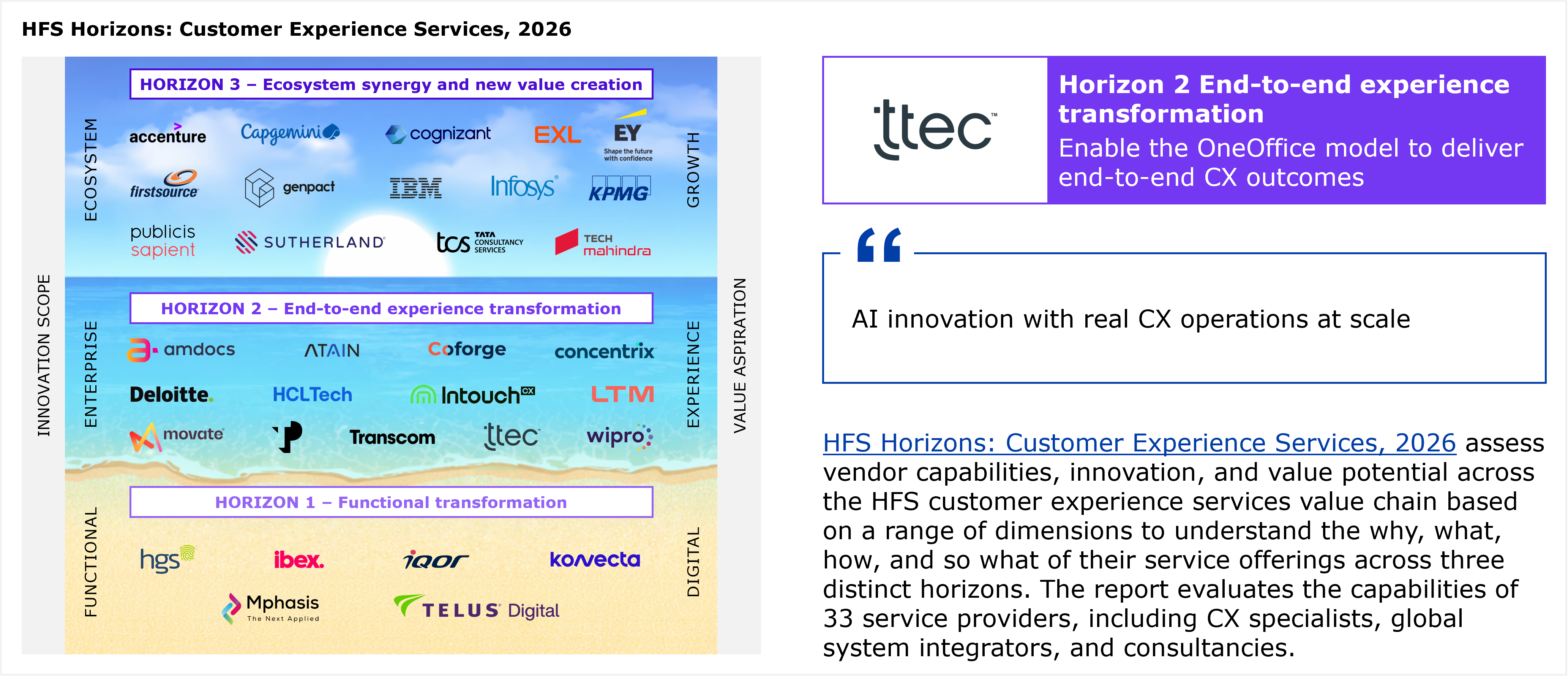
A beach-themed diagram showing three horizontal horizon bands stacked like sand layers, with two axes running alongside: innovation scope on the left (functional at the bottom, enterprise in the middle, ecosystem at the top) and value aspiration on the right (digital at the bottom, experience in the middle, growth at the top). Horizon 1, functional transformation, lists six providers in alphabetical order: hgs, ibex, iQor, Konvecta, Mphasis, and TELUS Digital. Horizon 2, end-to-end experience transformation, lists twelve providers in alphabetical order: Amdocs, Atain, Coforge, Concentrix, Deloitte, HCLTech, Intouch CX, LTM, Movate, TP, Transcom, and TTEC. Horizon 3, ecosystem synergy and new value creation, lists fourteen providers in alphabetical order: Accenture, Capgemini, Cognizant, EXL, EY, Firstsource, Genpact, IBM, Infosys, KPMG, Publicis Sapient, Sutherland, Tata Consultancy Services (TCS), and Tech Mahindra. Counting all three horizons together yields 32 named or logo-represented providers, one fewer than the "33 service providers" figure stated in the adjacent body text, an apparent discrepancy between the diagram and the narrative count. To the right of the diagram, a panel shows the TTEC logo in a box labeled "Horizon 2 End-to-end experience transformation," followed by a tagline reading that TTEC aims to enable the OneOffice model to deliver end-to-end CX outcomes. Below that sits a pull quote reading "AI innovation with real CX operations at scale," attributed to the HFS Horizons: Customer Experience Services, 2026 report. Beneath the quote, a paragraph explains that the HFS Horizons report assesses vendor capabilities, innovation, and value potential across the HFS customer experience services value chain based on a range of dimensions covering the why, what, how, and so what of service offerings across the three horizons, and that the report evaluates the capabilities of 33 service providers, including CX specialists, global systems integrators, and consultancies. A footnote below the diagram states that providers within each horizon are listed alphabetically. Source: HFS Research, 2026.

Note: All service providers within a Horizon are listed alphabetically
Source: HFS Research, 2026
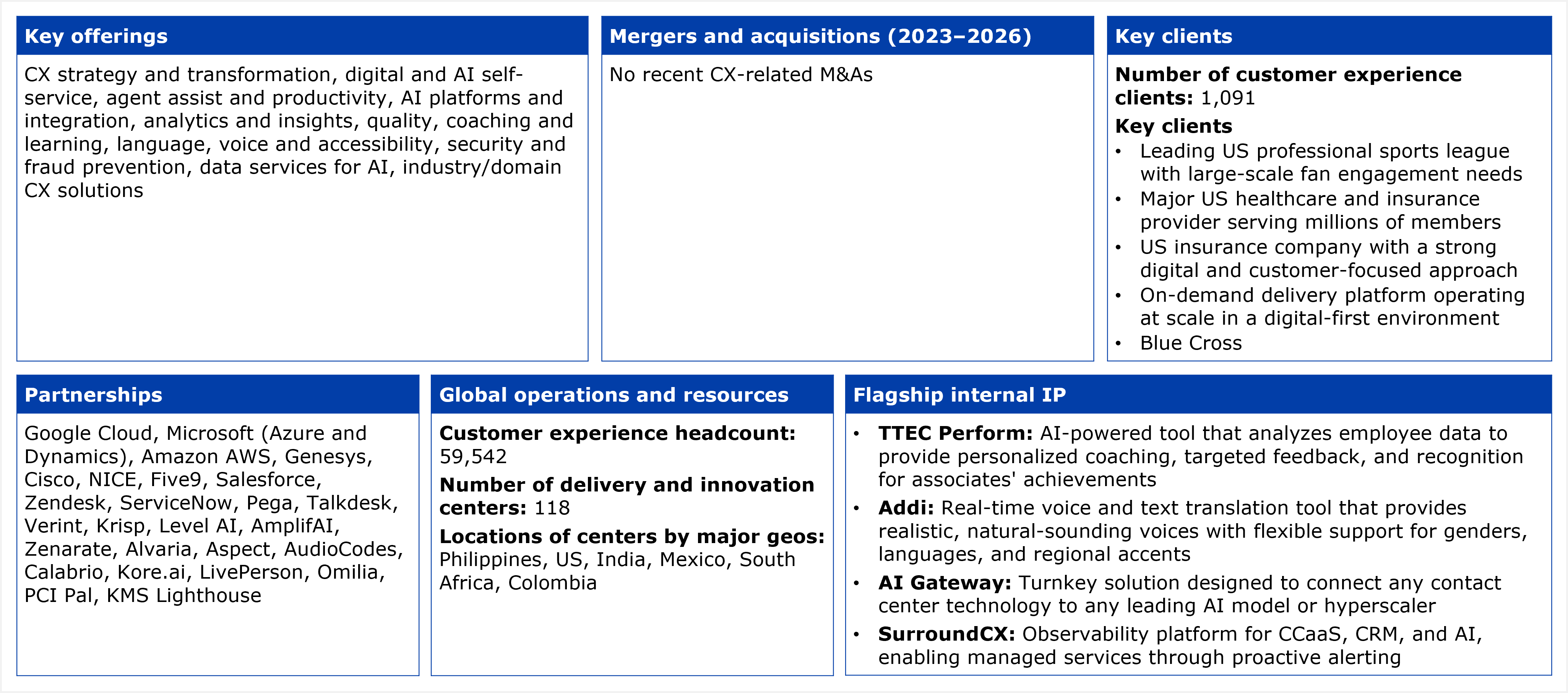
Key facts about TTEC’s customer experience services capabilities

A six-panel fact table covering TTEC's CX business. Key offerings panel lists: CX strategy and transformation, digital and AI self-service, agent assist and productivity, AI platforms and integration, analytics and insights, quality, coaching and learning, language, voice and accessibility, security and fraud prevention, data services for AI, and industry and domain CX solutions. Mergers and acquisitions panel (2023 to 2026) states there were no recent CX-related M&A activities. Key clients panel states the number of customer experience clients as 1,091, and describes five key clients: four by category rather than by name, a leading US professional sports league with large-scale fan engagement needs, a major US healthcare and insurance provider serving millions of members, a US insurance company with a strong digital and customer-focused approach, and an on-demand delivery platform operating at scale in a digital-first environment, alongside one client named directly, Blue Cross, making this panel a mix of named and anonymized client references. Partnerships panel lists: Google Cloud, Microsoft (Azure and Dynamics), Amazon AWS, Genesys, Cisco, NICE, Five9, Salesforce, Zendesk, ServiceNow, Pega, Talkdesk, Verint, Krisp, Level AI, AmplifAI, Zenarate, Alvaria, Aspect, AudioCodes, Calabrio, Kore.ai, LivePerson, Omilia, PCI Pal, and KMS Lighthouse. Global operations and resources panel states a customer experience headcount of 59,542, a total of 118 delivery and innovation centers, and center locations by major geography spanning the Philippines, the US, India, Mexico, South Africa, and Colombia. Flagship internal IP panel lists four items: TTEC Perform, described as an AI-powered tool that analyzes employee data to provide personalized coaching, targeted feedback, and recognition for associates' achievements; Addi, a real-time voice and text translation tool providing realistic, natural-sounding voices with flexible support for genders, languages, and regional accents; AI Gateway, a turnkey solution designed to connect any contact center technology to any leading AI model or hyperscaler; and SurroundCX, an observability platform for CCaaS, CRM, and AI, enabling managed services through proactive alerting. Source: HFS Research, 2026.

Source: HFS Research, 2026

TTEC’s performance in the study and HFS’ views of its strengths and development opportunities for customer experience services capabilities

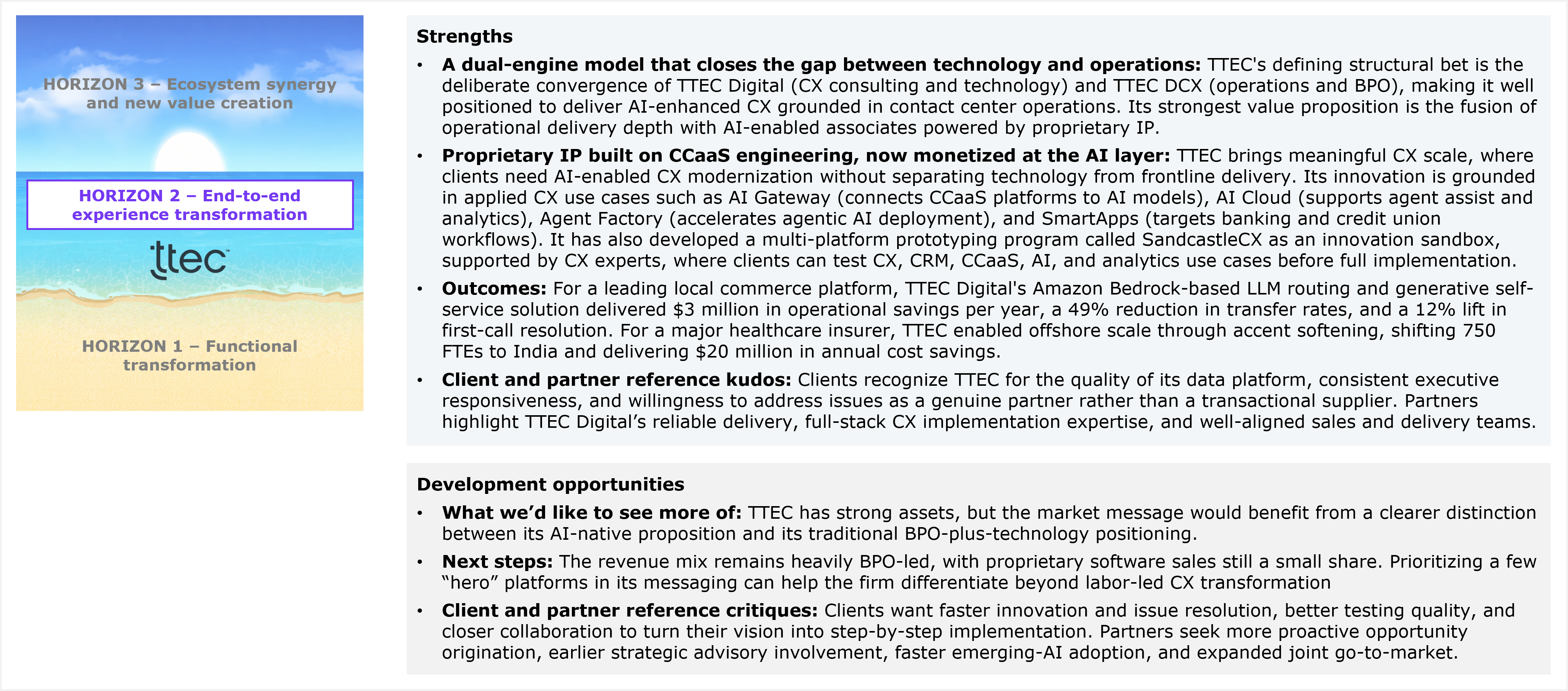
A simplified version of the beach-themed three-band horizon diagram, this time without any company names. Horizon 3 (ecosystem synergy and new value creation) sits at the top, Horizon 2 (end-to-end experience transformation) in the middle, and Horizon 1 (functional transformation) at the bottom. TTEC's assigned horizon, Horizon 2, is highlighted with a purple bordered label box and the TTEC logo placed directly beside it, while the labels for Horizon 1 and Horizon 3 are shown in muted gray text to indicate they are not the provider's assigned tier. To the right, a Strengths panel lists four points. First, a dual-engine model that closes the gap between technology and operations, describing TTEC's defining structural bet as the deliberate convergence of TTEC Digital, covering CX consulting and technology, and TTEC DCX, covering operations and BPO, positioning it to deliver AI-enhanced CX grounded in contact center operations through the fusion of operational delivery depth with AI-enabled associates powered by proprietary IP. Second, proprietary IP built on CCaaS engineering, now monetized at the AI layer, describing TTEC's innovation as grounded in applied CX use cases including AI Gateway, which connects CCaaS platforms to AI models, AI Cloud, which supports agent assist and analytics, Agent Factory, which accelerates agentic AI deployment, and SmartApps, which targets banking and credit union workflows, alongside a multi-platform prototyping program called SandcastleCX, described as an innovation sandbox supported by CX experts where clients can test CX, CRM, CCaaS, AI, and analytics use cases before full implementation; of these five named items, only AI Gateway also appears among the four items listed in the Flagship internal IP panel in Exhibit 2, with AI Cloud, Agent Factory, SmartApps, and SandcastleCX absent from that panel. Third, an outcomes point citing two client results, both described by category rather than named: for a leading local commerce platform, TTEC Digital's Amazon Bedrock-based LLM routing and generative self-service solution delivered $3 million in operational savings per year, a 49% reduction in transfer rates, and a 12% lift in first-call resolution; for a major healthcare insurer, TTEC enabled offshore scale through accent softening, shifting 750 FTEs to India and delivering $20 million in annual cost savings. Fourth, client and partner reference kudos, noting that clients recognize TTEC for the quality of its data platform, consistent executive responsiveness, and willingness to address issues as a genuine partner rather than a transactional supplier, while partners highlight TTEC Digital's reliable delivery, full-stack CX implementation expertise, and well-aligned sales and delivery teams. Below that, a Development opportunities panel lists three points, matching the full three-point structure used elsewhere in this report series. First, what HFS would like to see more of, namely that TTEC has strong assets, but the market message would benefit from a clearer distinction between its AI-native proposition and its traditional BPO-plus-technology positioning. Second, next steps, noting that the revenue mix remains heavily BPO-led, with proprietary software sales still a small share, and that prioritizing a few "hero" platforms in its messaging can help the firm differentiate beyond labor-led CX transformation. Third, client and partner reference critiques, noting that clients want faster innovation and issue resolution, better testing quality, and closer collaboration to turn their vision into step-by-step implementation, while partners seek more proactive opportunity origination, earlier strategic advisory involvement, faster emerging-AI adoption, and expanded joint go-to-market. Source: HFS Research, 2026.

Source: HFS Research, 2026

To read the complete report, click the download button below.

Sign in to view or download this research.

Login

Register

Insight. Inspiration. Impact.

Register now for immediate access of HFS' research, data and forward looking trends.

Get Started

Download Research

    Sign In

    Sign up for a free
    research account

    With the exception of our Horizons reports, most of our research is available for free on our website. Sign up for a free account and start realizing the power of insights now.

    By registering you agree to our privacy policy.

    I hereby consent that HFS Research can process my personal data.

    Digests/Newsletters: Overviews of the latest news, insight, and research by HFS.

    HFS Events: Exclusive invitations to HFS webinars, roundtables, and summits, bringing together key industry stakeholders focused on major innovations impacting business operations.

    Premium Access

    Our premium subscription gives enterprise clients access to our complete library of proprietary research, direct access to our industry analysts, and other benefits.

    Contact us at [email protected] for more information on premium access.

      Contact Ask HFS AI Support