This HFS Research Take 5 report, produced in partnership with Cognizant, is for UK&I business and IT leaders evaluating how to adopt vibe coding at scale to unlock productivity gains and advance their Services-as-Software ambitions.
Background
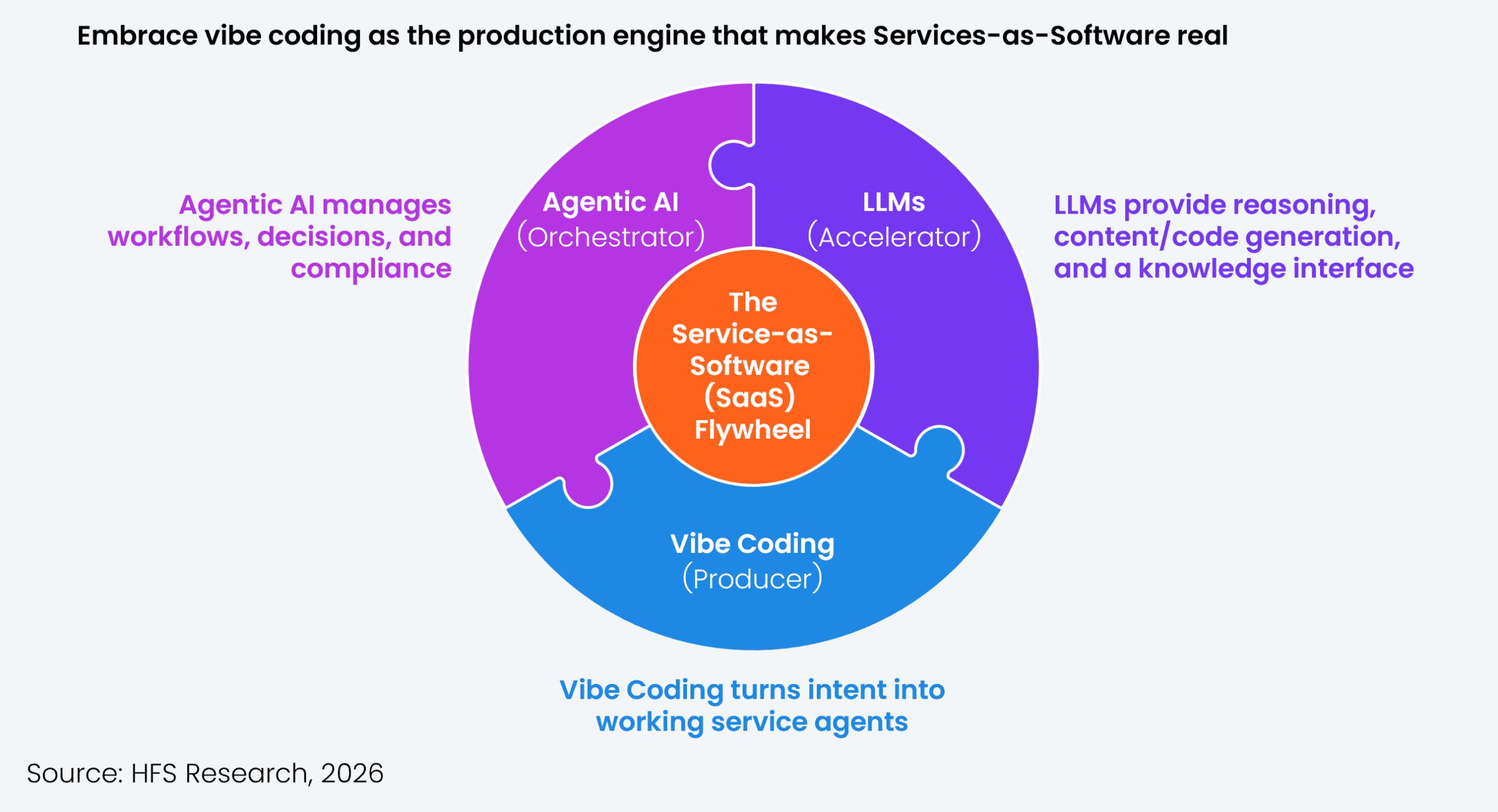
Vibe coding is the production engine to make Services-as-Software real, but firms must address their skills challenge to succeed.
HFS Research has identified vibe coding as the production engine to make Services-as-Software™ real. It has the potential to deliver greater productivity uplift than previous citizen-developer models, but only for organizations that develop AI-native talent and redesign leadership behaviors to enable decentralized innovation.
In partnership with Cognizant, HFS Research hosted a Roundtable in London in late 2025 and unearthed real concerns from enterprise leaders who felt they lacked the right people and skills to scale success with AI. Their feedback shaped the questions for this survey, providing insights from 100 UK&I business and IT leaders to understand the impact vibe coding has and will have, the value to be created, and the barriers we must overcome to succeed.
Executive summary
UK&I firms must embrace new ways of working, underpinned by open and clear governance
HFS Research, in partnership with Cognizant, surveyed 100 business and IT leaders across UK&I to provide these insights:
-
-
Most firms are not culturally and organizationally ready for vibe coding
27% actively don’t feel ready, and the largest group (38%) are still unsure.
-
Digital-savvy grads and early career technologists hold the key
88% of respondents recognize that AI-native talent is critical to unlocking the full potential of vibe coding and to move the needle on their cultural readiness.
-
Cultural drag will hamper adoption
Respondents see no more than 22% of their workforces actively using vibe coding within six months, slowed by risk aversion and lack of talent.
-
Leaders need to set clear rules
The biggest shackles on progress with vibe coding are blockers from legal, security and compliance functions and lack of confidence among teams (49%/43%). Clear, competent, and visible governance must be deployed to break through.
-
Productivity is first
Like so many new technologies, firms are pointing at vibe coding for productivity gains first and foremost. Acceleration is good, but transformation is better. Firms must embrace the latter to create real value.
-
Cursor is king
Despite the rise of Lovable and Replit, Cursor is the current defacto choice among enterprise vibe coding tools.
The Bottom Line: UK&I firms must move faster to take advantage of near-term productivity gains and open their doors to more grads and early career technologists to provide both the capabilities and culture change they need to win with vibe coding.
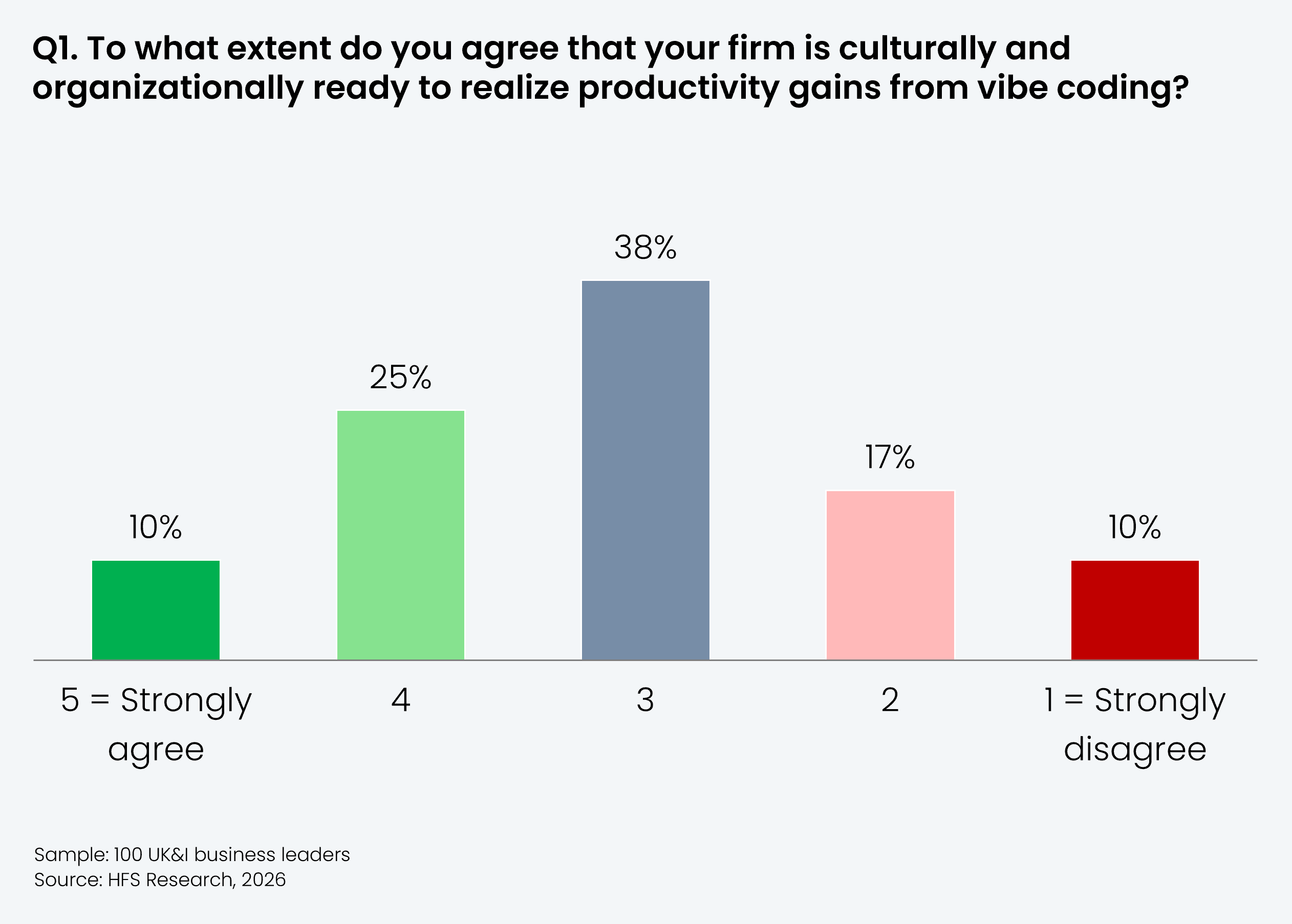
Most firms are not culturally and organizationally ready for vibe coding. We found that 27% actively don’t feel ready and 38% are still unsure.
- We are at the edge of a new culture in which impermanence takes precedence over software as structure: software for the moment and for the need, rather than built for the long run. It’s a lot to take in.
- Nearly 38% of respondents are neutral on their readiness for vibe coding (rating 3 on the 5-point scale), indicating substantial uncertainty about their firm’s cultural and organizational readiness. This is a messaging and awareness problem as much as it is a capability problem.
- With only 35% expressing confidence and 27% indicating they are not ready to realize productivity gains, there remains work to be done to educate firms on the benefits.
- Does vibe coding need to be perfect, future proof, or endlessly maintainable? Rising stars such as Prompt Driven reject such notions, arguing that code is so cheap and fast to build and there is no point in maintaining or fixing creaking code bases when you can just build for your next situational requirement.
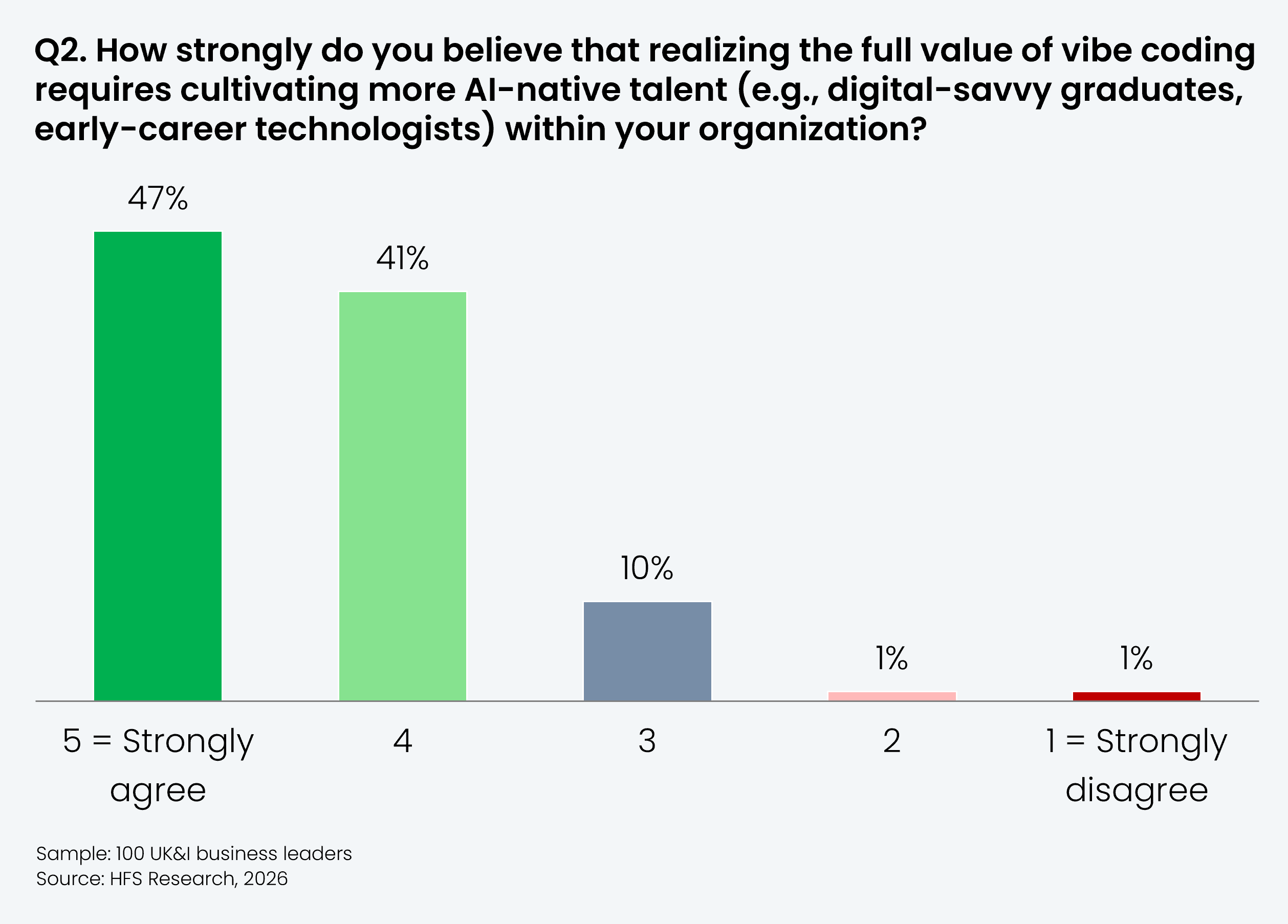
Around 88% of respondents recognize that AI-native talent is critical to unlocking the full potential of vibe coding and moving the needle on their cultural readiness.
- It seems UK&I firms are waking up to the fact that AI-native talent is the first place they should look to solve for the future.
- The year 2025 was tough for grads as less roles were available. Firms put recruitment on pause while they tried to work out the potential impact of AI.
- Our survey suggests that the brakes must be taken off. There is strong agreement that fresh blood is exactly what is needed to shift both the talent and culture needles.
- Around 88% of respondents recognize that AI-native talent is critical to unlocking the full potential of vibe coding, with nearly half (47%) strongly agreeing. Organizations understand they can’t simply retrain legacy teams; they must infuse fresh perspectives by hiring digital natives who instinctively collaborate with AI.
- Traditional software engineering skills are becoming table stakes. Organizations must now compete for a new breed of technologists: those who think in prompts, understand how AI models behave, and can orchestrate human-AI collaboration.
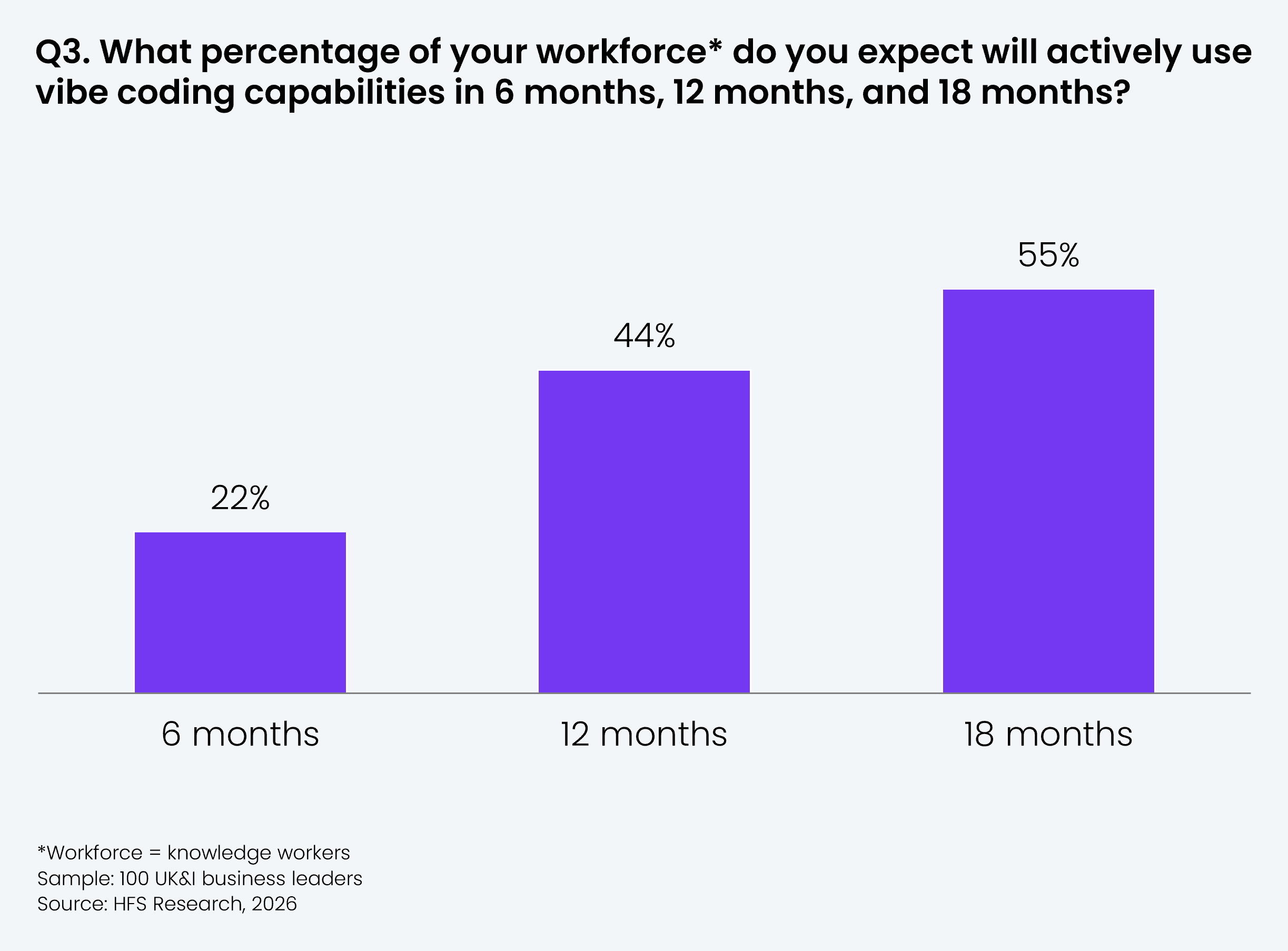
Respondents expect no more than 22% of their workforces to be vibe coding within six months, slowed by risk aversion and lack of talent.
- Cultural blockers and limited skills base, are slowing the adoption of vibe coding in UK&I companies. This can be accelerated by sharing success stories openly and addressing the constraints identified in responses to our fourth question (check next slide).
- Near-term adoption is minimal: Only 22% of the UK&I workforce is expected to actively use vibe coding capabilities within six months, suggesting that implementation will be limited to early adopters or isolated pockets in the organization. Rollout remains limited as firms face significant barriers to rapid adoption.
- Mid-term growth remains modest. By the 12-month mark, adoption is predicted to reach 44%, doubling from the six-month figure but still leaving more than half the workforce without active access.
- The 18-month outlook shows limited majority: Even at 18 months, only 55% of the workforce is projected to use vibe coding actively. The rate of adoption slows.
The biggest shackles on progress are legal, security and compliance functions and lack of confidence (49%/43%). Governance is the answer.
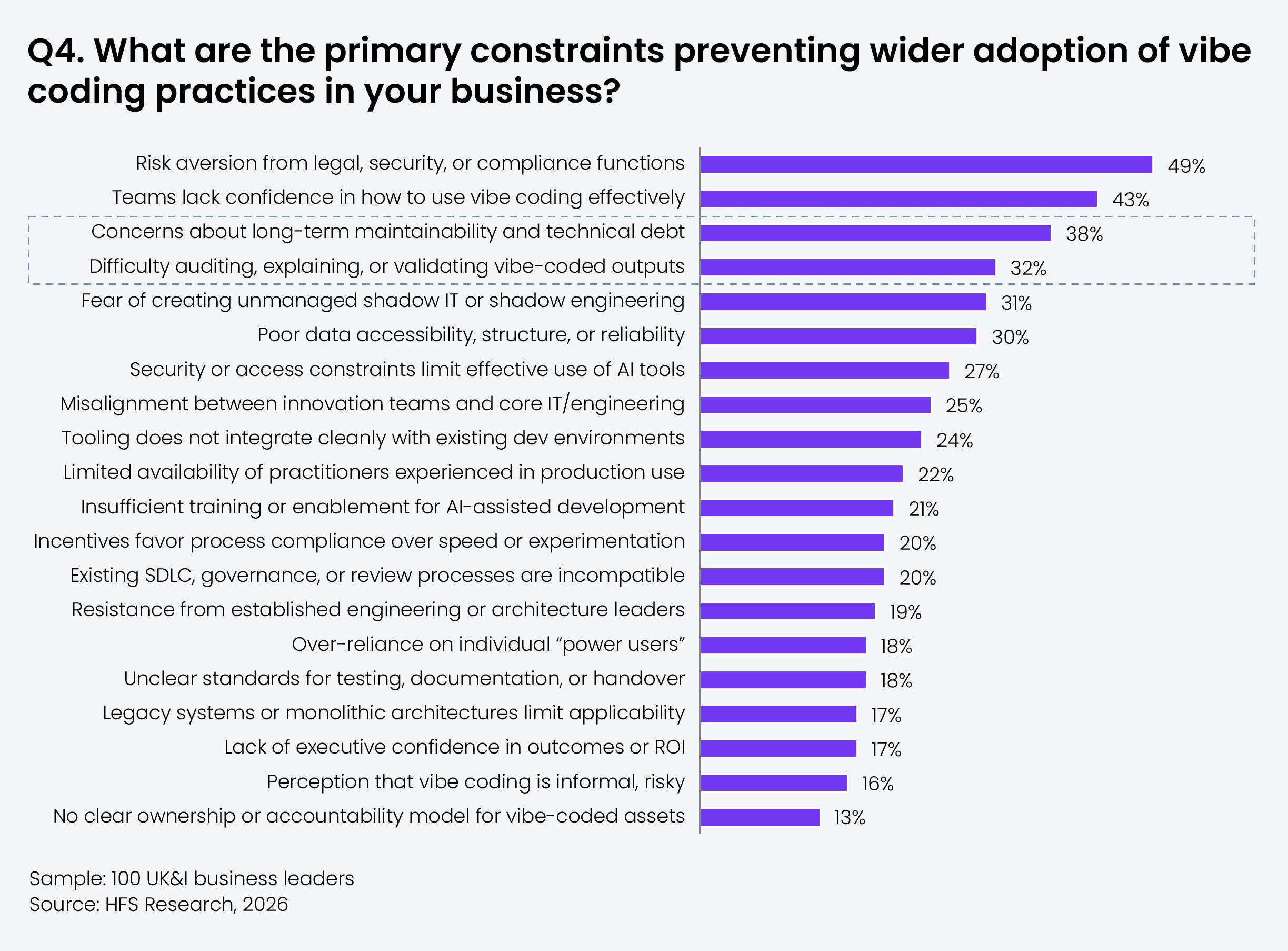
- Nearly half of the survey respondents cited risk aversion from legal, security, and compliance functions as the primary constraint on adopting vibe coding. However, this risk aversion masks a deeper concern: organizations lack relevant governance frameworks that could give them the confidence to make faster progress.
- The 43% capability gap is the second foundational blocker. You can deploy tools, but unless developers understand how to use them safely and effectively, adoption will remain shallow.
- The combined 70% concern about maintainability and auditability suggests most firms will not deploy vibe coding in mission-critical systems without implementing appropriate controls and governance.
While recognizing these concerns, firms must also prepare to adapt how and why they govern to align with the cheap, fast, and disposable benefits of vibe coding.
Like so many new technologies, firms are expecting productivity gains first. Acceleration is good, but transformation is better.
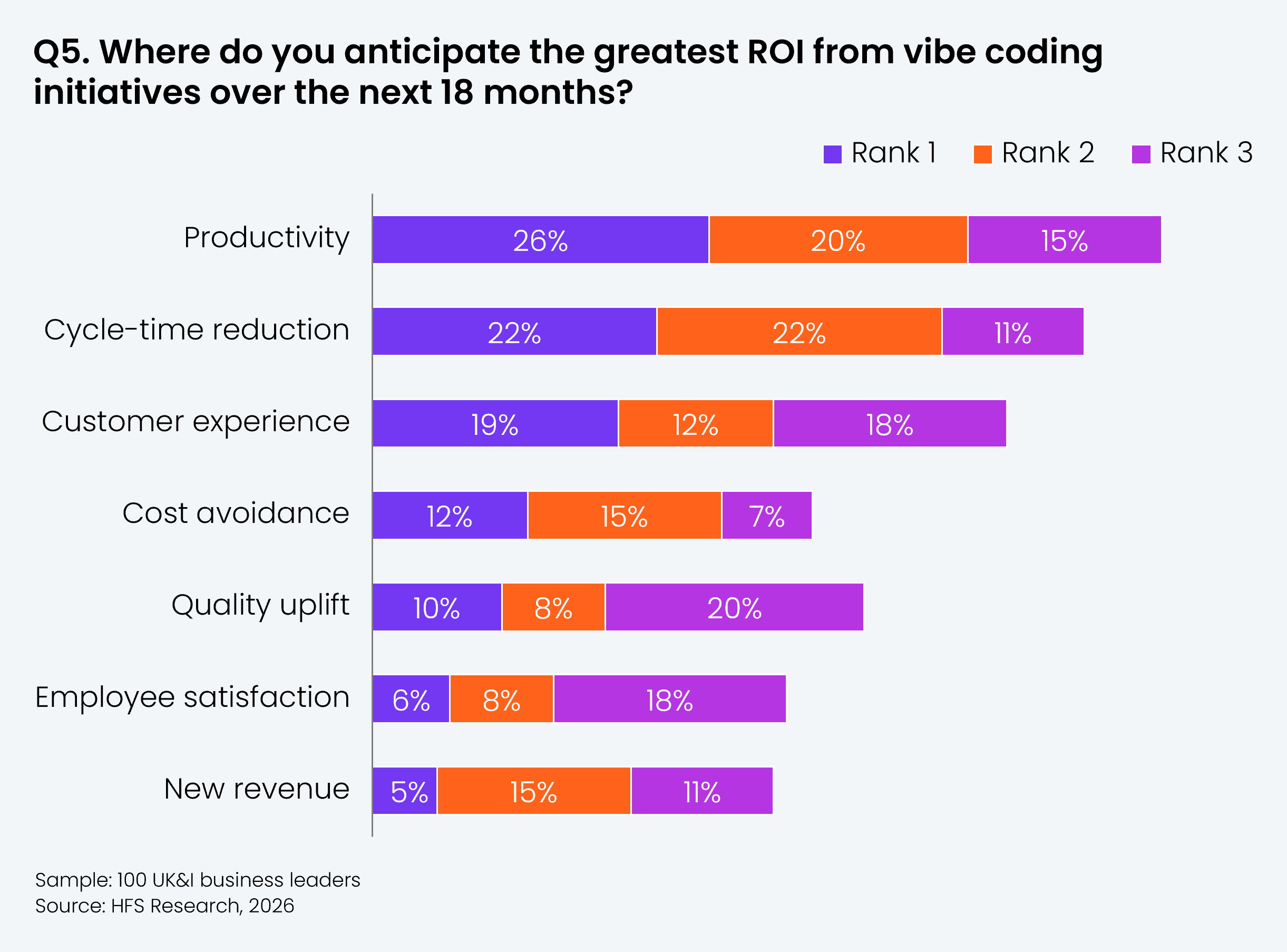
- Enterprises are deploying vibe coding as an acceleration play rather than to reshape outcomes or how they conduct work. The emphasis on doing more and much faster with existing resources suggests a pragmatic, risk-averse adoption pattern. Transformation, innovation, and new business models will follow later.
- Productivity is among the top three ROI priorities for 61% of the respondents, with 26% placing it first. This signals that enterprises see vibe coding primarily as a force multiplier for existing teams.
- Cycle-time reduction featured in the top three for 55%, with 22% ranking it first. Combined with productivity, this paints a clear picture: organizations seek to accelerate delivery rather than transform what they deliver.
- Customer experience follows close behind at 49%, indicating that firms are recognizing the opportunity to shape better customer outcomes.
Despite the rise of Lovable and Replit, Cursor remains the UK&I’s top choice among enterprise vibe coding tools.
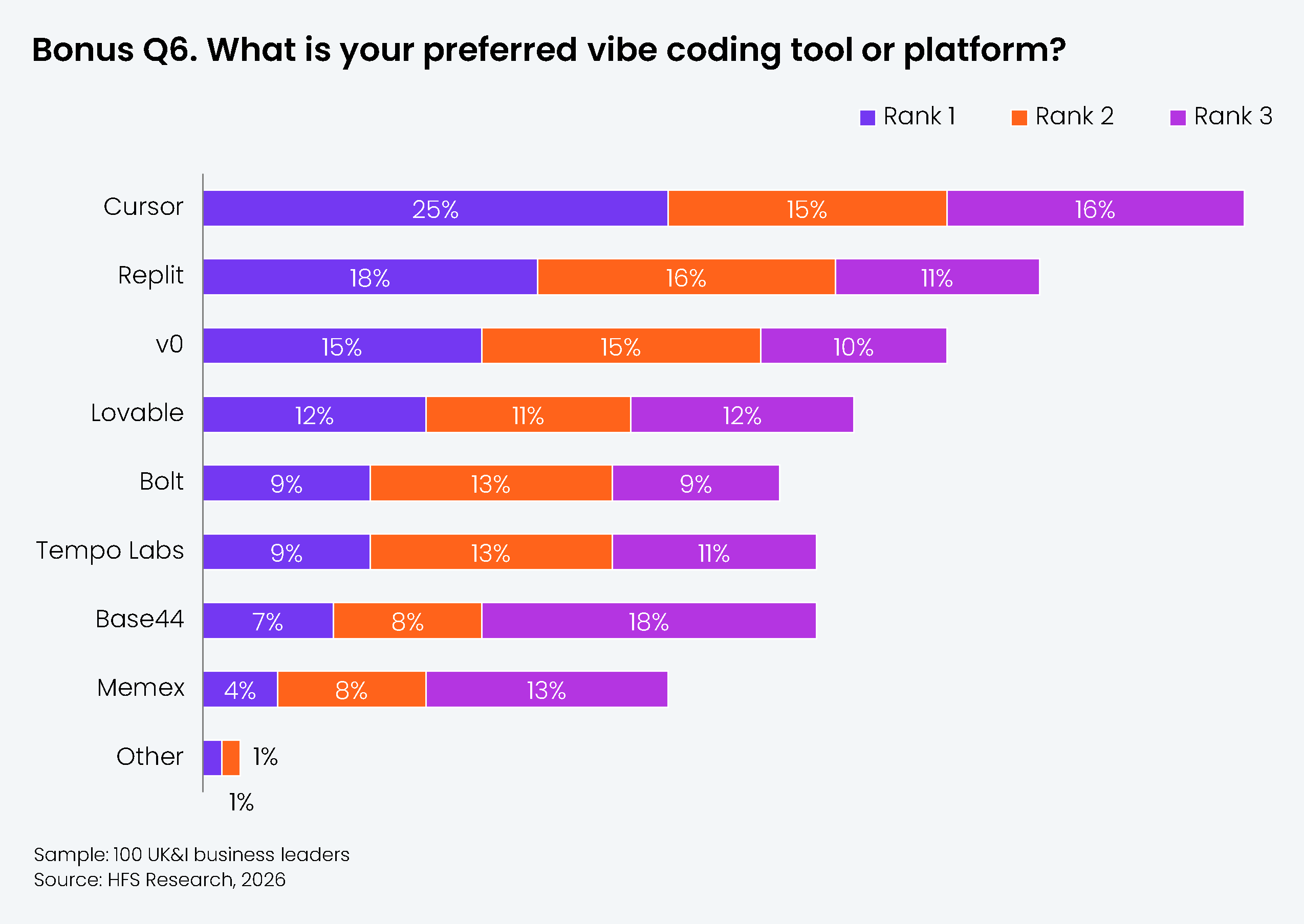
- This is a new market with performance updates landing in rapid iterations. While Cursor leads the way among UK&I enterprises, they should be wary of committing too hard and fast to any particular tool.
- As of January 2026:
- Cursor secures 25% of rank 1 preferences and a combined 56% across the top three rankings giving it a meaningful lead over its nearest rival, Replit, which records 18% in rank 1 and 45% in combined top-three preference.
- The rapidly rising Europe-based Lovable and v0 form a strong second tier, each landing between 35%–40% of the combined top three mentions, suggesting that developers are actively experimenting beyond the two front-runners but have not yet converged on a single alternative.
The Bottom Line: UK&I firms must move faster to take advantage of near-term productivity gains and open their doors to more grads and early-career technologists to provide the capabilities and culture change to win with vibe coding.
“We have long relied on enterprise IT for its solid architecture, rigorous testing, and robust governance. Today, code is increasingly spun up to answer a question, automate a quarterly decision, fill a temporary capability gap, run a quick experiment, or comply with regulatory windows.
Vibe coding meets these demands when paired with clear governance and appropriate controls. It is the production engine that drives your Services-as-Software ambitions. It is not a nice-to-have, but an essential capability. And the fastest way to make this happen is to bring in more grads and early-career technologists who can deliver vibe coding at scale.”


