Agentic AI will revolutionize individual productivity within 18 months, but your enterprise transformation is about to hit a wall. Tools like ChatGPT Agent, Google’s Project Mariner, and Perplexity’s Comet promise AI that can book reservations, manage workflows, and act autonomously. Yet the gap between what works for individuals and what scales across the enterprise is widening fast.
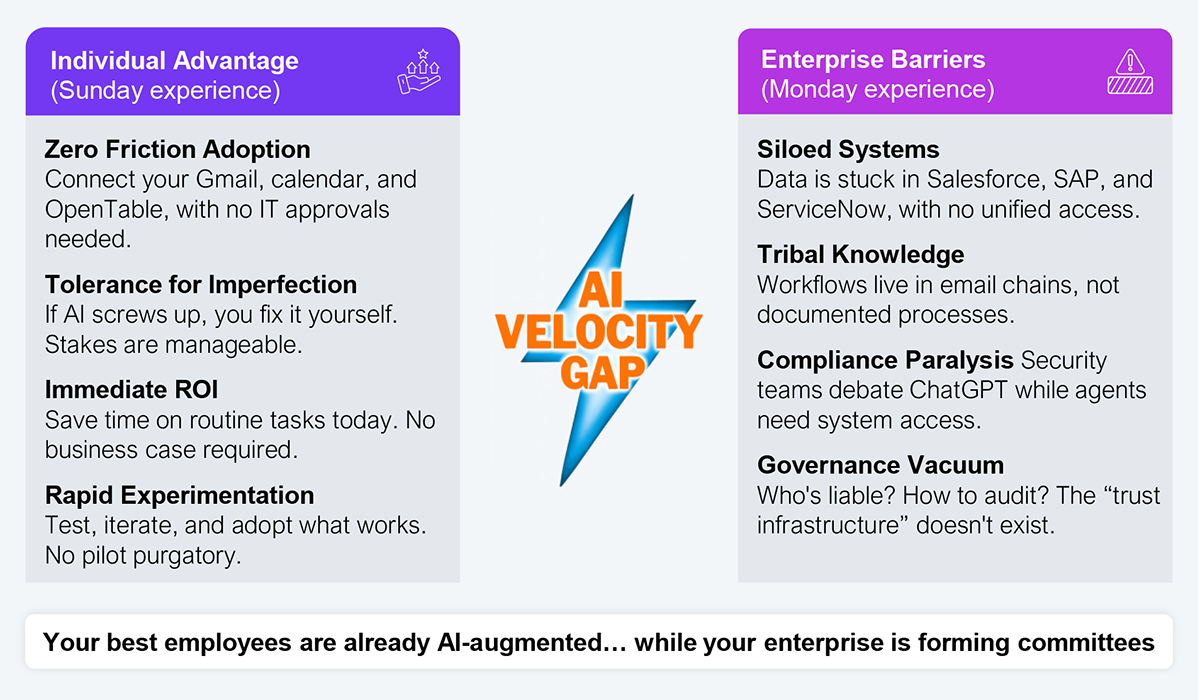
Individuals are racing ahead, seamlessly weaving AI into their daily routines, while enterprises remain bogged down in bureaucracy, silos, and security debates. The result is what we call the “AI Velocity Gap,” a widening divide between AI-empowered employees who move fast and experiment freely while their organizations are still forming committees to decide what’s safe. In this AI-first era, the real productivity revolution is happening at the individual level, not the institutional one, as we highlight in Exhibit 1.
Source: HFS Research, 2026
For knowledge workers, deploying agentic AI is trivial. You connect the agent to your Gmail, calendar, and OpenTable account, and you’re done. If it screws up your dinner reservation, you fix it. If it sends a weird email, you apologize. The experimentation is cheap, the stakes are manageable, and there’s no IT department blocking your access.
This is why productivity-obsessed individuals are already automating routine tasks like booking travel, summarizing documents, and managing follow-ups. The technology doesn’t need to be perfect; it just needs to save more time than it costs. And for workers drowning in administrative overhead, that bar is surprisingly low.
Your best employees are already using these tools. They’re becoming AI-augmented superhumans while your enterprise is still forming committees to discuss governance frameworks.
Deploying agentic AI in an enterprise isn’t a software implementation. It’s a complete business reinvention. There’s an extensive undertaking that requires enterprise leaders to consider the following:
This is admitting the uncomfortable truth: “Everybody is trying to build them, but right now they don’t actually work that well.” Individual users will tolerate imperfection and iterate quickly. Enterprises won’t and can’t.
We’re entering a period in which individual and enterprise productivity diverge sharply. Small teams of AI-literate workers will compete with larger organizations still stuck in pilot purgatory.
AI-augmented individuals will outperform traditional teams. A consultant with agentic AI handling research, scheduling, and follow-ups can serve 3x as many clients as competitors still doing everything manually. They’ll win deals on speed alone. Meanwhile, enterprises will move cautiously while competitors move fast. You’ll run pilots, wait for vendor roadmaps, and debate liability questions while nimbler competitors figure it out through experimentation. By the time you’ve solved governance, the market will have moved.
The reinvention cost is higher than the technology cost. You’re not just buying software. You’re rebuilding workflows, retraining employees, and changing incentive structures that reward being busy rather than being productive. This is a transformation on par with moving from paper to digital or from on-premises to the cloud. It takes years, not quarters.
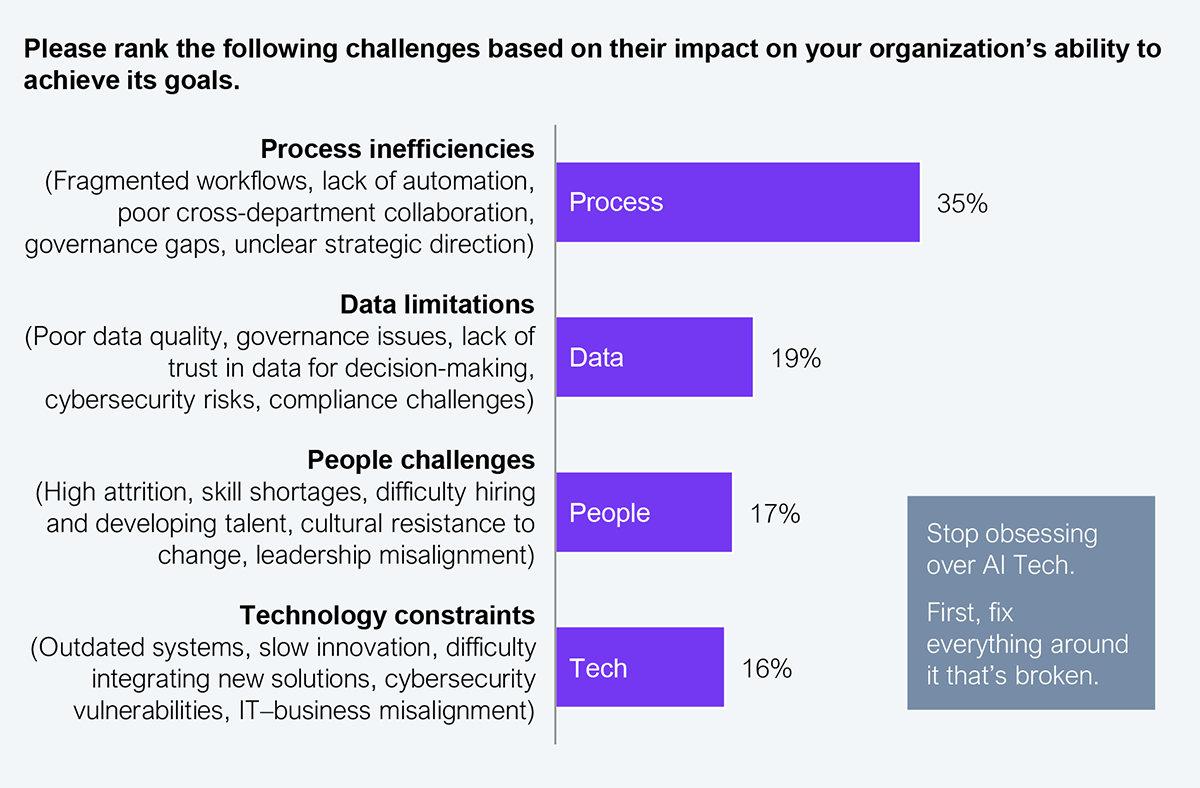
As our recent research across the Global 2000 reveals, the issue with agentic transformation isn’t the tech; it’s the archaic processes that are failing to produce better data to support decision making. It’s also the failure of leadership to train their people to rethink processes and be aware of the real business problems they are trying to solve. While so many stakeholders obsess over technical debt, the real change mandate is to address process, data, and people debt to exploit these wonderful technologies, as shown in Exhibit 2.
Sample: 305 major enterprise decision makers
Source: HFS Research Pulse, 2025
The irony? Enterprises have far more to gain from agentic AI than individuals do. The efficiency gains from automating routine processes at scale could be enormous, but you also have far more to lose if you get it wrong.
Too many enterprises are treating agentic AI as just another technology deployment. In reality, it requires a complete business model transformation, including the following steps:
The agentic AI revolution is real, but it’s going to roll out in two completely different timelines. Individual knowledge workers will see massive productivity gains in the next 12–18 months. Enterprises will spend the next 3–5 years figuring out governance, rebuilding workflows, and managing change.
The winners will be the individuals who adopt early and the enterprises that stop pretending this is another technology project. The losers will be the organizations that form yet another committee while their competitors reinvent their business models to take full advantage of AI.
Your employees are already becoming AI augmented. The question is whether your enterprise is willing to make the changes needed to catch up.
Register now for immediate access of HFS' research, data and forward looking trends.
Get StartedIf you don't have an account, Register here |
Register now for immediate access of HFS' research, data and forward looking trends.
Get Started