
Growth remains tightly coupled with headcount in most enterprises. This results in additional complexity and layers of administrative work, making margins harder to maintain. Line of business (LOB) leaders must respond by aligning their work with the internal Services-as-SoftwareTM journey (see Exhibit 1), while embracing the shift to end-to-end work through technology that agentic AI and the emergence of OpenClaw represent.
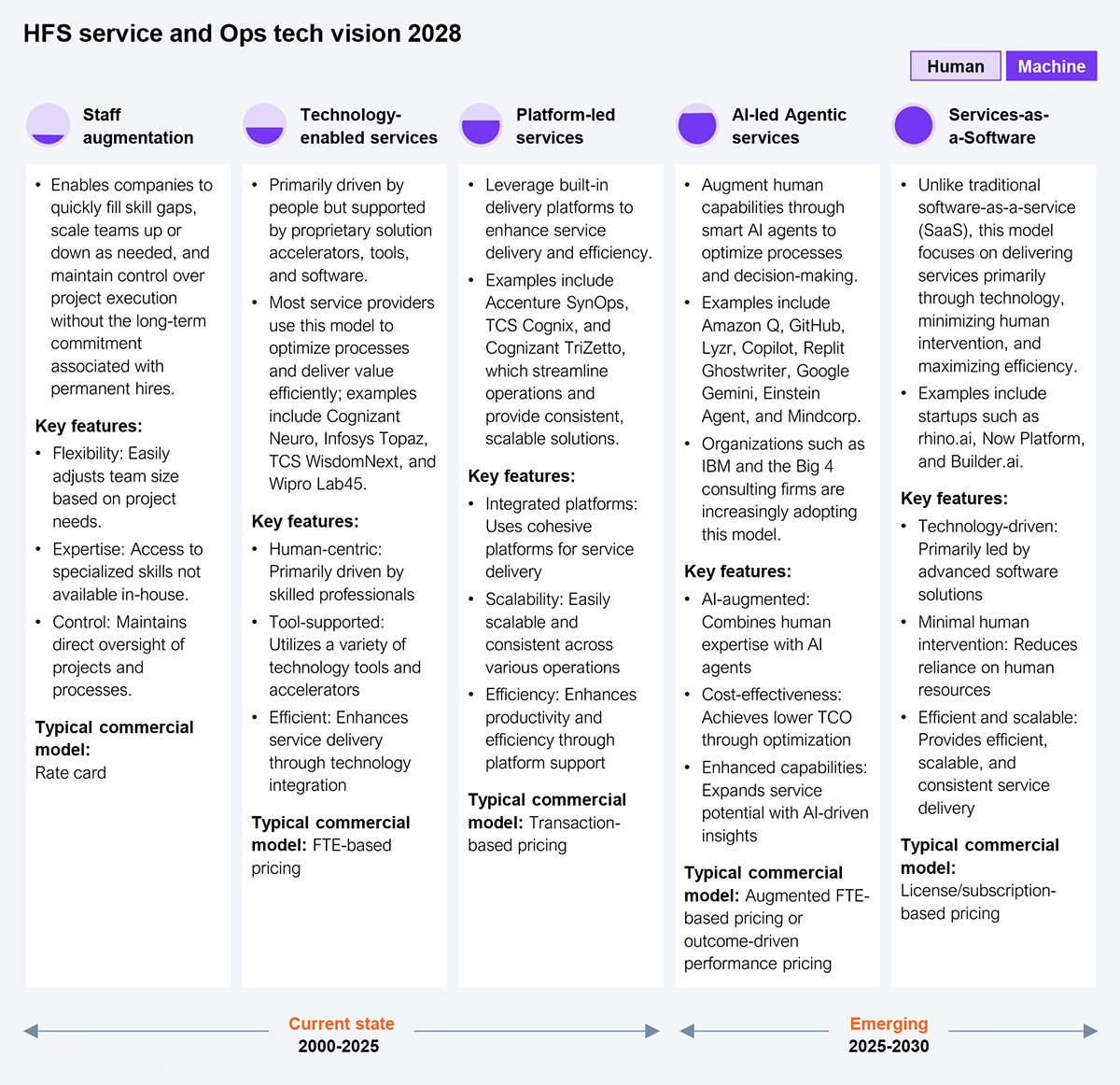
Source: HFS Research, 2026
OpenClaw is taking the AI heartland of the San Francisco Bay Area by storm. It is an open-source, self-hosted, and autonomous AI agent. The first Oakland-Claw community event at STAK Ventures in Oakland revealed the extent of this excitement. Hundreds turned out on a workday afternoon (see Exhibit 2), a sign that something is stirring that enterprises should pay attention to.

Source: HFS Research, 2026
OpenClaw runs on your local machine to manage files, browse the web, and execute tasks via chat apps such as Telegram and Slack. It is proving popular for its high-level automation, persistent memory, and privacy, acting more like a proactive AI employee than a passive chatbot. Such is the intensity of interest, OpenAI has effectively acquired the platform and its founder within weeks of it breaking cover.
This is no finished enterprise platform (though we suspect OpenAI’s acqui-hire will see it honed to play a part in its own recently announced Services-as-Software platform, Frontier). Currently, OpenClaw remains open source, supporting the urgent focus of community response. The Oakland space is dedicated wholly to founders who want to build now with OpenClaw, with live support from venture capitalists and twice-weekly gatherings from now on.
The combination of speed, turn-out, and intensity reveals a community that is not about to wait for market maturity. They are getting on with building, testing, deploying, and commercializing. Enterprises can do this too: start with objectives, define the tasks required to reach those objectives, identify the tools, and then link the agents to do the work.
The room recognized the value of domain expertise, describing it as under-rated by startups. Enterprises understand their own vertical workflows and where administrative overhead and business friction are high. This is where they will likely make operational gains first and fastest, using agents to remove admin, compress cycle times, and raise throughput.
One panel participant moved from sandbox to deploying OpenClaw in a real estate business within a couple of days, saving 275 hours of staff time over the next five days. Such stories should be assumed as anecdotal at this stage.
More important is how seriously this community is taking the challenge of making the tech robust enough for enterprise use. They acknowledge the need for a fuller stack around security, connectors, and clarity and certainty around where memory and data are stored.
While the excitement is justified, enterprises should understand that the operating model is not mature enough to be left to the enthusiasm of early startups. What OpenClaw does harden is the speed, openness, and workflow thinking of agentic AI, which no business leader should play down. It’s wise not to swallow the hype, but it’s also important to match the learning velocity we are witnessing across the Bay Area right now.
Don’t underestimate the speed and scale of the rise of OpenClaw. Read it as a glimpse of how Services-as-Software starts becoming an operational reality sooner than later. Business leaders should test by working with CIO and CTO teams to sandbox for safety. Start with at least one admin and co-ordination heavy workflow. Most people who try OpenClaw are left open-jawed. Get first-hand experience or risk lagging what may prove to be the next “ChatGPT moment.”
Register now for immediate access of HFS' research, data and forward looking trends.
Get StartedIf you don't have an account, Register here |
With the exception of our Horizons reports, most of our research is available for free on our website. Sign up for a free account and start realizing the power of insights now.
Our premium subscription gives enterprise clients access to our complete library of proprietary research, direct access to our industry analysts, and other benefits.
Contact us at [email protected] for more information on premium access.


