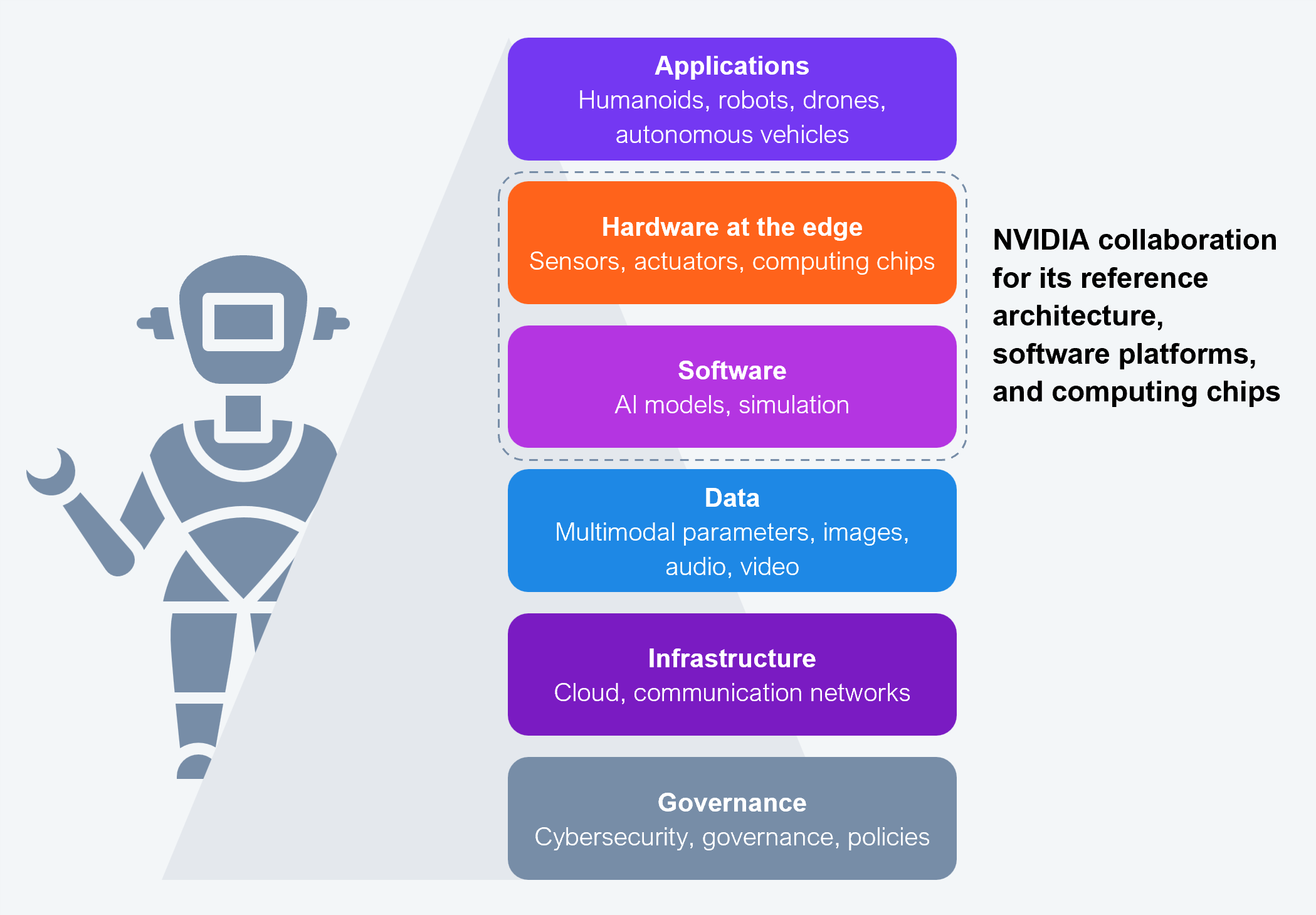
Industrial CIOs can’t scale physical AI on top of a fragmented tech stack due to data issues, legacy systems, tech debt, and talent gaps among other constraints. The priority now is an integrated stack that ties together IT, OT, infrastructure, and models and scales up mission-critical use cases. The Hitachi Hour! analyst event in March aimed to address that, highlighting its partnership with NVIDIA for its reference architecture, software platforms, and computing chips to make the tech stack complete (see Exhibit 1).
At the center of this physical AI strategy is Hitachi’s AI Factory, built to accelerate the development of solutions for industrial transformation and efficiency through a consolidated tech stack, supporting the implementation of advanced AI systems across sectors.
Source: Hitachi DS, HFS Research, 2026
The Hitachi-NVIDIA partnership reinforces that scaling physical AI requires a modular, partner-enabled, well-integrated stack, not discrete pieces stitched together sub-optimally. It is based on NVIDIA’s full-stack AI platform, including its reference architecture powered by GPUs and Omniverse libraries, for simulating physical facilities.
A modular approach gives CIOs more flexibility in make-or-buy decisions, allowing them to choose the best solution for each layer in the tech stack. When such bought-out components are used, it helps mitigate risks such as vendor lock-in through interoperability and cost escalation by leveraging the lessons learnt and best practices from the partner. For CIOs, partnering with specialists in hardware such as GPUs for physical AI enables them to architect modular solutions in a niche area supported by a limited number of experts.
With the hardware part taken care of, the focus should be on building AI models and mission-critical applications such as autonomous factory operations, material handling, and preventive maintenance to ensure efficiency and safety. For Hitachi Digital Services (DS), its parent Hitachi Group serves as “customer zero” to identify physical AI applications and pilot them.
Hitachi has already been deploying physical AI internally for mission-critical applications at the intersection of IT and OT across energy, rail, healthcare, building, finance, and digital industries. Its journey to physical AI has progressed from expert systems and fuzzy logic in the 1980s, to neural networks in the 1990s, and more recently to deep learning, advanced AI, and large language models (LLMs). Hitachi Rail’s digital factory, for instance, delivers railcars through automated quality inspections, backed by robotics and computer vision, along with AI-enabled safety monitoring across production operations.
To build its AI models, Hitachi has been accumulating data across its core industrial units, with foundational knowledge of physics and industrial equipment. These foundation models are the core of physical AI and at the intersection of equipment such as robots and AI to predict and control device movement based on physical constraints and spatial structures.
The physical AI stack is too complex for human consumption and must be integrated with natural language interfaces to translate the data and analytics into human-understandable insights. LLMs and their foundational transformer model (a type of neural network architecture) have made this possible. While LLMs and GenAI can generate textual, audio, and visual data, they can’t touch, see, hear, or sense movement, which are increasingly becoming central to industrial AI. Physical AI gives LLMs those capabilities but can also amplify errors. This makes it essential for CIOS to have strong guardrails in place through control technology and reliability concepts to ensure safe operations.
Physical AI is forcing the long-overdue convergence of IT, OT, and AI governance. Treating it as just another GenAI initiative will only lead to scale, cost, and interoperability challenges across the enterprise, making the state of the tech stack a critical issue. The need of the hour is to evaluate tech stacks, identify weak links, and sign up with partners to fill that gap. Enterprises that architect a consolidated, modular stack and choose ecosystem partners carefully will redefine industrial performance.
Register now for immediate access of HFS' research, data and forward looking trends.
Get StartedIf you don't have an account, Register here |
With the exception of our Horizons reports, most of our research is available for free on our website. Sign up for a free account and start realizing the power of insights now.
Our premium subscription gives enterprise clients access to our complete library of proprietary research, direct access to our industry analysts, and other benefits.
Contact us at [email protected] for more information on premium access.