
This HFS Market Impact Report, produced in partnership with Altimetrik, is for CIOs, COOs, chief AI officers, and enterprise transformation leaders who need to understand why AI deployment has outrun human control and what it takes to close that gap.
AI is already making decisions in your organization. You just haven’t decided who owns them yet.
Most enterprises have responded to this reality the same way: put a human in the loop and call it governance. It is not governance, but a feeling of governance. And the gap between the two is where accountability goes to die.
Being in the loop means reviewing outputs. Being at the helm means owning what the machine decides, defining when humans override it, and being able to answer, before something goes wrong and not after, who is accountable. That distinction sounds simple. Closing that gap is one of the hardest challenges enterprises face today, and the cost of delay is compounding.
This is a last-mile problem. Enterprises have deployed AI, but have not designed the human authority, capability, and accountability needed to govern it.
HFS Research partnered with Altimetrik to survey 505 senior executives across Global 2000 organizations to understand how AI decisions are made, who owns the outcomes, how confident workforces are, and how accountability travels across partners and platforms.
What we found is a consistent pattern of breakdown across five dimensions:


Humans at the helm is not a cultural slogan. It is an operating shift. It starts the moment leadership stops asking how fast we can scale AI and starts asking whether authority has been redesigned before autonomy is extended.
AI is everywhere. Enterprise autonomy is not.
AI is moving into enterprises faster than the institutions meant to guide it. Models are improving rapidly, organizations are embedding AI into everyday workflows, and leaders are under pressure to deploy these capabilities quickly. Yet the human systems surrounding this technology, leadership structures, governance frameworks, workforce capability, and decision authority, are evolving far more slowly.
This imbalance creates what we call the AI velocity gap. It is the widening distance between how quickly enterprises deploy intelligent systems and how slowly they redesign the human systems required to govern them.
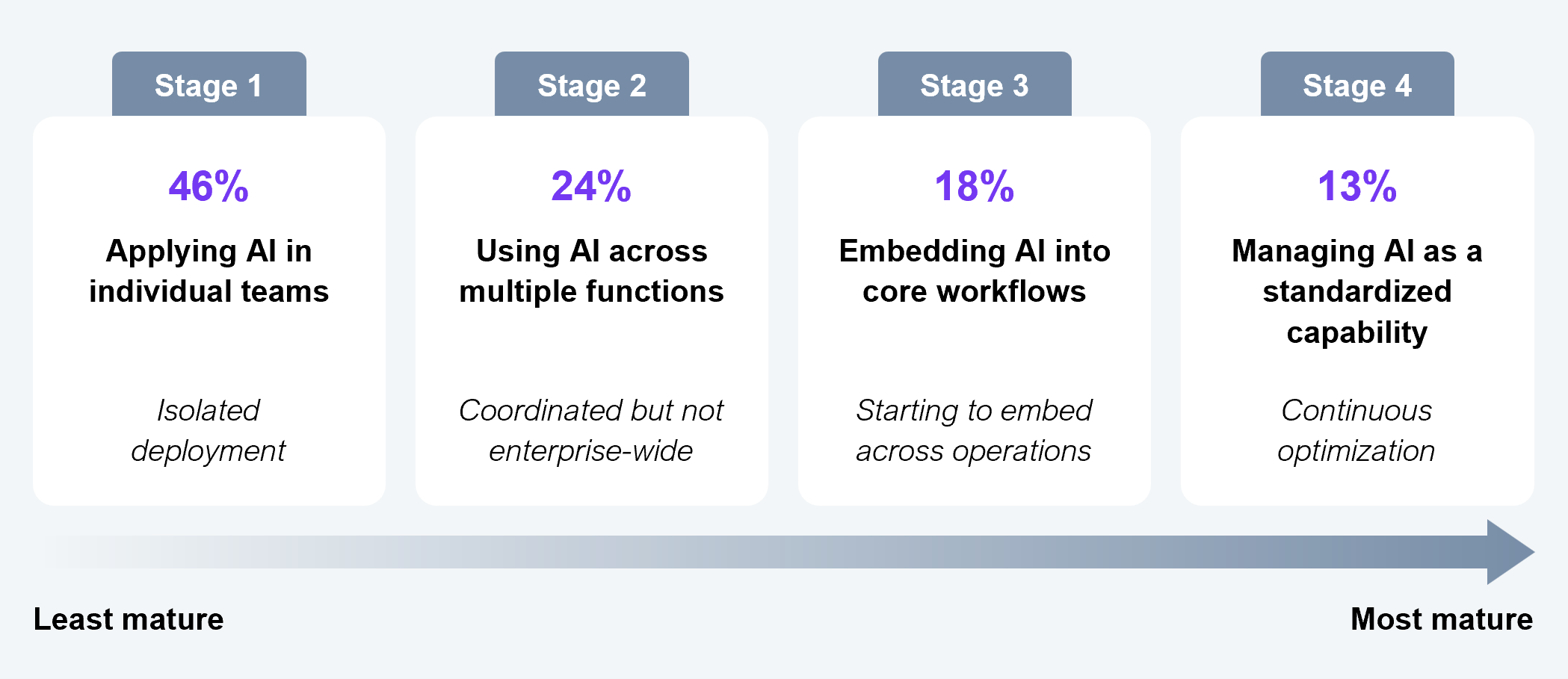
Nearly half of organizations (46%) are applying AI to defined tasks or individual workflows. But activity is not maturity. Institutionalization, the point at which AI becomes a standardized, continuously optimized capability rather than a collection of team-level experiments, remains uncommon. Only 13% of enterprises have reached it.
Sample: 505 executives across Global 2000 enterprises
Source: HFS Research, 2026
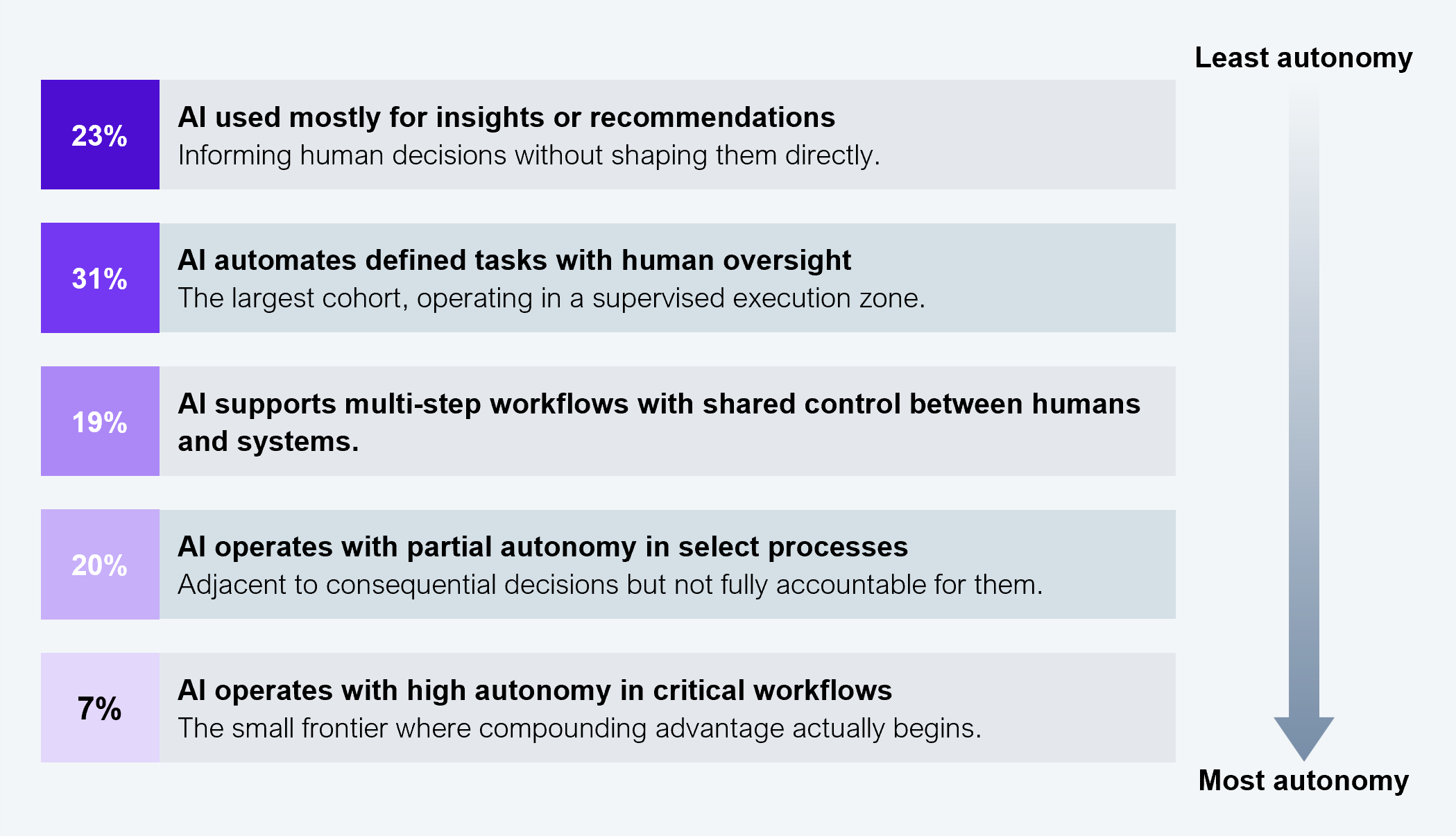
At the same time, most AI still operates in a supervised execution zone. Enterprises are automating predefined tasks or generating recommendations for human review but rarely extending AI into workflows where it holds meaningful authority. Only 7% operate with high autonomy in critical workflows, the small frontier where compounding advantage begins and where the design of human authority matters most. (See Exhibit 2)
Sample: 505 executives across Global 2000 enterprises
Source: HFS Research, 2026
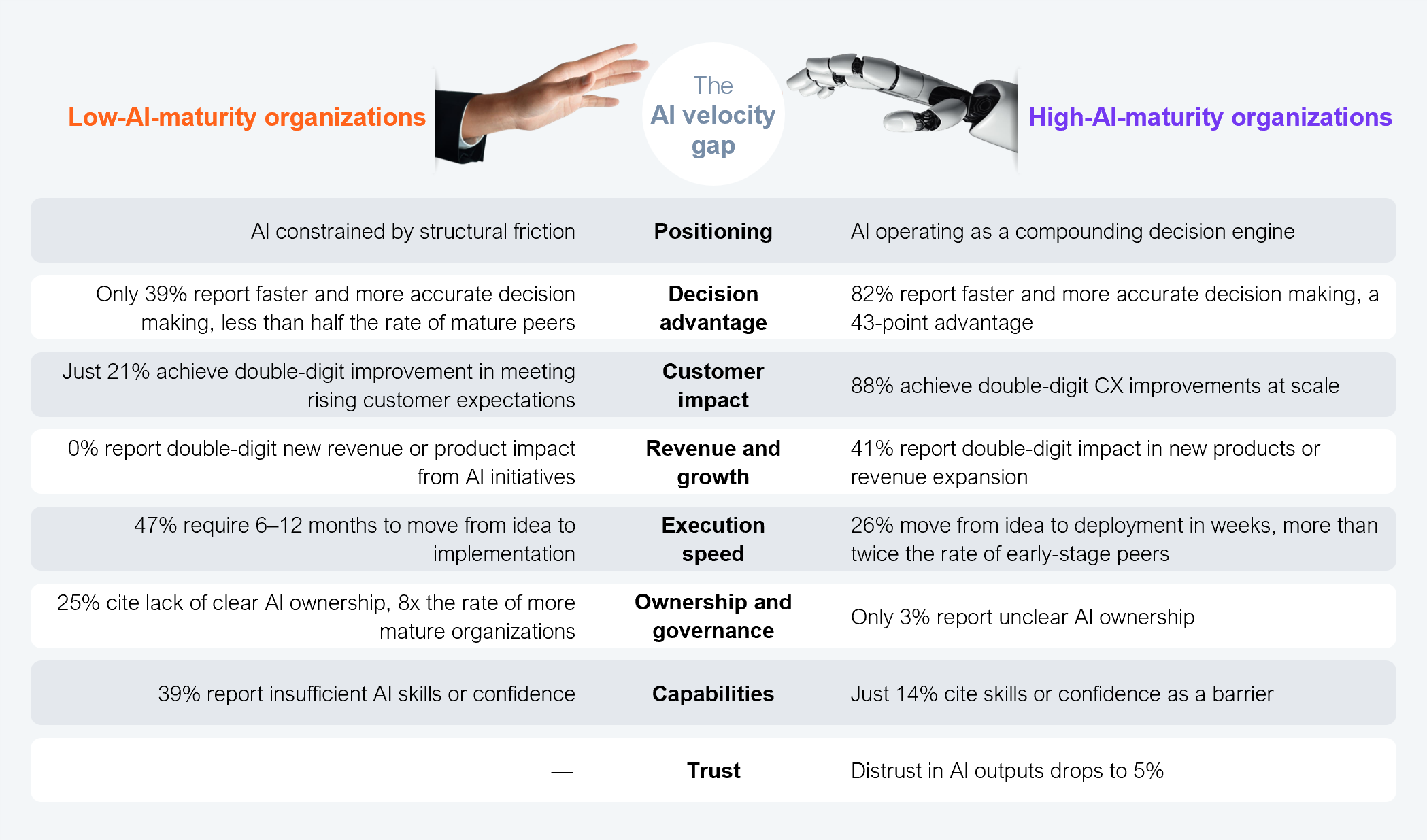
The organizations that have closed that gap are more than twice as likely to report faster, more accurate decision making, and are dramatically more likely to deliver measurable customer and revenue impact. The performance difference is not marginal. It is compounding in one direction. (See Exhibit 3)
The velocity gap persists not because enterprises lack ambition or good models. It persists because the human systems required to govern AI have not kept pace. Leadership has not declared where AI is going. Authority over what it decides has not been documented. Workforces lack the confidence and capability to challenge it, and accountability dissolves the moment it crosses an organizational boundary.
The organizations that have closed the gap did not do it by deploying better models. They did it by answering a question most enterprises have never formally asked: What does the human at the helm of this system actually have the authority, visibility, and accountability to do? That is the question this report is built around. The sections that follow examine why most enterprises cannot answer it, and what it takes to change that.
Sample: 505 executives across Global 2000 enterprises
Source: HFS Research, 2026
The bridge forward
Humans at the helm is the answer to the velocity gap—not as a constraint on AI, but as the design that makes AI authority governable, defensible, and compounding in the right direction.
Strategy is absent, ownership is misplaced, and accountability appears only when something goes wrong.
Enterprises are not failing to adopt AI. They are failing to lead it. The tools are deployed, and the budgets are committed. What is missing is a declared destination, documented decision rights, and accountability structures that follow outcomes rather than org charts. Until those exist, the helm is empty, not because leadership has abdicated but because no one has been asked to sit in it.
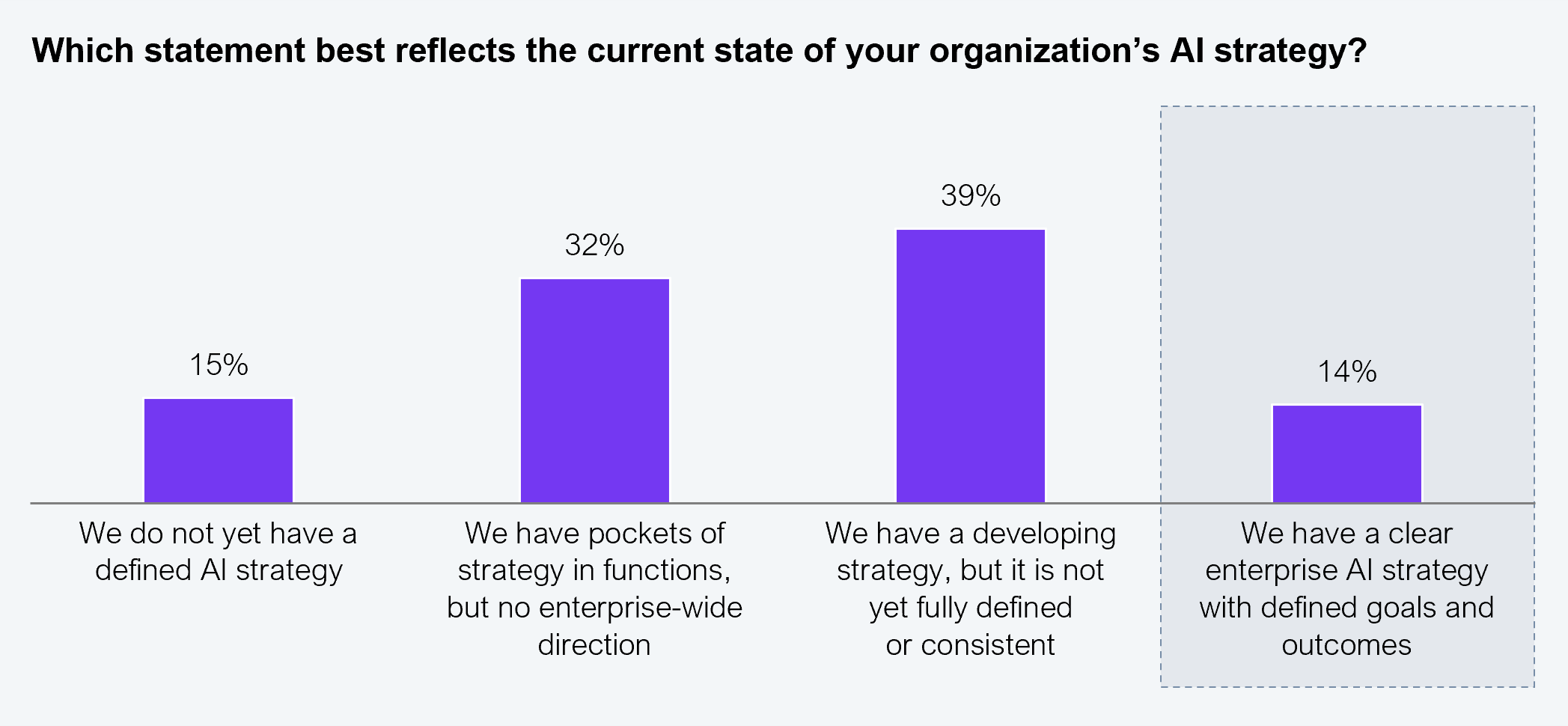
Most enterprises are not executing a strategy. They are managing a portfolio of experiments that has been left to find its own direction. Most are still developing a strategy (39%) or operating in disconnected pockets (32%). Without a declared destination, AI keeps moving while leadership debt compounds quietly behind it. (See Exhibit 4)
Sample: 505 executives across Global 2000 enterprises
Source: HFS Research, 2026
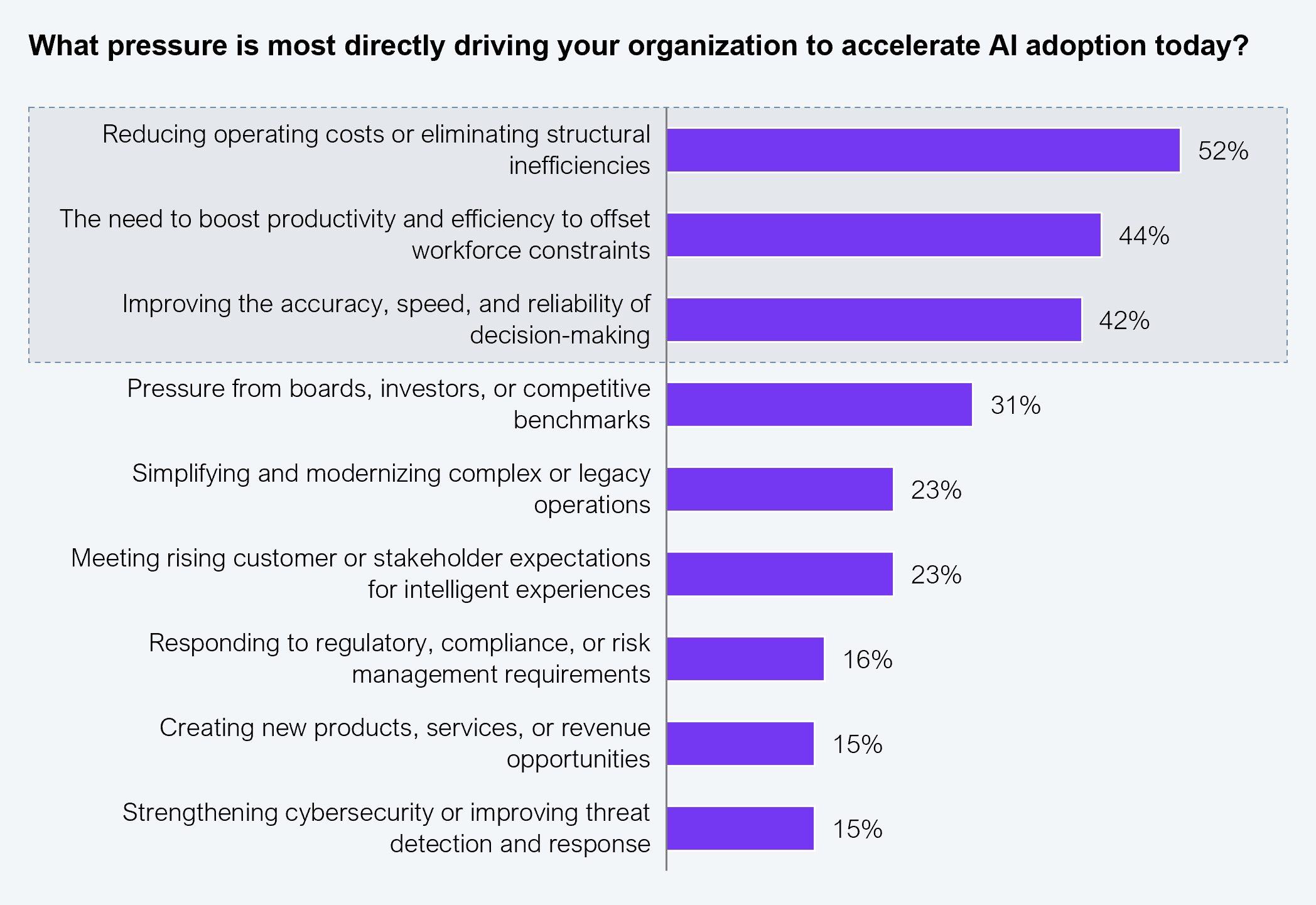
In the absence of strategic direction, AI gets justified through the safest available narrative. Cost reduction is the top driver for 52% of organizations. Revenue impact still lags far behind at 15%. Cost reduction requires no vision, no ownership model, and no declared direction. It survives every board presentation precisely because it commits to nothing. (See Exhibit 5)
Consider a global manufacturer that deployed AI across procurement and back-office operations with a single mandate: reduce costs. It did. Eighteen months later, leadership wanted to use the same infrastructure to build new revenue streams. They could not. The systems had been optimized purely around elimination. Nobody had decided what the enterprise wanted AI to help it become, and by the time anyone asked, the architecture had already answered.
Sample: 505 executives across Global 2000 enterprises
Source: HFS Research, 2026
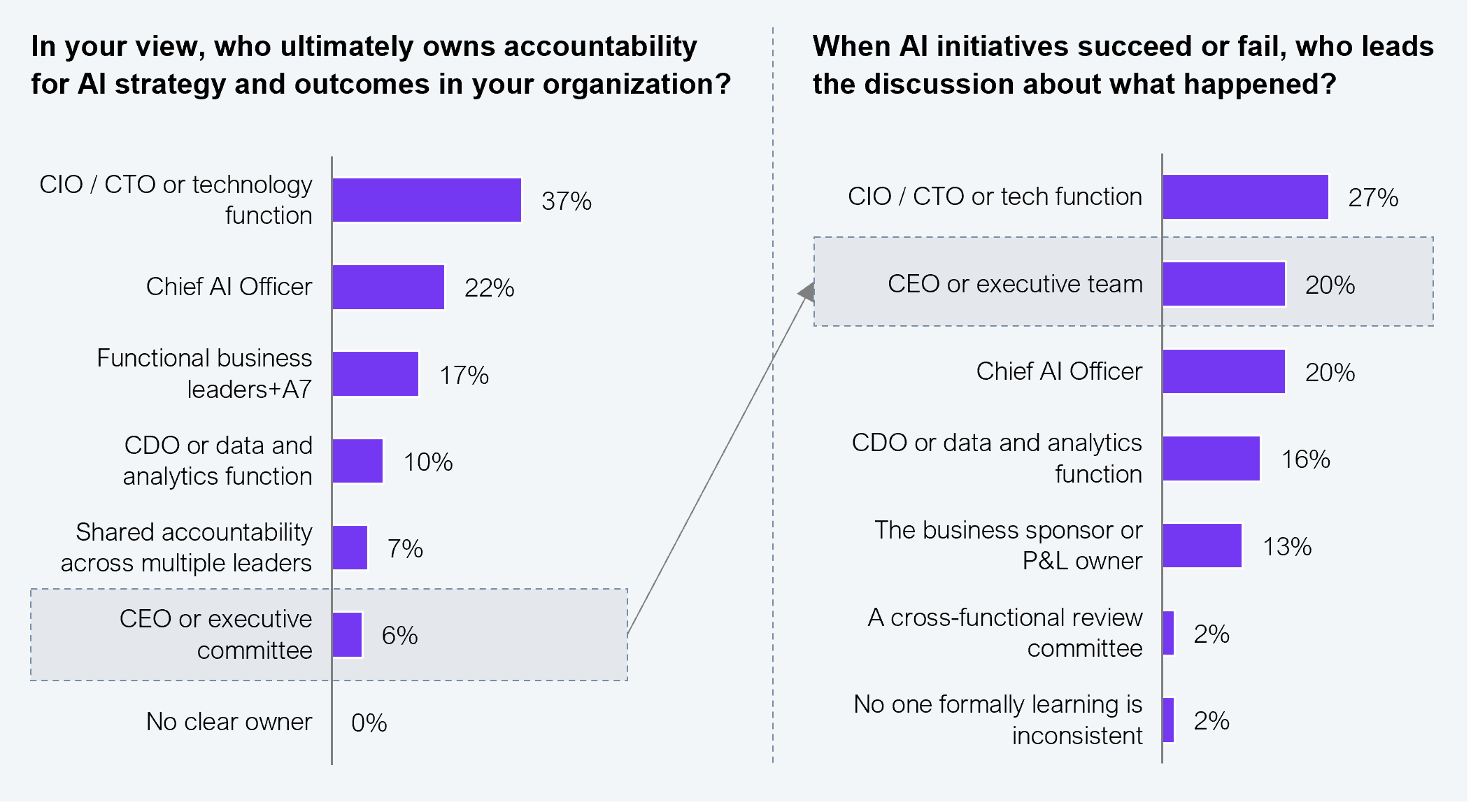
AI accountability rests with the CIO, CTO, or technology function in 37% of organizations day to day. The CEO owns it in 6%. But when AI initiatives fail, CEO or executive team involvement in the accountability conversation more than triples, rising to 20%. (See Exhibit 6)
When the people responsible for AI performance are not the same people responsible for business performance, the lessons from AI results accumulate in the wrong place. Technology teams learn what broke. Business leaders learn that something went wrong. The accountability loop is not closed. It is triggered by failure and then reset.
For the CIO or CTO, the exposure is specific. You are accountable for deployment, for cost, and for the post-incident conversation, but not for the strategic decisions that would have prevented the failure. That is not a technology problem. It is an authority design problem, and it requires a business leadership response.
Sample: 505 executives across Global 2000 enterprises
Source: HFS Research, 2026
The bridge forward
Putting humans at the helm begins here. Not with tools, training, or governance frameworks. It begins with the deliberate acts of naming a destination, documenting who decides what, and building an accountability structure that follows outcomes rather than org charts.
When conflict happens, no one knows who wins. When an override is needed, no one can see what to override.
Most enterprises believe they have solved the AI governance problem. Ask how they maintain control over AI systems, and the answer is consistent: humans are in the loop. Someone reviews the output before it becomes a decision. Someone can step in if something looks wrong. The loop exists. Therefore, governance exists.
The data reveals that the loop is largely hollow.
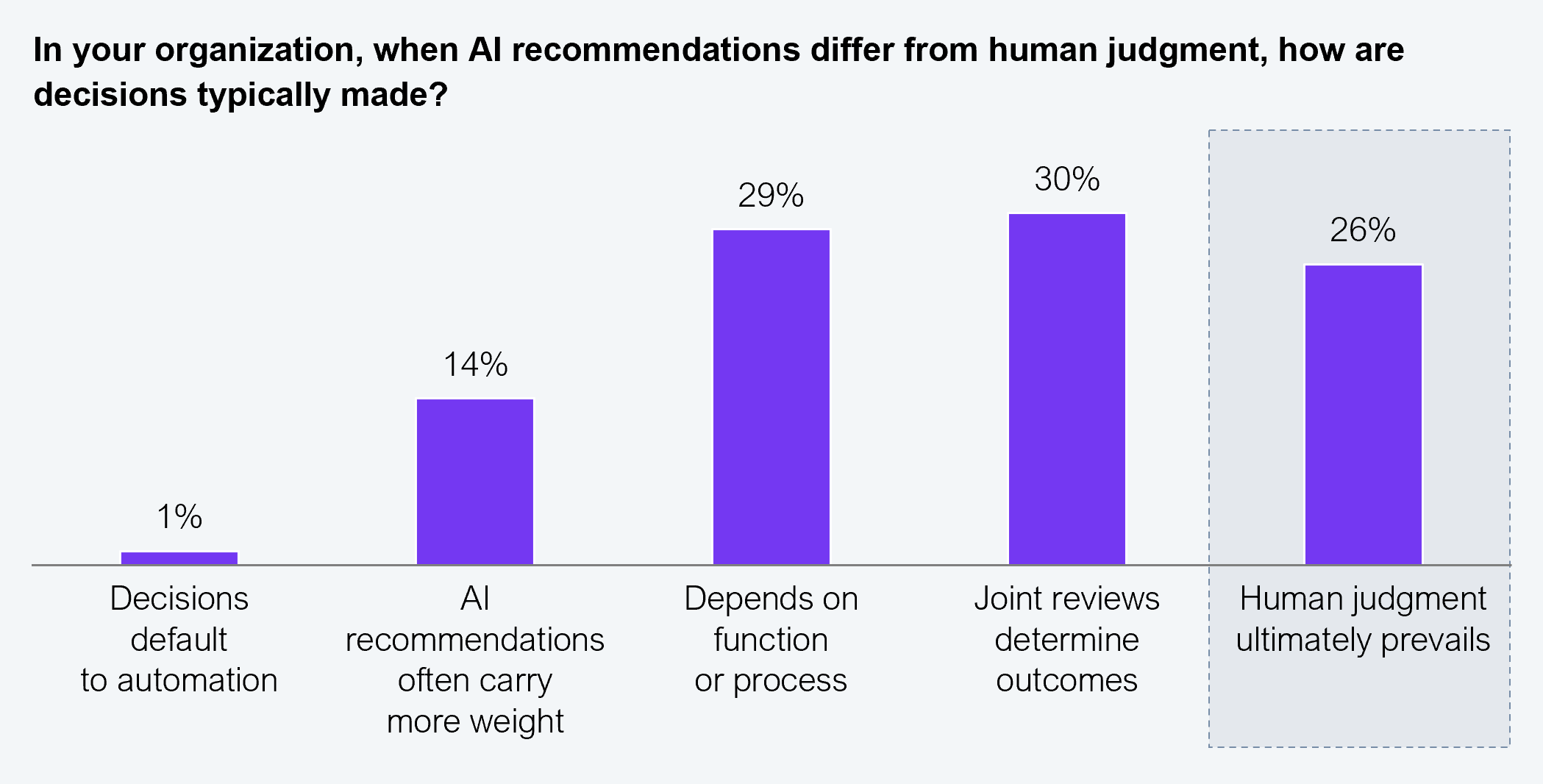
Start with the most basic test of human authority: what happens when AI and human judgment conflict? If humans are genuinely at the helm, the answer should be straightforward. It is not. Only 26% say human judgment clearly prevails in those moments. Thirty percent (30%) resolve the conflict through joint reviews. Twenty-nine percent (29%) say the outcome varies by function or process. Fourteen percent (14%) say AI recommendations often carry more weight. For three in four enterprises, the question of who wins when AI and humans disagree has no documented answer. It depends on who is in the room. (See Exhibit 7)
That is not a governance system. It is a negotiation with no rules, repeated across thousands of decisions, with no consistent principle determining the outcome.
Sample: 505 executives across Global 2000 enterprises
Source: HFS Research, 2026
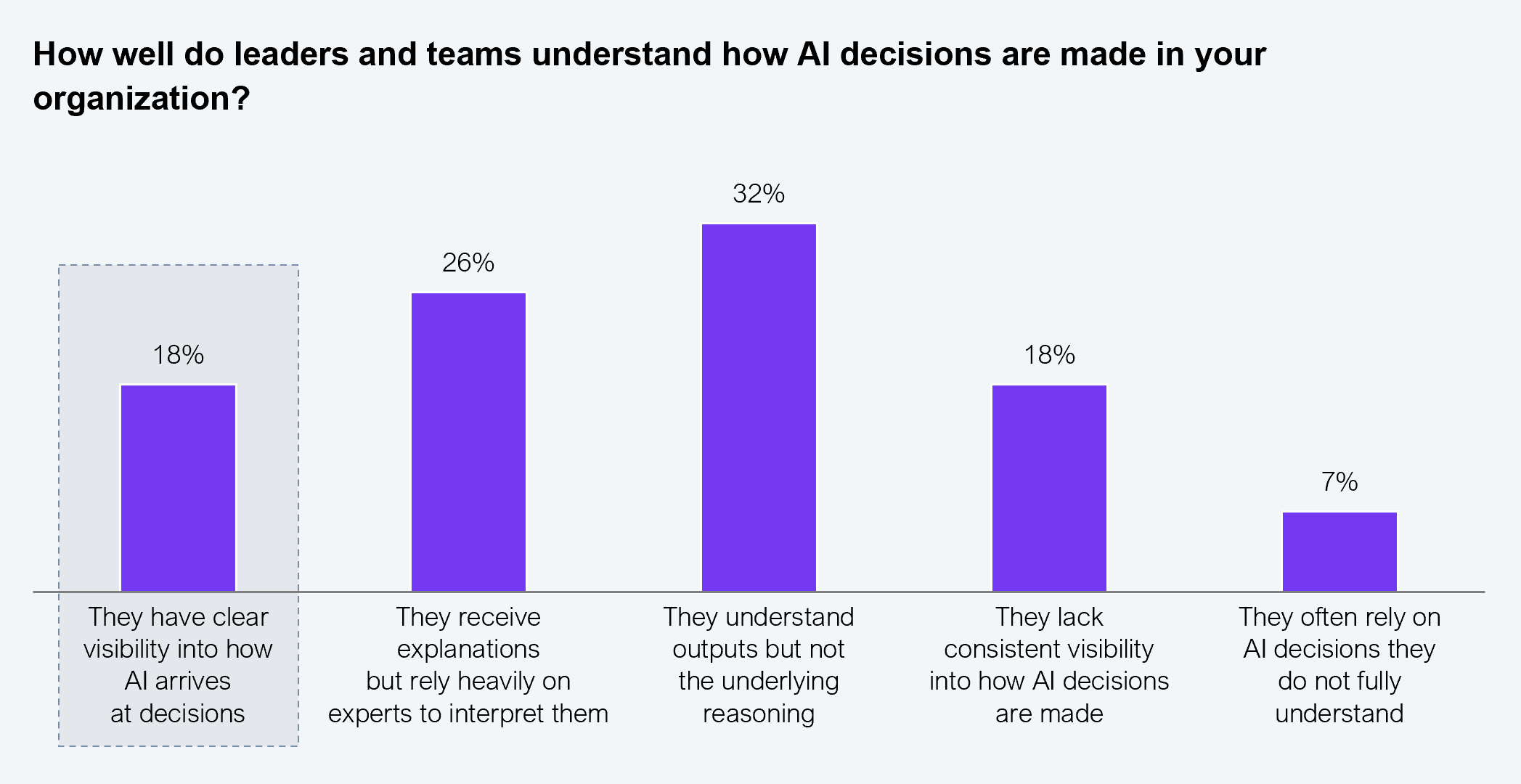
Now test the second assumption: that the humans reviewing AI outputs can see what they are reviewing. Only 18% of organizations have clear visibility into both what AI recommends and the reasoning behind it. Thirty-two percent (32%) understand the outputs but not the underlying logic. Seven percent (7%) say their teams rely on AI decisions they do not fully understand. The remaining majority sit somewhere in between, approving things they can describe but not explain. (See Exhibit 8)
An approval you cannot justify is not a governance act. It is a signature on something you cannot read. And if something goes wrong, the human who approved it becomes the accountability surface for a decision they were never actually equipped to make.
Sample: 505 executives across Global 2000 enterprises
Source: HFS Research, 2026
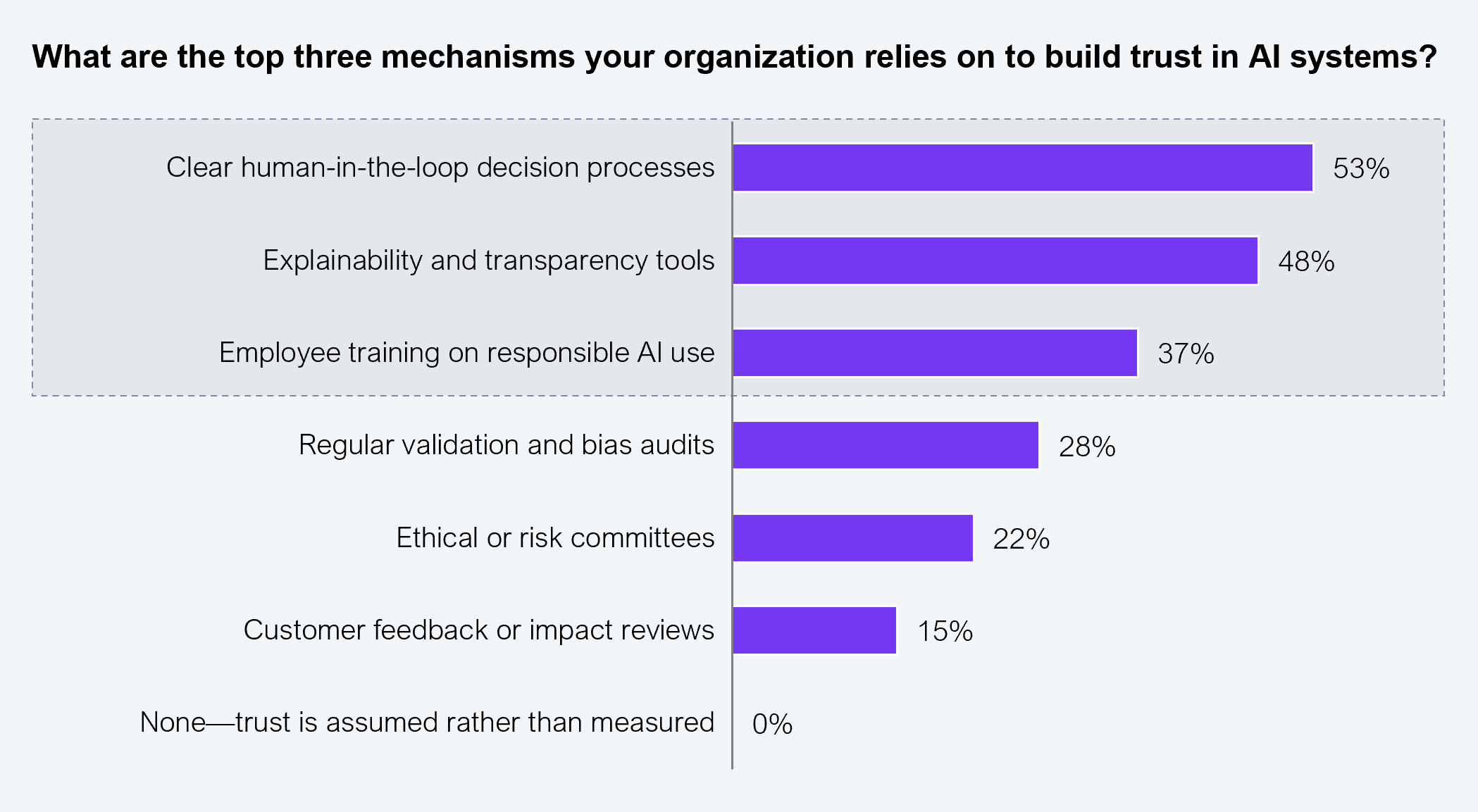
Fifty-three percent (53%) of enterprises name human-in-the-loop processes as their primary mechanism for building trust in AI, ranking ahead of explainability tools, bias audits, and training programs. But the humans in that loop cannot define when their judgment prevails, and most cannot see into the reasoning behind what they are approving. The governance mechanism enterprises depend on most is the one they have invested in least. (See Exhibit 9)
Enterprises have not failed to put humans in the loop. They have failed to make the loop mean anything.
Sample: 505 executives across Global 2000 enterprises
Source: HFS Research, 2026
The bridge forward
The question is not whether humans should be in the loop. It is whether the humans in the loop have been given the authority, visibility, and architecture to do anything meaningful with that position.
Enterprises expect humans to govern AI they are not equipped to use. Fear, not capability, is the primary brake.
Governance requires people who can interrogate AI, challenge it, and override it when it is wrong. Most enterprises have built the conditions that make all three of those things professionally risky. Not by design. By default.
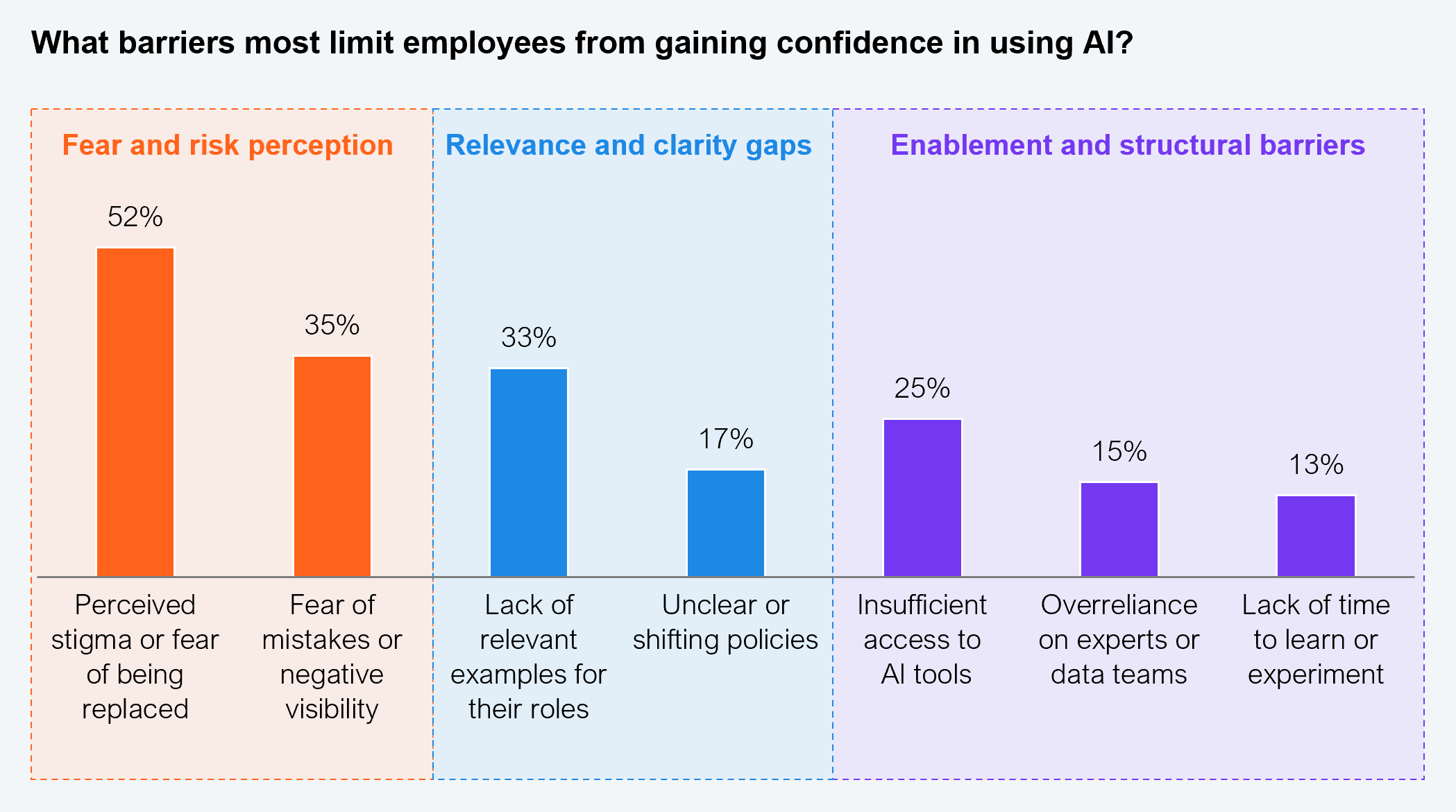
Ask employees what is stopping them from engaging critically with AI, and the answer is not tools, time, or access. It is fear. Fifty-two percent (52%) cite perceived stigma or fear of being replaced as their biggest barrier. Thirty-five percent (35%) fear making mistakes or attracting negative visibility. The barriers that rank last are the practical ones that enterprises are most likely to solve.
Sample: 505 executives across Global 2000 enterprises
Source: HFS Research, 2026
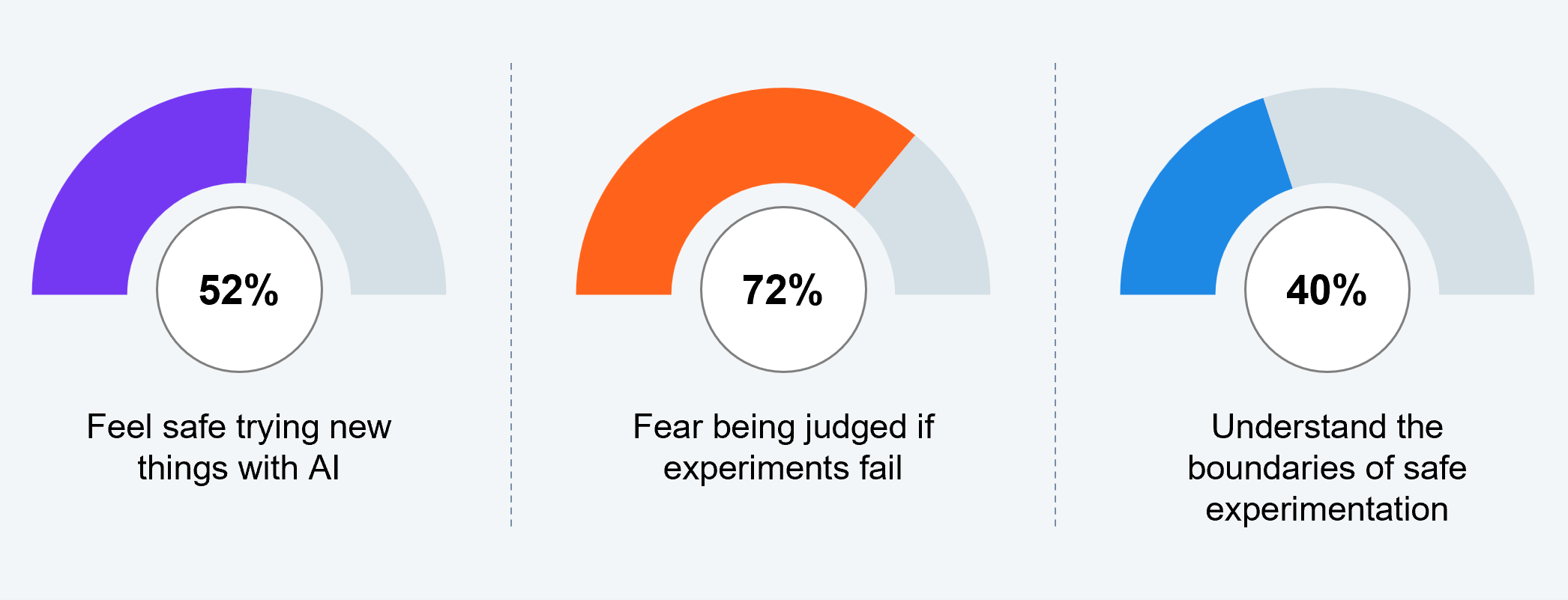
A slim majority of employees feel safe trying new things with AI (52%). But 72% fear being judged if those experiments fail. Only 40% say they understand the boundaries of safe experimentation.
Employees who are afraid of being judged for getting it wrong will not experiment. Employees who do not experiment will not develop judgment. And enterprises that penalize the visible cost of failure are not building a workforce capable of governing AI. They are building one capable of complying with it.
Sample: 505 executives across Global 2000 enterprises
Source: HFS Research, 2026
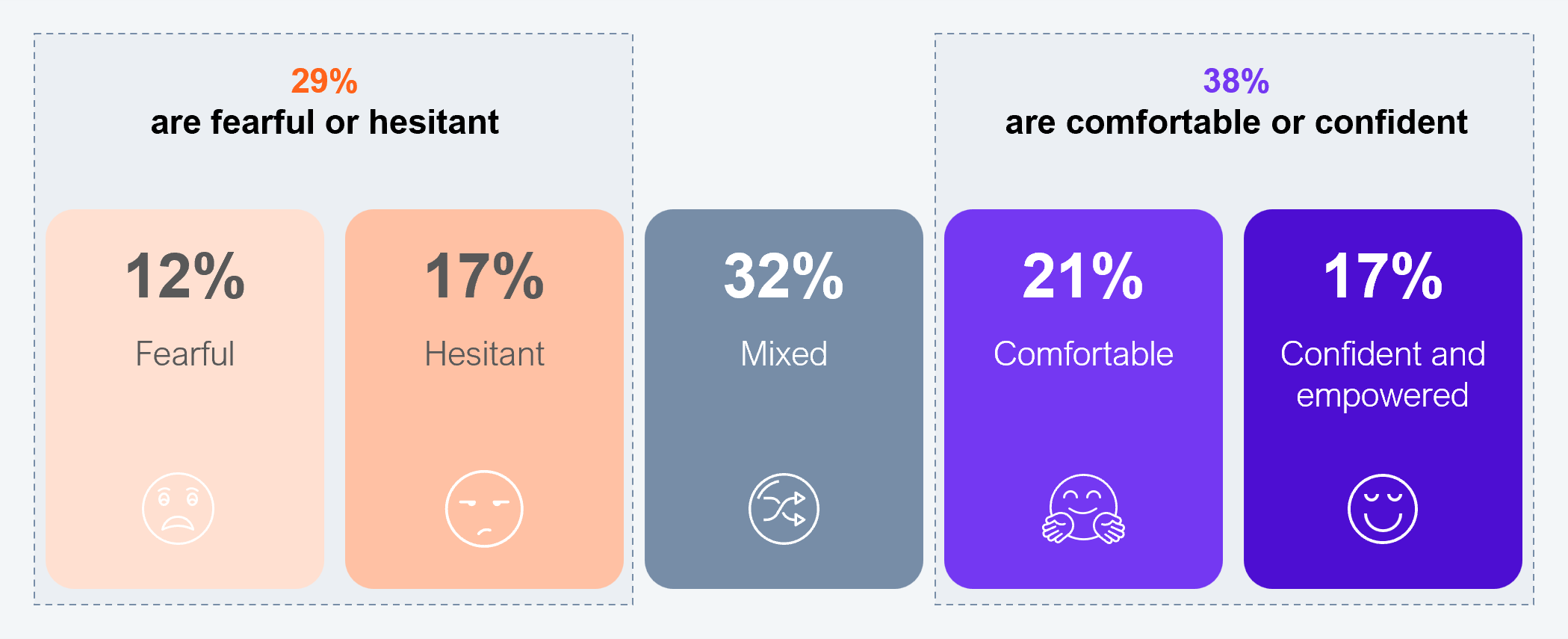
The consequences of unaddressed fear are visible in how the workforce now experiences AI. These are not isolated issues; they form a reinforcing pattern. Fear makes experimentation risky. Limited experimentation prevents judgment from developing. Without judgment, confidence does not form. And when confidence stays low, employees defer to AI rather than challenge it.
Only 17% feel confident and empowered. Seventeen percent (17%) are hesitant, worried about making mistakes or being judged. Twelve percent (12%) are fearful and actively avoid using AI. The majority sit in between, using AI without fully trusting their ability to question or override it.
This is not a mindset problem. It is the predictable outcome of an environment where experimentation is constrained and capability is underdeveloped.
Sample: 505 executives across Global 2000 enterprises
Source: HFS Research, 2026
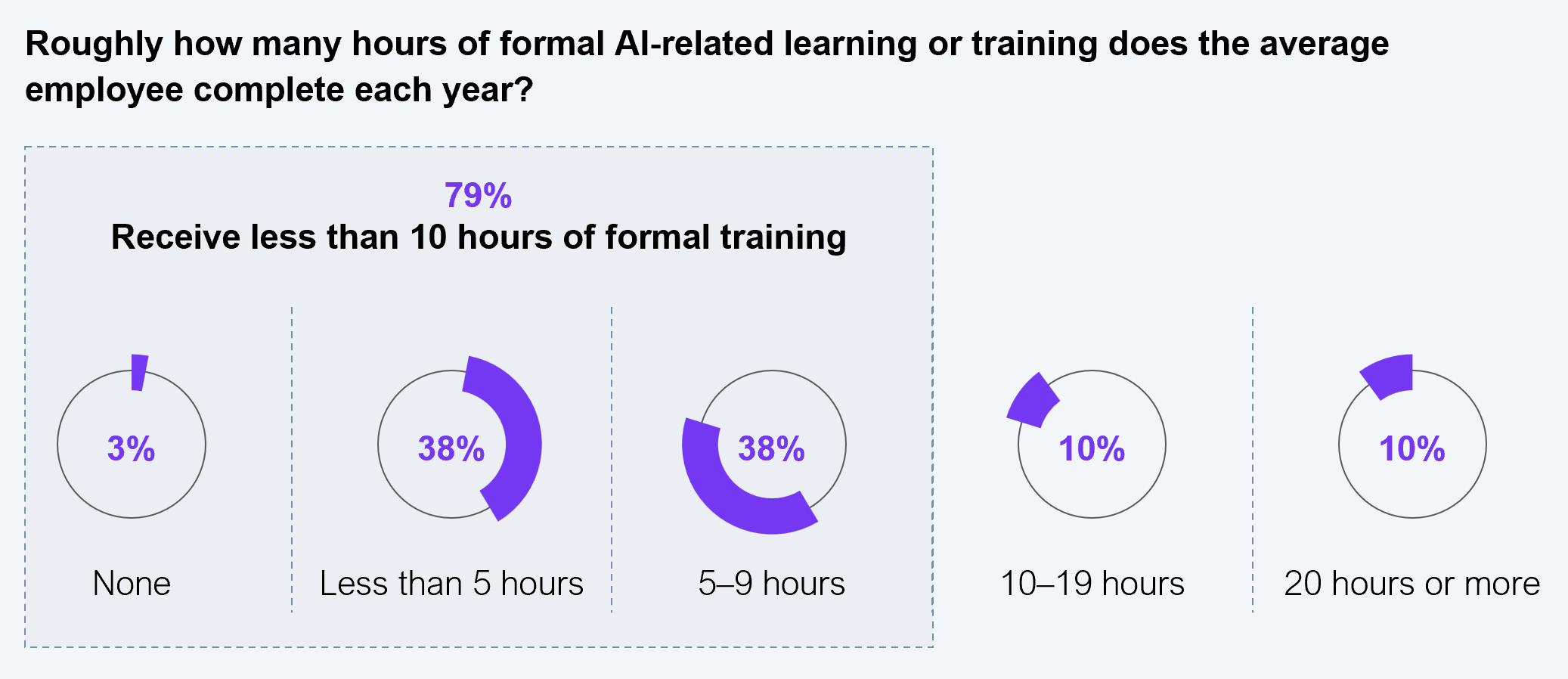
Nearly 80% employees receive fewer than 10 hours of formal AI-related training per year, with only 10% report 20 or more hours of structured learning (See Exhibit 13). You cannot build the capacity to challenge AI, override AI, or exercise meaningful judgment alongside AI by giving people less than one working day of training a year and hoping the rest follows. Confidence is a capability, not an attitude that emerges on its own.
Sample: 505 executives across Global 2000 enterprises
Source: HFS Research, 2026
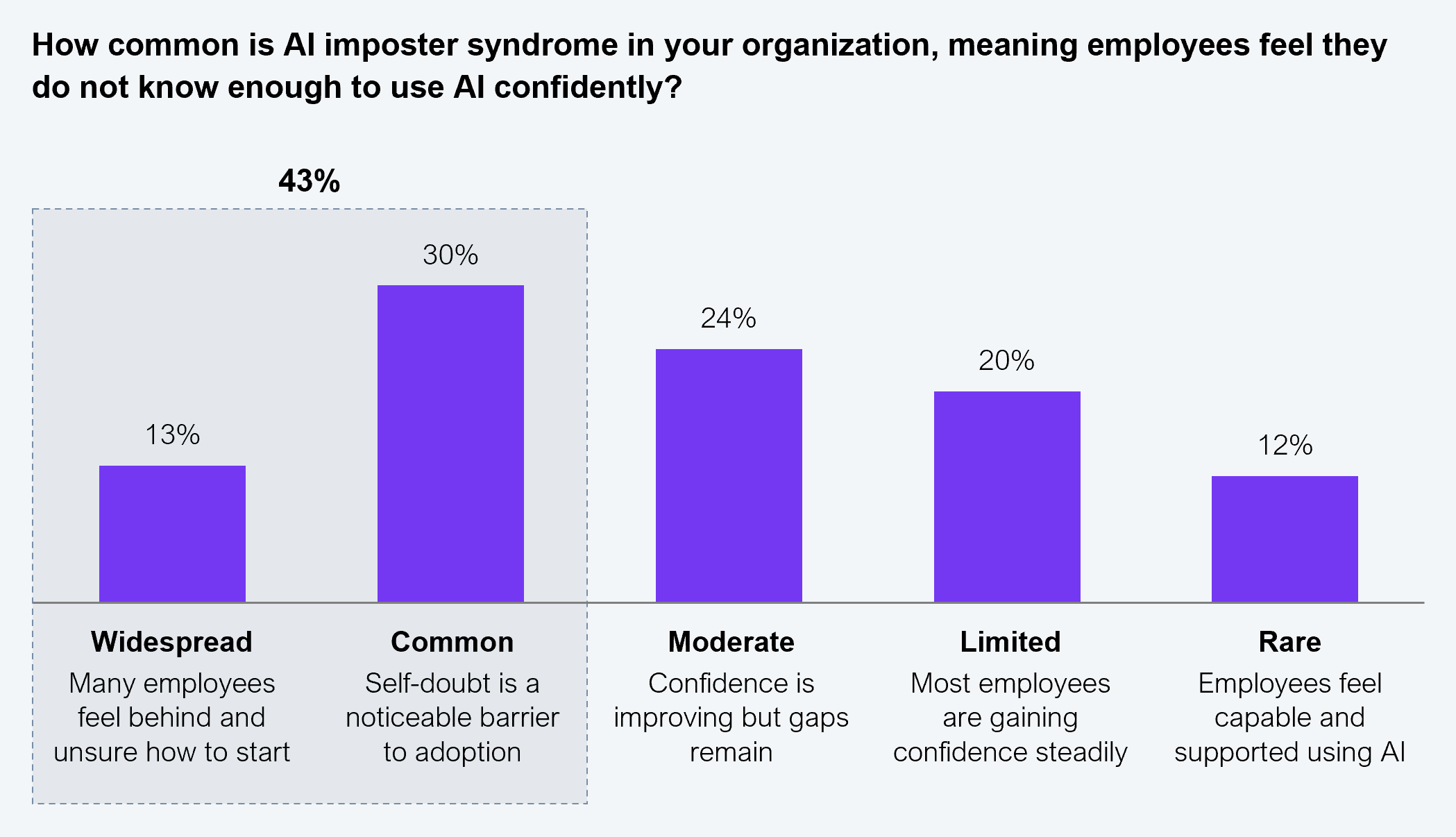
More than four in ten organizations say AI imposter syndrome is either common (30%) or widespread (13%), meaning self-doubt is actively slowing adoption across a significant portion of the workforce (See Exhibit 14).
Imposter syndrome emerges when people are placed in situations where they are expected to perform competently without being given the foundation to do so. When enterprises deploy AI broadly, expect employees to use it, and invest fewer than 10 hours a year in building the capability to do so well, imposter syndrome is not surprising. It is the predictable result of a capability gap that was never addressed.
An employee who does not feel legitimate engaging with AI critically will not challenge it, will not override it, and will not be the human at the helm that the organization needs them to be.
Sample: 505 executives across Global 2000 enterprises
Source: HFS Research, 2026
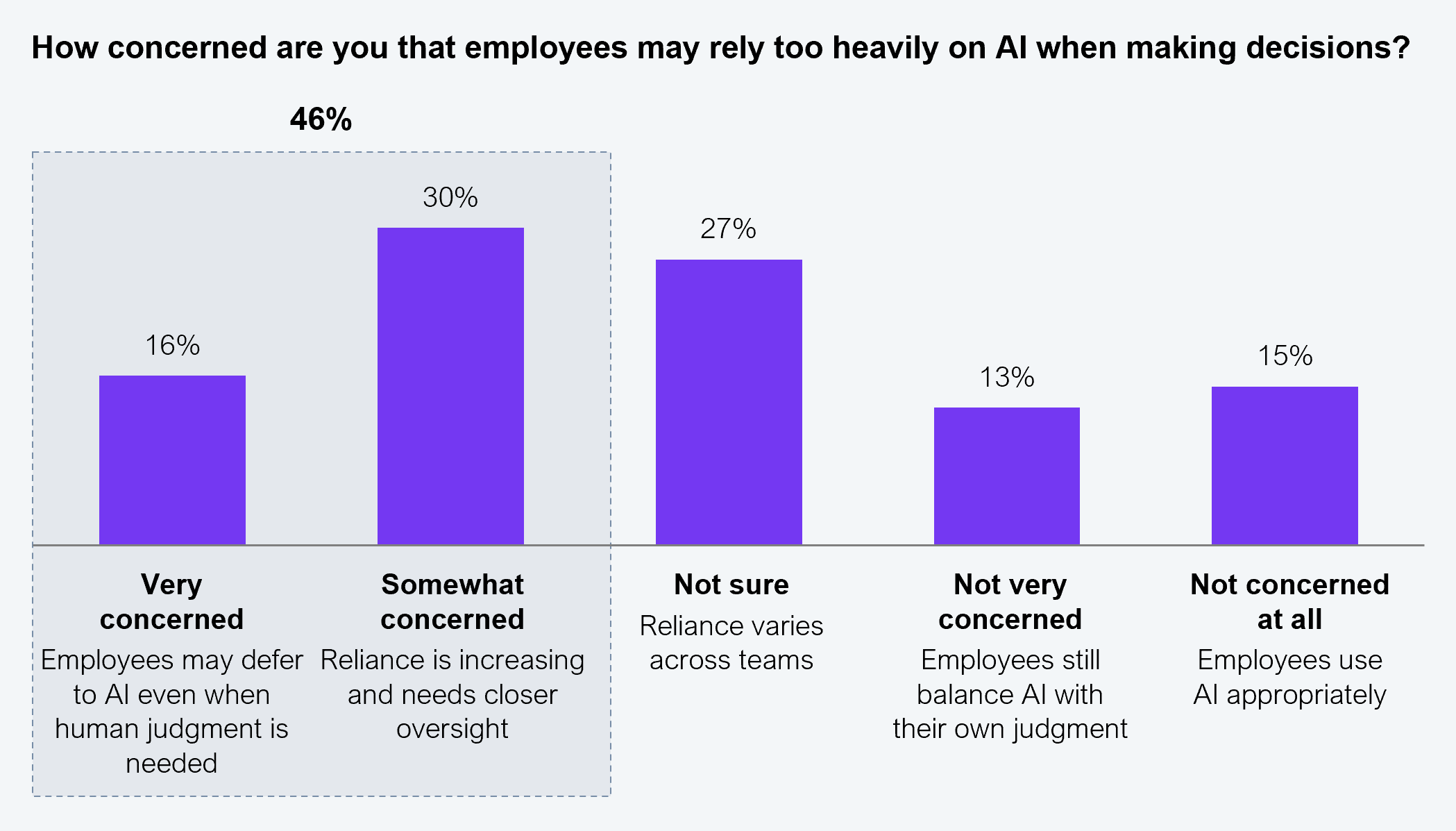
Nearly half of leaders say employees are deferring to AI even when human judgment is required. That is the predictable result of everything above. Employees who fear judgment will not experiment. Employees who cannot experiment will not develop judgment. Employees without judgment will defer. The chain is not complicated. And it leads in one direction—toward a workforce that has learned to follow AI rather than govern it.
Sample: 505 executives across Global 2000 enterprises
Source: HFS Research, 2026
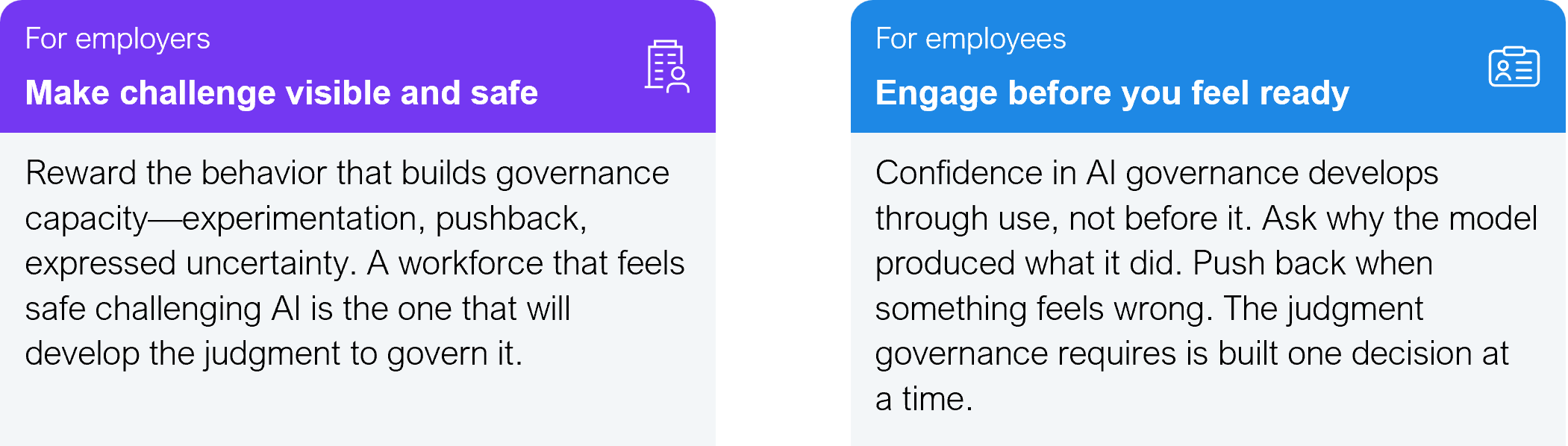
Closing the capability gap requires more than training programs. It requires redesigning the social contract around AI use—making experimentation safe, valuing challenge, and treating the development of human judgment as a deliberate organizational investment rather than something left to accumulate on its own. A workforce built for compliance will follow AI, not govern it.
The bridge forward
Confident humans are not the opposite of capable AI. They are the condition that makes AI governable.
AI is already reshaping work, but most of that reshaping is happening without a plan, without a conversation, and without the people it affects most.
AI is not approaching the workforce. It is already inside it. Roles are shifting, work is changing texture, and the experience of showing up and doing a job is different than it was two years ago. What is striking is not the pace of that change. It is how little of it has been designed. The transition is real. The strategy for it is not.
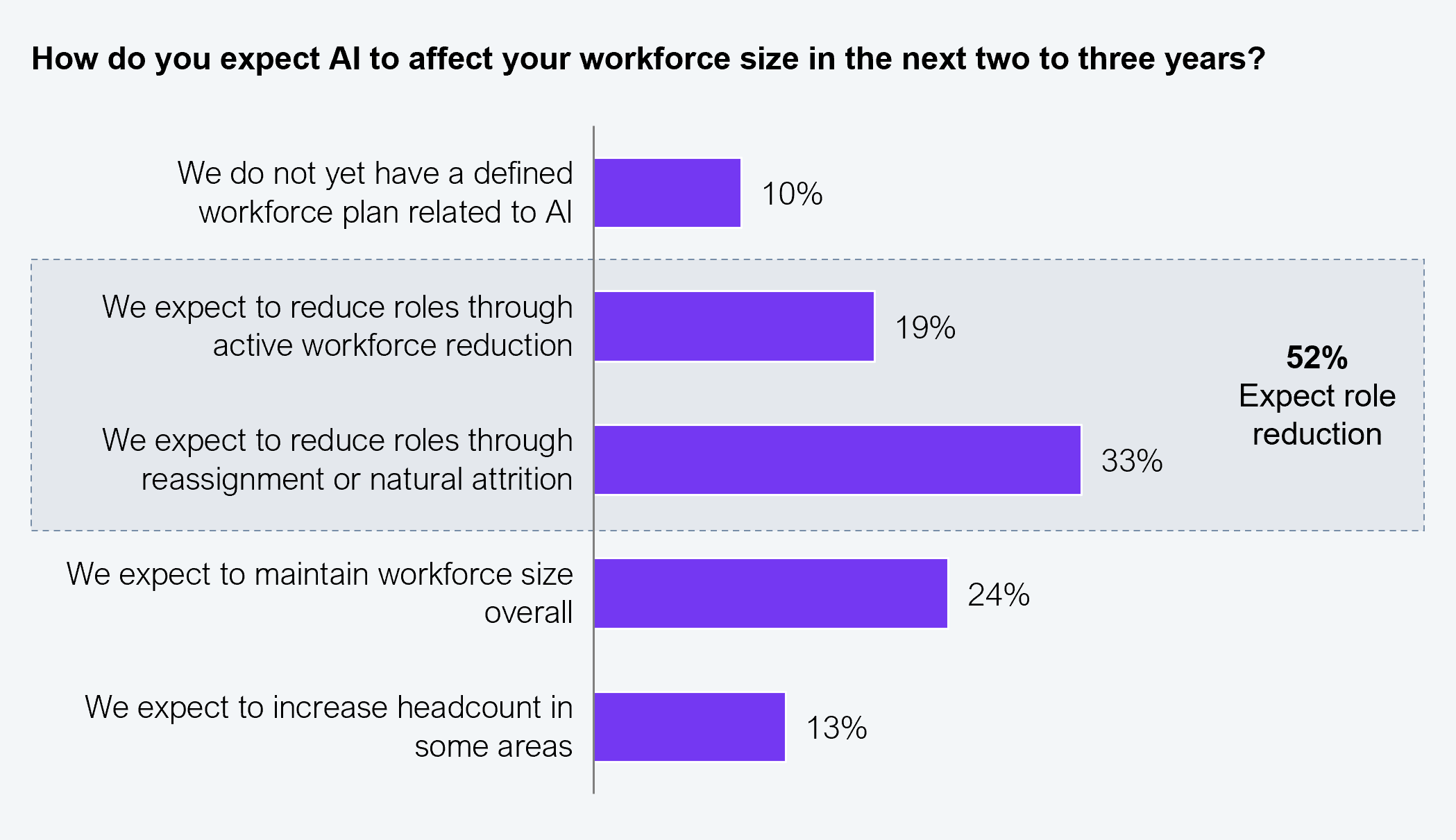
Fifty-two percent (52%) expect AI to reduce roles over the next two to three years, with most expecting that change to happen through reassignment or natural attrition (33%) rather than active workforce reduction (19%).
Attrition is not a transition strategy. It means the people whose roles are changing are not being told, not being prepared, and not being given any agency over what comes next. The enterprise is not managing a transition. It is waiting for one to happen and calling it planning.
Sample: 505 executives across Global 2000 enterprises
Source: HFS Research, 2026
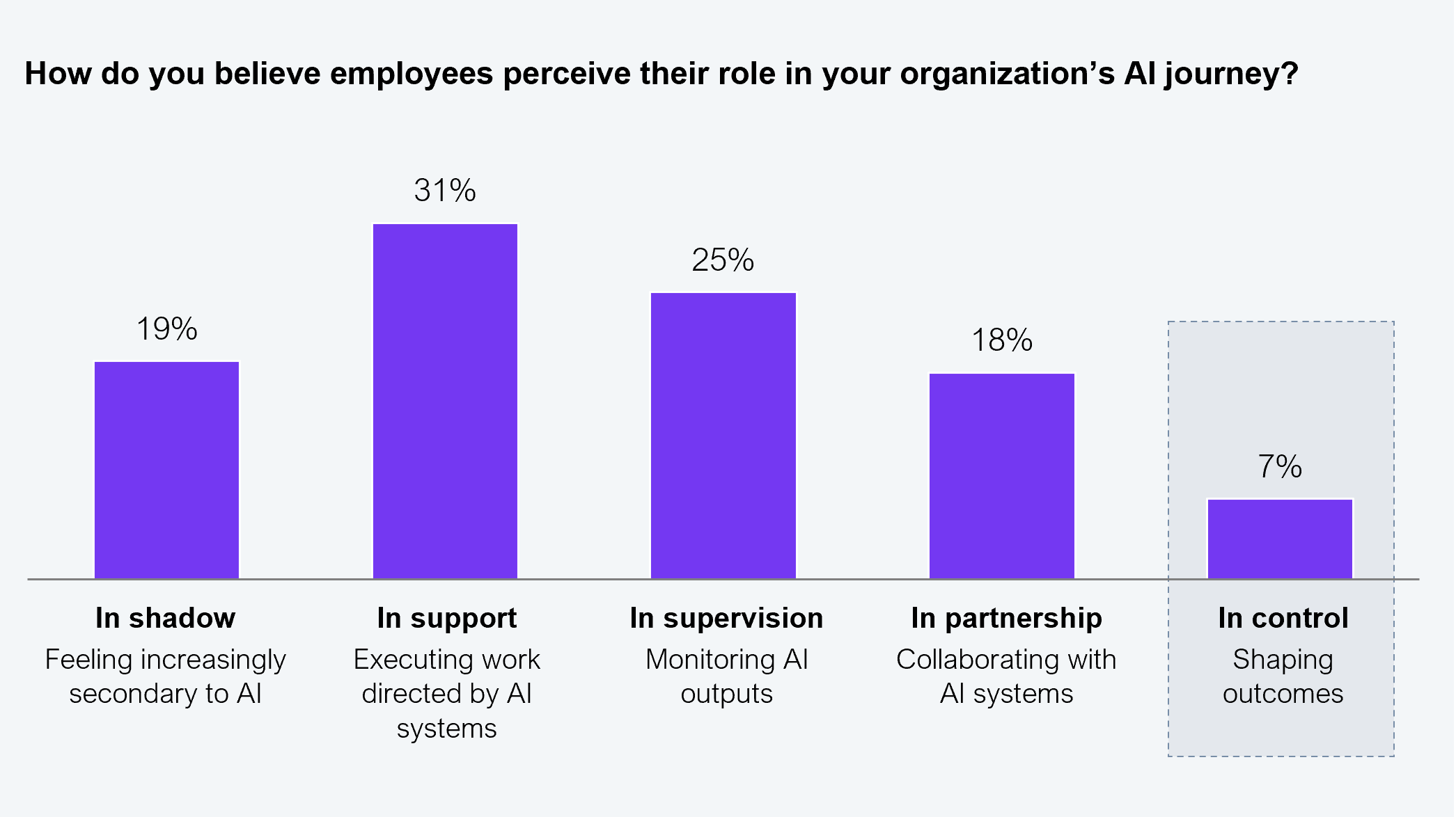
Most leaders believe employees see themselves executing work directed by AI, monitoring outputs, or feeling increasingly secondary to AI. Only 7% think employees feel in control and shaping outcomes.
AI is being experienced as something done to people, not with them. If the people inside the enterprise feel like passengers in a system they did not design and cannot direct, then there are no humans at the helm.
Sample: 505 executives across Global 2000 enterprises
Source: HFS Research, 2026
Putting humans at the helm of the transition requires the same deliberate act as putting humans at the helm of AI governance: someone has to decide it matters, name what the enterprise will look like on the other side, and build a path that brings people with it rather than leaving them to find out what happened after the fact.
The bridge forward
The workforce transition is not something AI is doing to enterprises. It is something enterprises are choosing not to design.
Enterprises are outsourcing AI speed to partners faster than they are defining who owns the outcome.
Every governance failure we’ve discussed has an external dimension that extends beyond the organization to every partner, platform, and system integrator building and running AI on the enterprise’s behalf. The helm is not just empty inside the organization. In many cases, it has been handed to someone outside it.
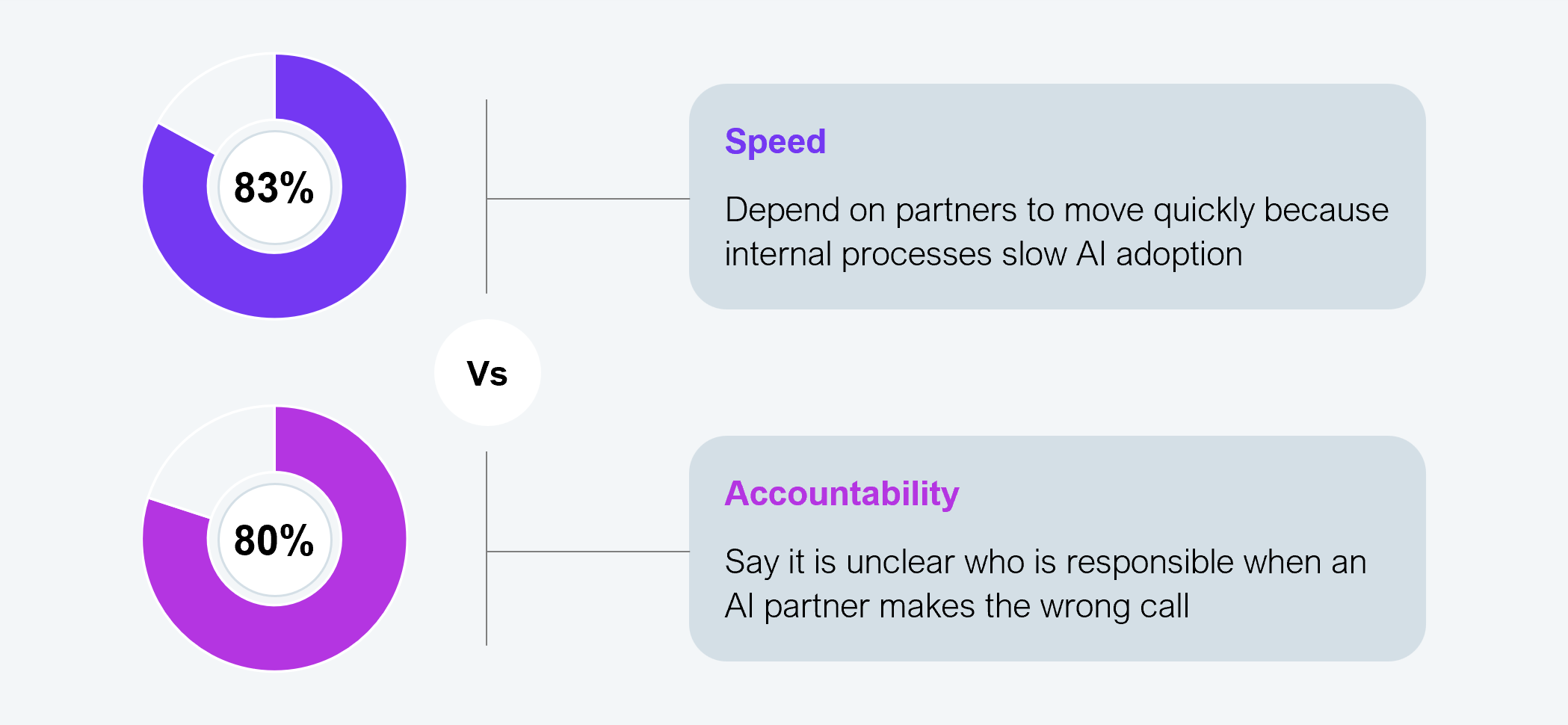
Enterprises are leaning on AI partners to move faster, with 83% citing internal process friction as the reason. The speed is real. So is the accountability gap: 80% say responsibility is unclear when AI fails.
When the machine is wrong and no one knows who owns the outcome, the human at the helm does not exist. There is only a liability with no address. Enterprises have not outsourced a service. They have outsourced a decision, failing to document who is responsible for it.
Sample: 505 executives across Global 2000 enterprises
Source: HFS Research, 2026
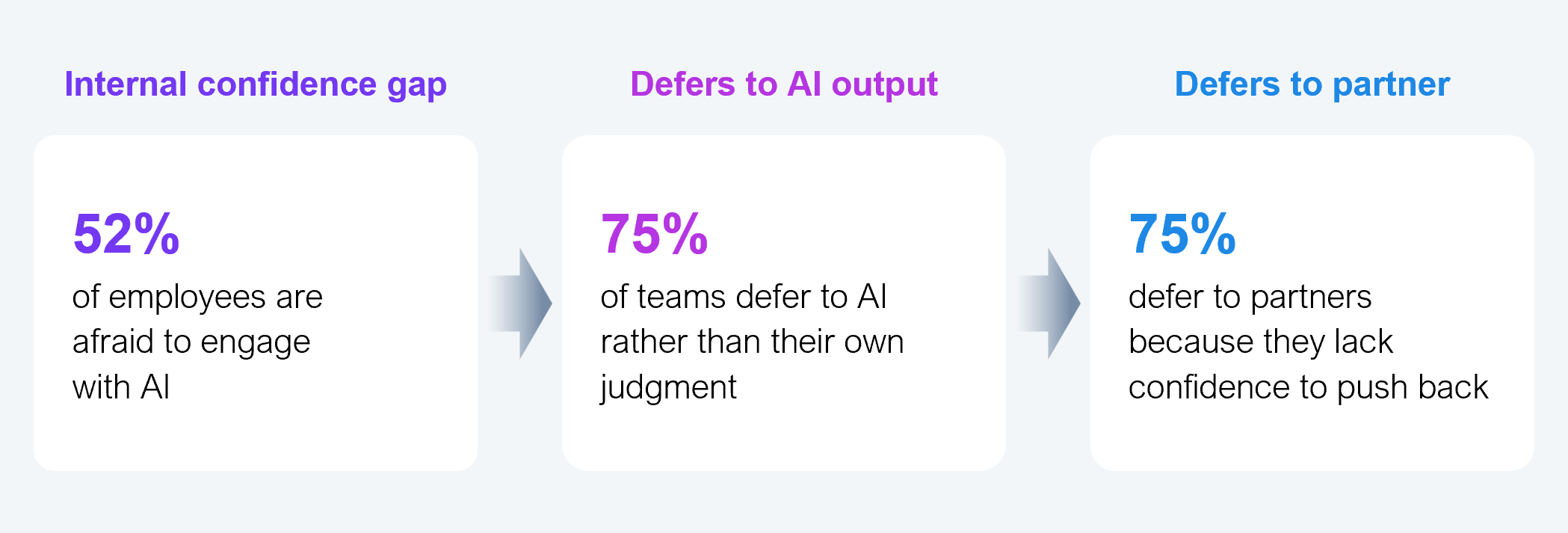
Seventy-five percent (75%) of organizations say their teams defer to partners because they lack the confidence to challenge AI recommendations. That number is not a partner problem. It is a direct extension of the confidence gap inside the organization. The same fear, underinvestment, and imposter syndrome that prevent employees from challenging internal AI outputs also prevent them from pushing back on partner decisions.
Enterprises are not just buying speed from partners. They are buying the authority they failed to build internally. The partner fills the confidence vacuum the organization created. That is not a sourcing strategy. It is a governance failure that has been contracted out.
Sample: 505 executives across Global 2000 enterprises
Source: HFS Research, 2026
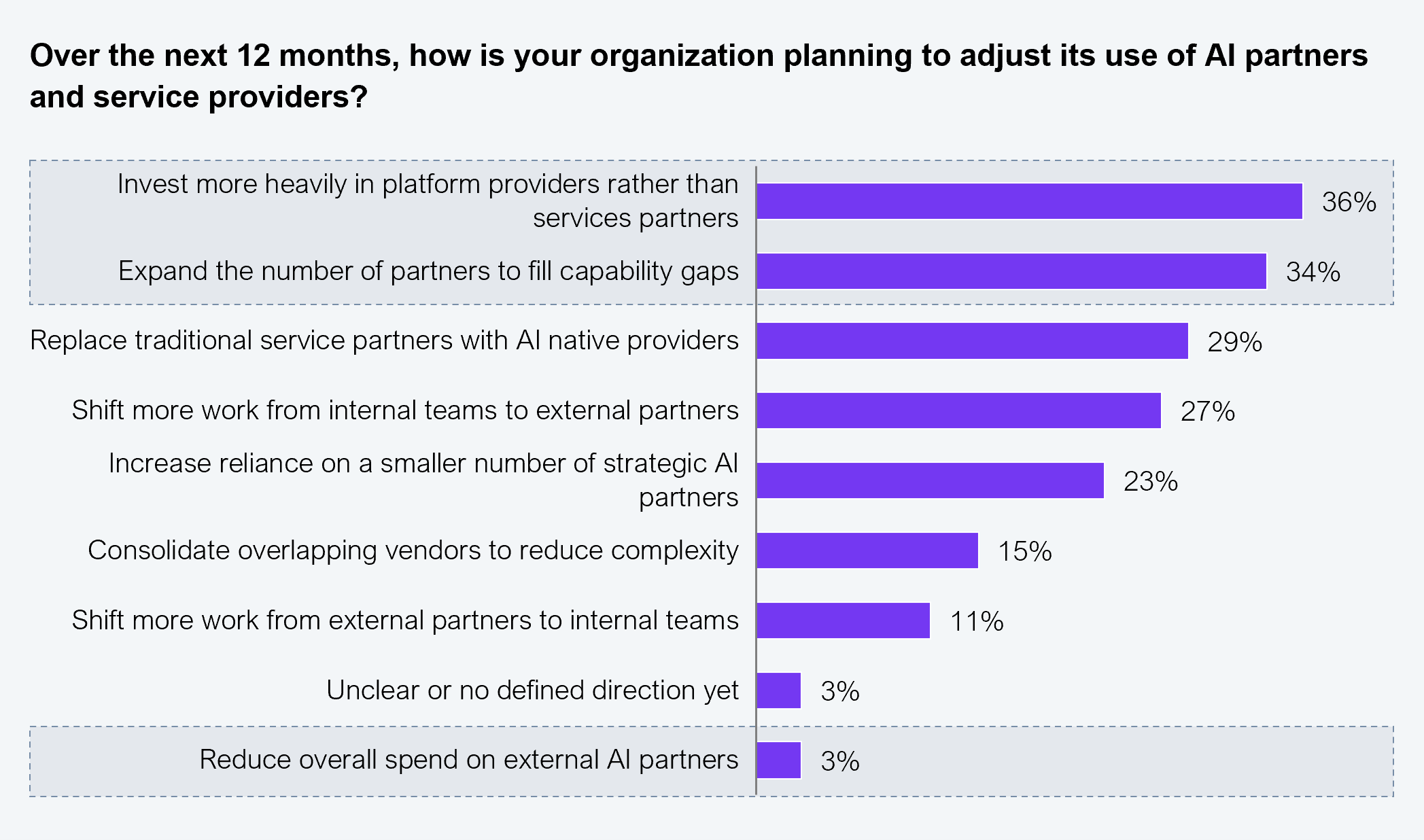
Over the next 12 months, enterprises plan to invest more heavily in platform providers (36%), expand their partner ecosystem to fill capability gaps (34%), and replace traditional services partners with AI-native firms (29%).
The direction is toward more dependency, not less. That is not inherently wrong. But every new partner relationship that goes live without documented decision rights, override criteria, and consequence ownership is another extension of the authority vacuum beyond the boundary of the organization.
Sample: 505 executives across Global 2000 enterprises
Source: HFS Research, 2026
Humans at the helm is not just an internal design challenge. It requires the enterprise to hold its partners to the same accountability standards it is trying to build internally—and to recognize that the governance failures described in this report do not remain within the organization.
The bridge forward
You cannot be at the helm if the engine is being steered by someone you have no accountability agreement with.
Leading AI enterprises put the human foundations in place before autonomy scales.
The velocity gap does not close on its own. The organizations closing it are not waiting for better models or clearer regulation. They are making deliberate choices about how authority is designed, how governance is resourced, and how people are prepared to engage with systems that increasingly act on their behalf.
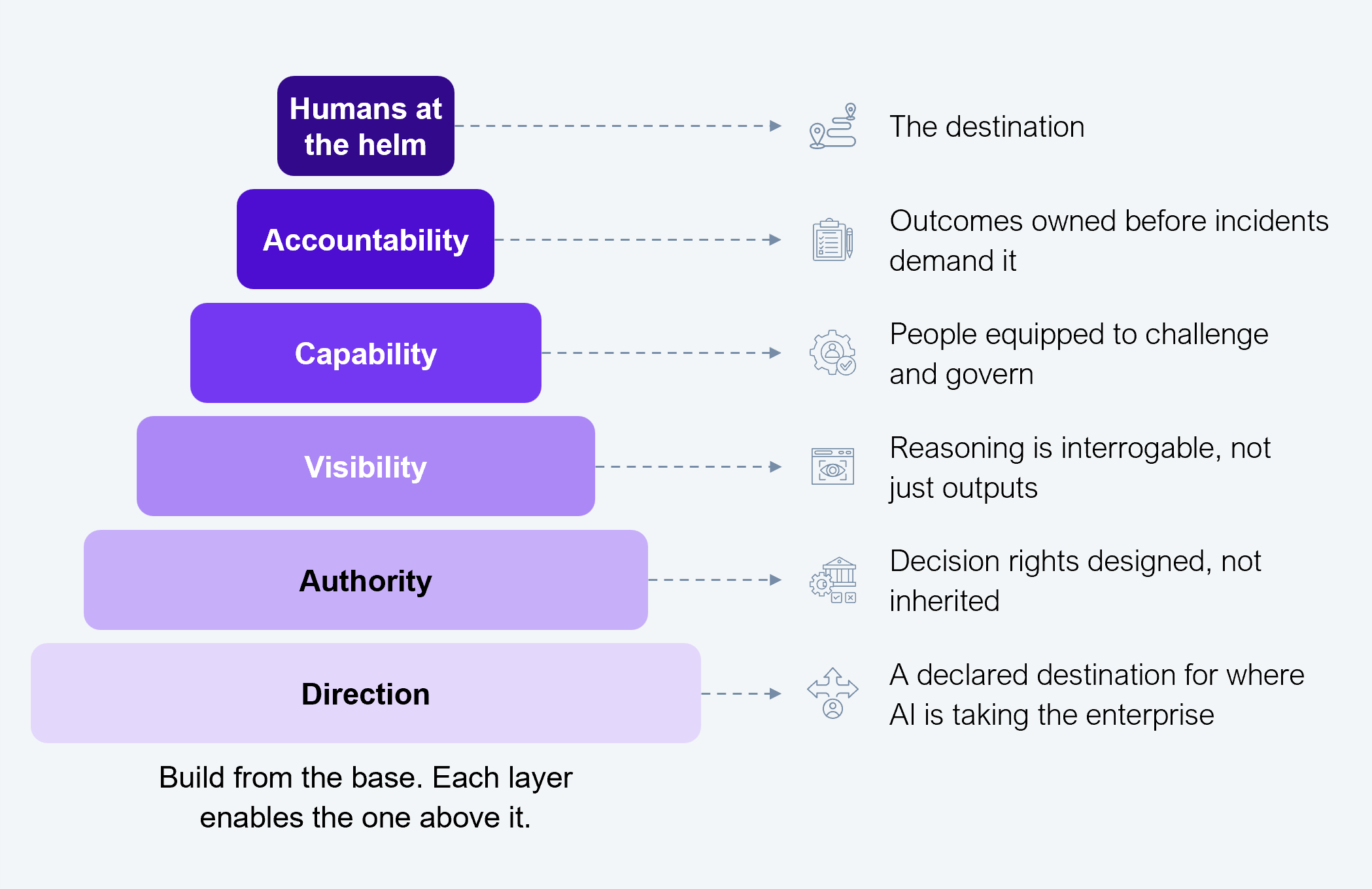
What they are discovering is that putting humans at the helm does not slow AI down. It enables AI to move with more confidence, more trust, and more speed because the decisions behind it are owned by someone who can be held accountable for them. (See Exhibit 21)
Sample: 505 executives across Global 2000 enterprises
Source: HFS Research, 2026
Most organizations are letting AI evolve into something rather than deciding what it should become. The organizations that have closed the velocity gap started not with deployment, but with a declared destination—a clear answer to what AI is meant to help the enterprise become.
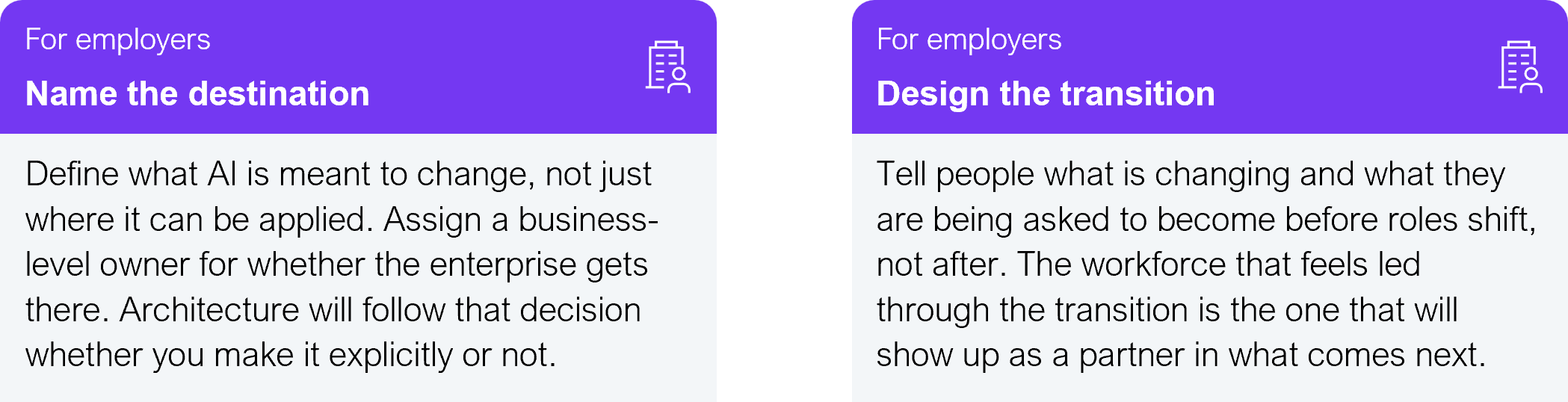
Direction is a leadership imperative. When it is declared clearly, it gives everyone inside the organization the foundation to exercise judgment, challenge AI outputs, and own outcomes with confidence. Without it, none of the layers above can fully hold.
Where authority is not defined, it defaults to the model or to whoever happens to be in the room. Documented decision rights are not bureaucracy. They are the condition that makes fast, confident action possible.
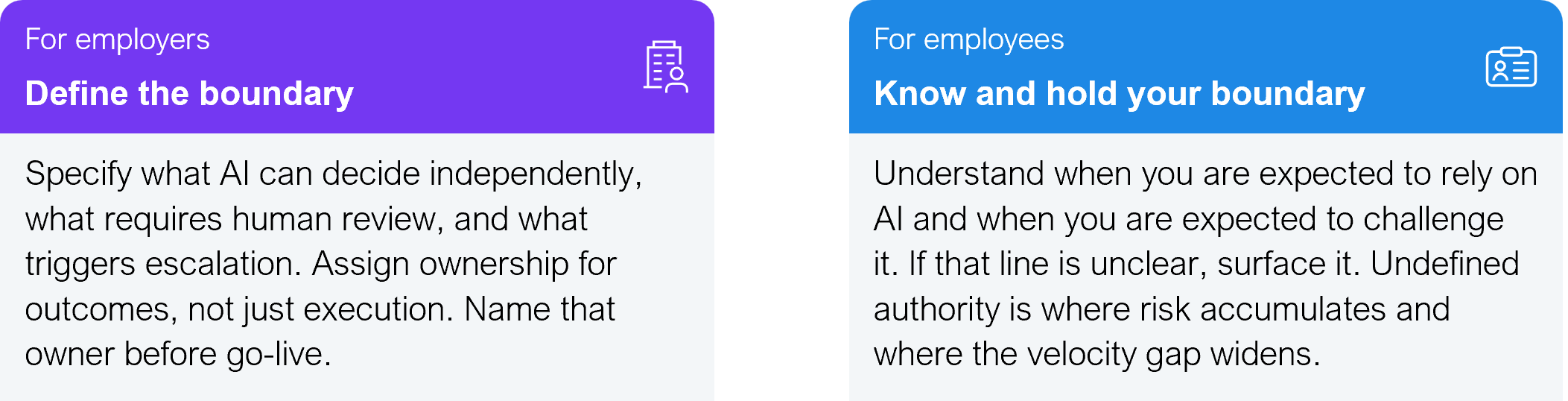
Visibility is what converts human review from a checkpoint into a genuine control. The organizations with the strongest human-AI operating models have made reasoning accessible at the point of decision—not as an afterthought, but as the infrastructure of trust.
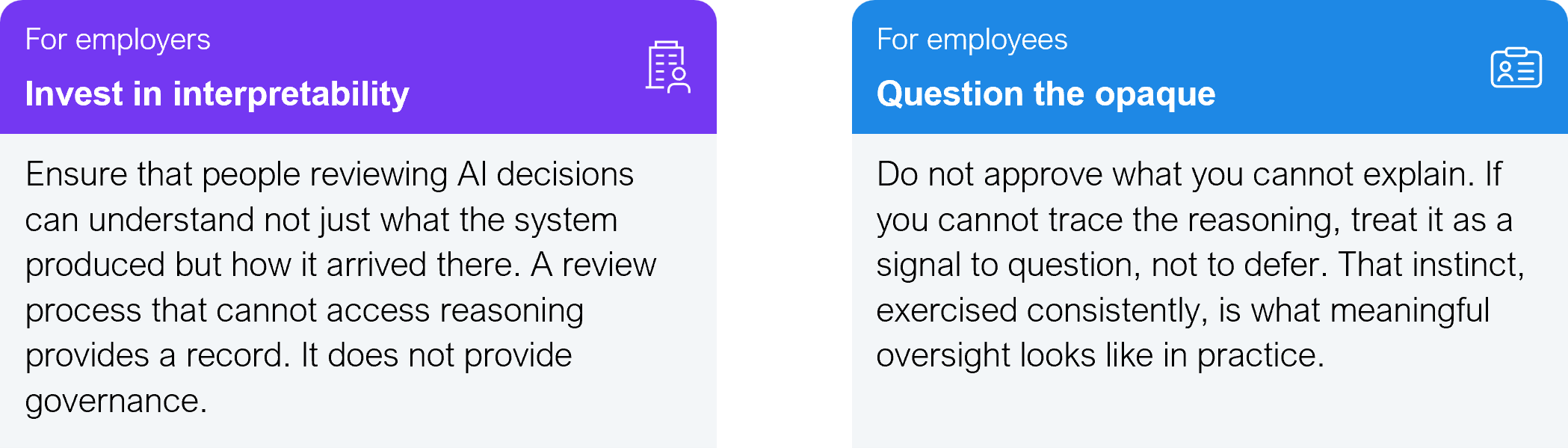
Most enterprises are training people to use AI. Very few are training them to challenge it. The organizations outpacing their peers have invested in the human capacity to govern AI, not just operate it—making experimentation safe, rewarding challenge, and treating judgment as a capability to be built.
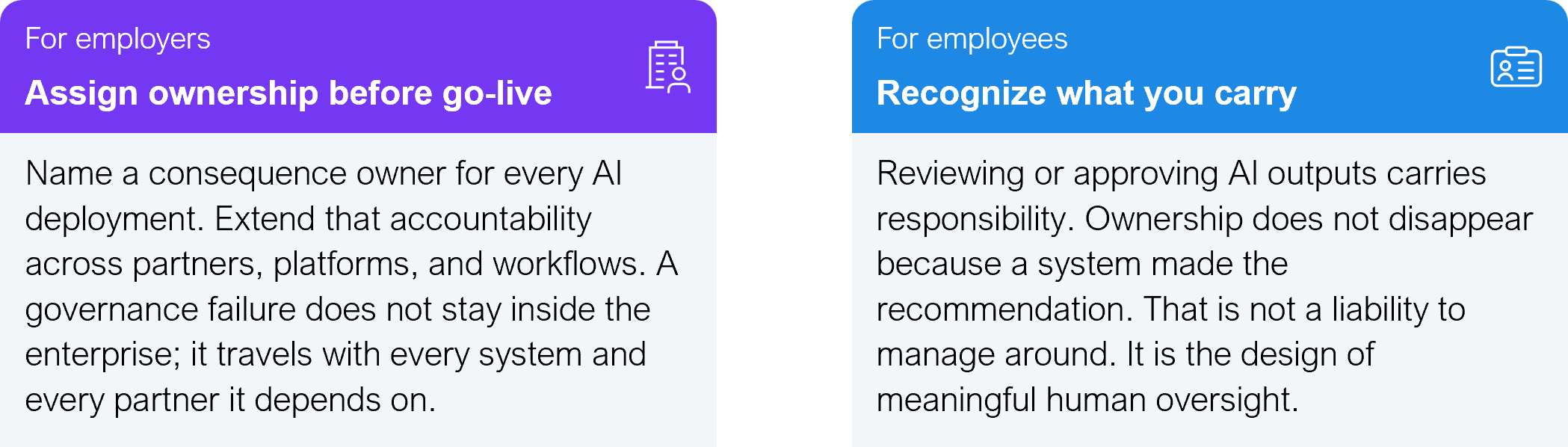
Accountability that appears after failure is not accountability. It is escalation. The organizations that have closed the velocity gap have made one consequential shift: they named who owns each AI-driven outcome before the system went live, and they extended that ownership across every partner and platform operating on their behalf.
Humans at the helm is not a constraint on AI. It is the design that makes AI authority governable, defensible, and compounding in the right direction. The enterprises that will lead in the AI decade are not the ones that moved fastest. They are the ones that moved with the clearest answer to the question that most are still deferring: what does the human at the helm actually have the authority, visibility, confidence, and accountability to do?
Register now for immediate access of HFS' research, data and forward looking trends.
Get Started



If you don't have an account, Register here |
With the exception of our Horizons reports, most of our research is available for free on our website. Sign up for a free account and start realizing the power of insights now.
Our premium subscription gives enterprise clients access to our complete library of proprietary research, direct access to our industry analysts, and other benefits.
Contact us at [email protected] for more information on premium access.

