
This HFS Hot Tech: Hazel AI report is for CIOs, COOs, and enterprise transformation leaders evaluating agentic platforms to accelerate data platform and ERP modernization programs.
Hazel AI is an early-stage agentic modernization platform taking an HFS Services-as-Software approach to data platform and ERP modernizations, where enterprises burn money because “understanding the work” or “understanding the institutional knowledge” takes longer than building the work.
Hazel AI encodes the organization’s workflow and best practices into specialized agents with its proprietary context engine to produce deterministic, reviewable outputs that cut the time and cost to modernize.
The initial focus is on modernizing data platforms (e.g., legacy systems-of-record to cloud data platform) that are information-dense, repetitive, and slow because humans must extract, normalize, and validate inputs across many steps. Where some solutions focus on automating slices of the modernization process with AI coding tools, Hazel AI is built to orchestrate the end-to-end outcome.
Hazel AI starts with a problem every CIO and COO recognizes: most legacy modernization programs slow down not because code is hard to generate, but because enterprise context is hard to reconstruct. The real constraint is the discovery and translation phase, which involves surfacing tribal knowledge, undocumented business rules, legacy process logic, and stakeholder-specific exceptions that sit across old systems, files, workflows, and people.
The typical pattern is this:
Hazel AI claims to compress this by taking the end-state intent (KPIs, outcomes, user roles) and generating the artifacts that typically require senior people doing weeks of business analysis and architecture work.
Hazel AI’s approach is to start from intent (e.g., “modernize my banking system of legacy Oracle Forms and PL/SQL into Java microservices and a cloud database”). Without workshopping explicit and specific prompts, the platform automatically generates a detailed product/business specification (complete with legacy technical and business logic, roles, journeys, user stories, KPIs and drill-down needs).
From this, it generates high-level and low-level designs (integration architecture, mappings, cost/performance considerations) for review in minutes, a fraction of the time (often months) required with manual processes. Customers then review and amend as necessary, and those designs effectively become the specifying instructions to generate end-to-end code, tests, and deployment scripts. These can then be handed to the customer as a deployment pipeline. The whole process, from capture to deployment, is cut to from a 9–18 months of engagement to nearer 10 weeks end-to-end.
Today, customers manually run the deployment pipeline through staging and promote to production after co-verifying outcomes. Hazel AI’s stated direction is to move toward customers granting deeper cloud access so it can deploy and maintain workflows continuously and autonomously. Enterprise leaders should therefore treat Hazel AI today as a delivery acceleration and specification/compliance compression play.
Hazel AI’s business model is an upfront per-workflow charge to build the workflow (outcome-based rather than tied to headcount or time consumed) with a recurring usage-based fee for running workflows.
This may prove cheaper than most CIOs have experienced, but Hazel AI’s real value lies in outcomes such as speed to business value, higher-grade outputs, and making scarce experts scale across more work.
If Hazel AI can prove value consistently, this becomes a practical Services-as-Software engine: codifying delivery into repeatable agentic workflows that scale without scaling headcount.
Yunus Mohammed Khan, Senior Director of Operations at Exceego Infolabs, said Hazel AI has materially accelerated their EHSWatch roadmap by turning detailed domain-specific requirements into documentation, prototypes, and code far faster than traditional delivery. Work completed in roughly three months, and potentially two without delays, would normally have taken seven to eight months, sharply compressing the path from requirement capture to usable AI features.
Yunus iterated that Hazel AI’s speed and ability to understand EHSWatch requirements helped embed AI across modules, improving go-to-market readiness and customer outcomes. He would like to see the company expand its time zone coverage or regional support to reduce response lag for his Gulf-based teams.
Hazel AI is tackling one of the key constraints in enterprise transformation: institutional knowledge trapped in people and process. Its claim that agents can generate production-grade specs, designs, and delivery assets is compelling because it attacks the budget sink: figuring out what should already be known and documented, but rarely is.
But enterprise leaders should be clear-eyed. If you let an agentic platform encode your workflow, you can scale faster. But you can also industrialize the wrong assumptions at machine speed. Hazel AI must prove governance, auditability, and security to earn the right to operate inside regulated, high-stakes environments.
If Hazel AI delivers on its promises, it is a direct threat to time-and-materials delivery models and a potential unlock for enterprises stuck in modernization backlogs. The real test if it is ready to show you repeatable outcomes beyond impressive first runs.
HFS Hot Tech is an exclusive group of emerging players, each with a differentiated value proposition aligned with creating momentum toward Services-as-Software™. HFS analysts regularly speak with numerous exciting startups and emerging players. We designate a select few as HFS Hot Tech based on their offerings’ distinctiveness, ecosystem robustness, client impact, financial position, and, in this case, their impact on Services-as-Software. HFS Hot Tech companies may not have the scale and size of more established rivals, but they have the vision and strategy to impact and disrupt the market. In the rapidly changing AI-led operations space, enterprises realize they can’t be everything to everyone.
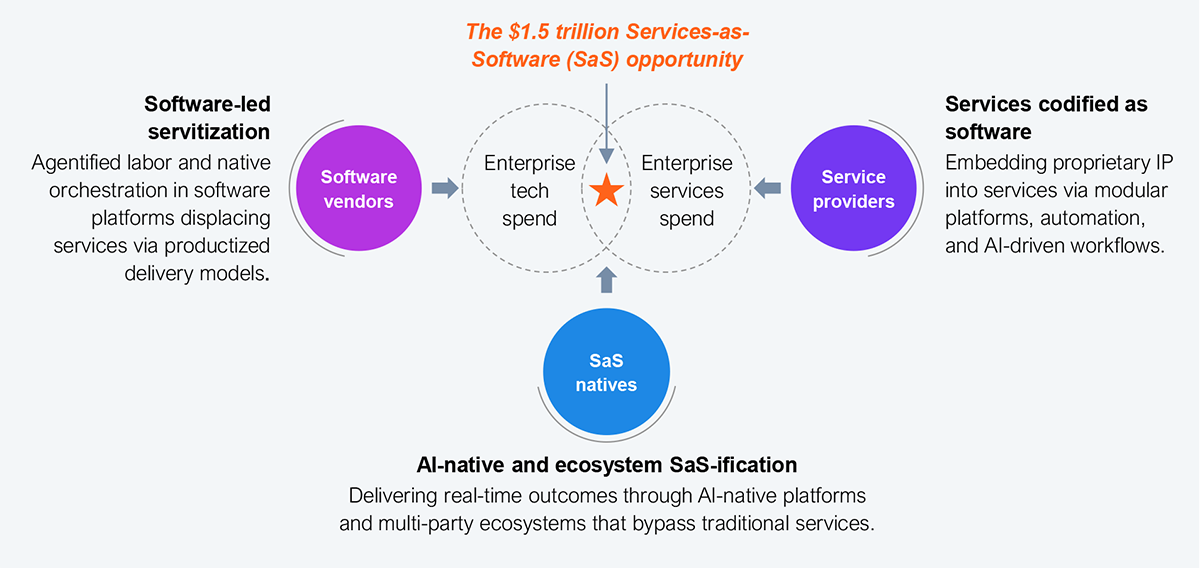
Source: HFS Research, 2026
Register now for immediate access of HFS' research, data and forward looking trends.
Get StartedIf you don't have an account, Register here |
With the exception of our Horizons reports, most of our research is available for free on our website. Sign up for a free account and start realizing the power of insights now.
Our premium subscription gives enterprise clients access to our complete library of proprietary research, direct access to our industry analysts, and other benefits.
Contact us at [email protected] for more information on premium access.


