This HFS Hot Tech profile of humanizetech.ai is for CIOs, SAP program leaders, and system integrators evaluating agentic platforms to accelerate enterprise software delivery.
For CIOs, program leaders, and system integrators running large SAP, Salesforce, or ServiceNow environments, the hardest part of a transformation is not always the technology. It is the dependence on a small set of specialists. Different stages such as discovery, design, configuration, coding, and testing all wait on the limited pool of people, and that is where most cost and time burnouts begin. humanizetech.ai is an agentic AI platform built to take on those steps. It reads legacy code and other relevant inputs, turns them into design documents, recommends configurations, generates code, and produces test cases. This makes delivery a repeatable process rather than one that depends on who is available.
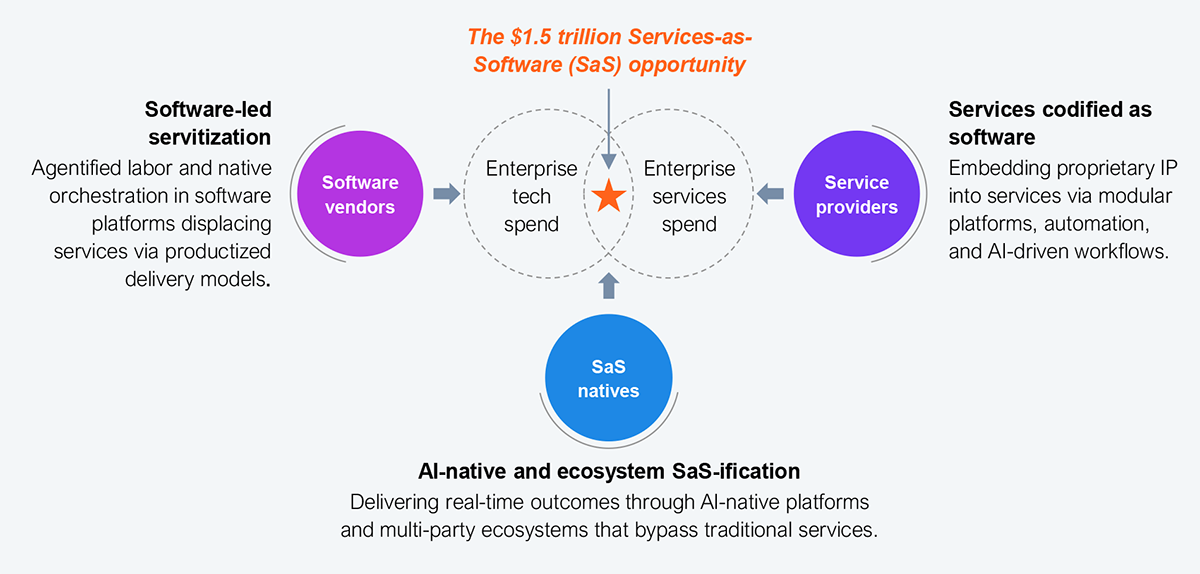
This is what places humanizetech.ai in the “services codified as software” part of the Services-as-Software™ landscape. Instead of selling consulting hours, the company takes the knowledge that usually sits in senior practitioners’ heads, along with the software vendor’s own delivery standards, and builds it into a platform that produces the work directly. It uses the same language itself, framing its work as the agentification of IT services and an example of Services-as-Software.
HFS designates humanizetech.ai a Hot Tech because it goes after the labor dependency at the center of enterprise software delivery, a problem traditional implementation models have never solved. The company is still SAP-led, but unlike coding assistants that only speed up developers, it automates the full delivery lifecycle, not just the code.
Delays in most SAP programs don’t appear at go-live. They build up much earlier, in the slow work of turning workshops, legacy code, and scattered notes into clear requirements and usable designs. This work depends on judgment that only senior practitioners hold, so when those people are stretched across several projects, everything behind them waits. The build phase adds more of the same because custom code, configurations, test cases, and documentation are still produced largely by hand.
Adding more people does not solve this, because the bottleneck is knowledge, not headcount. Each project re-interprets the same SAP standards from scratch, and weak early decisions harden into over-customization, which builds technical debt and forces rework that surfaces only late in the project. Packaged software was meant to make this faster, yet large implementations still run long and over budget. The problem is not a one-off. It is built into a delivery model that runs on people.
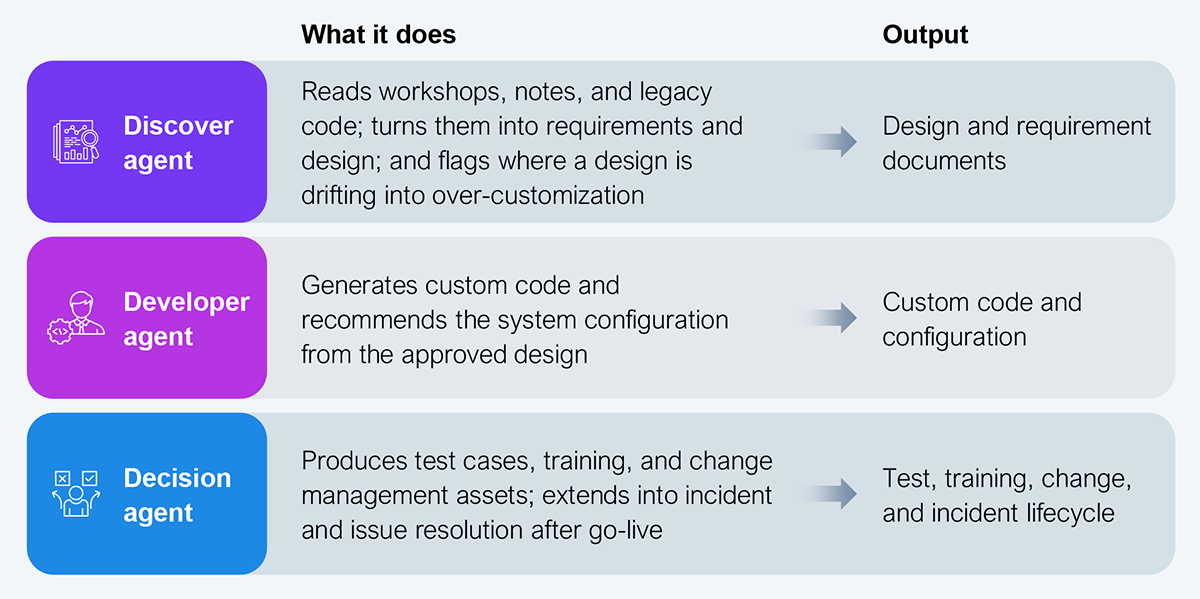
humanizetech.ai runs as a single pipeline across the enterprise software delivery lifecycle, with the deepest integration in SAP today and extending to Salesforce and ServiceNow. Required inputs, such as project details, recordings, legacy code, and live system usage data, pass through three agents. Each agent is responsible for its own successive value generation, from design through build, test, and now post-go-live support (see Exhibit 1).
Source: HFS Research, 2026
What separates this from a simple code generator is a validation loop that spans the agents, a maker, checker, and compiler cycle, so output is checked and compiled before handover rather than left as raw model output that no team would trust in production.
The real difference is what sits around the models. humanizetech.ai does not build its own AI; it calls frontier models and stays model-agnostic, so a stronger model is an upgrade, not a threat. A general-purpose coding assistant can write SAP code, but it does not know a client’s coding conventions, security rules, or the vendor’s delivery standards. humanizetech.ai grounds its agents in exactly that, the client context, the SAP standards, and practitioner knowledge, so the output fits the specific environment. This orchestration layer is the core of what it owns, backed by two patents and SAP’s approved-partner status. It also means the sharper competition is not generic AI but the large system integrators building their own SAP accelerators and SAP’s own embedded AI.
humanizetech.ai charges on subscription: a bundle of users pays a fixed monthly fee that covers a set amount of usage, anything beyond that is billed on actual consumption, and a dashboard shows how the platform is being used. Today, about half of clients buy on subscription alone, while the rest take the platform as part of a full implementation run by humanizetech.ai to prove the tool works and to build references.
The roadmap points beyond this. humanizetech.ai describes a staged path: SAP is the proven first step, Salesforce and ServiceNow come next, and a wider set of SaaS platforms, such as Oracle, Workday, and Microsoft Dynamics, follow. The goal is to stop handling delivery and become the platform that other system integrators and partners build their services on. Only the SAP step has been proven so far, and the final shift is the real test, because it means giving up the hands-on delivery that is still the core of the business today.
humanizetech.ai’s strongest evidence so far comes from large, complex SAP programs, where clients report both speed gains and better adoption.
A global textile manufacturer cut an S/4HANA build from nine months to six
A vertically integrated textile manufacturer supplying global fashion houses moved off a homegrown ERP to SAP S/4HANA, with 2.5 million yards of monthly production at stake. humanizetech.ai delivered the core modules, production planning, finance, sales, and materials management, and the client reports the implementation came in at six months against an industry norm of nine, without losing quality or user adoption, with an AMS framework supporting it after go-live.
A Fortune 500 aerospace and defense firm pulled training readiness back on track
A US aerospace and defense major, running greenfield, brownfield, and support tracks in parallel, turned to humanizetech.ai when program readiness was at risk. The client reports that the platform and its consultants moved training deliverables from red to green within a few weeks. These results are client-reported rather than independently verified by HFS, and the proof base so far sits mainly in SAP.
humanizetech.ai earns its Hot Tech designation for codifying the specialist-heavy work of enterprise software delivery, a clean example of services codified as software. Where it is proven, in SAP, the early client results are real, and the value to enterprises is clear.
The sharper test ahead is competitive. As the approach proves out, the real contest will be less with generic AI tools and more with the large system integrators building their own accelerators and the platform owners deploying their own AI, both of which hold the client relationships and scale that a young company does not yet have. What gives humanizetech.ai a head start is the patented orchestration layer, its SAP-approved foundation, and the client-specific knowledge the platform compounds with each delivery, which an incumbent or an in-house accelerator cannot replicate quickly. For enterprises and integrators frustrated by slow, specialist-bound delivery, humanizetech.ai is a credible early option, strongest where it is proven and well worth watching as it scales.
HFS Hot Tech organizations display truly differentiated offerings and out-of-the-box thinking that can be inspiring and useful. This report profiles one of the HFS Hot Techs selected through our rigorous five-step assessment. The HFS Hot Tech designation remains in place for one calendar year. Every Hot Tech joining our program remains listed on our exclusive and searchable database.
HFS Research coined “Services-as-Software” to encapsulate a concept reshaping how the world will consume technology services and software. This emerging category will disrupt traditional services and software models, absorbing significant revenue from both, and create a new total addressable market worth $1.5 trillion.
Source: HFS Research, 2026
Enterprises consuming third-party services, service providers, and technology providers need a smart ecosystem to succeed and survive in the future. HFS Hot Techs are service and technology providers handpicked by our analysts to help you flesh out your ecosystem with offerings that solve today’s complex business problems and exploit market opportunities.
Register now for immediate access of HFS' research, data and forward looking trends.
Get StartedIf you don't have an account, Register here |
With the exception of our Horizons reports, most of our research is available for free on our website. Sign up for a free account and start realizing the power of insights now.
Our premium subscription gives enterprise clients access to our complete library of proprietary research, direct access to our industry analysts, and other benefits.
Contact us at [email protected] for more information on premium access.