
The HFS Services-as-Software™ Hot Tech: Zime report is for chief revenue officers, sales enablement leaders, and go-to-market executives evaluating AI-powered sales execution platforms that turn top-performer behaviors into repeatable, measurable revenue outcomes.
Your chief revenue officer may have a plan, but the strategy rarely survives contact with the sales floor. Reps revert to the way they have always sold, win rates stall, and a widening portfolio of products make nuance hard learned and hard shared. Zime attacks that execution gap. It learns from how your best deals were won, distils the lessons into observable, scoreable behaviors, and embeds those behaviors in the tools reps already use so that a day-one starter can sell like a five-year veteran.
Zime codifies the delivery of work in an AI-native way. Sales coaching, enablement, and the forward-deployed “make-this-work-here” expertise that normally takes a new hire 12–18 months to acquire were traditionally bought as a service. Zime recasts them as software-delivered, continuously measured capabilities, enabling behavior change with a number attached to it.
This is why Zime fits in the HFS Services-as-Software™ (SaS) landscape. We see it as one of the few vendors converting the soft, judgment-heavy craft of revenue execution into something repeatable, owned by the enterprise, and tied to revenue outcomes rather than software seats.
The enterprise sales function has become too complex to carry in any one person’s head, even for the best in your team. Product portfolios expand quarterly (daily among some of the AI natives), competitive lines shift, and buyer personas move. The AI-forward CISO of 2026, for example, is a different buyer than the AI-cautious CISO of two years ago. Conventional fixes, including a learning management system, playbooks, or a battlecard PDF, rarely deliver knowledge to reps when it’s needed most: during the customer interaction.
Many AI sales tools do little to close the gap. Call intelligence and forecasting platforms record, transcribe, and score against generic, industry-average best practice. They tell a CRO what reps did and what might happen. But they do not encode your particular CRO’s current strategy against outcome-focused criteria or read whether the customer’s response to a salesperson’s behavior moved the deal. Zime argues that this is an execution-infrastructure problem.
Zime’s engine ingests an enterprise’s specific products and release notes, its competitors and how they are positioned, the buyer personas and the language they use, the deal stages and exit gates, and the call corpus itself. It uses this information to build what it calls an execution context graph, made specific to the enterprise’s requirements and all the way down to the customer’s ontology. For instance, in the security world, it knows that “Palo Alto” means the company and not the city, that “SASE” in is not to be confused with SaaS, and that “I had a breach last week” should be treated as a high-intensity buying trigger.
To gather that context, Zime analyzes the last 50 or so deals, tags whether each customer response was high- or low-intensity, and correlates behavior to deal movement. The output is a short set of behaviors, typically five, that have been proven to predict deal advancement with over 90% accuracy. Those behaviors are then scored on every call and surfaced to reps as just-in-time prep notes, role plays, objection handling drawn from past wins, and automatic CRM updates. The system is headless by design: it works inside Gong, Salesforce, Teams, Zoom, Slack, and via MCP, so reps never have to learn a new tool and you don’t have to fight a change management battle.
Zime provided a team of four forward deployed engineers, comprising a customer success/account lead, a playbook/methodology expert, a vertical GTM expert, and an AI engineer, to stand up each customer’s unique “brain” in 21 days through an engagement that it calls “Ignition.” They interview the CRO to capture a forward-looking strategy, resolve entities, design behavioral criteria, and run the reinforcement learning-from-human feedback loop that lifts model accuracy from roughly 30% on day one to over 90% in the first quarters. The result is that architected behavior change plus owned, outcome-focused context remains unique and enterprise owned.
The commercial model mirrors the outcome promise. Engagements begin with a fixed-scope, 21-day Ignition (around US$20,000) tied to a single initiative such as qualification, discovery, competitive win rates, or deal velocity. These engagements convert to an annual contract, and each new initiative is a further Ignition, ensuring that the spend tracks the value delivered. Zime reports net revenue retention of around 250% as customers expand stage by stage. Pricing anchored to outcomes positions Zime well for the market shift from usage to outcome-based pricing advocated by the HFS SaS approach.
Zime’s near-term reality is a focused sales execution product with proof in cybersecurity, enterprise hardware, and adjacent B2B plays. Its stated direction is broader: to become the “context-as-a-service” layer that every AI agent in the enterprise stack draws on, with MCP endpoints exposing that context to in-house agents. HFS’ view is that the platform vision is what will attract capital, but the sales-execution outcome is what will attract buyers.
Versa Networks is a leader in secure access service edge (SASE), a cloud-based framework that combines network connectivity and cybersecurity into a single, unified service allowing employees to access company apps from anywhere. The company has around 200 reps and an 8–10 month sales cycle. It was struggling to move early-stage deals through a long, specialized pipeline or to qualify them out cleanly. Zime converted Versa’s SASE playbooks, training content and release notes into measurable “actions” tuned to Versa’s product lines, buyer profiles, deal stages and channels. It then scored them on every call and mapped them to win/loss data in Salesforce.
The outcomes: a 10% increase in win rates, a 20% increase in SASE pipeline through better early-stage discovery and lead qualification, more than two hours per week saved for every rep and manager, and roughly 50% less time spent on coaching and pipeline reviews.
I wanted Zime to understand my playbooks and coach reps. No other tool does this. Zime is a huge win for all stakeholders. It saves half of my time on coaching AEs.
— Martin Mackay, Chief Revenue Officer, Versa Networks
Those headline metrics are echoed by Mickey Singh who runs sales strategy, go-to-market, and global sales and partner enablement at Versa Networks. With just 800-plus employees, the company has displaced incumbents such as Cisco, Fortinet, and Palo Alto Networks across SD-WAN, SASE and, increasingly, AI security. Singh evaluated Zime against Gong and chose it precisely because it could be molded to Versa’s own version of the MEDDIC (metrics, economic buyer, decision criteria, decision process, identify pain, champion) methodology, deal stages, and buyer’s journey rather than scoring reps against generic, industry-average best practice, while surfacing sharper AI insight from every call. Just as important, he deployed it as a tool for the rep rather than a management watchtower, a design choice he credits for driving adoption.
Two years in, Singh reports that MEDDIC adoption roughly doubled from under 40% to around the 75th percentile globally and that early-stage conversion climbed from approximately 14% to over 20% as poorly qualified deals were screened out sooner. The same call data now sharpens marketing’s positioning and battle cards, flags product feature gaps to engineering, powers competitive role-play for reps, and has replaced forecasting guesswork with a single, data-driven view shared across reps, managers and executives.
Confident with the return, Versa is expanding its Zime footprint by consolidating tooling onto the platform and building an “ask-me-anything” call-prep assistant and an automated RFP-response capability on top of its growing corpus of recorded calls. In another case, SonicWall drove a 30%–40% rise in reps making a clear end-of-call ask.
The published outcomes in Zime’s case studies concentrate in cybersecurity and enterprise hardware. The deployment base is still early (more than 15 customers), and the results depend on human expert-heavy setup and on customers providing a clean deal corpus. Be prepared to ask for a scoped proof-of-concept.
Zime attacks the gap between the strategy a CRO sets and what reps actually do on calls. Every other AI investment in the GTM stack, including call intelligence, forecasting, and context graphs, stop at insight. Zime goes after execution and ties it to a number leaders care about.
If Zime delivers, it fulfills a 20-year-old promise: making any seller as effective as the best seller and compressing the 12–18 month period it takes a new hire to become as productive as the best. The risk is the delivery model. The FDE-led setup is the source of Zime’s accuracy and defensibility, but it is human-intensive. And the company must prove that quality holds as it scales delivery through partners rather than founders.
Buyers should evaluate Zime on outcomes (behavior lift, win rate and velocity improvement, time-to-productivity) and treat the context-infrastructure vision as upside, not as the purchase rationale.
The company must now prove repeatable outcomes beyond cybersecurity and hardware, that partner-delivered FDEs match founder-led quality, and that the five-behavior causal model holds up across more specific sales processes and a larger customer base.
HFS Hot Tech organizations display truly differentiated offerings and out-of-the-box thinking that can be inspiring and useful. This report profiles one of the HFS Hot Techs selected through our rigorous five-step assessment. The HFS Hot Tech designation remains in place for one calendar year. Every Hot Tech joining our program remains listed on our exclusive and searchable database.
HFS Research coined “Services-as-Software” to encapsulate a concept reshaping how the world will consume technology services and software. This emerging category will disrupt traditional services and software models, absorbing significant revenue from both, and create a new total addressable market worth $1.5 trillion.
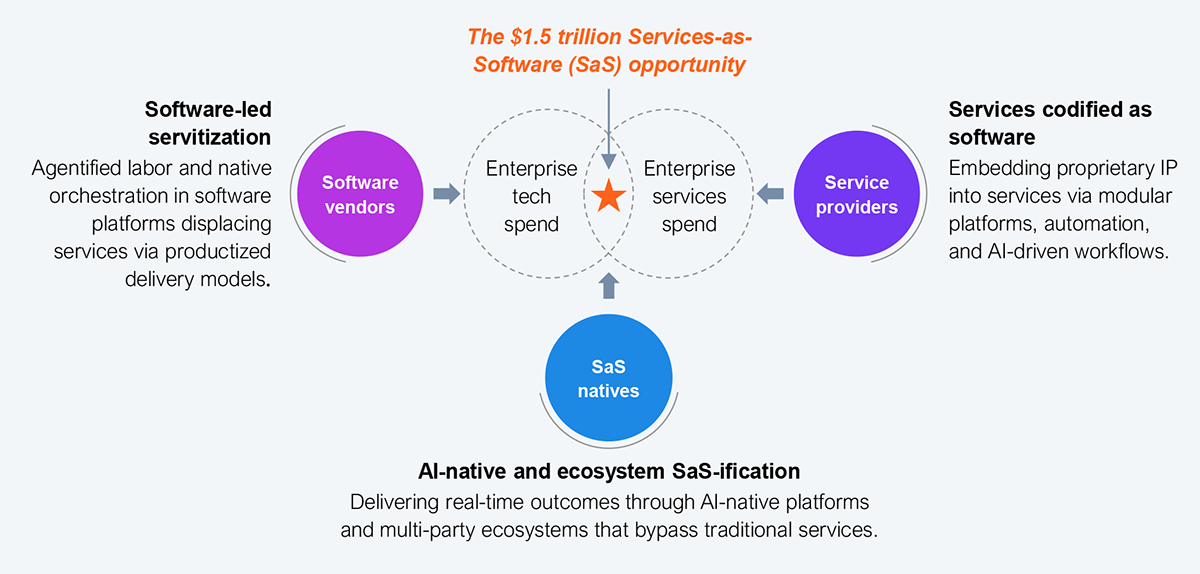
Source: HFS Research, 2026
Enterprises consuming third-party services, service providers, and technology providers need a smart ecosystem to succeed and survive in the future. HFS Hot Techs are service and technology providers handpicked by our analysts to help you flesh out your ecosystem with offerings that solve today’s complex business problems and exploit market opportunities.
Register now for immediate access of HFS' research, data and forward looking trends.
Get StartedIf you don't have an account, Register here |
With the exception of our Horizons reports, most of our research is available for free on our website. Sign up for a free account and start realizing the power of insights now.
Our premium subscription gives enterprise clients access to our complete library of proprietary research, direct access to our industry analysts, and other benefits.
Contact us at [email protected] for more information on premium access.


