This HFS Hot Tech report is for CIOs, chief AI officers, and enterprise transformation leaders evaluating agentic AI platforms that move beyond copilots to execute end-to-end workflows.
Enterprises are experimenting with agentic AI across functions, yet most deployments remain limited to productivity oriented siloed pilots. The deeper challenge is sustaining AI once it is running, adapting when a reorganization reshapes, updating when compliance rules shift, and reorienting when new systems come online. The gap between agentic AI-owned output and continuously operating execution has become the structural limitation on enterprise adoption.
HFS Research sees Ema as part of a new class of platforms addressing these challenges. Ema allows business and technical users to conversationally build AI employees. These are autonomous, multi-agent systems that reason, act, and orchestrate work across enterprise systems. They maintain a persistent understanding of the enterprise, including its structure, terminology, policies, and operational patterns, while continuously adapting to real-time context and human feedback to keep AI employees aligned as the business evolves. AI employees can execute multi-step workflows across employee experience, customer support, finance, and sales among other operations.
Ema is also seeing growing uptake from non-tech sectors such as financial services, insurance, manufacturing, and aerospace, where hybrid estates and modernization backlogs are colliding with the pressure to show results from agentic AI.
HFS Research selected Ema as a Hot Tech for its ability to transform fragmented enterprise processes into coordinated AI-driven execution through a platform-led approach.
Ema is not a copilot or point solution. It is an end-to-end agentic platform that covers design, testing, production, and continuous adaptation, enabling AI employees to keep working as the enterprise changes around them. Its AI employees are autonomous, multi-agent systems that combine reasoning, action, and orchestration to move beyond task-level assistance to full workflow execution.
At a foundational level, Ema’s architecture comprises a library of specialized AI agents, an orchestration layer that coordinates workflows across systems, and a low-code interface that enables business users to configure and deploy AI employees. Pre-integrated with numerous enterprise applications, the platform allows AI employees to interact with data, act across systems, and continuously improve through feedback. The autopilot feature helps identify the right use case, generate the workflow, debug issues in context, and self-adapt as workflows and conditions change, without users having to flag every change.
While the platform is horizontal, deployments are typically concentrated in four high-impact enterprise domains (see Exhibit 1).
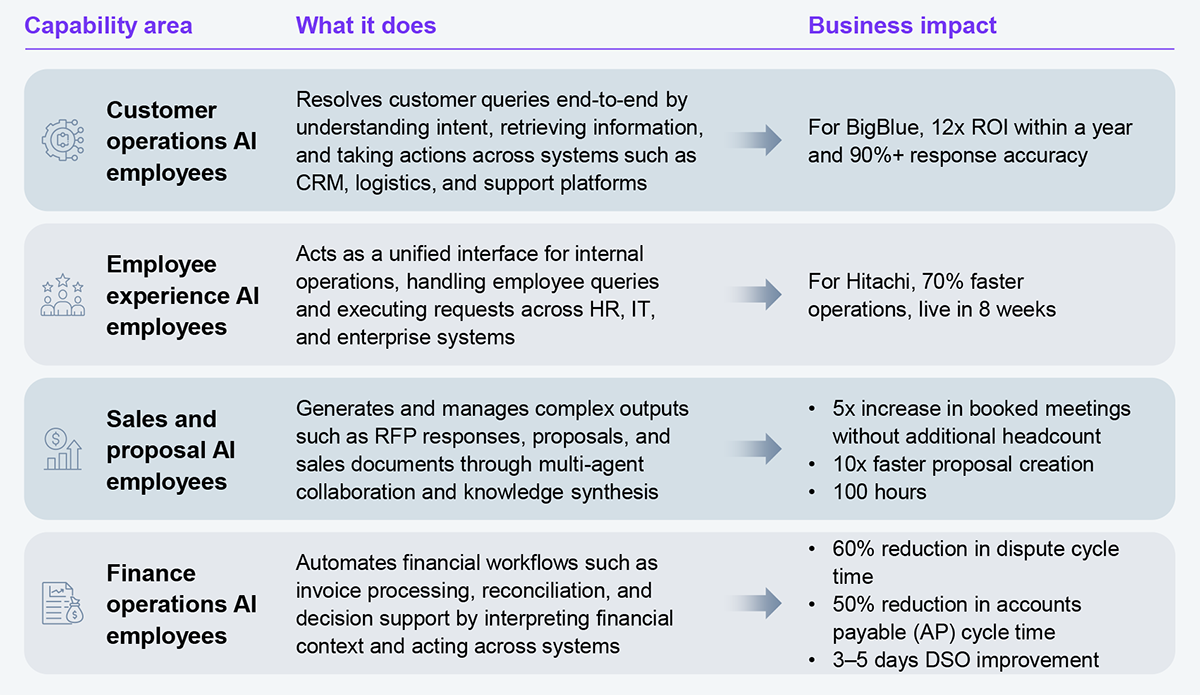
Source: Ema reported metrics; HFS Research, 2026
Individually, these capabilities address specific functional workflows. Together, they enable a shift from fragmented, task-based automation to coordinated, AI-driven execution across the enterprise.
Ema’s primary differentiation is time to value. Most agentic AI deployments stall in multi-month build cycles. Ema compresses that arc to days, letting enterprises validate outcomes quickly.
The second is accuracy at scale without a cost spiral. Agentic AI typically forces a trade-off: accuracy through larger models and heavier human oversight, or cost through narrower scope and simpler reasoning. Ema is built to deliver both, so the economics improve as deployments grow.
The third is enterprise-grade security with automatic personally identifiable information (PII) redaction. Sensitive data is detected and redacted at the platform level before it reaches any model. Ema holds SOC 2 Type II, IS27001, ISO 42001, HIPAA, GDPR, and many more certifications, with on-premises and air-gapped deployment available for regulated industries. Many enterprise environments remain hybrid, so Ema’s ability to run workflows across on-premises and cloud setups, regardless of where data resides, removes a common deployment constraint for regulated and asset-heavy firms.
Together, these elements position Ema as a trusted, safe, and compliant agentic AI platform for enterprises focused on execution, where AI moves beyond assistance to complete workflows across functions.
Enabled workflow orchestration across patient and employee operations at Hospital for Special Surgery
Hospital for Special Surgery (HSS) adopted Ema as a platform to address fragmented workflows across patient services and internal operations. Rather than deploying isolated automation tools, it used Ema to build AI employees to orchestrate processes such as patient navigation and employee service requests. By enabling real-time access to information and actions across systems, the platform reduced delays and operational friction in both patient-facing and internal workflows. HSS also highlighted Ema’s ability to support enterprise-grade deployment requirements and its co-build engagement model, where the Ema team works closely with business, IT, and data teams to design and scale workflows over time.
Ema is not a point solution. It’s a platform that allows us to build and deploy AI employees across workflows.
— Ashis Barad, Chief Transformation and Digital Information Officer, Hospital for Special Surgery
Accelerated proposal development and scaled knowledge reuse at NTT DATA
NTT DATA deployed Ema to improve efficiency in proposal and RFP response generation, a process traditionally dependent on manual knowledge synthesis and coordination across teams. By using AI employees to retrieve, structure, and generate content, the organization reduced the first-draft creation time by roughly 40% while maintaining quality and increasing throughput without adding headcount. Ema also helped capture institutional knowledge, enabling greater flexibility in staffing and faster onboarding of new team members. Following initial success, NTT DATA is exploring the use of Ema in adjacent workflows such as presentation generation, contract and SOW creation, and finance-related processes, reinforcing its potential as a broader enterprise platform.
We could either choose a product where AI was being added to a legacy offering, or we could choose to partner with someone who had a broader capability. Ema is a platform we could easily configure to fit different workflow nuances. Moreover, it’s AI-native, not a legacy system with AI bolted on later.
— Karen Bryant, NTT DATA
Ema has been awarded the HFS Hot Tech designation for addressing a structural limitation in enterprise AI adoption: the gap between AI-assisted productivity and end-to-end workflow execution. By enabling enterprises to deploy AI employees that can orchestrate and complete workflows across systems, Ema shifts AI from assistance to execution. Its ability to keep AI employees aligned as the business changes distinguishes it from copilots, point solutions, and platforms that stop at deployments.
Customer interviews suggest that Ema is delivering tangible outcomes in knowledge-intensive and operational workflows. Organizations report improvements in efficiency, such as faster proposal development and reduced friction in internal and customer-facing processes. The platform’s ability to capture and reuse institutional knowledge further supports scalability without proportional increases in headcount.
As with most agentic AI platforms, value realization depends on integration depth, data quality, and the ability to operationalize outputs within business processes. As the platform scales, deeper verticalization across industries may further strengthen its value proposition and support broader enterprise adoption.
For enterprises looking to move beyond productivity and operationalize AI across workflows, Ema represents a credible and emerging platform for execution-led AI adoption.
HFS Hot Tech organizations display truly differentiated offerings and out-of-the-box thinking that can be inspiring and useful. This report profiles one of the HFS Hot Techs selected through our rigorous five-step assessment. The HFS Hot Tech designation remains in place for one calendar year. Every Hot Tech joining our program remains listed on our exclusive and searchable database.
HFS Research coined “Services-as-Software” to encapsulate a concept reshaping how the world will consume technology services and software. This emerging category will disrupt traditional services and software models, absorbing significant revenue from both, and create a new total addressable market worth $1.5 trillion.
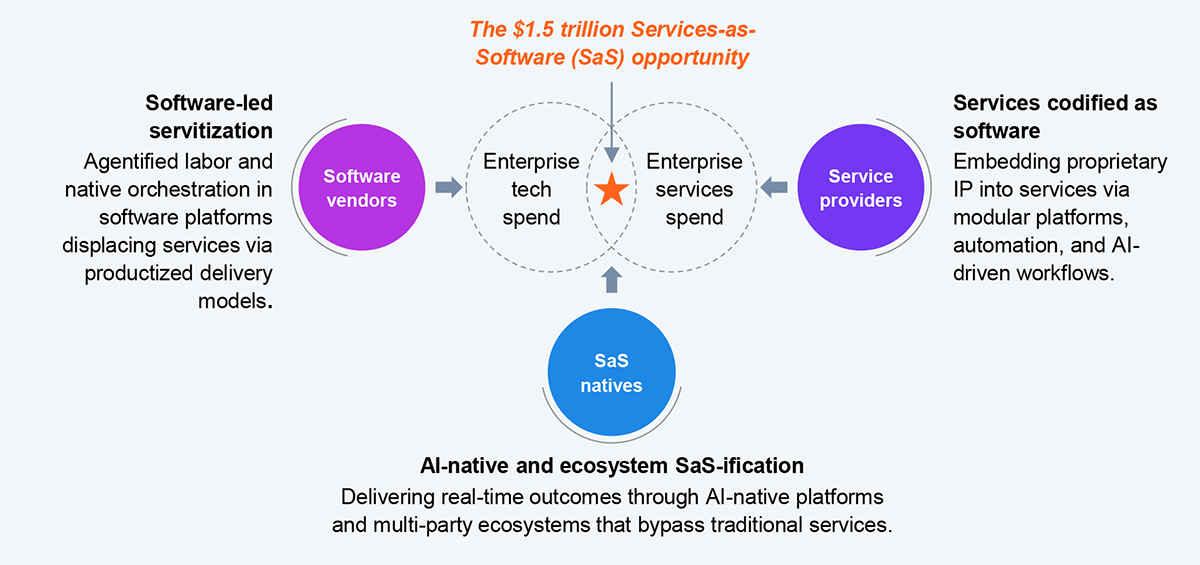
Source: HFS Research, 2026
Enterprises consuming third-party services, service providers, and technology providers need a smart ecosystem to succeed and survive in the future. HFS Hot Techs are service and technology providers handpicked by our analysts to help you flesh out your ecosystem with offerings that solve today’s complex business problems and exploit market opportunities.
Register now for immediate access of HFS' research, data and forward looking trends.
Get StartedIf you don't have an account, Register here |
With the exception of our Horizons reports, most of our research is available for free on our website. Sign up for a free account and start realizing the power of insights now.
Our premium subscription gives enterprise clients access to our complete library of proprietary research, direct access to our industry analysts, and other benefits.
Contact us at [email protected] for more information on premium access.